
Itch & Rash Treatments
Identify the pattern, exclude infection and fungal mimics, then match the active ingredient, vehicle, site, and duration.
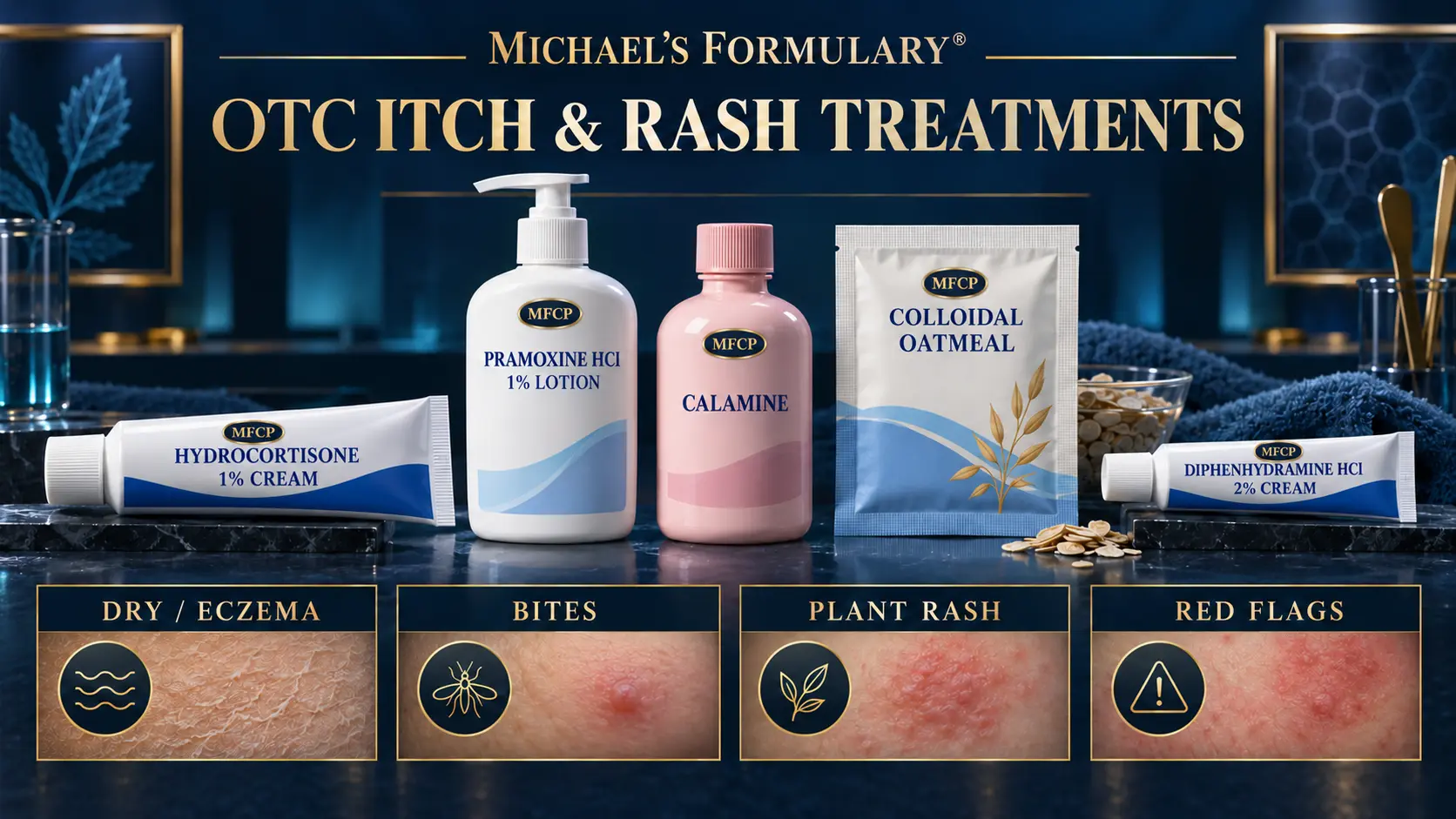
Compare OTC Active-Ingredient Families
 Compare OTC Active-Ingredient Families
Hydrocortisone 0.25%–1%
Temporary relief of itching associated with labeled minor inflammatory skin irritations and rashes. Avoid automatic use for diaper rash or an undiagnosed fungal eruption.
Role: localized inflammation and itch when the label and site fit.Open 0.5% & 1% controlled monograph →Pramoxine HCl 0.5%–1%
Temporarily relieves itching or pain associated with labeled minor skin irritations, bites, burns, cuts, scrapes, or plant dermatitis.
Role: symptom relief without a topical corticosteroid.Open Pramoxine HCl 1% controlled monograph →Calamine 1%–25%
Calamine products may protect irritated skin and, when appropriately labeled, dry the oozing and weeping of poison ivy, oak, or sumac.
Role: wet or weeping plant dermatitis and protective care.Open Calamine controlled monograph →Colloidal Oatmeal
Temporarily protects and helps relieve minor irritation and itching due to labeled rashes, eczema, plant dermatitis, or insect bites.
Forms: direct-application products, baths, compresses, and wet dressings.Open Colloidal Oatmeal controlled monograph →Diphenhydramine HCl 1%–2%
Temporary relief of itching or pain for labeled minor irritations. Its restrictions are substantial and must be read before selection.
Never combine with another diphenhydramine product, including oral products.Open topical monograph and oral-antihistamine bridge →Cream, Lotion, Gel, Spray or Bath
The same active can behave differently by dosage form, treatment area, skin condition, and application method.
Match vehicle to dry, intact, wet, hairy, or difficult-to-reach skin.Choose by Pattern, Not by Package Color
 Choose by Pattern, Not by Package Color
Separate Site, Skin Integrity & Delivery Route
 Separate Site, Skin Integrity & Delivery Route
| Site or situation | Control point | MFCP rule |
|---|---|---|
| Face or eyelids | Thin skin, eye exposure, diagnosis | Do not automatically transfer body-product directions; seek product-specific professional guidance. |
| External genital or anal itching | External use only, bleeding, discharge, age | Use only when the exact product carries that indication and follow every additional warning. |
| Broken, blistered, raw, or oozing skin | Absorption and irritation risk | Topical diphenhydramine and many external analgesics have route-specific restrictions; verify before use. |
| Large body area | Extent and systemic disease | Do not use prolonged or over large areas when the label prohibits it; widespread rash needs evaluation. |
| Child under 2 years | Age-specific directions | Do not use external-analgesic antipruritic products without clinician direction. |
| Diaper area | Occlusion and diagnosis | Hydrocortisone Drug Facts direct consumers not to use it for diaper rash without consulting a doctor. |
Label-Directed Use
 Label-Directed Use
- Identify the rash pattern, body site, size, and skin integrity before selecting a product.
- Read every active ingredient, purpose, use, warning, age limit, and dosage-form direction.
- For hydrocortisone, pramoxine, or diphenhydramine products, adults and children 2 years and older generally apply to the affected area no more than 3 to 4 times daily; children under 2 require medical direction.
- For colloidal-oatmeal baths, compresses, or direct-application products, follow the specific preparation, contact, drying, and slip-prevention directions.
- Stop and reassess if the condition worsens, persists beyond 7 days, or clears and returns within a few days.
Safety & When to Refer
 Safety & When to Refer
- Seek emergency help for trouble breathing or swallowing, or swelling of the eyes or lips.
- Refer a rash over most of the body; rapid spread; blisters, open sores, or raw skin; fever or illness; significant pain; or involvement of the eyes, lips, mouth, or genital skin.
- Refer possible infection: pus, yellow or golden crust, worsening pain, swelling, warmth, unpleasant odor, red streaking, fever, or swollen lymph nodes.
- Avoid the eyes and follow restrictions for large areas, prolonged use, broken skin, occlusion, and combination products.
- Do not use topical diphenhydramine with another diphenhydramine product, even one taken by mouth.
- Do not treat suspected ringworm, jock itch, athlete’s foot, or another fungal pattern with hydrocortisone alone.
Evidence Control
 Evidence Control
- U.S. FDA OTC external analgesic drug monograph: External Analgesic Drug Products
- U.S. FDA OTC Monograph M016: Skin Protectant Drug Products
- DailyMed: Hydrocortisone 1% Cream Drug Facts
- DailyMed: Pramoxine Hydrochloride 1% Lotion Drug Facts
- DailyMed: Diphenhydramine Hydrochloride 2% / Zinc Acetate 0.1% Cream Drug Facts
- American Academy of Dermatology: Rash Warning Signs
Readability disclosure: This landing page supports product-family navigation and referral decisions. It does not diagnose a rash or replace the current Drug Facts label and individualized clinical care.