
Hydrocortisone 0.5% & 1%
Low-potency topical corticosteroid for temporary relief of label-matched itching, inflammation, and minor rashes.
01 · Controlled Clinical PositionPharmacist Bottom Line™
OTC hydrocortisone 0.5% and 1% provides short-term anti-inflammatory and antipruritic control for minor, localized, label-matched rashes. It belongs among the lowest-potency topical corticosteroids, but the finished vehicle, body site, skin integrity, surface area, duration, and occlusion can materially change exposure.
02 · Active Ingredient ControlIdentity, Chemistry & Potency
| Attribute | MFCP controlled statement |
|---|---|
| Established name | Hydrocortisone; some products use hydrocortisone acetate equivalent to hydrocortisone. |
| Chemical formula | C21H30O5 |
| Chemical identity | 11β,17α,21-trihydroxypregn-4-ene-3,20-dione |
| OTC external analgesic drug standard range | Hydrocortisone 0.25%–1%; hydrocortisone acetate equivalent to hydrocortisone 0.25%–1%. |
| This monograph | Controls the requested 0.5% and 1% product families. |
| Potency position | Low-potency topical corticosteroid; commonly placed in the lowest U.S. potency group. Finished formulation and use conditions still matter. |
03 · Monograph at a Glance™MAG™ Clinical Snapshot
04 · Inflammatory-Signal ControlMechanism · Glucocorticoid Receptor Signaling
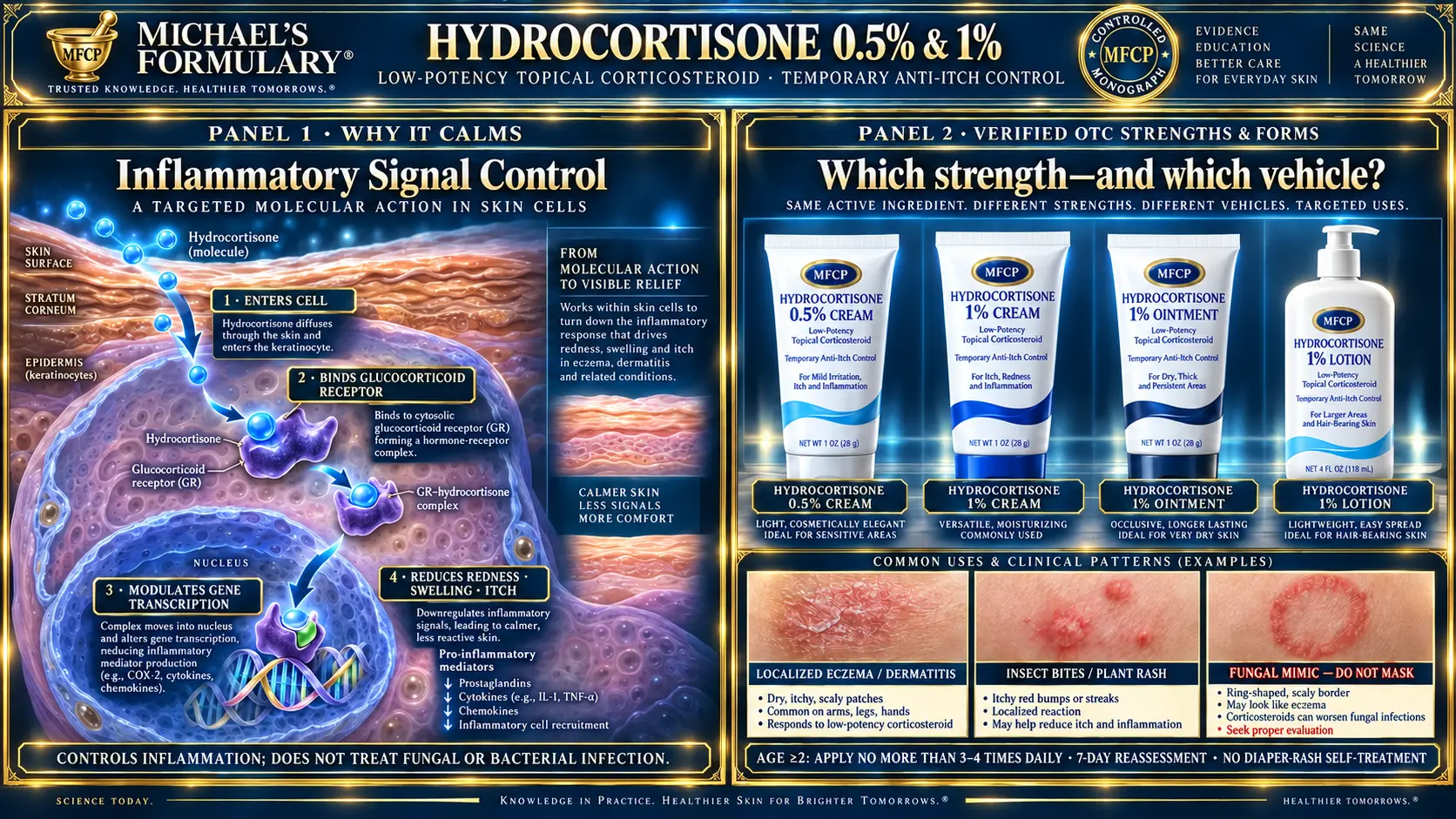
Hydrocortisone crosses the cell membrane and binds the cytosolic glucocorticoid receptor. The activated complex moves to the nucleus and changes transcription of inflammatory-response genes. The combined genomic and local vascular effects reduce cytokine and chemokine signaling, arachidonic-acid mediator production, edema, erythema, and itch.
05 · Condition Before ProductConfirm a Label-Matched Minor Rash
| Pattern | Controlled interpretation |
|---|---|
| Localized eczema or minor contact dermatitis | May fit when the exact product label includes the condition and no infection or referral signs are present. |
| Insect bite or plant dermatitis | May fit temporary itch and inflammatory-symptom control after exposure removal and skin assessment. |
| Mild localized psoriasis or seborrheic dermatitis | Permitted label language exists, but persistent, facial, scalp, fold, or recurrent disease needs diagnosis and a maintenance plan. |
| Ring-shaped advancing border, groin fold, or scaling foot | Suspect fungal infection. Hydrocortisone alone can mask appearance without eradication. |
| Golden crust, pus, warmth, increasing pain, or rapid spread | Possible bacterial infection; refer rather than suppress inflammation. |
| Widespread, blistering, painful, mucosal, or systemic rash | Outside routine OTC self-care; prompt evaluation is required. |
06 · Dosage-Form DisciplineCream, Ointment & Lotion
| Vehicle | Formulation behavior | Selection control |
|---|---|---|
| Cream | Emulsion vehicle; available in 0.5% and 1% finished products. | Often spreads readily, but preservatives and inactive ingredients vary. Verify the exact site and label. |
| Ointment | Greasy, occlusive vehicle; 1% products are available. | Occlusion can increase penetration. Do not transfer ointment use to folds, face, genital skin, or the diaper area without professional direction. |
| Lotion | Flowable vehicle; 1% products are available. | Useful distribution characteristics do not override treatment-site warnings. Shake when the package directs. |
07 · Label-Directed AdministrationOTC Directions & Duration
| Control point | Direction |
|---|---|
| Adults and children ≥2 years | Apply to the affected area no more than 3 to 4 times daily. |
| Children under 2 years | Do not use; consult a doctor. |
| Worsening or persistent symptoms | Stop use and consult a doctor if worse, present beyond 7 days, or cleared and returned within a few days. |
| Diaper rash | Do not use for treatment; consult a doctor. |
| Other uses | Only under the advice and supervision of a doctor. |
08 · Technique ControlApply Only to the Confirmed Area
- Confirm the pattern, treatment site, extent, and skin integrity.
- Read the active ingredient, strength, dosage form, Uses, Warnings, and Directions.
- Clean and dry only as directed; avoid additional irritants or harsh cleansers.
- Apply the labeled amount to the affected external skin, avoiding the eyes.
- Do not cover tightly, combine with another hydrocortisone product, or extend to another body site unless professionally directed.
- Reassess response and stop at the label’s referral threshold.
09 · Outcome ControlExpected Response & Reassessment
| Observation | MFCP action |
|---|---|
| Itch, redness, or swelling decreases | Continue only within the label-directed course; do not extend prophylactically. |
| No meaningful improvement | Reassess diagnosis, adherence, site, and possible fungal, bacterial, allergic, or chronic inflammatory disease. |
| Clears then quickly returns | Stop and consult rather than restarting another hydrocortisone product. |
| Worsening, spreading, pain, drainage, or systemic symptoms | Stop and seek clinical assessment. |
10 · Tolerability & OveruseAdverse Effects
11 · Population SafeguardsChildren, Face, Folds & Occlusion
| Population or site | MFCP position |
|---|---|
| Children under 2 years | Do not use under OTC directions; consult a doctor. |
| Children ≥2 years | Use only the labeled product, site, amount, frequency, and duration; avoid large-area or occlusive use. |
| Face, eyelids, folds, groin, or genital skin | Absorption and diagnostic uncertainty are higher. Use only when the exact label permits and professional guidance supports the site. |
| Diaper area | Do not self-treat with hydrocortisone. Diapers and plastic pants can act as occlusion. |
| Pregnancy or breastfeeding | Seek product-specific professional advice, especially for repeated, extensive, breast-area, or occlusive use. |
| Immunocompromised patient | Lower threshold for evaluation of persistent, atypical, or possibly infected rash. |
12 · Referral ThresholdsSafety, Warnings & Escalation
- External use only; avoid contact with the eyes.
- Stop if the condition worsens, persists beyond 7 days, or clears and returns within a few days.
- Do not begin another hydrocortisone product after a stop-rule event without consulting a doctor.
- Do not use for diaper rash without a doctor.
- Promptly evaluate widespread, rapidly spreading, blistering, painful, raw, mucosal, or systemically symptomatic eruptions.
- Refer possible infection: pus, golden crust, warmth, increasing pain, red streaking, fever, or swollen lymph nodes.
- Seek emergency help for breathing or swallowing difficulty or swelling of the lips, tongue, or eyes.
13 · Shelf VerificationMFCP Buying Standard™
| Checkpoint | Verification standard |
|---|---|
| Active ingredient | Hydrocortisone or hydrocortisone acetate equivalent to hydrocortisone |
| Strength | 0.5% or 1% for this controlled monograph |
| Vehicle | Cream, ointment, or lotion; do not infer technique from strength alone |
| Indications | Read the exact Uses panel; do not transfer claims between products |
| Inactive ingredients | Check sensitizers, preservatives, fragrances, and personal allergies |
| Warnings and age | Verify eye, duration, diaper-rash, site-specific, and pediatric restrictions |
| Package integrity | No damaged, leaking, opened, contaminated, or expired product |
14 · Evidence ControlPrimary Sources & Readability Disclosure
- U.S. Food and Drug Administration: OTC external analgesic drug monograph
- DailyMed: Hydrocortisone 0.5% Cream Drug Facts
- DailyMed: Hydrocortisone 1% Cream Drug Facts
- DailyMed: Hydrocortisone 1% Lotion Drug Facts
- DailyMed: Hydrocortisone 1% Ointment Drug Facts
Evidence control: the FDA external analgesic drug standard establishes the permitted active strengths, identity, indications, warnings, and directions. Current finished-product Drug Facts labeling controls the selected vehicle and package.
Readability disclosure: This educational monograph supports product selection and referral decisions. It does not replace the current Drug Facts label, diagnosis, or individualized care.
← Return to OTC Itch & Rash Treatments