
Selenium Sulfide 1%
OTC rinse-off shampoo for dandruff and seborrheic-dermatitis symptom control.
01 · Controlled Clinical PositionPharmacist Bottom Line™
Selenium sulfide 1% is an OTC rinse-off active for controlling symptoms and recurrence of dandruff and seborrheic dermatitis. Successful use depends on suspension mixing, scalp delivery, labeled frequency, and thorough rinsing—not on concentration alone.
02 · Active Ingredient ControlDrug Identity & Product Character
| Attribute | MFCP controlled statement |
|---|---|
| Established name | Selenium sulfide |
| OTC strength | 1% for dandruff and seborrheic dermatitis |
| Additional monograph pathway | Micronized selenium sulfide 0.6% for dandruff only; not interchangeable with the 1% pathway |
| Dosage form | Topical rinse-off shampoo or lotion-shampoo; suspension behavior makes shaking important |
| Therapeutic role | Antidandruff / antiseborrheic active with antifungal and cytostatic effects |
| Route | Topical, brief exposure, then wash off |
| Exclusion | Not an oral product and not an OTC psoriasis active under M032 |
03 · Monograph at a Glance™MAG™ Clinical Snapshot
04 · Scalp BiologyMechanism · Antifungal + Cytostatic Control
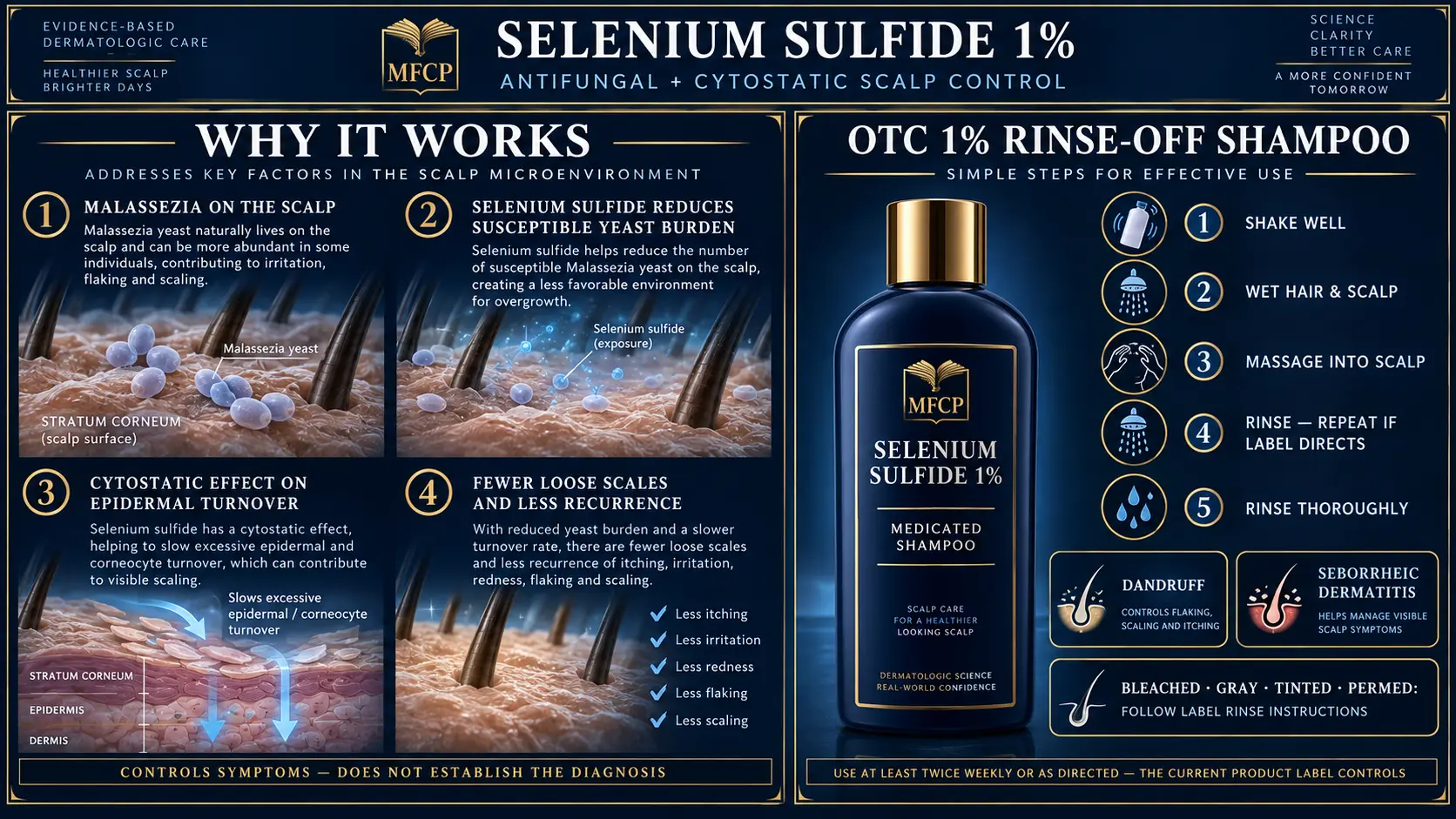
Selenium sulfide reduces susceptible scalp yeast activity and has a cytostatic effect that slows excessive epidermal and corneocyte turnover. Together, these actions support control of flaking, scaling, itching, irritation, and redness associated with dandruff and seborrheic dermatitis.
05 · Condition Before ProductConfirm the Treatment Pathway
| Pattern | Controlled interpretation |
|---|---|
| Loose flakes with itching | May fit dandruff when no red flags are present. |
| Greasy or yellow-white scale with redness | May fit seborrheic dermatitis; confirm the exact product carries that indication. |
| Thick, sharply defined plaques | May suggest psoriasis; selenium sulfide is not the M032 psoriasis pathway. |
| Broken hairs, patchy hair loss, pustules, boggy swelling, crust, or drainage | Refer for evaluation; consider tinea capitis or bacterial/inflammatory disease. |
| Infant scalp scale | Do not extrapolate adult medicated-shampoo directions to cradle cap. |
| Face, ears, beard, chest, or folds | Scalp-shampoo availability does not authorize use at every body site; follow the exact label. |
06 · Dosage-Form DisciplineSuspension & Rinse-Off Delivery
1% Medicated Shampoo
Applied to wet hair and scalp, massaged into the scalp, and rinsed according to the current label.
Shake Well
Redistribute the active before dispensing. Uneven suspension can undermine controlled delivery.
Rinse-Off Only
Do not convert a rinse-off shampoo into a leave-on treatment.
| Route boundary | OTC 1% | Prescription 2.5% |
|---|---|---|
| Regulatory pathway | OTC Monograph M032 | Prescription product labeling |
| Established use | Dandruff and seborrheic dermatitis | Dandruff, seborrheic dermatitis, and labeled tinea-versicolor treatment |
| Technique | Current OTC Drug Facts controls; no universal 2–3 minute rule | Representative Rx labeling uses 2–3 minutes for scalp treatment and 10 minutes for tinea versicolor |
| Clinical rule | Do not borrow Rx schedules or body-treatment directions | Use only under the prescription label and clinician direction |
07 · Label-Directed AdministrationOTC Directions & Frequency
| Control point | MFCP direction |
|---|---|
| Preparation | Shake well. |
| Application | Wet hair and scalp; massage the product onto the scalp. |
| Rinse / repeat | Rinse thoroughly. Repeat only when the exact product label directs or permits. |
| Frequency | For best results, use at least twice a week or as directed by a doctor; product-specific labels may direct use with each shampoo. |
| Exposure time | There is no single universal contact time for every 1% product. Follow the current label. |
| Hair-treatment safeguard | For bleached, gray, tinted, or permed hair, follow the label’s special rinsing instruction; a current representative label specifies at least five minutes of rinsing. |
08 · Technique ControlFive-Step Scalp Application
09 · Outcome ControlExpected Response & Reassessment
| Assessment | MFCP action |
|---|---|
| Regular directed use | Monitor itching, irritation, redness, flaking, scaling, and recurrence. |
| Improvement | Continue only according to the current label’s treatment or maintenance schedule. |
| No improvement | Consult a doctor when the condition does not improve after regular directed use. |
| Worsening | Stop and reassess diagnosis, site, technique, and product tolerance. |
10 · TolerabilityAdverse Effects & Hair/Scalp Reaction
11 · Population SafeguardsAge, Hair Treatment & Clinical Complexity
| Population or factor | MFCP position |
|---|---|
| Children | M032 does not establish one universal age direction for every selenium-sulfide product; follow the exact label and seek professional guidance when uncertain. |
| Infants / cradle cap | Do not extrapolate general medicated-shampoo directions to infants. |
| Bleached, gray, tinted, or permed hair | Follow the product’s extended-rinse or other hair-specific instruction exactly. |
| Large body area | For seborrheic dermatitis covering a large area, consult a doctor before use. |
| Broken, infected, or severely inflamed skin | Seek assessment rather than escalating routine self-treatment. |
| Immunocompromise or recurrent disease | Lower the threshold for diagnostic confirmation and clinician-directed care. |
12 · Referral ThresholdsSafety, Warnings & Escalation
13 · Shelf VerificationMFCP Buying Standard™
| Checkpoint | Verification standard |
|---|---|
| Active ingredient | Selenium sulfide |
| Strength | 1%; do not confuse with micronized 0.6% or prescription 2.5% |
| Condition claim | Dandruff and/or seborrheic dermatitis as stated on Drug Facts |
| Dosage form | Rinse-off shampoo / lotion-shampoo |
| Preparation | Shake-well direction visible |
| Directions | Exact frequency, contact, rinse, repeat, and treated-hair instructions verified |
| Package integrity | Do not use damaged, leaking, opened, or expired packaging |
14 · Evidence ControlPrimary Sources & Readability Disclosure
- U.S. Food and Drug Administration: OTC Monograph M032
- DailyMed: Selenium Sulfide 1% Shampoo Drug Facts
- NIH PubChem: Selenium Disulfide chemical record
- DailyMed: Prescription Selenium Sulfide 2.5% Lotion label
- Clinical study: selenium disulfide shampoo and dandruff/scalp microbiome outcomes
Evidence control: The 1% conditions and rinse-off frequency floor are controlled by OTC Monograph M032. The cited DailyMed entry is a current representative 1% label and supplies product-specific shaking, repeat, and treated-hair rinsing details; it is not a universal substitute for every package.
Readability disclosure: Patient-action language is written for rapid scalp-care decisions. Technical terms remain where they protect diagnostic or pharmacologic meaning. This educational monograph does not replace the current Drug Facts label or individualized clinical evaluation.
← Return to Dandruff, Seborrheic Dermatitis & Psoriasis