
Acne & Keratolytic Therapy
Match the acne pattern to the active ingredient, dosage form, frequency, tolerability, and referral threshold.
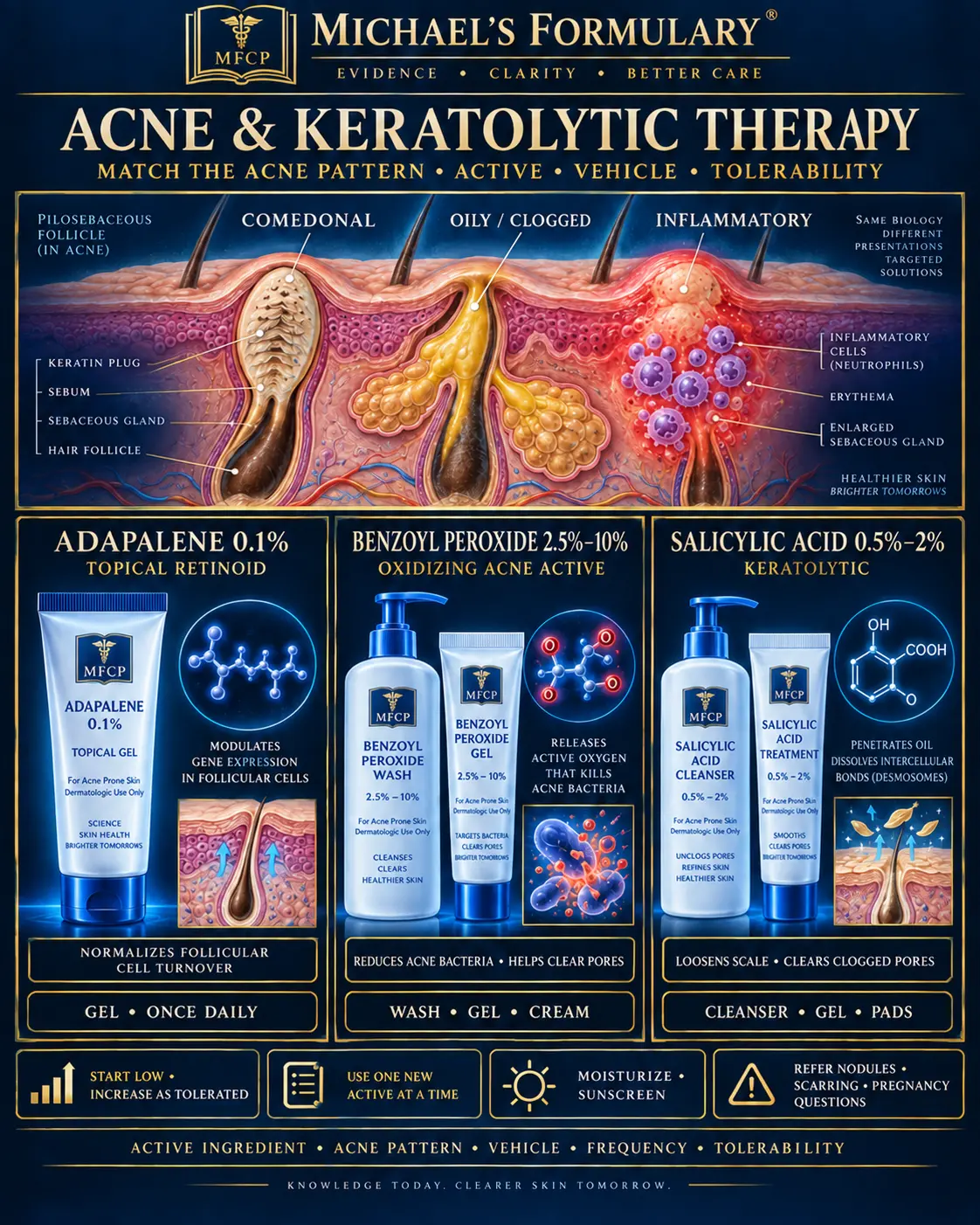
Compare OTC Active-Ingredient Families
Adapalene 0.1%
Once-daily, full-field therapy that normalizes follicular keratinization and treats acne across the affected area rather than only visible lesions.
Control: age 12 years and older; damaged skin, pregnancy, sun exposure, waxing, irritation, and three-month response checks.Open Adapalene Gel 0.1% controlled monograph →Benzoyl Peroxide 2.5%–10%
Monograph acne active used in rinse-off and leave-on products for inflammatory pimples and acne blemishes.
Control: very sensitive skin, irritation, sun exposure, eyes and mucosa, plus bleaching of hair and dyed fabrics.Open Benzoyl Peroxide 2.5%–10% controlled monograph →Salicylic Acid 0.5%–2%
Monograph acne active used in cleansers, gels, lotions, pads, and other label-directed dosage forms for blackheads, whiteheads, and acne blemishes.
Control: start conservatively; concurrent topical acne medicines increase dryness and irritation risk.Open Salicylic Acid 0.5%–2% controlled monograph →Sulfur 3%–10%
Independent monograph acne active available in removed and leave-on dosage forms.
Control: do not apply to broken skin or large areas; apply only to areas with acne.Open Sulfur 3%–10% controlled monograph →Sulfur + Resorcinol Systems
Permitted configurations are sulfur 3%–8% with resorcinol 2%, or sulfur 3%–8% with resorcinol monoacetate 3%.
Control: preserve exact ingredient and strength discipline; these are not interchangeable with sulfur monotherapy.Open Sulfur–Resorcinol controlled monograph →Barrier & Excoriation Control
Gentle cleansing, noncomedogenic moisturization, sunscreen, and plain hydrocolloid protection can support a regimen without becoming acne-drug classes.
Control: distinguish medication, cosmetic support, and non-drug wound protection.Choose by Acne Pattern, Not Package Format
Secondary Delivery-System Modifiers
| Delivery system | Primary control point | MFCP rule |
|---|---|---|
| Rinse-off wash, cleanser, soap, or mask | Coverage, contact, removal, frequency | Follow the finished product label; do not impose a universal contact time. |
| Leave-on gel, cream, lotion, or solution | Field coverage and irritation | Use a thin layer and only the frequency directed for the specific active and product. |
| Focal spot product | Localized lesion versus field disease | Do not use focal treatment as a substitute for referral of deep nodules, cysts, or scarring. |
| Occlusive medicated patch | Drug Facts active and strength | Treat as an acne medicine only when the package identifies a recognized active and compliant labeling. |
| Plain hydrocolloid disc | Non-drug protection | Classify as an adjunct for exudate and excoriation control, not as an acne active. |
Initiation, Frequency & Tolerability
- Confirm the pattern is compatible with acne and document baseline severity, distribution, pain, scarring, skin integrity, and current products.
- Introduce one new active at a time and use the lowest practical irritation burden.
- For adapalene 0.1%, adults and children 12 years and older apply a thin layer to the entire affected area once daily; using more does not improve results faster.
- For M006 actives, clean the skin before application, begin once daily, and increase only when needed and tolerated according to the current Drug Facts label.
- Reduce frequency if bothersome dryness or peeling occurs. Stop and obtain help for severe irritation or allergic-reaction symptoms.
- Use moisturizer and sunscreen as supportive care when compatible with the regimen and skin type.
Safety & When to Refer
- Refer deep nodules, cysts, abscess-like lesions, draining lesions, rapid worsening, significant pain, or any active scarring.
- Refer suspected infection, widespread disease, severe psychosocial distress, uncertain diagnosis, or failure of an adequate label-directed OTC trial.
- Adapalene: ask a doctor before use during pregnancy or breast-feeding; stop and ask a doctor if pregnancy occurs or is planned during use.
- Adapalene: do not apply to cuts, abrasions, eczema, or sunburn; limit sun exposure and do not wax treated skin.
- Benzoyl peroxide: avoid use in very sensitive skin, protect from unnecessary sun, avoid eyes, lips, and mouth, and warn about bleaching of hair and dyed fabrics.
- Sulfur: do not use on broken skin or large areas; apply only to areas with acne.
- Stop and seek care for severe irritation, hives, swelling, shortness of breath, or another suspected allergic reaction.
Evidence Control
Regulatory boundary: Benzoyl peroxide, salicylic acid, sulfur, and the permitted sulfur/resorcinol systems are controlled by M006. OTC adapalene 0.1% follows its FDA-approved application and current finished-product labeling rather than M006.
Readability disclosure: This landing page supports product-family navigation, selection, and referral. It does not diagnose acne or replace the current Drug Facts label and individualized clinical care.