
OTC Fungal Treatments
Match the condition, organism, active ingredient, vehicle, age, and treatment duration.
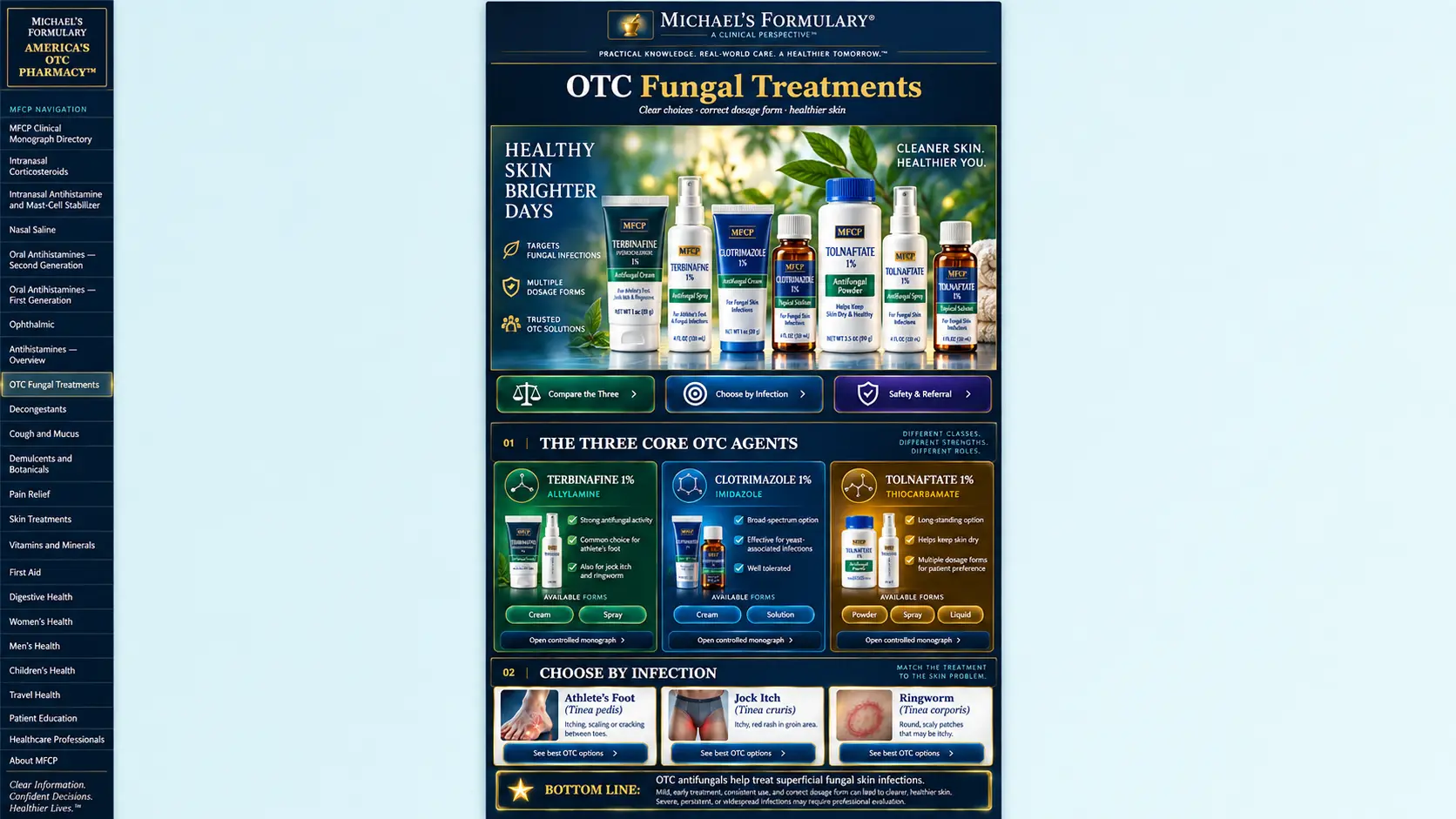
Match Spectrum to the Condition
Terbinafine 1%
Dermatophyte-focused option for athlete’s foot, jock itch, and ringworm. Use the labeled course for the site and product.
Open monograph →Clotrimazole 1%
Broad azole option for common tinea infections. Yeast-related claims and directions vary by product and dosage form.
Open monograph →Miconazole Nitrate 2%
Separate external-skin and vaginal product pathways. Route, dosage form, warnings, and duration are not interchangeable.
Open monograph →Tioconazole 6.5%
Vaginal-only, single-dose ointment. One application does not mean full relief in one day; symptoms may take up to 7 days to resolve.
Open monograph →Tolnaftate 1%
One dermatophyte option among several. Some qualifying products also carry athlete’s-foot prevention directions.
Open monograph →Ketoconazole 1%
OTC anti-dandruff shampoo for flaking, scaling, and itching. Age limits and directions must be taken from the current Drug Facts label.
Other Dandruff Actives
Dandruff and seborrheic dermatitis are not interchangeable with tinea. Select the scalp active and vehicle by condition, age, and label.
Choose by Condition
Dosage Forms & Deliveries
Form is part of the treatment decision. The controlled family includes creams and gels for localized skin, solutions and sprays for hairy or broad areas when label-supported, powders and powder sprays for moisture-prone sites, and shampoos for scalp-labeled conditions.
Safety & When to Refer
- Infants and young children when a medicated scalp product is being considered.
- Nail involvement, hair loss, broken or inflamed scalp, or suspected tinea capitis.
- Severe pain, warmth, drainage, odor, crusting, pus, bleeding, or spreading redness.
- Extensive, recurrent, uncertain, or immunocompromised disease.
- Failure to improve within the current product’s label-directed interval.
Supplemental Selection Guide
Compare the controlled products by likely infecting organism, condition, treatment course, and applications per day.
Open Product · Organism · Condition · Frequency Guide →