
Coal Tar 0.5%–5%
OTC keratoplastic scale control for labeled dandruff, seborrheic-dermatitis, and psoriasis pathways.
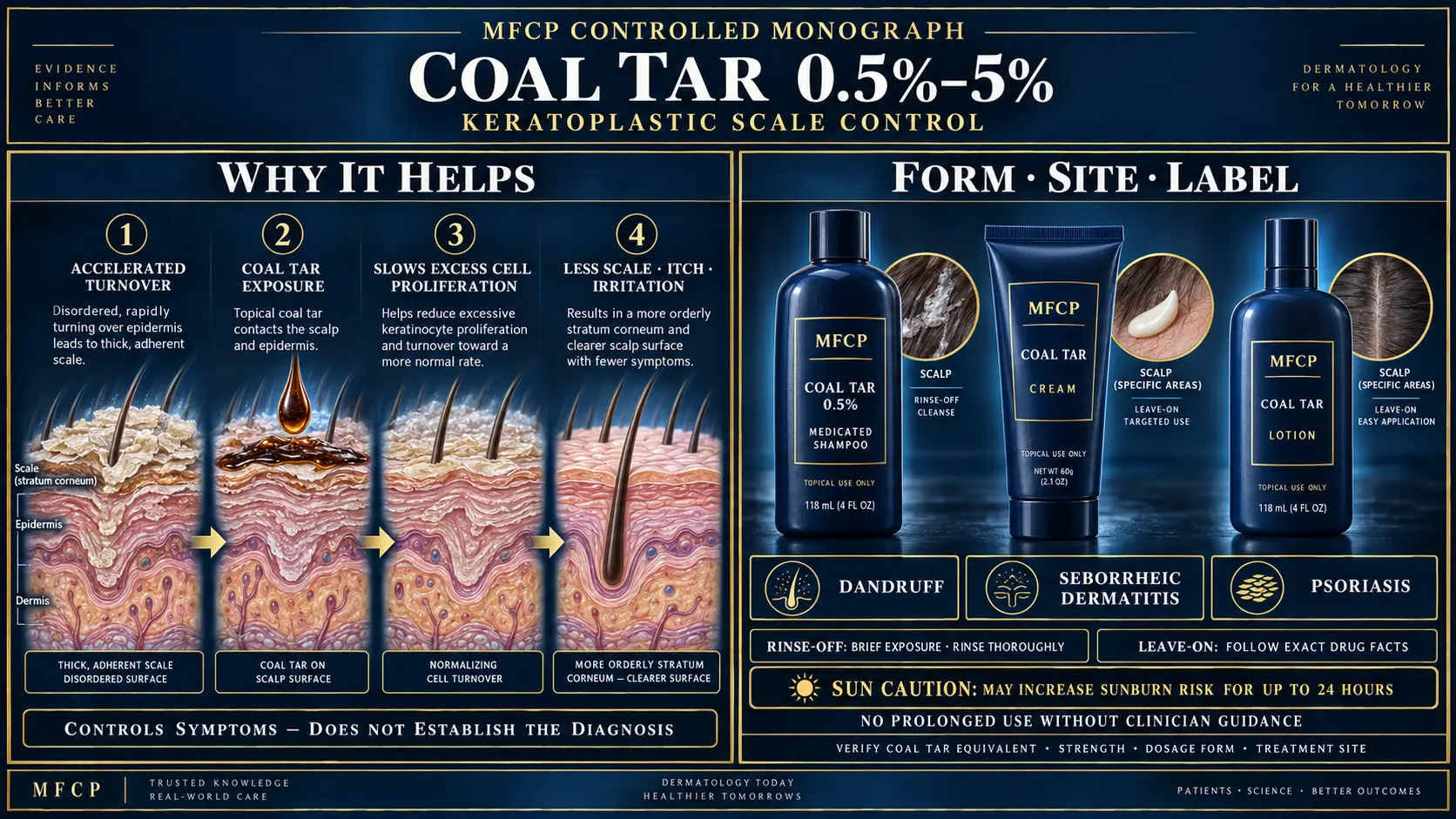
01 · Controlled Clinical PositionPharmacist Bottom Line™
Coal tar is an OTC active for symptom control in dandruff, seborrheic dermatitis, and psoriasis when the concentration, product form, treatment site, and Drug Facts claim match. It is a heterogeneous pharmaceutical mixture, not one discrete molecule.
02 · Active Ingredient ControlIdentity, Composition & Standardization
| Attribute | MFCP controlled statement |
|---|---|
| Source | Byproduct of destructive distillation of bituminous coal |
| Chemical character | Complex heterogeneous mixture containing polycyclic aromatic hydrocarbons, phenols, cresols, and heterocyclic compounds |
| Physical character | Dark, viscous material with characteristic odor; pharmaceutical extracts and solutions improve incorporation into topical vehicles |
| OTC range | Coal tar 0.5% to 5% for dandruff, seborrheic dermatitis, or psoriasis under M032 |
| Source declaration | When a solution, derivative, or fraction is the source, labeling must identify the source concentration and final coal-tar concentration |
| Route | Topical rinse-off or leave-on, according to product labeling |
03 · Monograph at a Glance™MAG™ Clinical Snapshot
04 · Epidermal BiologyMechanism · Differentiation + Turnover Control
Coal tar suppresses excessive epidermal DNA synthesis and keratinocyte proliferation and supports more orderly differentiation. Research also implicates aryl hydrocarbon receptor signaling and epidermal barrier-protein regulation. These molecular models inform pharmacology but do not replace labeled claims or clinical diagnosis.
05 · Condition Before ProductConfirm the Treatment Pathway
| Pattern | Controlled interpretation |
|---|---|
| Loose scalp flakes and itching | May fit a dandruff-labeled shampoo when no red flags are present. |
| Greasy scale with redness | May fit seborrheic dermatitis; verify indication and treatment site. |
| Thick sharply defined plaques | May fit psoriasis, but extent, site, concurrent therapy, and diagnosis govern self-care suitability. |
| Face, groin, genital, rectal, or fold use | Do not transfer scalp directions. Leave-on coal tar should not be used around the rectum, genital area, or groin except on medical advice. |
| Hair loss, broken hairs, pustules, pain, drainage, or fever | Refer for evaluation; do not treat as routine dandruff or psoriasis. |
06 · Dosage-Form DisciplineRinse-Off & Leave-On Delivery
Medicated Shampoo
Wet hair, massage into scalp, lather, observe the exact labeled brief exposure, then rinse thoroughly.
Cream, Lotion or Ointment
Apply only to labeled affected areas at the directed frequency; protect clothing and surfaces from staining.
Verify Equivalent Strength
Do not equate source-solution percentage with final active coal-tar percentage.
07 · Label-Directed AdministrationOTC Directions & Frequency
| Pathway | M032 direction | Product-specific control |
|---|---|---|
| Rinse-off shampoo | For best results, use at least twice a week or as directed by a doctor. | Follow the exact wetting, lathering, contact, rinse, and repeat instructions; a current representative 0.5% label states “several minutes.” |
| Leave-on product | Apply to affected areas one to four times daily or as directed by a doctor. | Verify treatment site, amount, vehicle, clothing precautions, and wash-off instructions. |
| Psoriasis with other therapy | Do not combine with ultraviolet radiation or prescription drugs unless directed by a doctor. | Specialist-directed combination care is separate from OTC self-care. |
08 · Technique ControlApplication by Delivery Route
09 · Outcome ControlExpected Response & Reassessment
| Assessment | MFCP action |
|---|---|
| Regular directed use | Track scale, itching, irritation, redness, plaque thickness, and recurrence. |
| Improvement | Continue only within the current label; do not extend prolonged use without clinician guidance. |
| No improvement | Consult a doctor after regular directed use without improvement. |
| Worsening or severe reaction | Stop use and reassess diagnosis, product tolerance, sun exposure, and concurrent therapies. |
10 · TolerabilityAdverse Effects & Product Burden
11 · Population SafeguardsExtent, Site & Concurrent Therapy
| Factor | MFCP position |
|---|---|
| Children | Follow the exact product’s age directions; M032 does not supply one universal age rule for all coal-tar products. |
| Pregnancy / breastfeeding | Use only after product-specific professional review; avoid application where an infant could contact treated skin. |
| Large body area | Consult a doctor before use when seborrheic dermatitis or psoriasis covers a large area. |
| Genital, groin, or rectal area | Leave-on coal-tar products require medical advice for these sites. |
| Concurrent psoriasis treatment | Do not combine with ultraviolet radiation or prescription therapy unless directed. |
12 · Referral ThresholdsSafety, Warnings & Escalation
13 · Shelf VerificationMFCP Buying Standard™
| Checkpoint | Verification standard |
|---|---|
| Active ingredient | Coal tar |
| Equivalent strength | Final coal-tar concentration, not just source-extract percentage |
| Condition claim | Dandruff, seborrheic dermatitis, and/or psoriasis exactly as labeled |
| Dosage form | Rinse-off versus leave-on clearly identified |
| Treatment site | Scalp and/or skin location authorized by label |
| Warnings | Sun, prolonged-use, eye, large-area, and concurrent-therapy controls present |
| Package integrity | No damaged, leaking, opened, or expired product |
14 · Evidence ControlPrimary Sources & Readability Disclosure
- U.S. FDA: OTC Monograph M032
- DailyMed: Coal Tar 0.5% Therapeutic Shampoo Drug Facts
- Review: Mechanism of Action of Coal Tar in Psoriasis
- Research: Aryl Hydrocarbon Receptor Regulation of Filaggrin and Barrier Proteins
- Cohort Study: Cancer Risk After Dermatological Coal-Tar Treatment
Evidence control: M032 controls OTC concentrations, indications, warnings, and route-specific directions. The cited DailyMed label is a representative current 0.5% rinse-off product, not a universal direction set.
Readability disclosure: This educational monograph supports product selection and referral decisions. It does not replace Drug Facts, diagnosis, or individualized dermatology care.
← Return to Dandruff, Seborrheic Dermatitis & Psoriasis