
Pramoxine HCl 1%
Nonsteroidal topical local anesthetic and antipruritic for temporary relief of label-matched itching and minor skin discomfort.
01 · Controlled Clinical PositionPharmacist Bottom Line™
Pramoxine hydrochloride 1% is a nonsteroidal topical local anesthetic used for temporary symptom control. It is useful when local itch relief is desired without a corticosteroid, but the product family crosses separate regulatory pathways: external-skin products follow FDA OTC external analgesic drug monograph, while anorectal products follow the FDA anorectal drug standard. Their directions, age limits, treatment sites, and permissible combinations are not interchangeable.
02 · Active Ingredient ControlIdentity, Chemistry & Class
| Attribute | MFCP controlled statement |
|---|---|
| Established name | Pramoxine hydrochloride; also called pramocaine hydrochloride. |
| Chemical name | 4-[3-(4-butoxyphenoxy)propyl]morpholine hydrochloride |
| Molecular formula | C17H27NO3 · HCl |
| Structural class | Morpholine-derived ether local anesthetic; structurally distinct from classical ester and amide local anesthetics. |
| External skin strength range | Pramoxine hydrochloride 0.5% to 1%. |
| Anorectal strength | Pramoxine hydrochloride 1%. |
| This monograph | Controls the 1% product family while keeping external-skin and anorectal routes separate. |
03 · Monograph at a Glance™MAG™ Clinical Snapshot
04 · Peripheral Signal ControlMechanism · Reversible Nerve-Conduction Blockade
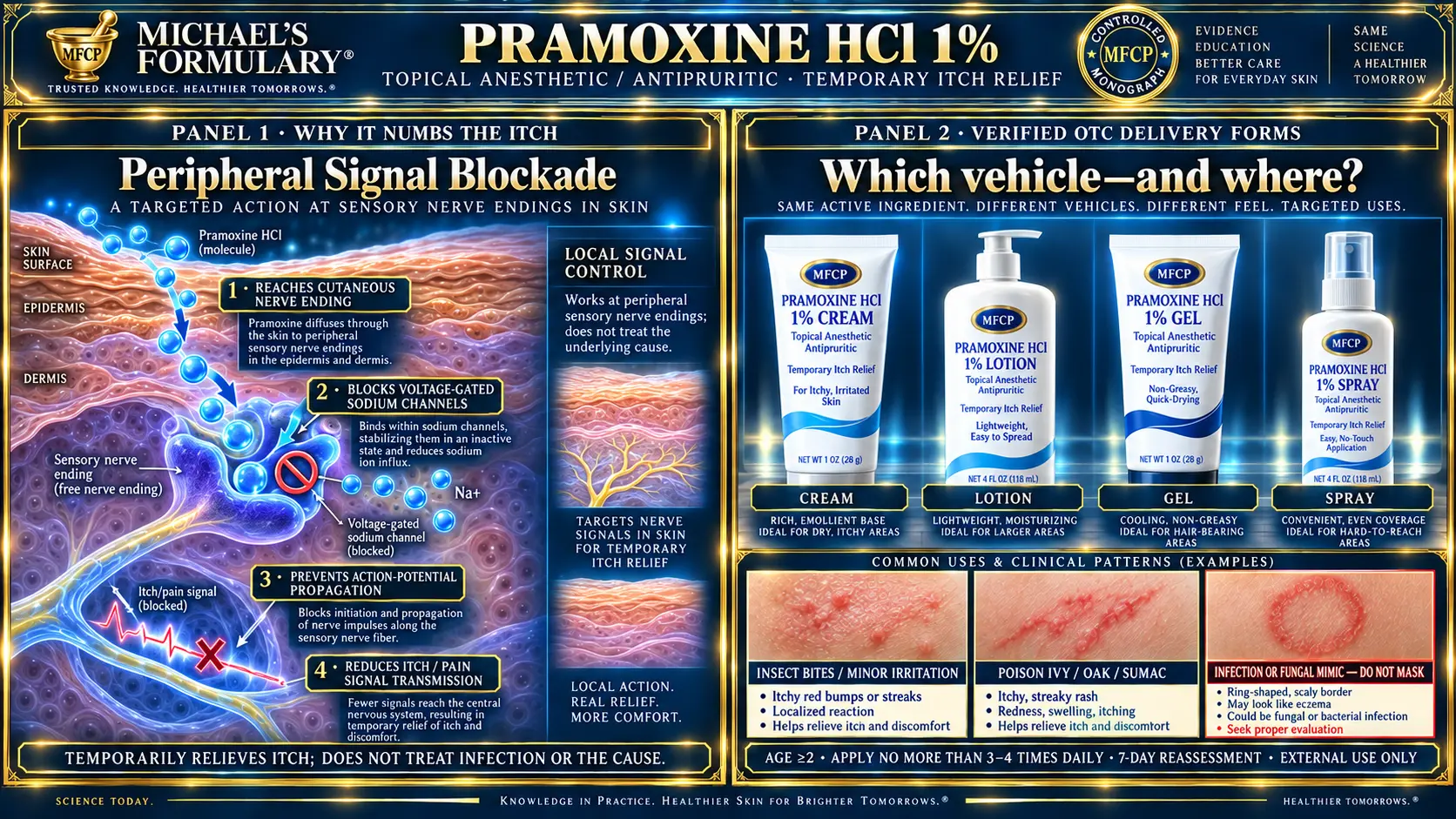
Pramoxine acts locally as a membrane-stabilizing anesthetic. Like other local anesthetics, it reduces sodium-dependent excitability in peripheral sensory nerve fibers. When sufficient channels are blocked, threshold depolarization and action-potential propagation decrease, so fewer itch and superficial pain signals reach the central nervous system. The effect is symptomatic and reversible; the provoking disease or exposure remains.
05 · Condition Before ProductConfirm a Label-Matched Minor Condition
| Pattern | Controlled interpretation |
|---|---|
| Minor burn or sunburn | External skin use may fit temporary pain and itch relief when the finished label permits and the injury is minor. |
| Minor cut, scrape, insect bite, or sting | May fit temporary symptom relief after severity, contamination, skin integrity, and allergy risk are assessed. |
| Poison ivy, oak, sumac, or minor irritation | May fit itch relief after exposure removal; spreading, facial, genital, blistering, or extensive reactions need evaluation. |
| Dry-skin itch, eczema, or urticaria | Use only if the exact Drug Facts label includes the condition. Pramoxine does not correct barrier failure or inflammation by itself. |
| Ring-shaped scale, groin fold, scaling foot, or advancing border | Possible fungal infection; numbing alone can delay correct treatment. |
| Golden crust, pus, warmth, increasing pain, red streaking, or fever | Possible infection; refer rather than suppress symptoms. |
06 · Dosage-Form DisciplineForms, Vehicles & Route Control
| Product pathway | Selection control |
|---|---|
| External-skin product | Use only for the conditions, age group, frequency, and treatment area printed in its Drug Facts. |
| Anorectal product | Must be specifically labeled for anorectal or hemorrhoidal use. External-only and intrarectal directions differ. |
| Combination product | Protectants, corticosteroids, vasoconstrictors, or other actives add separate claims, warnings, and dosage ceilings. |
| Prescription combination | Hydrocortisone 2.5% / pramoxine 1% products are prescription therapies and are outside routine OTC substitution. |
07 · Label-Directed AdministrationExternal-Skin and Anorectal Directions
| Pathway | Controlled direction |
|---|---|
| External skin · adults and children ≥2 | Apply to the affected area no more than 3 to 4 times daily. |
| External skin · under 2 | Do not use; consult a doctor. |
| External analgesic stop rule | Stop and consult if worse, present beyond 7 days, or cleared and returned within a few days. |
| External anorectal · adults | Cleanse and gently dry as directed; pramoxine products may be applied externally up to 5 times daily. |
| Anorectal · under 12 | Consult a doctor. |
| Intrarectal | Use only a product specifically labeled for intrarectal administration and follow its applicator or dosage-form directions. |
08 · Technique ControlApply Only to the Confirmed Site
- Identify the condition pattern, treatment site, surface area, and skin integrity.
- Confirm pramoxine hydrochloride 1%, dosage form, Uses, Warnings, Directions, and route.
- Clean and dry only as the finished label directs.
- Apply the labeled amount without extending to eyes, nasal passages, or another body site.
- For sprays, direct away from the face and avoid inhalation; use any ventilation required by the package.
- Do not occlude, combine, or reapply more often than the label permits.
- Reassess response and stop at the applicable seven-day or product-specific referral threshold.
09 · Outcome ControlExpected Response & Reassessment
| Observation | MFCP action |
|---|---|
| Temporary reduction in itch or superficial discomfort | Continue only within the label-directed frequency and duration; do not use prophylactically. |
| Symptoms return as the local effect fades | Do not exceed the label. Reassess whether the underlying cause needs condition-directed therapy. |
| No meaningful benefit | Recheck diagnosis, route, vehicle, technique, and whether infection, allergy, or another condition is present. |
| Redness, irritation, swelling, or pain develops or increases | Stop use and consult a clinician; an allergic or irritant reaction is possible. |
| Worsening, rapid spread, drainage, bleeding, or systemic symptoms | Stop and seek clinical assessment. |
10 · Tolerability ControlAdverse Effects & Misuse Risks
11 · Route & Population SafeguardsDo Not Collapse Separate Product Families
| Population or site | MFCP position |
|---|---|
| Children under 2 · external skin | Do not use under the FDA external analgesic drug standard directions; consult a doctor. |
| Children under 12 · anorectal | Consult a doctor under the FDA anorectal drug standard directions. |
| Pregnancy or breastfeeding | Seek product-specific professional advice, especially for repeated, extensive, breast-area, anorectal, or damaged-skin use. |
| Broken, blistered, raw, or large areas | Follow the exact label and use a low threshold for assessment; do not assume a lotion or spray permits wide-field use. |
| Perianal external use | Use only a product specifically labeled for anorectal external use; external-only products must not be inserted. |
| Intrarectal use | Use only a labeled intrarectal product and applicator. Stop and consult if insertion causes additional pain. |
| History of topical-product allergy | Review all active and inactive ingredients; stop promptly if redness, swelling, or irritation increases. |
12 · Referral ThresholdsSafety, Warnings & Escalation
- External-skin products are for external use only; avoid the eyes and follow the package for accidental exposure.
- Stop and consult if symptoms worsen, persist beyond 7 days, or clear and return within a few days.
- For anorectal use, consult promptly for bleeding, worsening symptoms, lack of improvement within 7 days, or additional pain with an applicator.
- Do not put an external-only anorectal product into the rectum with fingers or a mechanical device.
- Refer possible infection: pus, golden crust, warmth, increasing pain, red streaking, fever, or swollen lymph nodes.
- Promptly evaluate widespread, rapidly spreading, blistering, painful, mucosal, or systemically symptomatic eruptions.
- Seek emergency help for breathing or swallowing difficulty or swelling of the lips, tongue, or eyes.
13 · Shelf VerificationMFCP Buying Standard™
| Checkpoint | Verification standard |
|---|---|
| Active ingredient | Pramoxine hydrochloride |
| Strength | 1% for this controlled monograph |
| Route | External skin, external anorectal, or intrarectal—never infer interchangeability |
| Vehicle | Cream, lotion, gel, spray, or other labeled form; technique follows the package |
| Indications | Read the exact Uses panel; do not transfer claims between products |
| Other actives | Identify corticosteroids, protectants, vasoconstrictors, or other anesthetics and apply all combined warnings |
| Inactive ingredients | Check fragrance, preservatives, alcohols, propylene glycol, and personal allergies |
| Package integrity | No damaged, leaking, opened, contaminated, or expired product |
14 · Evidence ControlPrimary Sources & Readability Disclosure
- U.S. Food and Drug Administration: OTC external analgesic drug monograph
- U.S. Food and Drug Administration: OTC anorectal drug monograph
- DailyMed: Pramoxine Hydrochloride 1% Lotion Drug Facts
- DailyMed: Pramoxine Hydrochloride 1% Anorectal Product Drug Facts
Evidence control: the FDA external analgesic drug standard establishes external-analgesic strengths, indications, warnings, and directions. The FDA anorectal drug standard separately controls anorectal products. Current finished-product Drug Facts labeling controls the selected route, vehicle, combinations, and package.
Readability disclosure: This educational monograph supports product selection and referral decisions. It does not replace the current Drug Facts label, diagnosis, or individualized care.
← Return to OTC Itch & Rash Treatments