Skip to content
MFCP mortar and pestle emblemMichael’s FormularyCLINICAL PERSPECTIVE™

Clinical library / Skin & hair

On this page
MICHAEL’S FORMULARY & CLINICAL PERSPECTIVE™ · DERMATOLOGY / DERMS
Controlled Monograph · Dermatology / Derms

Neomycin Sulfate 3.5 mg/g

OTC topical aminoglycoside first aid, separated from prescription oral therapy and controlled for sensitization, route, wound size, and duration.
TOPICAL OTCAMINOGLYCOSIDEFIRST-AID SCOPE
30S binding · mRNA misreading · abnormal proteins · bacterial death
1Confirm minor wound2Verify topical product3Screen ingredient allergy4Limit to label duration
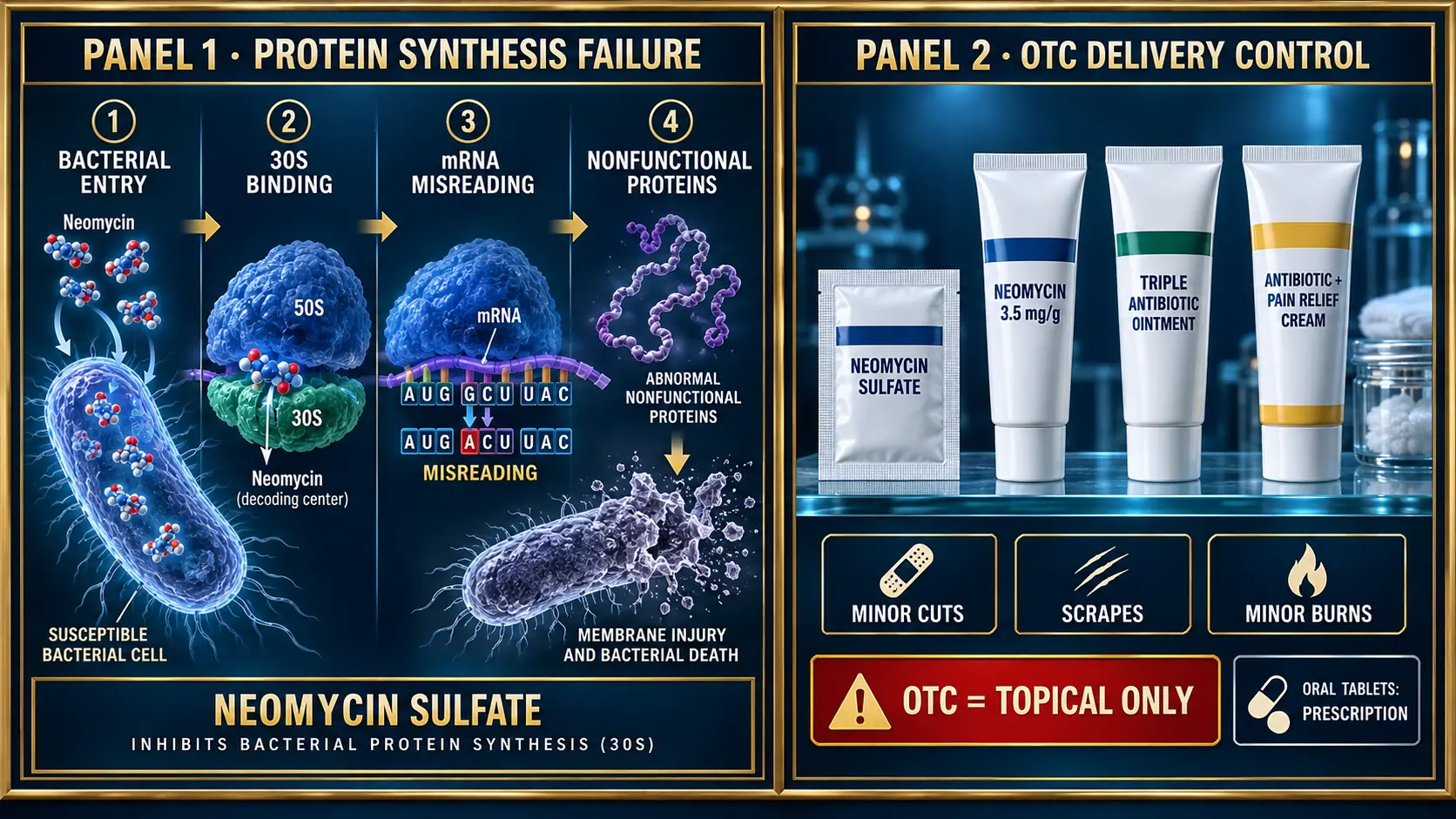
Dual-panel MFCP artwork showing neomycin 30S ribosomal action and topical OTC delivery controls
Dual-panel control: aminoglycoside protein-synthesis disruption and topical first-aid delivery selection.

01 · Controlled Clinical PositionPharmacist Bottom Line™

OTC neomycin is a topical first-aid antibiotic for minor cuts, scrapes, and burns. A current single-ingredient ointment supplies neomycin sulfate equivalent to 3.5 mg neomycin per gram. Neomycin is also common in double- and triple-antibiotic products and in some antibiotic-plus-pain-relief creams.

OTC roleExternal topical first aid after cleaning a minor superficial wound.
Prescription separationOral neomycin tablets are prescription products with boxed warnings for systemic toxicity; they are not substitutes for topical first-aid products.
★ BOTTOM LINE: Verify topical route, exact active ingredients, minor-wound scope, allergy history, and the one-week maximum unless directed by a doctor.

02 · Product and Route ControlIdentity, Strength & OTC Boundary

Established nameNeomycin sulfate
Pharmacologic classAminoglycoside antibiotic
OTC strength3.5 mg neomycin per gram
OTC dosage formsTopical ointment and cream under FDA Monograph M004
OTC purposeFirst aid to help prevent infection in minor cuts, scrapes, and burns
Prescription routeOral 500 mg tablets for specific clinician-managed indications
Route rule: “Neomycin” on a product is not enough. Confirm topical versus oral route, concentration, combination ingredients, treatment purpose, and current labeling.

03 · Aminoglycoside Pharmacology30S Ribosomal Binding & mRNA Misreading

  1. Neomycin must reach susceptible bacterial cells and enter through energy-dependent transport processes.
  2. It binds the bacterial 30S ribosomal subunit at the decoding region.
  3. Codon recognition becomes inaccurate, producing mistranslated and nonfunctional proteins.
  4. Abnormal membrane proteins amplify permeability injury and contribute to concentration-dependent bacterial killing.
Mechanism rule: Neomycin is a protein-synthesis inhibitor. It does not inhibit peptidoglycan cross-linking and should not be illustrated as a cell-wall antibiotic.

04 · Dosage-Form DisciplineOTC Topical Products & Delivery

Product familyRepresentative formulationSelection control
Single-ingredient ointmentNeomycin sulfate equivalent to 3.5 mg neomycin/g in petrolatum and mineral oilOcclusive topical first aid; verify allergy history
Single-ingredient creamNeomycin sulfate equivalent to 3.5 mg neomycin/g in a cream basePermitted by M004; verify actual product availability and Drug Facts
Double-antibiotic productNeomycin may be paired with bacitracin or polymyxin B in permitted formulations“Double” does not identify the exact active pair
Triple-antibiotic ointmentNeomycin plus bacitracin or bacitracin zinc and polymyxin BThree allergy opportunities; read every ingredient
Antibiotic plus pain-relief creamNeomycin and polymyxin B with pramoxine in a permitted cream formulationAdditional anesthetic warnings and purpose statements apply
Vehicle rule: Ointment and cream are not automatically interchangeable. The active ingredients, strength, base, pain-relief component, allergy profile, and current Drug Facts panel control selection.

05 · Label-Directed AdministrationClean, Apply, Cover & Reassess

  1. Clean the affected area.
  2. Apply a small amount, approximately equal to the surface area of a fingertip, 1 to 3 times daily.
  3. The area may be covered with a sterile bandage.
  4. Do not use in the eyes, over large areas, or longer than 1 week unless directed by a doctor.
  5. Stop and seek advice if the condition persists, worsens, or a rash or other allergic reaction develops.

06 · Toxicity and Sensitization BoundarySafety, Allergy & Systemic Separation

Allergic contact dermatitisNeomycin is a frequent contact sensitizer. Increasing itch, erythema, edema, vesiculation, or worsening local inflammation may be allergy rather than infection.
Large or severely damaged areasDo not use OTC products over large body areas. Deep wounds, punctures, bites, and serious burns require clinical evaluation.
Oral boxed warningsPrescription oral neomycin labeling warns of nephrotoxicity, permanent bilateral auditory ototoxicity, and neuromuscular blockade, even when used at recommended doses.
Do not infer IV availabilityNeomycin is not a routine intravenous product. The clinically marketed systemic formulation is prescription oral neomycin, used only for specific indications under supervision.
Referral: Uncontrolled bleeding, wound closure need, deep or puncture wound, animal or human bite, serious burn, spreading erythema, warmth, pus, red streaking, fever, severe pain, hearing symptoms, reduced urine output, or systemic illness.

07 · Evidence ControlPrimary and Authoritative Sources

Readability disclosure: Systemic toxicity language describes prescription oral neomycin and the risk of absorption under inappropriate exposure conditions; it should not be used to imply that routine label-directed topical use produces the same exposure. This educational monograph does not replace Drug Facts, prescription labeling, wound assessment, or individualized care.

← Return to OTC Topical Antibacterials
Educational reference · Verify current Drug Facts labeling before use.
Contents
  1. 01 · Controlled Clinical Position Pharmacist Bottom Line™
  2. 02 · Product and Route Control Identity, Strength & OTC Boundary
  3. 03 · Aminoglycoside Pharmacology 30S Ribosomal Binding & mRNA Misreading
  4. 04 · Dosage-Form Discipline OTC Topical Products & Delivery
  5. 05 · Label-Directed Administration Clean, Apply, Cover & Reassess
  6. 06 · Toxicity and Sensitization Boundary Safety, Allergy & Systemic Separation
  7. 07 · Evidence Control Primary and Authoritative Sources
  8. Source links

Source links

Links already cited on this page.