Skip to content
MFCP mortar and pestle emblemMichael’s FormularyCLINICAL PERSPECTIVE™

Clinical library / Skin & hair

On this page
MICHAEL’S FORMULARY & CLINICAL PERSPECTIVE™ · DERMATOLOGY / DERMS
Controlled Monograph · Dermatology / Derms

Polymyxin B Sulfate

Gram-negative outer-membrane disruption, paired with strict separation of OTC topical combinations from prescription eye, ear, and systemic products.
OTC IN COMBINATIONSCYCLIC LIPOPEPTIDEROUTE CONTROL
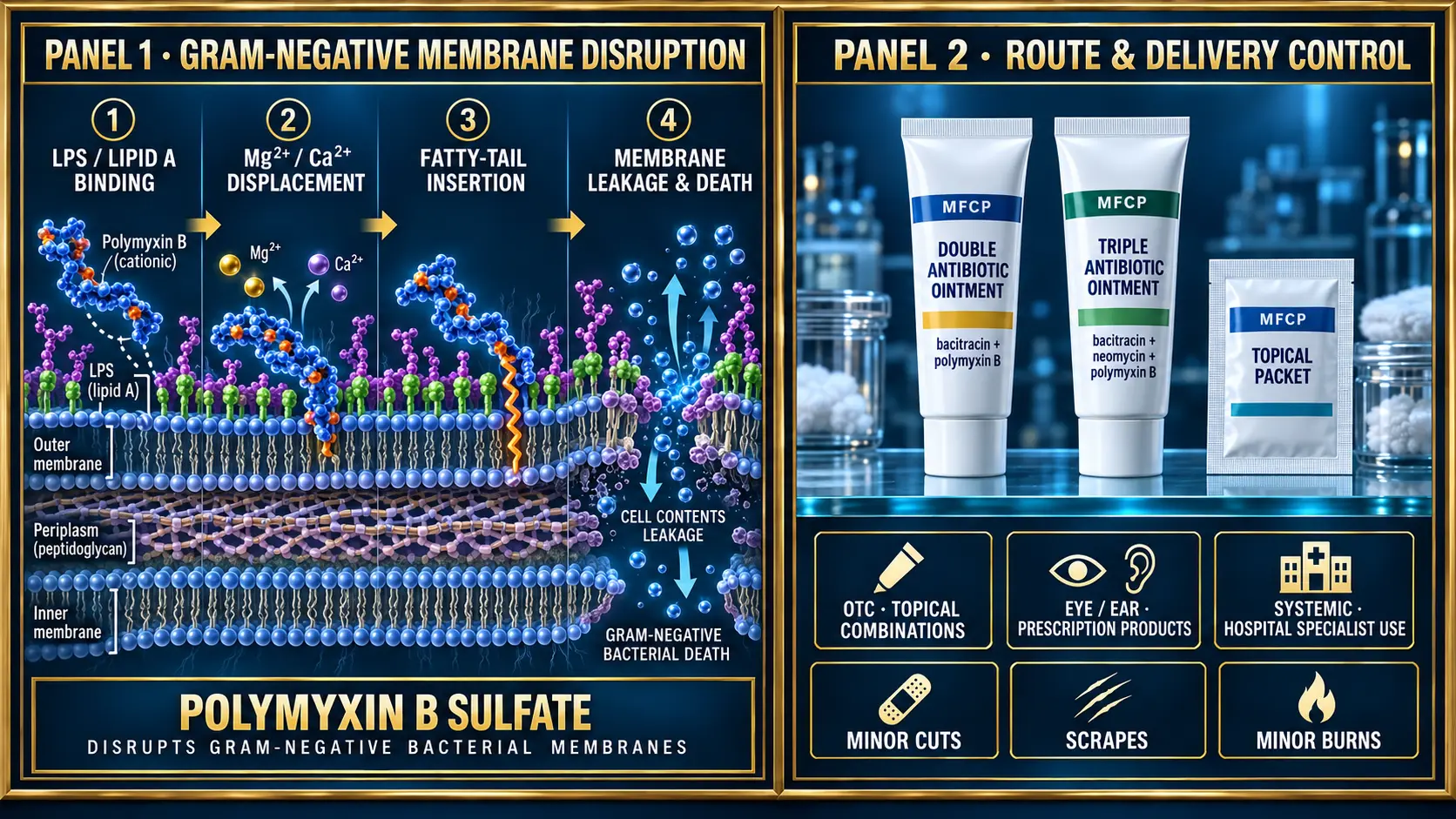
Lipid A binding · Divalent-cation displacement · Membrane insertion · Leakage
1Confirm minor wound2Verify all ingredients3Match sterile route4Limit OTC duration
Dual-panel MFCP artwork showing polymyxin B disruption of the Gram-negative bacterial membrane and controlled topical, eye, ear, and systemic routes
Dual-panel control: lipid A–directed membrane disruption and route-specific product selection.

01 · Controlled Clinical PositionPharmacist Bottom Line™

Polymyxin B sulfate appears in over-the-counter first-aid products as part of permitted topical antibiotic combinations, commonly with bacitracin or with bacitracin plus neomycin. The OTC purpose remains narrow: first aid to help prevent infection in minor cuts, scrapes, and burns. Prescription ophthalmic, otic, and parenteral products belong to separate routes and must never be substituted with a skin product.

OTC roleExternal topical combination products after cleaning a minor superficial wound.
Prescription separationSterile eye and ear products and systemic polymyxin B require route-specific prescription labeling and clinical supervision.
★ BOTTOM LINE: Confirm the route, every active ingredient, the minor-wound indication, allergy history, and the one-week maximum unless directed by a doctor.

02 · Product and Route ControlIdentity, Structure & OTC Boundary

Established namePolymyxin B sulfate
Pharmacologic classCationic cyclic lipopeptide antibiotic
Commercial materialRelated congeners, principally polymyxins B1 and B2
OTC positionTopical first-aid combinations under FDA Monograph M004
Primary targetLipid A of Gram-negative outer-membrane lipopolysaccharide
Prescription routesRoute-specific ophthalmic, otic, and parenteral products
Identity rule: Polymyxin B is not an OTC single-ingredient monograph active. In OTC first aid, it is used in specifically permitted combinations and strengths; the Drug Facts panel controls.

03 · Membrane PharmacologyLipid A Binding & Membrane Permeabilization

  1. Positively charged diaminobutyric acid residues bind negatively charged phosphate groups in lipid A within Gram-negative outer-membrane lipopolysaccharide.
  2. Polymyxin B displaces membrane-stabilizing magnesium and calcium ions.
  3. Its hydrophobic fatty-acyl segment inserts into the membrane, disrupting lipid packing and promoting self-facilitated uptake.
  4. Outer- and inner-membrane permeability increases, intracellular constituents leak, and susceptible bacteria undergo rapid concentration-dependent killing.
Mechanism rule: Lipopolysaccharide binding is central to antibacterial action. Do not convert biochemical endotoxin binding into an unqualified claim that topical or systemic polymyxin B prevents septic shock.

04 · Gram-Negative PositionSpectrum & Resistance

Polymyxin B is active against selected aerobic Gram-negative bacilli, including susceptible Pseudomonas aeruginosa, Acinetobacter baumannii, and Enterobacterales. Activity is organism- and isolate-specific. Gram-positive organisms, anaerobes, and atypical bacteria are not covered.

Intrinsic resistanceProteus, Providencia, Morganella, Serratia marcescens, and Burkholderia cepacia complex are important examples of organisms with intrinsic or usual resistance.
Lipid A modificationPmrAB and PhoPQ pathways can reduce the membrane’s negative charge through lipid A remodeling, weakening polymyxin binding.
Mobile resistancemcr phosphoethanolamine-transferase genes can confer transferable resistance among Gram-negative organisms.
OTC interpretationSpectrum language does not authorize self-treatment of an established, spreading, deep, ocular, otic, or systemic infection.

05 · Dosage-Form DisciplineTopical Combinations & Prescription Routes

Product familyRepresentative compositionControlled role
OTC double-antibiotic ointmentBacitracin zinc 500 units/g plus polymyxin B 10,000 units/gExternal first aid for minor cuts, scrapes, and burns
OTC triple-antibiotic ointmentBacitracin or bacitracin zinc plus neomycin sulfate and polymyxin B sulfate; permitted strengths varySame narrow first-aid indication; screen every component for allergy
Other M004 combinationsSpecified cream, aerosol, or powder combinationsPermitted only at monograph-specified ingredients, strengths, dosage forms, and labeling; verify actual availability
Prescription ophthalmic / oticSterile route-specific combinationsClinician-directed eye or ear use; never substitute a nonsterile skin product
Prescription parenteralPolymyxin B sulfate for injectionSpecialist-managed therapy for selected serious susceptible Gram-negative infections
OTC directions: Clean the affected area; apply a small amount, approximately equal to the surface area of a fingertip, 1 to 3 times daily; cover with a sterile bandage if desired. Do not use longer than 1 week unless directed by a doctor.

06 · Route-Specific Risk ControlSafety, Toxicity & Referral

OTC topical limitsFor external use only. Do not use in the eyes, over large areas, or on deep or puncture wounds, animal bites, or serious burns without medical direction.
AllergyStop if rash or another allergic reaction develops. In a multi-ingredient product, the responsible allergen cannot be identified from appearance alone.
Systemic toxicityParenteral polymyxin B can cause nephrotoxicity and neurotoxicity, including neuromuscular blockade; monitoring belongs to hospital specialist care.
Resistance-era roleModern resistant-pathogen therapy is susceptibility-guided and regimen-specific. It is not an extension of OTC topical first aid.
Referral: Uncontrolled bleeding, wound closure need, deep or puncture wound, animal or human bite, serious burn, spreading redness, warmth, pus, red streaking, fever, severe pain, eye or ear involvement, or systemic illness.

07 · Evidence ControlPrimary and Authoritative Sources

Readability disclosure: Systemic pharmacology and toxicity describe prescription parenteral therapy and must not be used to imply comparable exposure from routine label-directed topical use. This educational monograph does not replace Drug Facts, prescription labeling, susceptibility testing, wound assessment, institutional policy, or individualized care.

← Return to OTC Topical Antibacterials
Educational reference · Verify current Drug Facts or prescription labeling before use.
Contents
  1. 01 · Controlled Clinical Position Pharmacist Bottom Line™
  2. 02 · Product and Route Control Identity, Structure & OTC Boundary
  3. 03 · Membrane Pharmacology Lipid A Binding & Membrane Permeabilization
  4. 04 · Gram-Negative Position Spectrum & Resistance
  5. 05 · Dosage-Form Discipline Topical Combinations & Prescription Routes
  6. 06 · Route-Specific Risk Control Safety, Toxicity & Referral
  7. 07 · Evidence Control Primary and Authoritative Sources
  8. Source links

Source links

Links already cited on this page.