
Triple-Antibiotic Products
Three active ingredients, three bacterial targets, and one narrow topical first-aid indication controlled by the current Drug Facts label.
01 · Controlled Clinical PositionPharmacist Bottom Line™
OTC triple-antibiotic ointments combine bacitracin zinc, neomycin sulfate, and polymyxin B sulfate as topical first-aid antibiotics. Their label-directed role is to help prevent infection in minor cuts, scrapes, and burns. The combination does not replace wound cleaning, closure assessment, tetanus review, or evaluation of an established or spreading infection.
02 · Package Identity StandardWhat This Is & What the Label Must Confirm
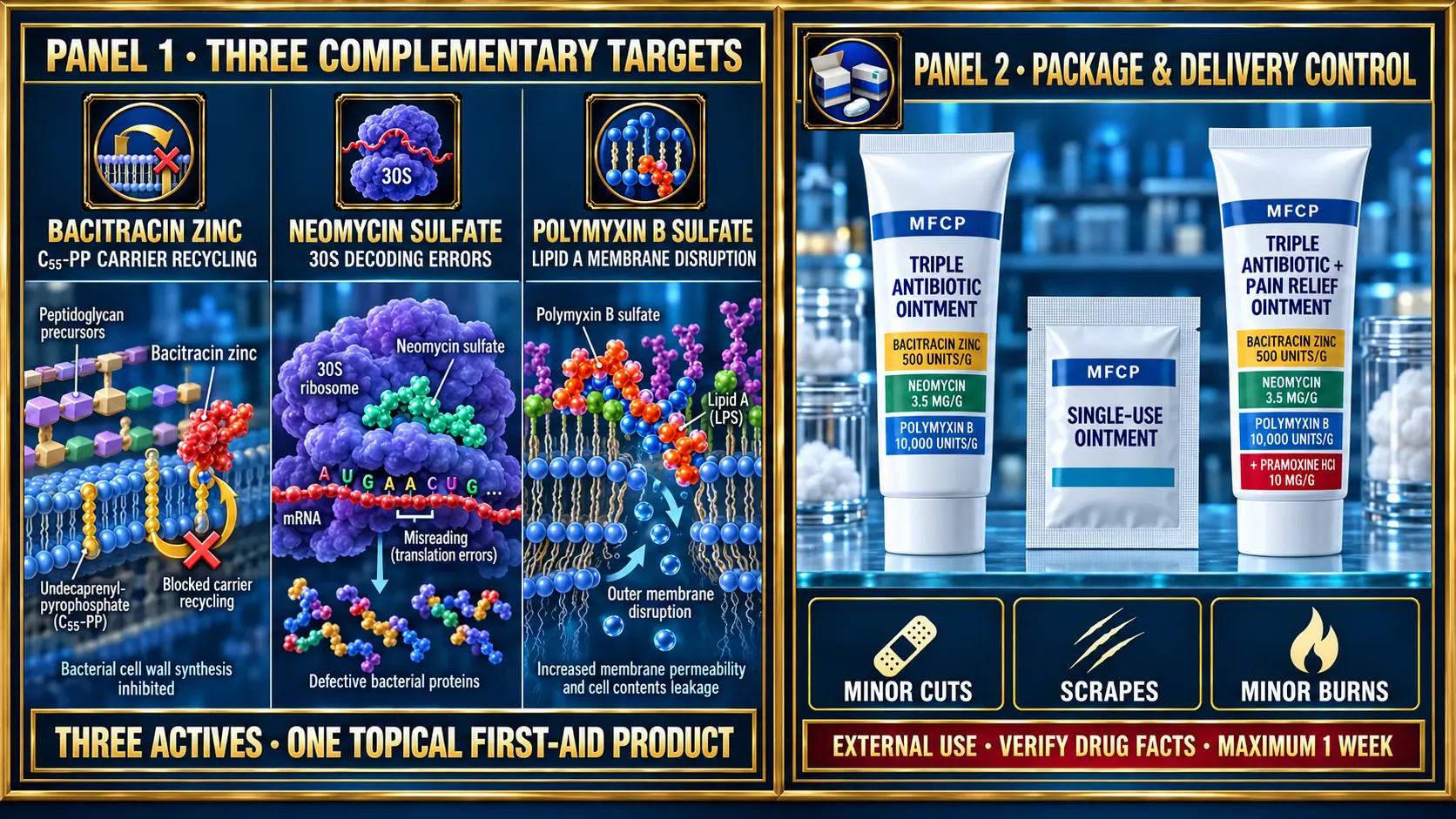
03 · Complementary PharmacologyThree Actives, Three Bacterial Targets
| Active ingredient | Defining mechanism | Selection meaning |
|---|---|---|
| Bacitracin zinc | Binds the undecaprenyl-pyrophosphate carrier complex and interrupts carrier recycling required for peptidoglycan assembly | Adds primarily Gram-positive activity; topical sensitization remains important |
| Neomycin sulfate | Binds the bacterial 30S ribosomal subunit, causing decoding errors and abnormal proteins | Broadens antibacterial activity but is a frequent contact sensitizer |
| Polymyxin B sulfate | Binds lipid A and disrupts the Gram-negative outer and inner membranes | Adds activity against selected Gram-negative organisms |
04 · Dosage Form and Package ControlOintments, Packets, Tubes & Pain-Relief Variants
| Product presentation | Representative contents | Control point |
|---|---|---|
| Original-strength ointment | Permitted formulations include bacitracin zinc 400 to 500 units/g, neomycin 3.5 mg/g, and polymyxin B 5,000 to 10,000 units/g | Strengths vary by product; verify all three |
| Maximum-strength or pain-relief ointment | Common formula: bacitracin zinc 500 units/g, neomycin 3.5 mg/g, polymyxin B 10,000 units/g, plus pramoxine HCl 10 mg/g | The anesthetic adds its own purpose, warnings, and age directions |
| Single-use unit | Foil or unit-dose packaging, commonly around 0.5 to 0.9 g | Useful for first-aid kits; single-use packaging does not change the indication |
| Multi-use tube | Common retail and institutional sizes include approximately 0.5 oz, 1 oz, and 2 oz | Keep the cap and tip clean; discard damaged, contaminated, or expired packages |
05 · Label-Directed AdministrationClean, Apply, Cover & Reassess
- Clean the affected area.
- Apply a small amount, approximately equal to the surface area of a fingertip, 1 to 3 times daily.
- The area may be covered with a sterile bandage.
- Do not use in the eyes, over large areas, or longer than 1 week unless directed by a doctor.
- Follow the exact age directions on the selected product; pain-relief variants may direct caregivers to ask a doctor before use in children younger than 2 years.
06 · Multi-Ingredient Risk ControlAllergy, Wound Boundaries & Referral
07 · Evidence ControlPrimary and Authoritative Sources
- U.S. FDA OTC Monograph M004: First Aid Antibiotic Drug Products
- DailyMed: Triple-Antibiotic Ointment Unit-Dose and Tube Labeling
- DailyMed: Original-Strength Triple-Antibiotic Ointment
- DailyMed: Triple-Antibiotic Plus Pramoxine Pain-Relief Ointment
Readability disclosure: This educational monograph separates FDA-permitted formulations from retailer category language. It does not replace the current Drug Facts panel, wound assessment, institutional policy, tetanus evaluation, or individualized clinical care.
← Return to OTC Topical Antibacterials