
Pyrithione Zinc
OTC antimicrobial and antifungal active with route-specific dandruff and seborrheic-dermatitis pathways.
01 · Controlled Clinical PositionPharmacist Bottom Line™
Pyrithione zinc is an OTC active ingredient for dandruff and seborrheic dermatitis when the concentration, dosage form, treatment site, and label claim match. Rinse-off and leave-on products occupy different concentration ranges and use patterns; they are not interchangeable.
02 · Active Ingredient ControlDrug Identity & Chemistry
| Attribute | MFCP controlled statement |
|---|---|
| Established name | Pyrithione zinc; zinc pyrithione; ZPT |
| Chemical formula | C10H8N2O2S2Zn |
| Chemical character | Neutral zinc coordination complex with two bidentate pyrithione ligands coordinated through oxygen and sulfur |
| Physical behavior | Very low aqueous solubility; rinse-off products commonly deliver suspended microparticles rather than a freely dissolved active |
| Pharmacologic function | Topical antimicrobial, antifungal, and antiseborrheic active |
| OTC conditions | Dandruff and seborrheic dermatitis, according to concentration and dosage form |
| Route | Topical; rinse-off or leave-on |
| Exclusion | Not listed as a pyrithione-zinc pathway for psoriasis in OTC Monograph M032 |
03 · Monograph at a Glance™MAG™ Clinical Snapshot
04 · Fungal BiologyMechanism · Copper-Mediated Antifungal Action
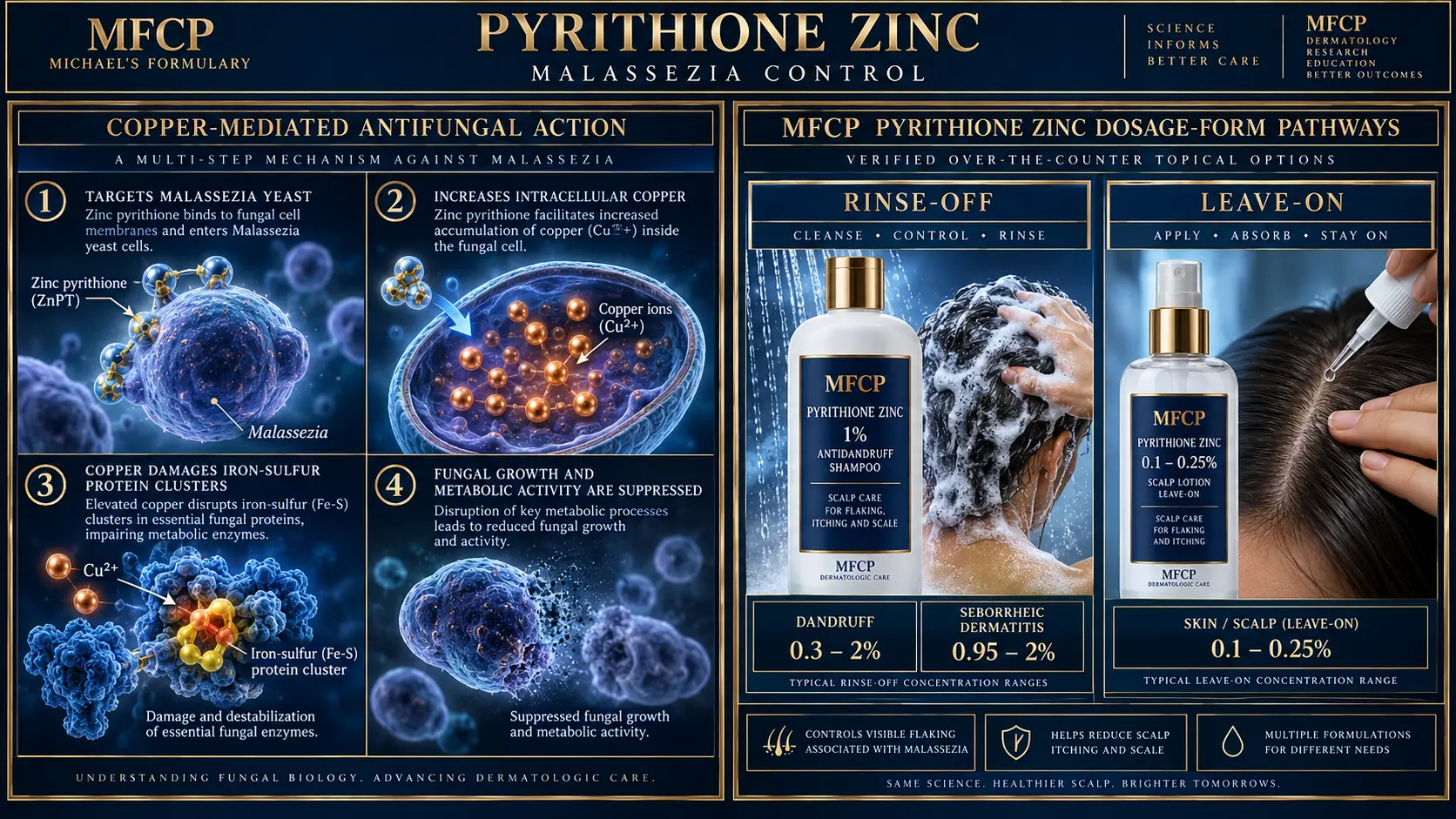
Experimental research indicates that zinc pyrithione increases intracellular copper in susceptible fungi. Elevated copper damages iron-sulfur clusters in proteins essential for fungal metabolism, suppressing growth and metabolic activity. This model helps explain activity against Malassezia, but it does not replace a clinical diagnosis or product-specific labeling.
05 · Condition Before ProductConfirm the Treatment Pathway
| Pattern | Controlled interpretation |
|---|---|
| Loose flakes with scalp itching | May fit a dandruff-labeled product when no red flags are present. |
| Greasy scale with redness or irritation | May fit seborrheic dermatitis; verify the product carries that indication and the percentage matches the route. |
| Thick sharply defined plaques | May suggest psoriasis; pyrithione zinc is not the monograph’s psoriasis active. |
| Hair loss, broken hairs, pain, crust, drainage, or boggy swelling | Refer for evaluation; do not treat as routine dandruff. |
| Face, ears, beard, chest, or folds | Verify the dosage form is labeled for the treatment site; scalp shampoo directions do not automatically authorize body use. |
| Tinea versicolor or Malassezia folliculitis | These are not the labeled OTC M032 pyrithione-zinc self-care indications. Do not convert shampoo availability into an unsupported treatment recommendation. |
06 · Dosage-Form DisciplineRinse-Off & Leave-On Delivery
Shampoo or Rinse
Brief-exposure products are applied and washed off. Dandruff and seborrheic-dermatitis ranges differ at the lower end.
Lotion, Cream or Hair-Groom
Lower-strength products remain on the skin or scalp and use a different application frequency.
Scalp vs. Skin
Product identity, label claim, and application site must all match.
07 · Label-Directed AdministrationOTC Concentrations & Directions
| Pathway | Concentration | Monograph direction |
|---|---|---|
| Rinse-off dandruff | 0.3% to 2% | For best results, use at least twice a week or as directed by a doctor. |
| Rinse-off seborrheic dermatitis | 0.95% to 2% | For best results, use at least twice a week or as directed by a doctor. |
| Leave-on dandruff | 0.1% to 0.25% | Apply to affected areas one to four times daily or as directed by a doctor. |
| Leave-on seborrheic dermatitis | 0.1% to 0.25% | Apply to affected areas one to four times daily or as directed by a doctor. |
08 · Technique ControlApplication by Delivery Route
09 · Outcome ControlExpected Response & Reassessment
| Assessment | MFCP action |
|---|---|
| Regular directed use | Monitor itching, flaking, scaling, redness, irritation, and recurrence. |
| Improvement | Continue only according to the exact label and intended maintenance schedule. |
| No improvement | Consult a doctor if the condition does not improve after regular directed use. |
| Worsening | Stop use and consult a doctor; reassess both diagnosis and product tolerance. |
10 · TolerabilityAdverse Effects & Product Reaction
11 · Population SafeguardsAge, Extent & Clinical Complexity
| Population or factor | MFCP position |
|---|---|
| Children | OTC Monograph M032 does not establish one universal age direction for every pyrithione-zinc product; follow the exact Drug Facts label and seek professional guidance when uncertain. |
| Infants or cradle cap | Do not extrapolate adult or general-use medicated-product directions to infants. |
| Large body area | For seborrheic-dermatitis products, consult a doctor before use when the condition covers a large area. |
| Broken, infected, or severely inflamed skin | Seek assessment rather than routine product escalation. |
| Immunocompromise or recurrent disease | Lower the threshold for diagnostic confirmation and clinician-directed care. |
12 · Referral ThresholdsSafety, Warnings & Escalation
13 · Shelf VerificationMFCP Buying Standard™
| Checkpoint | Verification standard |
|---|---|
| Active ingredient | Pyrithione zinc |
| Condition claim | Dandruff and/or seborrheic dermatitis; not assumed from front-panel styling |
| Strength | Must fall within the route-specific monograph range |
| Dosage form | Rinse-off or leave-on, clearly identified |
| Treatment site | Scalp and/or skin as stated on the package |
| Directions | Exact frequency, exposure, rinse, and repeat instructions verified |
| Package integrity | Do not use damaged, leaking, opened, or expired packaging |
14 · Evidence ControlPrimary Sources & Readability Disclosure
- U.S. Food and Drug Administration: OTC Monograph M032
- DailyMed: Pyrithione Zinc 1% Shampoo Drug Facts
- Reeder et al.: Antifungal Mechanism of Action of Zinc Pyrithione
- Chandler and Segel: Pyrithione-Induced Fungal Membrane Depolarization
- European Union Regulation 2021/1902: Cosmetic-Product Restriction
Evidence control: Concentration ranges and route-specific directions are controlled by OTC Monograph M032. The cited DailyMed label is a current representative 1% rinse-off product, not a universal direction set for every formulation.
Readability disclosure: Patient-action language is written for rapid scalp- and skin-care decisions. Technical terms remain where they protect diagnostic or pharmacologic meaning. This educational monograph does not replace the current Drug Facts label or individualized clinical evaluation.
← Return to Dandruff, Seborrheic Dermatitis & Psoriasis