
Topical Diphenhydramine HCl 1%–2%
Route-specific temporary itch and pain relief with hard controls for treatment area, skin integrity, age, frequency, duration, and duplicate diphenhydramine exposure.
01 · Controlled Clinical PositionPharmacist Bottom Line™
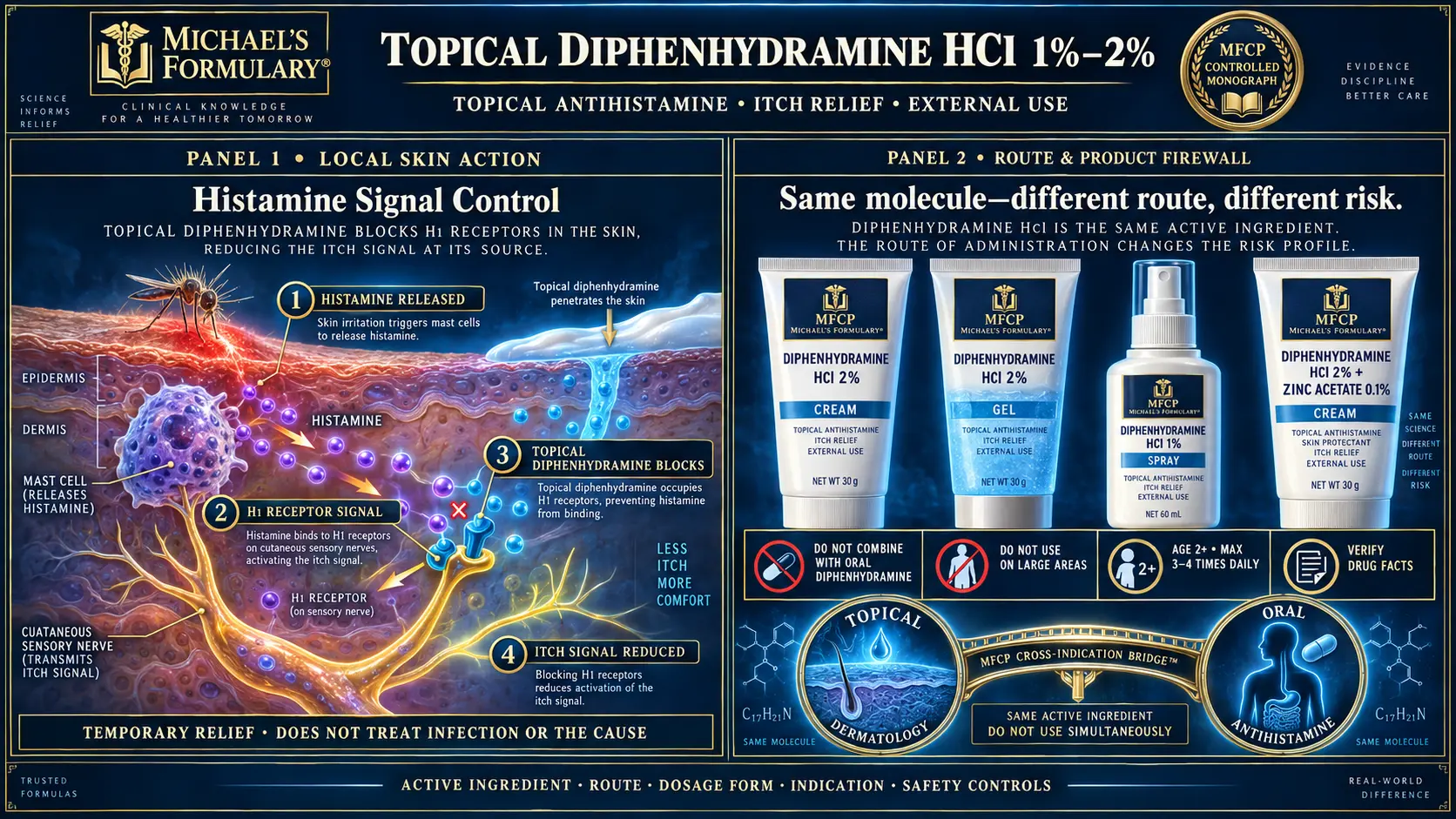
Diphenhydramine HCl 1%–2% is an FDA OTC topical antihistamine/external analgesic for temporary relief of pain, itching, or both when the finished label lists a qualifying minor skin condition. Its role is short-term symptom relief on small areas of intact skin—not treatment of infection, extensive dermatitis, or the underlying cause.
02 · Active-Ingredient and Route ControlIdentity, Strength & Regulatory Position
| Control point | MFCP standard |
|---|---|
| Active | Diphenhydramine hydrochloride. |
| Monograph strength | 1% to 2% under the FDA OTC external analgesic drug monograph. |
| Topical identity | External analgesic, topical analgesic, or pain-relieving dosage form as permitted by the controlling monograph and finished label. |
| Route | External cutaneous use only; not an oral dose and not a substitute for an oral-antihistamine decision. |
| Common combination | Diphenhydramine HCl 2% with zinc acetate 0.1% skin protectant; every active and warning must be reviewed. |
| Cross-indication rule | One molecule may appear in more than one therapeutic domain; route and duplicate-exposure controls remain mandatory. |
03 · Monograph at a Glance™MAG™ Clinical Snapshot
04 · Local Receptor PharmacologyH1-Receptor Signal Control
Diphenhydramine acts as an H1-receptor inverse agonist/antagonist. At the application site it reduces histamine-mediated sensory signaling and can temporarily decrease itch. Local action does not establish the diagnosis, remove an allergen, eradicate a microorganism, or control a severe systemic allergic reaction.
05 · Condition Before ProductWhat Fits—and What Does Not?
| Pattern | Controlled interpretation |
|---|---|
| Minor insect bite or minor localized irritation | May fit when listed in Uses and the skin is intact. |
| Minor cut, scrape, or burn | Use only if the exact finished label permits it and the product-specific warnings do not exclude the presentation. |
| Poison ivy, oak, or sumac | Topical diphenhydramine carries a monograph do-not-use warning for poison ivy; choose another appropriate pathway. |
| Sunburn or chickenpox | Do not use topical diphenhydramine. |
| Ring-shaped, scaling, moist-fold, or advancing edge | Possible fungal disease; select the antifungal pathway rather than masking itch. |
| Pus, crust, warmth, increasing pain, drainage, or red streaking | Possible infection; stop self-treatment and obtain assessment. |
06 · Delivery-Form DisciplineForm, Area & Combination Control
07 · Label-Directed AdministrationAge, Frequency & Duration
| Control | Direction |
|---|---|
| Adults and children 2 years and older | Apply to the affected area not more than 3 to 4 times daily. |
| Children under 2 years | Do not use; consult a doctor. |
| Duration | Stop and consult a doctor if symptoms worsen, persist more than 7 days, or clear and return within a few days. |
| Product-specific label | Follow any more restrictive site, amount, age, spray, or combination-product direction. |
08 · Technique ControlVerify, Apply Thinly & Recheck
- Confirm the target problem is minor, localized, and included in the product’s Uses.
- Check every active ingredient and screen oral, sleep, allergy, cold, and topical products for diphenhydramine.
- Do not use on chickenpox, poison ivy, sunburn, large areas, or broken, blistered, or oozing skin.
- Apply a small amount only to the affected intact area; keep away from eyes and mucosa.
- Do not exceed the labeled daily frequency or combine delivery forms.
- Wash hands after application unless the hands are the treated area.
- Stop for worsening redness, burning, swelling, rash, or lack of appropriate response.
09 · Outcome ControlExpected Response & Reassessment
| Observation | MFCP action |
|---|---|
| Temporary itch reduction | Expected symptom response; continue only within label limits. |
| Increasing redness, itch, or blistering | Stop; consider irritation, allergic contact dermatitis, worsening disease, or an incorrect diagnosis. |
| No meaningful improvement | Reassess the cause rather than increasing area, amount, or frequency. |
| Symptoms beyond 7 days or rapid recurrence | Stop and obtain professional evaluation. |
| Breathing difficulty, facial swelling, faintness, or generalized hives | Emergency response; topical therapy is not appropriate treatment. |
10 · Tolerability ControlAdverse Effects & Product Pitfalls
11 · Site & Population SafeguardsChildren, Skin Integrity & Route Separation
| Site or population | MFCP position |
|---|---|
| Children under 2 | Do not use unless a doctor directs care. |
| Children 2 and older | Use adult supervision, a small area, the labeled frequency, and no oral or topical duplicate. |
| Broken, blistered, or oozing skin | Do not use. |
| Face, eyes, mouth, genitals, or mucosa | Avoid eyes and mucosa; use only if the exact product and site are labeled and appropriate. |
| Pregnancy or breastfeeding | Seek product-specific advice when treatment would involve the breast, repeated use, a large area, damaged skin, or another diphenhydramine product. |
| Older adults or anticholinergic vulnerability | Maintain the topical boundary and avoid duplicate oral exposure; open the oral monograph for systemic-risk controls. |
12 · Referral ThresholdsDo-Not-Use Firewall & Escalation
- Do not use on chickenpox, poison ivy, sunburn, large areas, or broken, blistered, or oozing skin.
- Do not use more often than directed or with any other product containing diphenhydramine—even one taken by mouth.
- For external use only; avoid the eyes.
- Stop if the condition worsens, persists for more than 7 days, or clears and returns within a few days.
- Refer possible infection, a spreading or painful eruption, widespread blistering, mucosal involvement, fever, or systemic symptoms.
- Use emergency care for trouble breathing, facial or throat swelling, faintness, or a severe generalized reaction.
13 · Shelf VerificationMFCP Buying Standard™
| Checkpoint | Verification standard |
|---|---|
| Active | Diphenhydramine hydrochloride appears in Drug Facts at 1%–2% |
| Route | External cutaneous product—not an oral, ophthalmic, otic, or mucosal product |
| Combination | Identify zinc acetate or every other active ingredient |
| Use | The target minor condition is listed under Uses |
| Warnings | The chickenpox, poison ivy, sunburn, large-area, damaged-skin, frequency, and duplicate-diphenhydramine controls are readable |
| Age and frequency | Age 2+ and not more than 3–4 times daily unless the exact label is more restrictive |
| Medication screen | No oral, sleep, allergy, cold, or topical product duplicates diphenhydramine |
| Package | Sealed, legible, unexpired, and appropriate for the selected application method |
14 · Evidence ControlPrimary Sources & Readability Disclosure
- U.S. Food and Drug Administration: OTC external analgesic drug monograph
- DailyMed: diphenhydramine HCl 2% / zinc acetate 0.1% topical cream label
Evidence control: the FDA external analgesic drug standard controls the permitted strength, labeled Uses, first warning, age, frequency, and stop rule. The finished Drug Facts label controls the exact formulation and application.
Readability disclosure: This educational monograph supports product selection and referral decisions. It does not replace diagnosis, the current Drug Facts label, or individualized care.