
Colloidal Oatmeal
OTC skin protectant for label-matched minor irritation and itching, with direct-application, bath, compress, and wet-dressing pathways.
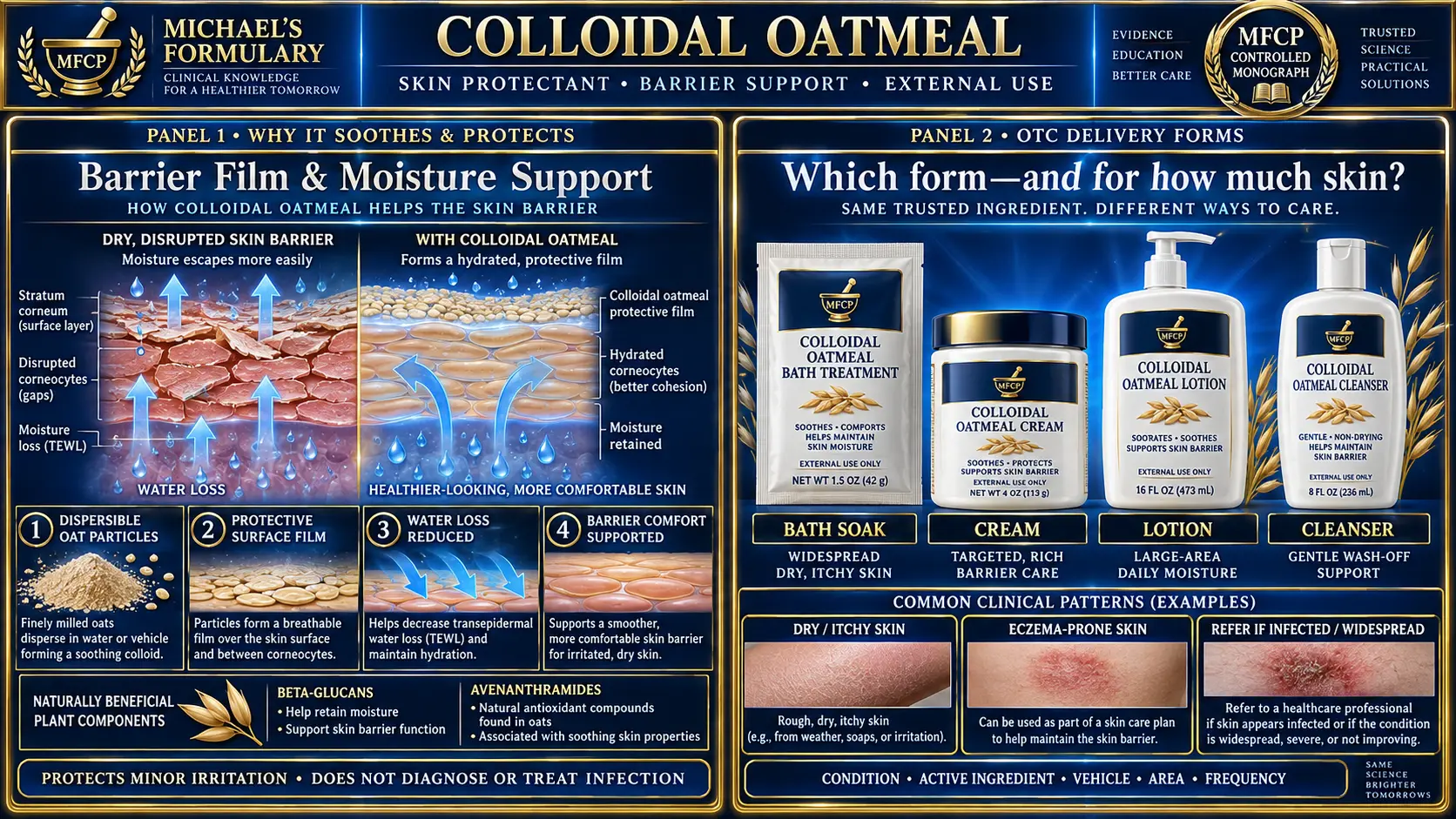
01 · Controlled Clinical PositionPharmacist Bottom Line™
Colloidal oatmeal is an FDA OTC skin-protectant active. It can temporarily protect and help relieve minor skin irritation and itching due to one or more labeled conditions: rashes, eczema, poison ivy, oak, or sumac, and insect bites. It supports the surface barrier; it does not diagnose a rash or treat bacterial, fungal, or systemic disease.
02 · Active-Ingredient ControlIdentity, Composition & Regulatory Position
| Control point | MFCP standard |
|---|---|
| Source | Finely milled whole-oat grain material from Avena sativa, manufactured for colloidal dispersion and topical use. |
| Regulatory class | Skin protectant under current FDA OTC Monograph M016. |
| General minimum | Colloidal oatmeal 0.007% minimum. |
| Oilated combination | 0.003% minimum colloidal oatmeal when combined with mineral oil under the permitted M016 pathway. |
| Permitted labeled uses | Temporary protection and relief of minor irritation and itching due to selected labeled rashes, eczema, poison ivy, oak, or sumac, and insect bites. |
| Constituent families | Starches, beta-glucans, proteins, lipids, saponins, and phenolic avenanthramides contribute to physical, emollient, cleansing, antioxidant, and soothing properties. |
03 · Monograph at a Glance™MAG™ Clinical Snapshot
04 · Multi-Component Surface PharmacologyBarrier Film, Hydration & Soothing Activity
Colloidal oatmeal is a multi-component botanical active rather than a single purified molecule. Its principal OTC action is physical protection of irritated skin. Experimental and formulation studies also support complementary hydration, buffering, antioxidant, and soothing effects; these mechanisms do not expand the finished product’s labeled Uses.
05 · Condition Before ProductWhat Fits—and What Does Not?
| Pattern | Controlled interpretation |
|---|---|
| Dry, itchy, eczematous skin | May fit when eczema or rash is listed in Uses and no infection or referral findings are present. |
| Poison ivy, oak, or sumac | May temporarily protect and relieve minor irritation and itching when the product carries that indication; remove residual exposure first. |
| Minor insect bites | May fit temporary protection and itch relief when listed on the exact product. |
| Hives, sunburn, psoriasis, or generalized xerosis | Do not assume a class-wide M016 indication. Select only when the finished label supports the use or obtain professional guidance. |
| Ring-shaped, advancing, moist-fold, or scaling-foot pattern | Consider fungal disease; colloidal oatmeal may soothe but does not provide antifungal treatment. |
| Pus, golden crust, warmth, increasing pain, or red streaking | Possible infection; refer rather than delaying assessment with barrier care alone. |
06 · Delivery-Form DisciplineWhich Form—and for How Much Skin?
| Delivery method | Controlled distinction |
|---|---|
| Tub, sitz, or infant bath | The manufacturer must provide directions yielding the required colloidal-oatmeal concentration; soak time is 15–30 minutes as needed or as directed. |
| Foot bath | M016 requires directions yielding at least 0.25% colloidal oatmeal. |
| Compress / wet dressing | Prepare the labeled mixture, soak a clean soft cloth, apply loosely for 15–30 minutes, and discard the mixture after use. |
| Direct application | Apply as needed unless the finished label provides more specific directions. |
07 · Label-Directed AdministrationConcentration, Contact Time & Frequency
| Product pathway | Controlled direction |
|---|---|
| Dispersible bath powder | Slowly sprinkle the labeled quantity under a full-force warm-water faucet and stir material settled on the bottom. |
| Tub, sitz, or infant bath | Soak the affected area for 15–30 minutes as needed or as directed by a doctor; pat dry, do not rub. |
| Foot bath | Follow the product-specific quantity needed to reach the labeled 0.25% minimum bath concentration. |
| Compress or wet dressing | Apply the saturated cloth loosely for 15–30 minutes; repeat as needed or as directed; discard the mixture after each use. |
| Direct-application topical | Apply as needed unless the finished Drug Facts label specifies another frequency. |
08 · Technique ControlPrepare, Apply, Pat Dry & Reassess
- Confirm that the condition is minor and matches the product’s labeled Uses.
- Read every active ingredient, concentration, warning, preparation step, and age direction.
- Use warm rather than hot water and prepare only the amount stated by the manufacturer.
- For dispersible powder, add it gradually under running water and stir any material on the bottom.
- Use a tub mat or other slip-control measure before entering the bath or shower.
- Complete the labeled 15–30 minute soak or compress, then pat rather than rub the skin dry.
- For direct-application or rinse-off products, use the route-specific directions; do not transfer bath instructions.
- Reassess if irritation increases, the condition spreads, or the expected response does not occur.
09 · Outcome ControlExpected Response & Reassessment
| Observation | MFCP action |
|---|---|
| Less tightness, dryness, or itch | Continue as needed within the label; maintain gentle skin care and avoid the provoking irritant. |
| Improved softness or hydration | Expected with a suitable emollient vehicle; response reflects the whole formulation, not colloidal oatmeal alone. |
| Stinging, redness, or worsening itch | Stop and review oat sensitivity, fragrance, preservatives, surfactants, and other ingredients. |
| Persistent or recurrent eruption | Reassess diagnosis and obtain evaluation when the 7-day stop rule is reached. |
| Spread, pus, pain, fever, or mucosal involvement | Stop self-care and seek prompt clinical assessment. |
10 · Tolerability ControlAdverse Effects & Product Pitfalls
11 · Site & Population SafeguardsChildren, Sensitive Skin & Special Use
| Site or population | MFCP position |
|---|---|
| Infants and young children | Use only an age-appropriate product and preparation method. Maintain direct supervision and prevent powder inhalation, drinking bathwater, and slipping. |
| Older adults or impaired mobility | Bath treatments create a fall hazard; use assistance, stable handholds, and a nonslip mat. |
| Pregnancy or breastfeeding | Follow the exact label and seek product-specific advice for large-area, repeated, breast-area, combination-product, or damaged-skin use. |
| Face or eyelids | Avoid eye exposure and use only a product labeled for the site; persistent facial dermatitis needs diagnosis. |
| Known oat allergy | Avoid unless a clinician has assessed the risk and product. |
| Celiac disease or dermatitis herpetiformis | Do not infer a topical contraindication solely from dietary gluten concerns; review personal allergy history and the complete formulation. |
| Immunocompromised patient | Use a lower threshold for evaluation of widespread, atypical, persistent, or possibly infected skin disease. |
12 · Referral ThresholdsSafety, Infection Boundary & Escalation
- For external use only; avoid the eyes.
- Use a mat in the tub or shower because colloidal-oatmeal baths can make surfaces slippery.
- Some skin conditions can be overdried by prolonged soaking; stop when the labeled contact time is complete.
- Stop use and ask a doctor if the condition worsens, lasts more than 7 days, or clears and returns within a few days.
- Refer possible infection: pus, golden crust, increasing pain, warmth, swelling, red streaking, fever, or drainage.
- Promptly evaluate widespread blistering, raw skin, facial or mucosal involvement, systemic symptoms, or breathing or swallowing difficulty.
- Colloidal oatmeal does not replace antifungal, antibacterial, anti-inflammatory, or emergency treatment when one is required.
13 · Shelf VerificationMFCP Buying Standard™
| Checkpoint | Verification standard |
|---|---|
| Active ingredient | “Colloidal oatmeal” appears in Drug Facts, not only oat extract, oat oil, or marketing copy |
| Concentration | At least 0.007%, or the permitted 0.003% mineral-oil combination pathway |
| Use | The target condition is specifically listed under Uses |
| Delivery form | Bath powder, compress preparation, cream, ointment, lotion, gel, or labeled wash matched to the treatment area |
| Directions | Exact quantity, dilution, contact time, frequency, and drying method are available and readable |
| Other ingredients | Review fragrance, preservatives, surfactants, botanicals, mineral oil, and other active ingredients |
| Bath safety | Slip warning present when the product is labeled for tub or shower use |
| Package integrity | No damaged, opened, contaminated, leaking, or expired product |
14 · Evidence ControlPrimary Sources & Readability Disclosure
- U.S. Food and Drug Administration: OTC Monograph M016
- Mechanism of action and clinical benefits of colloidal oatmeal for dermatologic practice
- Effects of colloidal oatmeal cream on skin microbiome and barrier properties
Evidence control: FDA M016 controls the permitted concentration, labeled Uses, warnings, bath preparation, contact time, direct-application directions, and stop rule. Experimental and clinical research supports the barrier and soothing profile but does not replace the finished Drug Facts label.
Readability disclosure: This educational monograph supports product selection and referral decisions. It does not replace diagnosis, the current Drug Facts label, or individualized care.
← Return to OTC Itch & Rash Treatments