
Calamine 1%–25%
Topical skin protectant and drying active for label-matched oozing and weeping from poison ivy, oak, or sumac.
01 · Controlled Clinical PositionPharmacist Bottom Line™
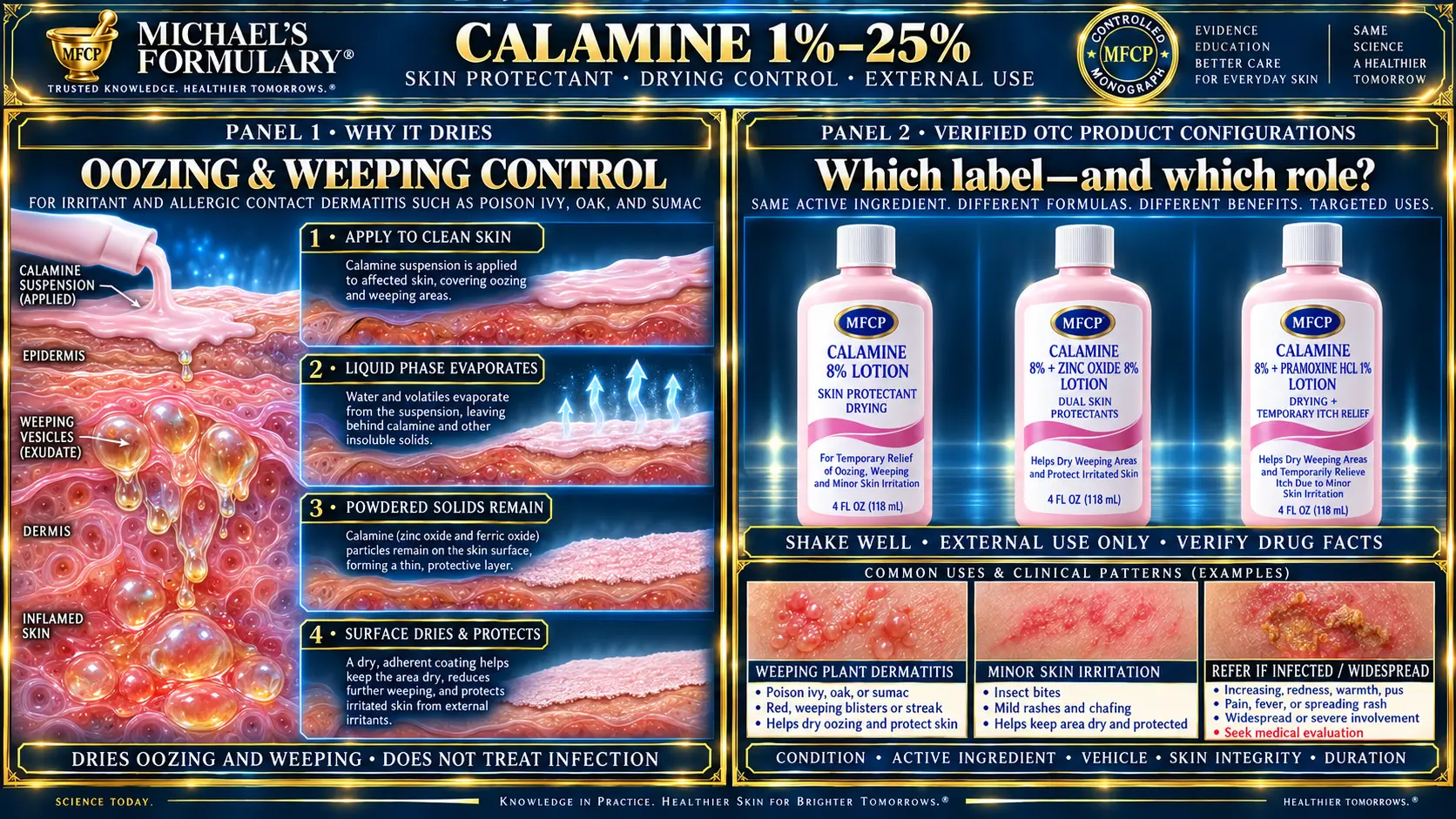
Calamine is an insoluble topical skin protectant and drying active. FDA OTC Monograph M016 permits calamine at 1%–25% and allows poison ivy, oak, and sumac drying and protectant labeling. Its strongest self-care fit is superficial oozing or weeping that is minor, localized, and consistent with the finished Drug Facts label.
02 · Active Ingredient ControlIdentity, Composition & Physical Behavior
| Attribute | MFCP controlled statement |
|---|---|
| Regulatory class | Skin protectant under current FDA OTC Monograph M016. |
| Permitted strength | Calamine 1%–25%. |
| Physical character | Insoluble particulate material commonly delivered as a pink suspension. |
| Color | Historically associated with zinc oxide colored by ferric oxide; current finished-product records and active-moiety listings vary, so Drug Facts controls. |
| Vehicle behavior | Suspended solids may settle during storage and require shaking to restore uniform distribution. |
| Combination families | Calamine may appear with zinc oxide or other labeled actives. Each combination has its own monograph and Drug Facts controls. |
03 · Monograph at a Glance™MAG™ Clinical Snapshot
04 · Surface ControlMechanism · Drying & Protective Film
Calamine acts primarily through physical surface effects. In lotion suspensions, the liquid vehicle spreads insoluble particles over affected skin. Evaporation can provide transient cooling while leaving a dry particulate film. That residual coating helps manage superficial moisture and separates irritated skin from friction and environmental contact. Strong claims of antiseptic action, tissue eschar formation, capillary constriction, or specific nerve-fiber suppression should not be inferred from the OTC label.
05 · Condition Before ProductWet, Weeping, Dry or Infected?
| Pattern | Controlled interpretation |
|---|---|
| Localized linear or streaked vesicles after plant exposure | May fit a labeled poison ivy, oak, or sumac drying/protectant product after decontamination. |
| Superficial oozing or weeping without infection signs | Calamine may help manage the surface when the exact label includes the condition. |
| Dry, cracked, lichenified, or chronically scaly skin | Calamine may overdry and increase tightness or irritation; select barrier-restoring care or obtain diagnosis. |
| Insect bite, heat rash, chickenpox, or intertrigo | Do not assume a class-wide indication. Use only if the finished product specifically labels the condition and the presentation remains appropriate for self-care. |
| Golden crust, pus, warmth, increasing pain, or red streaking | Possible infection; refer rather than coating and delaying assessment. |
| Widespread blistering, facial or genital involvement, fever, or swelling | Outside routine self-care; prompt evaluation is required. |
06 · Product-Family DisciplineVerified OTC Configurations
| Control point | MFCP rule |
|---|---|
| Suspension | Shake well when directed; settled particles can otherwise produce uneven delivery. |
| Claim | Use only for the condition and purpose stated by the finished Drug Facts label. |
| Combination | Do not transfer single-active directions to a multi-active product. |
| Appearance | A dried pink or pale residue is expected with many lotions; residue is not a measure of dose uniformity. |
07 · Label-Directed AdministrationDirections, Frequency & Duration
| Product pathway | Controlled direction |
|---|---|
| Single-active M016 drying/protectant product | Apply as needed, following the finished product’s preparation and application directions. |
| Shakeable lotion | Shake well before use when directed so settled particles are redistributed. |
| Calamine + pramoxine | Combination labels commonly direct adults and children 2 years and older to apply no more than 3–4 times daily; under 2 years, do not use and ask a doctor. |
| Calamine + zinc oxide | Follow the exact Drug Facts panel; do not import frequency or age directions from another calamine product. |
| Self-care limit | Stop and ask a doctor if worse, present beyond 7 days, or cleared and returned within a few days. |
08 · Technique ControlPrepare, Apply, Dry & Reassess
- Confirm the eruption is minor, localized, and appropriate for self-care.
- After suspected poison ivy, oak, or sumac exposure, wash exposed skin, nails, clothing, tools, and pet fur as appropriate; calamine does not neutralize absorbed urushiol.
- Read the active ingredients, strengths, Uses, Warnings, Directions, and inactive ingredients.
- Shake the closed container vigorously when directed until the suspension is uniform.
- Apply to the affected external skin with clean hands or an applicator specified by the label.
- Allow the coating to dry; avoid the eyes, mouth, inhalation, and unapproved body sites.
- Reassess the pattern and discontinue when the weeping stage resolves or the label’s stop rule is reached.
09 · Outcome ControlExpected Response & Stage Transition
| Observation | MFCP action |
|---|---|
| Surface becomes drier and less wet | Continue only as needed and within the label; do not equate drying with resolution of the inflammatory cause. |
| Temporary cooling or itch reduction | Expected with some vehicles, but relief is not proof that the diagnosis is correct. |
| Lesion becomes dry, tight, cracked, or increasingly itchy | Stop calamine and reassess whether continued desiccation is now counterproductive. |
| No meaningful improvement | Recheck diagnosis, exposure control, technique, and whether a different therapy or evaluation is needed. |
| Worsening, spread, pus, pain, fever, or facial swelling | Stop and seek clinical assessment. |
10 · Tolerability ControlAdverse Effects & Formulation Pitfalls
11 · Site & Population SafeguardsWhere Calamine Does Not Automatically Belong
| Site or population | MFCP position |
|---|---|
| Face or eyelids | High eye-exposure risk and diagnostic uncertainty; use only with product-specific professional guidance. |
| Mouth, genital mucosa, or intrarectal tissue | Do not transfer external-skin directions to mucosal use. |
| Children | Single-active M016 products do not share one universal pediatric age line; combination-product labeling controls. |
| Pregnancy or breastfeeding | Seek product-specific advice for large-area, repeated, breast-area, combination-product, or damaged-skin use. |
| Dry eczema, psoriasis, or xerosis | Drying residue may aggravate the barrier defect; favor diagnosis and barrier-restoring care. |
| Deep wound, animal bite, or serious burn | Outside labeled self-care pathways; obtain clinical assessment. |
| Immunocompromised patient | Lower threshold for evaluation of blistering, atypical, persistent, or possibly infected lesions. |
12 · Referral ThresholdsSafety, Skin Integrity & Escalation
- For external use only; do not get into the eyes.
- Stop and ask a doctor if the condition worsens, lasts more than 7 days, or clears and occurs again within a few days.
- Do not self-treat deep or puncture wounds, animal bites, or serious burns.
- Refer possible infection: pus, honey-colored crust, worsening warmth, increasing pain, red streaking, fever, or swollen lymph nodes.
- Promptly evaluate widespread, rapidly spreading, blistering, painful, raw, facial, genital, or mucosal eruptions.
- Seek emergency help for breathing or swallowing difficulty or swelling of the lips, tongue, or eyes.
- Review every active ingredient in combination lotions before use; front-label “calamine” does not describe the whole product.
13 · Shelf VerificationMFCP Buying Standard™
| Checkpoint | Verification standard |
|---|---|
| Active ingredient | Calamine, with every additional active identified separately |
| Strength | 1%–25% for M016 calamine; verify the exact percentage |
| Purpose | Skin protectant and/or poison ivy, oak, sumac drying claim as labeled |
| Vehicle | Lotion or other finished form; confirm whether shaking is required |
| Combination actives | Check zinc oxide, pramoxine, diphenhydramine, benzocaine, camphor, or other actives and apply all warnings |
| Inactive ingredients | Review alcohol, fragrance, preservatives, propylene glycol, botanicals, and personal allergies |
| Package integrity | No leaking, separated beyond redispersion, contaminated, damaged, opened, or expired product |
14 · Evidence ControlPrimary Sources & Readability Disclosure
- U.S. Food and Drug Administration: OTC Monograph M016
- U.S. Food and Drug Administration: OTC external analgesic drug monograph
- DailyMed: Calamine Lotion Drug Facts
- DailyMed: Calamine 8% / Zinc Oxide 8% Lotion Drug Facts
- DailyMed: Calamine 8% / Pramoxine HCl 1% Lotion Drug Facts
Evidence control: M016 establishes calamine’s permitted range, skin-protectant identity, drying claim, warnings, and directions. The FDA external analgesic drug standard applies when an external-analgesic active is present. Current finished-product Drug Facts labeling controls the selected combination and vehicle.
Readability disclosure: This educational monograph supports product selection and referral decisions. It does not replace the current Drug Facts label, diagnosis, or individualized care.
← Return to OTC Itch & Rash Treatments