
Bacitracin / Bacitracin Zinc
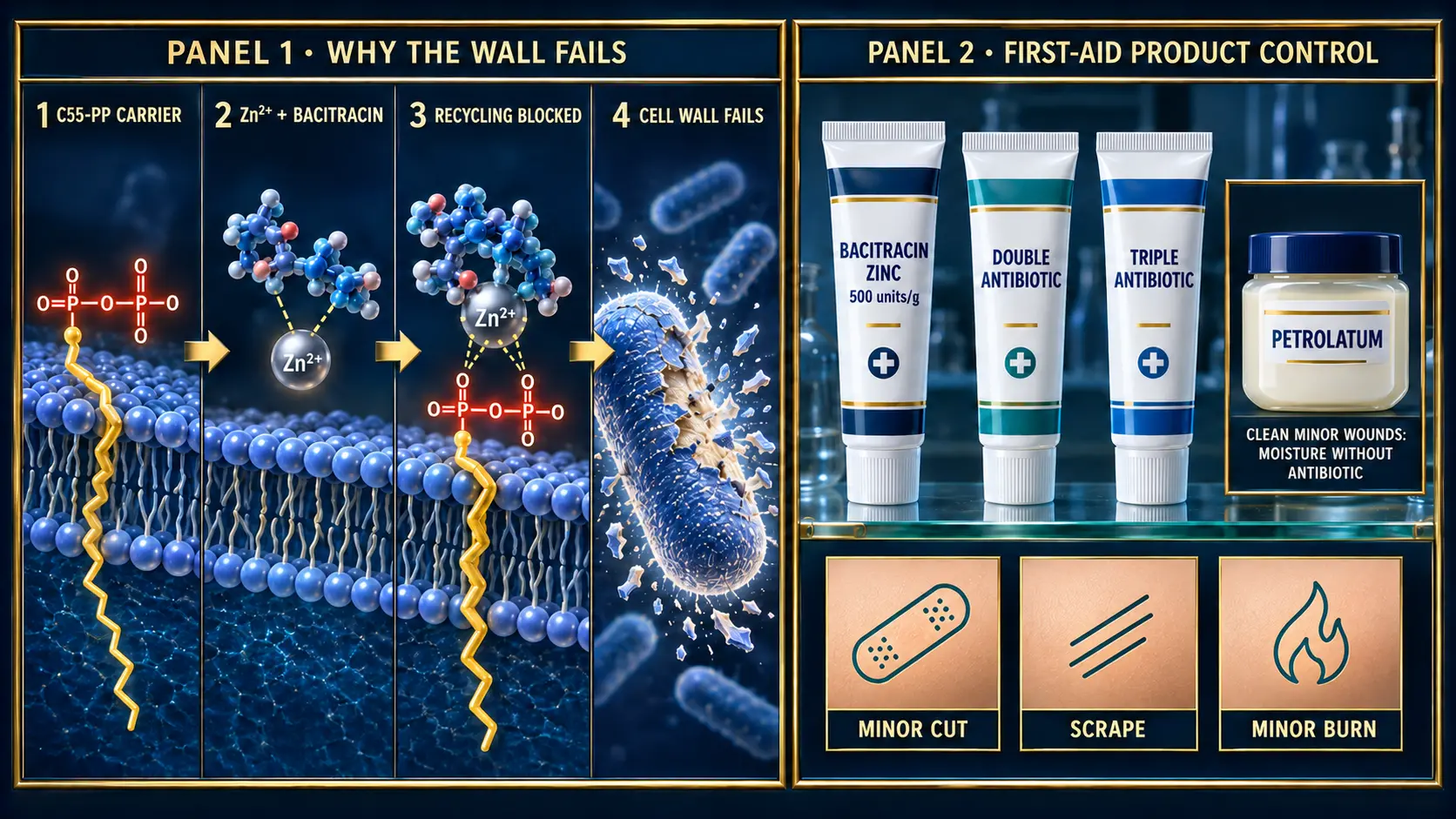
Zinc-enabled interruption of bactoprenol recycling, paired with strict first-aid product and wound-selection control.
01 · Controlled Clinical PositionPharmacist Bottom Line™
Bacitracin zinc 500 units per gram is an over-the-counter first-aid antibiotic ointment labeled to help prevent infection in minor cuts, scrapes, and burns. It is not the routine answer for every clean minor wound. Plain petrolatum is a nonantibiotic moist-wound option, and topical bacitracin can cause allergic contact dermatitis that resembles worsening infection.
02 · Molecular IdentityCyclic Peptide Complex & Zinc Activation
Bacitracin is a complex mixture of related nonribosomal cyclic peptide congeners rather than one single molecular species. Bacitracin A is a principal active component. Divalent metal binding, especially zinc coordination, stabilizes the antibiotic–target complex and supports binding to the pyrophosphate headgroup of the bacterial lipid carrier.
03 · Cell-Wall Carrier ControlMechanism of Action
- Peptidoglycan precursors are transported across the bacterial membrane by the lipid carrier undecaprenyl pyrophosphate, also called bactoprenol pyrophosphate or C55-PP.
- After precursor delivery, the carrier must be dephosphorylated and recycled for additional rounds of cell-wall assembly.
- The metal–bacitracin complex binds C55-PP and shields its pyrophosphate group, preventing normal dephosphorylation and recycling.
- Carrier depletion stalls peptidoglycan assembly, compromises cell-wall integrity, and can produce bactericidal lysis in susceptible organisms.
04 · Narrow-Spectrum PositionAntimicrobial Spectrum & Resistance
Bacitracin activity is concentrated against susceptible Gram-positive organisms. Most Gram-negative bacteria are intrinsically poorly susceptible because the outer membrane limits access. Susceptibility is variable, and laboratory activity does not expand the OTC indication beyond first aid for minor cuts, scrapes, and burns.
05 · Product & Route DisciplineFormulations and Clinical Applications
| Product family | Representative composition | Controlled role |
|---|---|---|
| Bacitracin monotherapy ointment | Bacitracin or bacitracin zinc, typically 500 units/g | First aid to help prevent infection in minor cuts, scrapes, and burns |
| Double-antibiotic ointment | Often bacitracin zinc 500 units/g plus polymyxin B sulfate 10,000 units/g | Same narrow first-aid indication; verify the exact active pair and strengths |
| Triple-antibiotic ointment | Bacitracin or bacitracin zinc plus neomycin sulfate and polymyxin B sulfate | Same narrow first-aid indication; screen every component for allergy |
| Ophthalmic bacitracin products | Sterile ophthalmic formulations | Clinician-directed ocular use; never substitute a nonsterile skin ointment |
| Plain petrolatum | Nonantibiotic occlusive wound-care product | Moist wound care for clean minor wounds when topical antibiotic therapy is unnecessary |
06 · Sensitization & Modern PracticeSafety, Allergy and the Petrolatum Alternative
07 · Evidence ControlPrimary and Authoritative Sources
- U.S. FDA OTC Monograph M004: First Aid Antibiotic Drug Products
- DailyMed: Bacitracin Zinc 500 Units/g First-Aid Antibiotic Ointment
- U.S. FDA: Withdrawal of Bacitracin for Injection
- Bacitracin A–Zinc Binding Study
- Randomized Trial: White Petrolatum Versus Bacitracin Ointment
- American Academy of Dermatology: How to Treat Minor Cuts
Readability disclosure: Mechanistic language is retained where it protects pharmacologic meaning. This educational monograph does not replace the current Drug Facts label, wound assessment, tetanus review, or individualized clinical care.
← Return to OTC Topical Antibacterials