
Povidone & Polyvinyl Alcohol Povidone 1%–2% · Polyvinyl Alcohol 1.4%
Two synthetic, nonionic polymer pathways organized by active identity, complete vehicle, package architecture, optical demands, and the controlling Drug Facts label.
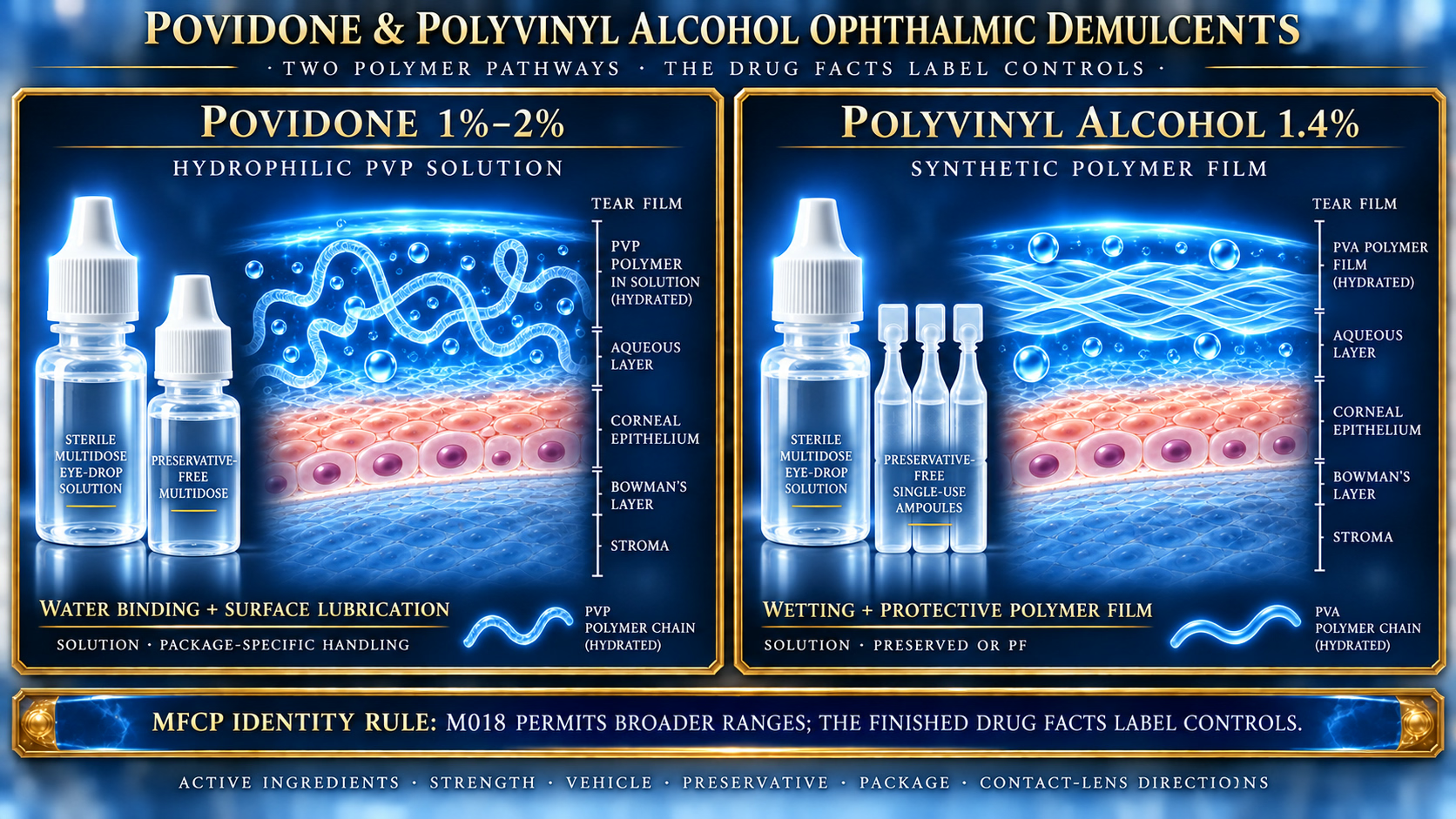
MFCP At-a-GlanceMAG™ — Clinical Identity Before Product Choice
Temporary relief of burning and irritation due to dryness; protection against further irritation.
Synthetic, water-soluble polymers used in sterile ocular lubricant solutions.
Featured 1%–2% pathway does not exclude lower compliant strengths.
Polyvinyl alcohol 1.4% is a common single-active presentation.
Clear solutions in preserved or preservative-free packages.
Reduces surface friction and supplements the aqueous tear phase.
Product-specific priming, shaking, and discard directions still control.
Preservation strategy and closure design determine handling.
Lubricant-drop identity does not automatically establish a rewetting-drop claim.
Stop and seek professional review for eye pain, vision change, persistent redness, worsening, or symptoms lasting beyond 72 hours.
M018 ControlActive Range and Combination Logic
The dual panel emphasizes the 1%–2% pathway requested for this module. Current marketed labels may use other monograph-compliant strengths, including 0.5%.
PVA 1.4% is a common single-active presentation. Combination products may use a different strength while remaining inside the broader M018 range.
M018 permits combinations of two or three listed ophthalmic demulcent actives when each ingredient remains within its established concentration.
Molecular and Vehicle MechanicsHydration, Wetting & Boundary Lubrication
Polar groups along each polymer chain interact with the aqueous vehicle and tear phase.
The finished formulation distributes a lubricating layer over the ocular surface.
A hydrated boundary film cushions blink-related contact and provides temporary relief.
Povidone is highly water soluble. Its polar pyrrolidone groups support water association and solution-phase wetting. Molecular weight, concentration, tonicity, pH, and co-ingredients determine the finished drop—not the active name alone.
PVA supplies multiple hydroxyl groups and forms a hydrated lubricating film after instillation. The grade of polymer, concentration, salts, buffer, and preservative affect spreading, comfort, clarity, and residence.
Do Not Collapse Distinct ProductsPathway and Label Comparison
| Representative pathway | Active identity | Package example | Clinical control |
|---|---|---|---|
| Povidone-only lubricant | Povidone 0.5% on a current label | Preservative-free filtered multidose bottle | Demonstrates that compliant marketed strengths may sit below the featured 1%–2% design pathway. |
| PVA single-active solution | Polyvinyl alcohol 1.4% | Preserved multidose dropper | A familiar clear-solution pathway; preservative and bottle directions remain part of the clinical decision. |
| Combination lubricant | Povidone 2% + PVA 2.7% | Product-specific preservative-free presentations | A distinct dual-active formula—not a substitute identity for either single-active pathway. |
Package and HandlingMultidose Bottles & Preservative-Free Systems
A preservative supports microbial control during repeated opening. Tip hygiene, recapping, storage, and the labeled after-opening discard period control safe use.
A specialized closure can protect a preservative-free formulation from retrograde contamination. Dispensing may be slower and require firm pressure or product-specific priming.
Single-use packaging avoids repeated-container preservation. Do not reuse; discard after opening according to the label.
Representative povidone and PVA drops are clear solutions. Do not use if a product changes color or becomes cloudy.
Preservative-free status does not automatically authorize use over lenses. Some povidone products are labeled lens-compatible; others require removal or a defined wait.
M018 demulcent directions use as-needed dosing. Shaking, priming, lens handling, storage, and discard timing remain product-specific.
Administration ArchitectureRegimen, Contact-Lens & Sequencing Controls
- Read the exact label.
Confirm active ingredients, strength, preservation system, contact-lens directions, storage, and discard date. - Protect the sterile tip.
Do not touch the bottle or vial tip to the eye, fingers, lashes, or another surface; replace the cap immediately. - Sequence active medications first.
When another ophthalmic medicine is used, follow its labeling and separate drops as directed; a practical interval is commonly used to reduce washout. - Use ointments last.
Solutions are generally instilled before gels or ointments so the thicker product does not obstruct distribution of the earlier drop. - Treat lens use as a separate claim.
Use over a contact lens only when the specific product label permits it. Otherwise remove lenses and follow the stated reinsertion interval. - Match the formulation to the problem.
Rapid-clearance polymer solutions may suit intermittent aqueous dryness; persistent evaporative or severe disease may require a different lubricant architecture and professional assessment.
M018 Warning GateStop, Refer & Prevent Contamination
New eye pain, altered vision, or marked sensitivity is not routine dry-eye self-care.
Stop and ask a doctor if the condition worsens or continues for more than 72 hours.
A shared bottle, reused single-dose vial, or contaminated tip can introduce organisms directly to the ocular surface.
Do not use a solution that has changed color, become cloudy, or passed its labeled expiration or after-opening period.
Keep out of reach of children. If swallowed, obtain medical help or contact Poison Control promptly.
Trauma, infection, inflammation, acute glaucoma, and corneal disease require a different pathway.
Controlling SourcesEvidence & Labeling
- U.S. Food and Drug Administration. OTC Monograph M018: Ophthalmic Drug Products for OTC Human Use.
- DailyMed. Polyvinyl alcohol 1.4% ophthalmic lubricant solution.
- DailyMed. Povidone 0.5% preservative-free multidose ophthalmic lubricant.
- DailyMed. Povidone 2% / polyvinyl alcohol 2.7% ophthalmic lubricant combination.