
External inflammatory itching
Short-term, label-matched use may reduce itching, redness, and inflammation on external perianal skin when infection, bleeding, and another referral cause are not suspected.
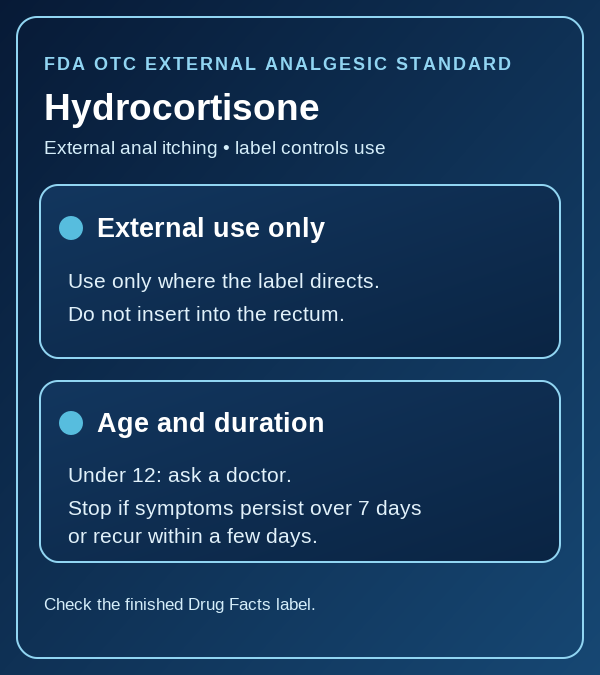

External anal-itch use only when the finished Drug Facts label permits it
Short-term, label-matched use may reduce itching, redness, and inflammation on external perianal skin when infection, bleeding, and another referral cause are not suspected.
Hydrocortisone does not reproduce phenylephrine’s α1-mediated vasoconstriction and does not treat a thrombosed or prolapsed hemorrhoid.
It does not reproduce pramoxine’s surface-anesthetic action. Relief depends on reduction of the inflammatory process rather than immediate sensory blockade.
Stop and consult if the condition worsens, persists beyond seven days, or clears and returns within a few days.
The FDA external analgesic drug standard identifies hydrocortisone and hydrocortisone acetate equivalent to hydrocortisone at 0.25%–1%. This MFCP monograph focuses on 0.5%–1% products.
Hydrocortisone is commonly categorized in the least-potent U.S. topical-corticosteroid group. Vehicle, site, occlusion, amount, and duration still change clinical exposure.
A finished product may include temporary relief of external anal itching. General eczema or dermatitis claims do not automatically convert into an internal anorectal indication.
| Drug Facts element | What it controls | MFCP rule |
|---|---|---|
| Active ingredient | Hydrocortisone or hydrocortisone acetate equivalent | Verify the exact strength and active |
| Uses | Conditions and body sites the product may treat | Do not transfer claims between packages |
| Warnings | External route, eye avoidance, recurrence, diaper rash, bleeding | All warnings remain active |
| Directions | Age, cleansing, amount, frequency, and duration | The current finished label controls |
Glucocorticoid-receptor signaling can increase transcription of anti-inflammatory proteins, including pathways involving annexin A1 and reduced phospholipase A2-dependent mediator formation.
Glucocorticoid signaling can suppress transcriptional programs involving NF-κB, AP-1, cytokines, chemokines, COX-2, and inducible nitric-oxide synthase.
Reduced redness or itching does not prove the underlying disorder is benign, noninfectious, or correctly identified.
Absorption through intact keratinized skin is limited but variable. Do not assign one universal percentage across vehicles, sites, patients, and skin conditions.
Inflammation, excoriation, larger treated area, frequent application, prolonged use, and occlusion can increase local penetration and systemic exposure.
OTC external-anal-itch directions do not authorize rectal insertion. Mucosal exposure and prescription rectal formulations require separate product-specific evaluation.
| Exposure factor | Why it matters | Controlled response |
|---|---|---|
| Raw, eroded, or bleeding tissue | Barrier integrity and diagnosis are uncertain | Stop self-treatment and obtain assessment |
| Tight covering or heavy occlusion | Hydration and contact time may increase penetration | Avoid unless the label or clinician directs it |
| Repeated or prolonged courses | Raises risk of atrophy, infection masking, and systemic effects | Do not continue beyond the self-care window |
| Pediatric use | Body-surface-area differences increase exposure concern | Children under 12 with external anal itching: consult a doctor |
| Form | General vehicle tendency | Selection control |
|---|---|---|
| 0.5%–1% cream | Emulsion that is usually easier to spread and wash away | Preservatives, alcohols, fragrances, and other excipients vary; verify allergies and the exact label |
| 1% ointment | More occlusive hydrocarbon-rich vehicle in many products | Occlusion can increase penetration; never assume preservative-free or appropriate for macerated, raw, or infected tissue |
| Combination product | May add an anesthetic, protectant, or another active under a separate approved or prescription pathway | Do not create an unapproved combination by layering products; read every active and follow the strictest direction |
When practical, cleanse with mild soap and warm water and rinse, or use an appropriate cleansing pad as the finished label directs.
Use tissue or a soft cloth without vigorous rubbing. Aggressive wiping can perpetuate the itch–scratch–injury cycle.
Adults should apply only the labeled amount to the external affected area. More product does not authorize more frequent use.
Do not place the product into the rectum with fingers, a mechanical device, or an applicator.
External-anal-itch labeling requires professional guidance for children younger than 12 years.
Stop earlier for bleeding, worsening, recurrence, irritation, infection signs, or severe pain.
Prolonged, excessive, or occluded corticosteroid exposure can impair dermal support and contribute to atrophy, fissuring, purpura, or telangiectasia.
Candidal or dermatophyte infection may itch less while infection persists or becomes morphologically altered. Avoid corticosteroid monotherapy when infection is suspected.
Pus, crust, warmth, vesicles, ulcers, warts, spreading redness, or systemic symptoms require evaluation rather than repeated steroid use.
Fragrance, preservatives, wipes, soaps, adhesives, and other ingredients can provoke or perpetuate perianal dermatitis.
Clinically important HPA-axis suppression is unusual with brief, label-directed low-potency use, but risk rises with excessive area, duration, damage, occlusion, or pediatric exposure.
Recurrent or diminishing benefit should trigger diagnostic reassessment—not thicker application, greater frequency, or serial hydrocortisone products.
| Finding | Why it matters | Controlled action |
|---|---|---|
| Any rectal bleeding | External irritation cannot be assumed to explain the source | Consult a doctor promptly |
| Dark or tarry stool, heavy bleeding, weakness, faintness, or shortness of breath | Possible significant gastrointestinal bleeding | Urgent or emergency evaluation |
| Sharp defecation pain, persistent fissure-like symptoms, or prolapse | May require diagnosis and condition-specific treatment | Clinical evaluation; do not rely on steroid relief |
| Tender fluctuance, induration, fever, drainage, or throbbing pain | Possible perianal abscess or spreading infection | Urgent assessment |
| Worsening, no improvement by 7 days, or rapid recurrence | Diagnosis, treatment, or exposure may be wrong | Stop use and consult |
| New atrophy, fissuring, purpura, irritation, or expanding rash | Adverse effect, contact reaction, or masked infection is possible | Discontinue and obtain evaluation |
Hydrocortisone active range, external-anal-itch claim, warnings, age controls, frequency ceiling, and external route boundary.
External anal itching, no rectal insertion, no more than 3–4 daily applications, under-12 control, bleeding warning, and seven-day boundary.
External anal-itch labeling, route restriction, dosing, bleeding warning, recurrence control, and inactive-ingredient review.
Links already cited on this page.