
1,250 mg compound = 500 mg elemental calcium
This is representative chemistry. For a supplement, the declared elemental calcium on Supplement Facts controls the dose.

One compound · two OTC roles · one elemental-calcium control
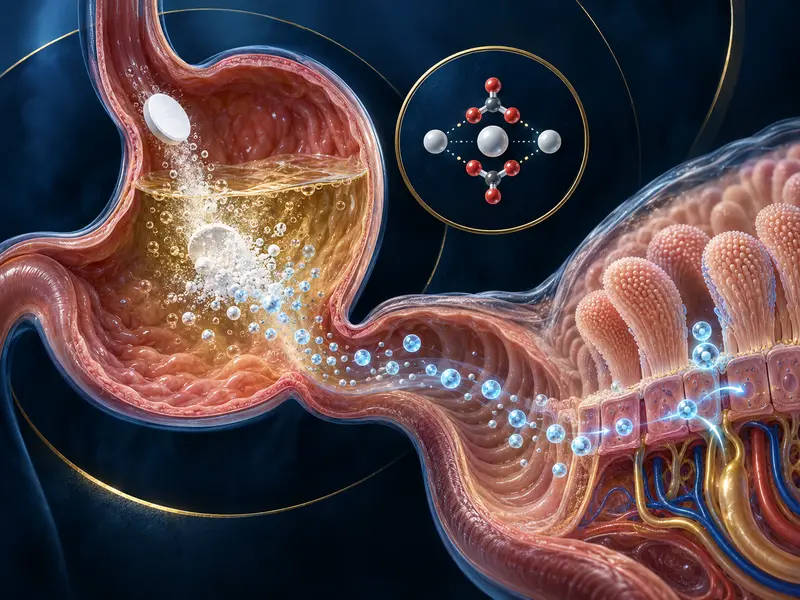
Calcium carbonate is 40% elemental calcium by weight. Gastric acid helps dissolve the salt; calcium is then absorbed through active and passive intestinal pathways. Food, vitamin D status, dose size, age, and gastrointestinal physiology all affect the result.
This is representative chemistry. For a supplement, the declared elemental calcium on Supplement Facts controls the dose.
Smaller divided doses, use with meals, or a different calcium salt may improve tolerability.
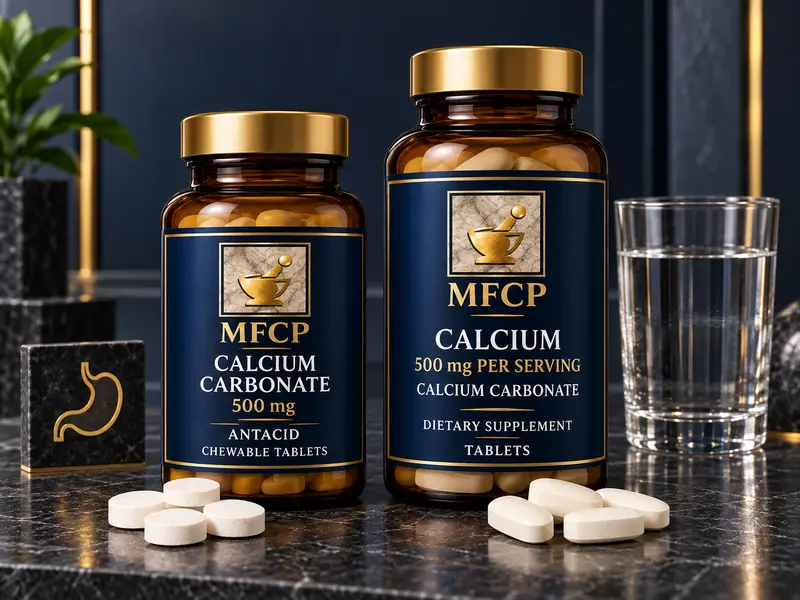
A chewable antacid neutralizes gastric acid locally. A calcium supplement contributes elemental calcium to total dietary intake. Similar-looking calcium carbonate products can answer different questions and must never exchange directions.
Verify calcium carbonate per chewable unit, indication, age limits, maximum daily use, duration, interactions, and warnings on that exact package.
Verify elemental calcium per serving, units per serving, vitamin D and other ingredients, then count food, multivitamins, and other calcium products.
When a supplemental dose exceeds 500 mg elemental calcium, divided administration generally improves fractional absorption.
Older age, atrophic gastritis, bariatric anatomy, and acid-suppressing therapy can change formulation fit; calcium citrate is less acid-dependent.
Calcium can reduce absorption of levothyroxine, bisphosphonates, tetracyclines, fluoroquinolones, and iron. Follow the interacting medicine’s exact instructions.
Total diet, vitamin D, exercise, age, endocrine status, fall risk, medicines, and diagnosis determine the complete plan.
Calcium carbonate can neutralize gastric acid locally or supply calcium for absorption. The selected label lane determines which job is intended.
Drug Facts commonly states calcium carbonate per antacid unit. Supplement Facts declares elemental calcium per serving. Read the correct panel before counting exposure.
Heartburn, low dietary intake, osteoporosis, hypocalcemia, kidney disease, and recurrent stones are different clinical questions and cannot share one protocol.
Chewables, tablets, soft chews, powders, and combination products vary in strength, serving size, ingredients, warnings, and intended duration.
★ BOTTOM LINE: identify the regulatory panel, intended purpose, elemental amount, total daily exposure, and duration before interpreting calcium carbonate.
Pure calcium carbonate is about 40% calcium by mass, so 1,250 mg CaCO3 contains 500 mg calcium. The marketed supplement’s declared elemental amount remains controlling.
Carbonate solubility is lower when gastric acid is low. Supplements are generally best taken with food; calcium citrate is less acid-dependent.
| Checkpoint | What it establishes | What it does not establish |
|---|---|---|
| Compound name | The calcium salt: calcium carbonate | The intended clinical use or directions |
| Elemental amount | Calcium delivered per serving or unit | Absorption, adequacy, or treatment success |
| Meal relationship | Better carbonate dissolution and typical absorption fit | A guarantee of tolerance or effectiveness |
| Vitamin D status | A determinant of active intestinal calcium transport | That every calcium product requires added vitamin D |
Translation rule: calcium chemistry explains the compound; patient physiology, total intake, product labeling, and the clinical question determine the plan.
| Product family | Required label | What must be verified | MFCP control |
|---|---|---|---|
| Chewable antacid | Drug Facts | Active ingredient per unit, indication, directions, age limits, maximum use, warnings | Chew completely and follow that exact product; do not invent a universal tablet count |
| Calcium supplement | Supplement Facts | Elemental calcium per serving, serving size, salt form, vitamin D, other ingredients | Count diet, multivitamins, calcium combinations, and antacid-derived calcium |
| Calcium + vitamin D | Supplement Facts | Both nutrient amounts, units, serving size, duplication | Each constituent has its own intake and safety question |
| Multi-mineral product | Supplement Facts | Calcium, magnesium, zinc, iron, serving size, medicine-spacing implications | The blend name never replaces constituent-level review |
| Prescription phosphate binder | Prescription labeling | Renal indication, meal timing, laboratory monitoring, clinician dose | Not an OTC self-care extension of an antacid or supplement |
| Clinical Factor | Regular Chewable Tablets | Ultra-Strength Tablets | Soft Chews & Liquids |
|---|---|---|---|
| Active Drug | 500 mg to 750 mg CaCO3 | 1,000 mg CaCO3 | 1,177 mg to 1,250 mg CaCO3 |
| Pure Calcium Yield | 200 mg to 300 mg elemental Ca | 400 mg elemental Ca | 470 mg to 500 mg elemental Ca |
| How to Take | Chew completely, then drink water | Chew completely, then drink water | Chew thoroughly or shake liquid hard |
| Typical Dose | 2 to 4 tablets as symptoms hit | 1 to 2 tablets as symptoms hit | 1 to 2 chews (or 10 mL) as symptoms hit |
| Daily Ceiling | Max 7,500 mg/day (≤ 3,000 mg Ca) | Max 7 to 8 tablets per 24 hours | Strict adherence to elemental cap |
| Pregnancy Limit | Capped at 5,000 mg/day (≤ 2,000 mg Ca) | Capped at 5,000 mg/day (≤ 2,000 mg Ca) | Capped at 5,000 mg/day (≤ 2,000 mg Ca) |
Product-specific control: strengths, tablet counts, daily maximums, and pregnancy limits vary by formulation. The current Drug Facts label on the exact product controls.
Record elemental calcium per serving and the number of tablets, chews, or scoops required. Front-panel compound weight cannot substitute for this step.
Vitamin D, magnesium, zinc, iron, antacid ingredients, sodium, sweeteners, and allergens can create separate dose, interaction, or tolerability questions.
Do not exchange lanes: antacid Drug Facts directions are not supplement directions, and a supplement serving is not a heartburn-treatment protocol.
| Clinical question | Evidence position | Controlled interpretation |
|---|---|---|
| Occasional acid indigestion or heartburn | Calcium carbonate neutralizes gastric acid and is an established OTC antacid active ingredient | Short-term symptom relief only; persistent, recurrent, nocturnal, or alarm symptoms require evaluation |
| Dietary calcium gap | Supplements can increase total calcium intake when food and fortified foods are insufficient | Estimate intake first; add only the amount needed for the identified gap |
| Bone health and osteoporosis | Calcium is necessary for bone health, but trial findings for fracture prevention are mixed | Do not present calcium carbonate alone as osteoporosis treatment or a universal fracture-prevention plan |
| Hypocalcemia | Low serum calcium has multiple causes including vitamin D, magnesium, parathyroid, illness, and medicines | Diagnosis and treatment are clinician-directed; a retail bottle cannot identify the cause |
| Kidney stones | Dietary and supplemental calcium are not interchangeable exposures; evidence on supplemental calcium risk is mixed | Stone history, timing with meals, urine findings, diet, and total dose require individualized review |
| Hyperphosphatemia in kidney disease | Calcium-based binders may be used in selected patients | Prescription/clinician-directed use with laboratory monitoring—not OTC self-treatment |
Evidence cannot be transferred: antacid efficacy does not prove nutritional adequacy; elemental-calcium content does not diagnose deficiency; and a bone-health rationale does not establish fracture prevention for every person.
Use Drug Facts for antacid units and duration. Use Supplement Facts plus a defined dietary goal for nutritional intake.
Fractional absorption is highest at 500 mg elemental calcium or less per dose. Larger daily amounts are generally divided.
A meal supports acid-dependent dissolution and can improve absorption. The exact antacid product’s directions still govern symptom use.
Add food, fortified beverages, multivitamins, calcium supplements, combination products, and frequent calcium-containing antacid use.
| Label feature | What changes | Question to answer |
|---|---|---|
| Chewable or soft chew | Unit strength, excipients, and chew instructions | How many milligrams per unit and what is the labeled maximum? |
| Serving of two or more tablets | Actual daily unit burden | Is the elemental amount stated per unit or per serving? |
| Calcium plus vitamin D | Two separate exposures | What are both amounts, and what other products duplicate them? |
| Interacting medicine | Absorption or calcium balance | What does that medicine’s current label require for spacing or monitoring? |
Arithmetic control: dose decisions use labeled elemental calcium and total exposure—not “calcium carbonate 1,250 mg” copied from another product.
Carbonate can be less tolerable than citrate, particularly when stomach acid is low. Smaller divided doses or another form may help.
High calcium plus absorbable alkali can cause nausea, vomiting, weakness, confusion, kidney injury, and rhythm disturbances.
Kidney disease, dehydration, recurrent stones, and clinician-directed binders change both benefit and risk.
Calcium can alter absorption of levothyroxine, quinolones, tetracyclines, dolutegravir, bisphosphonates, and iron; lithium and thiazides can change calcium risk.
| Situation | Why it matters | Controlled action |
|---|---|---|
| Persistent or frequent heartburn | May signal reflux disease, ulcer, medicine injury, or another cause | Stop serial self-treatment and seek evaluation |
| Trouble/pain swallowing, bleeding, weight loss | Alarm symptoms are not an antacid-selection problem | Prompt professional assessment |
| Vomiting, confusion, marked weakness, irregular heartbeat | Possible severe electrolyte or systemic toxicity | Urgent medical assessment |
| Kidney disease, recurrent stones, high-dose duplicates | Clearance and cumulative exposure can change sharply | Pharmacist or clinician review before continued use |
Emergency boundary: chest pressure, black or bloody stool, vomiting blood, collapse, severe confusion, seizure, or a dangerous rhythm requires urgent care—not another antacid or supplement dose.
Carbonate may dissolve less efficiently and cause more gastrointestinal effects. Review meals, acid suppression, constipation, total intake, and alternatives.
Count prenatal products, food, antacids, and supplements together. Persistent reflux or high-dose calcium plans deserve obstetric review.
Adult antacid directions and adult supplement servings do not transfer to children. Keep chewables secured and distinguish them from candy.
Calcium, phosphorus, vitamin D therapy, binders, stones, and laboratory results must be integrated by the renal care team.
Procedure type, gastric acidity, vitamin D status, diet, and clinician protocol determine whether carbonate is an appropriate form.
Fortified beverages and foods can contribute substantially; verify the label because fortification amounts and bioavailability vary.
Calcium adequacy matters, but vitamin D, protein, exercise, fall risk, medicines, bone density, and osteoporosis therapy remain separate controls.
Use the current prescription label or pharmacist plan for levothyroxine, antibiotics, dolutegravir, bisphosphonates, iron, lithium, and thiazides.
Professional control: age, renal function, gastrointestinal anatomy, pregnancy status, medicines, diagnosis, and total dietary intake can change the correct product—or eliminate self-care.
Confirm whether the product is an antacid medicine, a calcium supplement, or a combination. The regulatory panel defines the lane.
Capture serving size, units per serving, salt form, and every additional source. Do not dose from compound weight alone.
Review meal timing, gastric acidity, swallowing, constipation, bariatric anatomy, and whether citrate is a better fit.
Occasional antacid use, dietary gap filling, and clinician-directed treatment are separate decisions with separate endpoints.
| Source | Controls used in this monograph | Open source |
|---|---|---|
| NIH Office of Dietary Supplements · Calcium | Composition, absorption, food effect, elemental dose, intake targets, adverse effects, excess, interactions, evidence boundaries | NIH professional fact sheet ↗ |
| DailyMed · Calcium carbonate antacid labels | Product-specific active strength, indication, directions, age limits, warnings, duration, inactive ingredients | Search current labels ↗ |
| FDA · Nutrition and Supplement Facts | Elemental calcium declaration, Daily Value context, serving-size and labeling framework | FDA label resources ↗ |
| MFCP development dossier | Item 36 dual-lane architecture, wording control, arithmetic checks, evidence transfer boundaries | Controlled internal source |
Brand-name rule: formulations change. Re-read the exact package every time; never assign an ingredient, strength, serving, warning, or direction from color, shape, product-family name, or a prior purchase.
Readability control: patient-facing decisions use plain language and short scanning units. Chemical, regulatory, renal, and evidence terms remain only where precision requires them.
The antacid label may emphasize calcium carbonate strength; the supplement panel declares elemental calcium. Do not transfer the front-panel number between products.
Indication, directions, daily ceiling, age limits, and duration come from the exact regulatory panel for the selected clinical purpose.
Kidney disease, hypercalcemia, stone history, dehydration, thiazides, and duplicate calcium or alkali exposure require individualized review.
Links already cited on this page.