
Adapalene Gel 0.1%
Once-daily OTC topical retinoid for full-field acne treatment, follicular normalization, and prevention of new microcomedones.
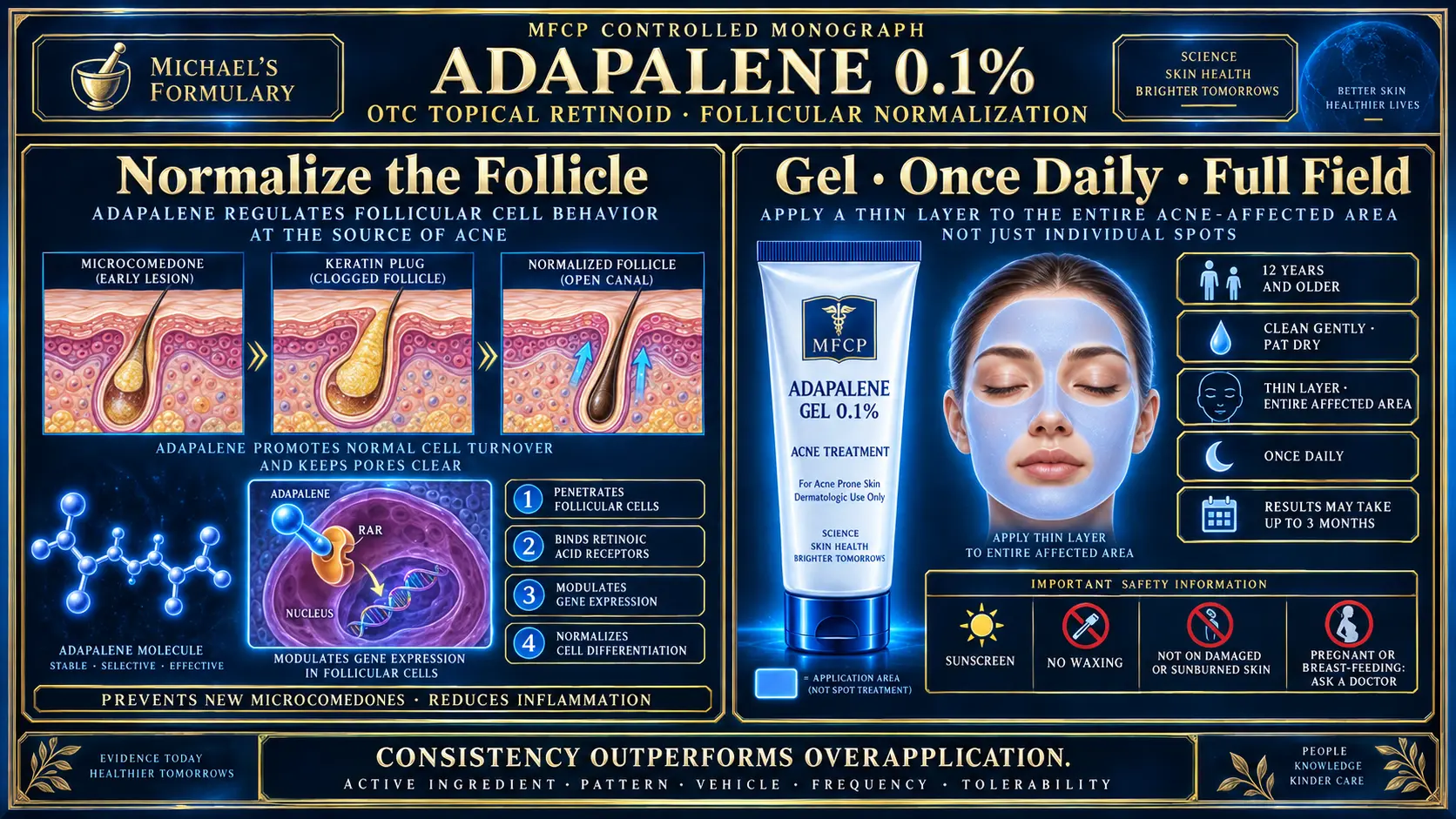
01 · Controlled Clinical PositionPharmacist Bottom Line™
OTC adapalene gel 0.1% is a once-daily topical retinoid for adults and children 12 years and older. It is best positioned as consistent field therapy for comedonal or mixed mild-to-moderate acne, with deliberate initiation, gentle cleansing, moisturization when needed, sun protection, and a three-month response checkpoint.
02 · Active Ingredient ControlIdentity, Chemistry & Regulatory Position
| Attribute | MFCP controlled statement |
|---|---|
| Established name | Adapalene |
| Chemical name | 6-[3-(1-adamantyl)-4-methoxyphenyl]-2-naphthoic acid |
| Molecular formula | C28H28O3 |
| Molecular weight | 412.52 |
| Drug class | Synthetic naphthoic-acid derivative with retinoid activity |
| OTC product controlled here | Adapalene gel 0.1% |
| Regulatory pathway | FDA-approved OTC labeling through an application pathway; adapalene is not an M006 monograph active. |
03 · Monograph at a Glance™MAG™ Clinical Snapshot
04 · Follicular NormalizationMechanism · Nuclear Retinoid Signaling
Adapalene enters follicular epithelial cells and binds specific nuclear retinoic-acid receptors. The resulting transcriptional effects modulate cellular differentiation, keratinization, and inflammatory processes involved in acne. Normalized follicular epithelial differentiation reduces microcomedone formation and helps prevent new blocked follicles.
05 · Pattern Before ProductConfirm an Acne Pattern
| Pattern | Controlled interpretation |
|---|---|
| Blackheads and whiteheads | Strong fit for follicular-normalization therapy when age, skin condition, and label directions fit. |
| Mild inflammatory papules with comedones | May fit as field therapy; reassess whether an additional acne active is needed only after tolerability is established. |
| Monomorphic itchy follicular bumps | Consider folliculitis or a yeast-associated eruption rather than assuming ordinary acne. |
| Perioral, rosacea-like, or eczematous eruption | Do not route automatically to adapalene; diagnosis and barrier condition matter. |
| Deep nodules, cysts, draining lesions, or scarring | Outside routine OTC self-care; refer for professional acne assessment. |
06 · Dosage-Form DisciplineOTC Gel 0.1%
| Product feature | Formulation behavior | Selection control |
|---|---|---|
| Gel 0.1% | Aqueous polymer gel spreads in a thin film over the acne-affected field. | This monograph controls OTC adapalene gel 0.1%; do not transfer its OTC status to another adapalene strength or dosage form. |
| Inactive ingredients | Finished gels vary by manufacturer and may contain humectants, preservatives, chelators, or surfactants. | Check allergies, sensitivities, and the exact package label. |
| Package size | Tubes and pumps may vary. | Package format does not change once-daily frequency or the full-field application rule. |
07 · Label-Directed AdministrationOTC Directions & Response Window
| Control point | Direction |
|---|---|
| Adults and children ≥12 years | Use once daily. |
| Children under 12 years | Ask a doctor. |
| Preparation | Clean the skin gently and pat dry. |
| Coverage | Cover the entire affected area with a thin layer. |
| Maximum frequency | Do not use more than once daily; more does not provide faster or better results. |
| Assessment | It may take up to 3 months of once-daily use to see results. Ask a doctor if there is no improvement after 3 months. |
08 · Technique ControlApply Across the Acne-Affected Field
- Confirm the acne distribution and ensure the skin is not cut, abraded, eczematous, or sunburned.
- Clean gently and pat dry; avoid abrasive scrubbing.
- Apply a thin layer to the entire acne-affected area, avoiding the eyes, lips, and mouth.
- Wash hands after application.
- Use moisturizer and sunscreen when appropriate; avoid waxing treated areas.
- Do not add another irritating acne medication until the adapalene regimen is tolerable and the combination has been deliberately reviewed.
09 · Outcome ControlExpected Response & Reassessment
| Observation | MFCP action |
|---|---|
| Early dryness, redness, itching, or burning | These effects are more likely during early weeks and often lessen; simplify the regimen and obtain advice if irritation is severe. |
| Acne appears worse early | The label notes temporary early worsening may occur. Continue as directed unless severe irritation or an allergic reaction develops. |
| Progressive improvement | Continue consistent once-daily use; do not increase amount or frequency. |
| No improvement after 3 months | Stop self-directed escalation and ask a doctor. |
| New scarring, deep pain, nodules, or cysts | Refer without waiting for the full OTC response window. |
10 · Tolerability ControlAdverse Effects & Irritation
11 · Population SafeguardsAge, Pregnancy, Breast-Feeding & Skin Condition
| Population or condition | MFCP position |
|---|---|
| Children under 12 years | Ask a doctor before use. |
| Pregnancy or planning pregnancy | Ask a doctor before use. Stop and ask a doctor if pregnancy occurs or is planned during treatment. |
| Breast-feeding | Ask a doctor before use; obtain site-specific guidance and avoid infant contact with treated skin. |
| Eczema, abrasions, cuts, or sunburn | Do not apply to damaged or inflamed skin identified in the Drug Facts warning. |
| High sun exposure | Limit exposure, avoid tanning beds, and use sunscreen and protective clothing. |
| Highly reactive skin or complex regimen | Introduce deliberately and review concurrent exfoliants, astringents, alcohol-rich products, and other acne medicines. |
12 · Referral ThresholdsSafety, Warnings & Escalation
- External use only; avoid contact with eyes, lips, and mouth. Flush with water after accidental contact.
- Do not apply to cuts, abrasions, eczema, or sunburn.
- Limit sun exposure, avoid tanning beds, and use sunscreen outdoors.
- Do not wax skin treated with adapalene.
- Stop and ask a doctor for severe irritation, pregnancy or planned pregnancy, an allergic reaction, or no improvement after three months.
- Refer deep nodules, cysts, draining lesions, active scarring, significant pain, diagnostic uncertainty, or severe psychosocial impact.
- Seek emergency help for shortness of breath or swelling of the lips, eyelids, tongue, or throat.
13 · Shelf VerificationMFCP Buying Standard™
| Checkpoint | Verification standard |
|---|---|
| Active ingredient | Adapalene |
| Strength | 0.1% |
| OTC dosage form | Topical gel |
| Purpose | Acne treatment |
| Age and directions | 12 years and older; once daily; thin layer across the entire affected area |
| Warnings | Pregnancy, breast-feeding, sun exposure, waxing, damaged skin, irritation, eyes/lips/mouth, and three-month stop rule |
| Package integrity | No damaged, opened, contaminated, frozen, or expired product |
14 · Evidence ControlPrimary Sources & Readability Disclosure
- DailyMed: Adapalene Gel USP 0.1% OTC Drug Facts
- DailyMed: Adapalene 0.1% Clinical Pharmacology and Mechanism
- U.S. Food and Drug Administration: Adapalene Gel 0.1% Labeling
Evidence control: The current OTC Drug Facts label controls age, use, frequency, application, warnings, and stop rules. The FDA-approved prescription labeling supports chemical identity and mechanism. The selected finished product label controls its inactive ingredients, package, storage, and manufacturer-specific instructions.
Readability disclosure: This educational monograph supports product selection and referral decisions. It does not replace diagnosis, the current Drug Facts label, or individualized clinical care.
← Return to Acne & Keratolytic Therapy