
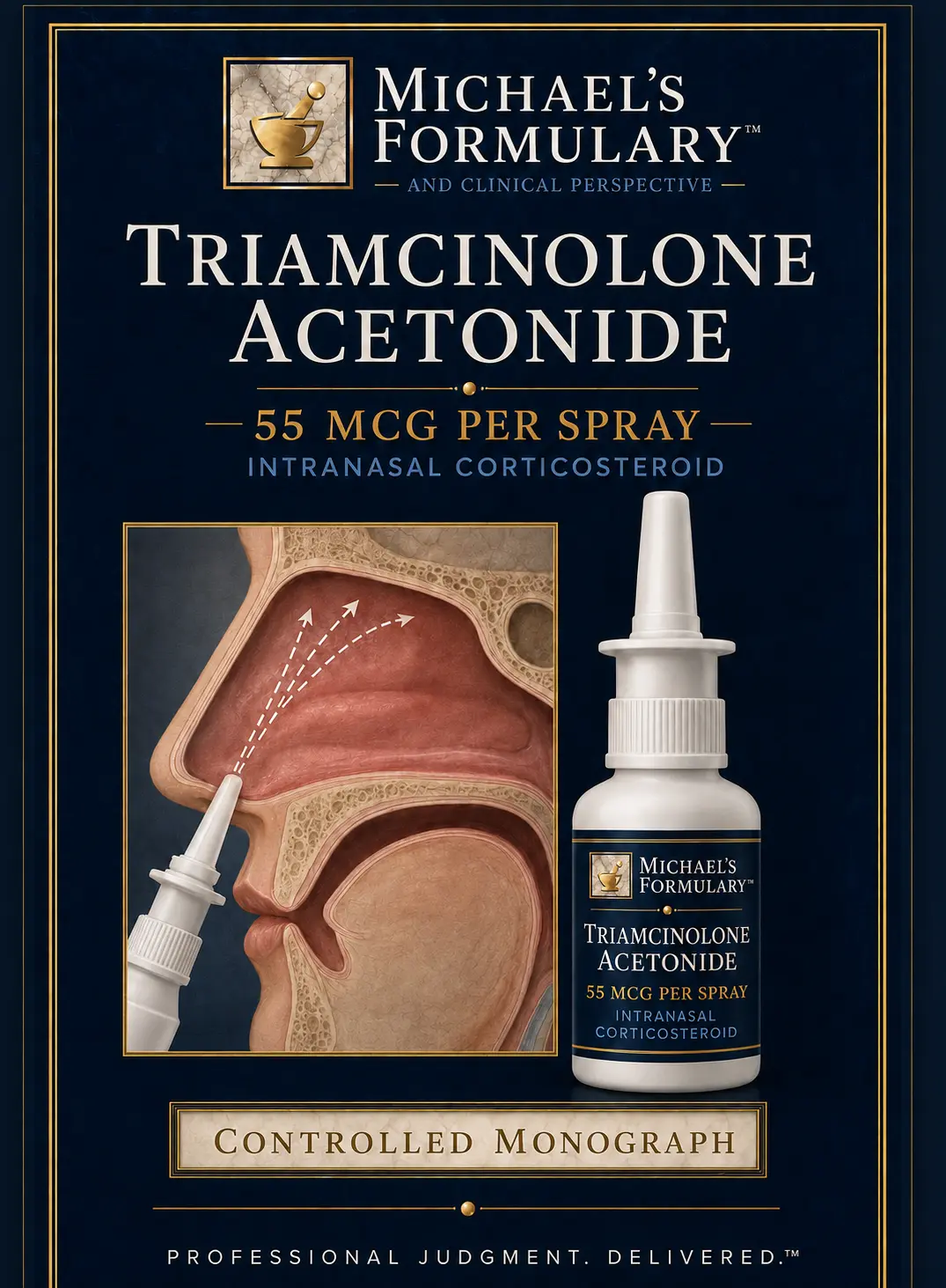
Intranasal corticosteroid · Controlled monograph
Triamcinolone Acetonide 55 MCG PER SPRAY · NASACORT® ALLERGY 24HR
Daily local anti-inflammatory control for nasal allergy symptoms.

Part of the guide: Top 20 OTC Medicines for Ear and Balance Self-Care →
 02
Contents
Scent-free daily allergy control. Correct aim. Consistent use.
Triamcinolone acetonide 55 mcg per spray reduces nasal allergy swelling. It is not an instant decongestant. Some symptoms may improve on the first day. Maximum relief may require up to one week of daily use.

Best fit
Seasonal or year-round stuffy nose, runny nose, sneezing, and nasal itching.
Key skill
Use the opposite hand and aim outward, away from the septum.

Hard stop
Do not use under age 2. Ask before use after recent nasal surgery or an injury that has not healed.
 03
MAG™ · Monograph at a Glance™
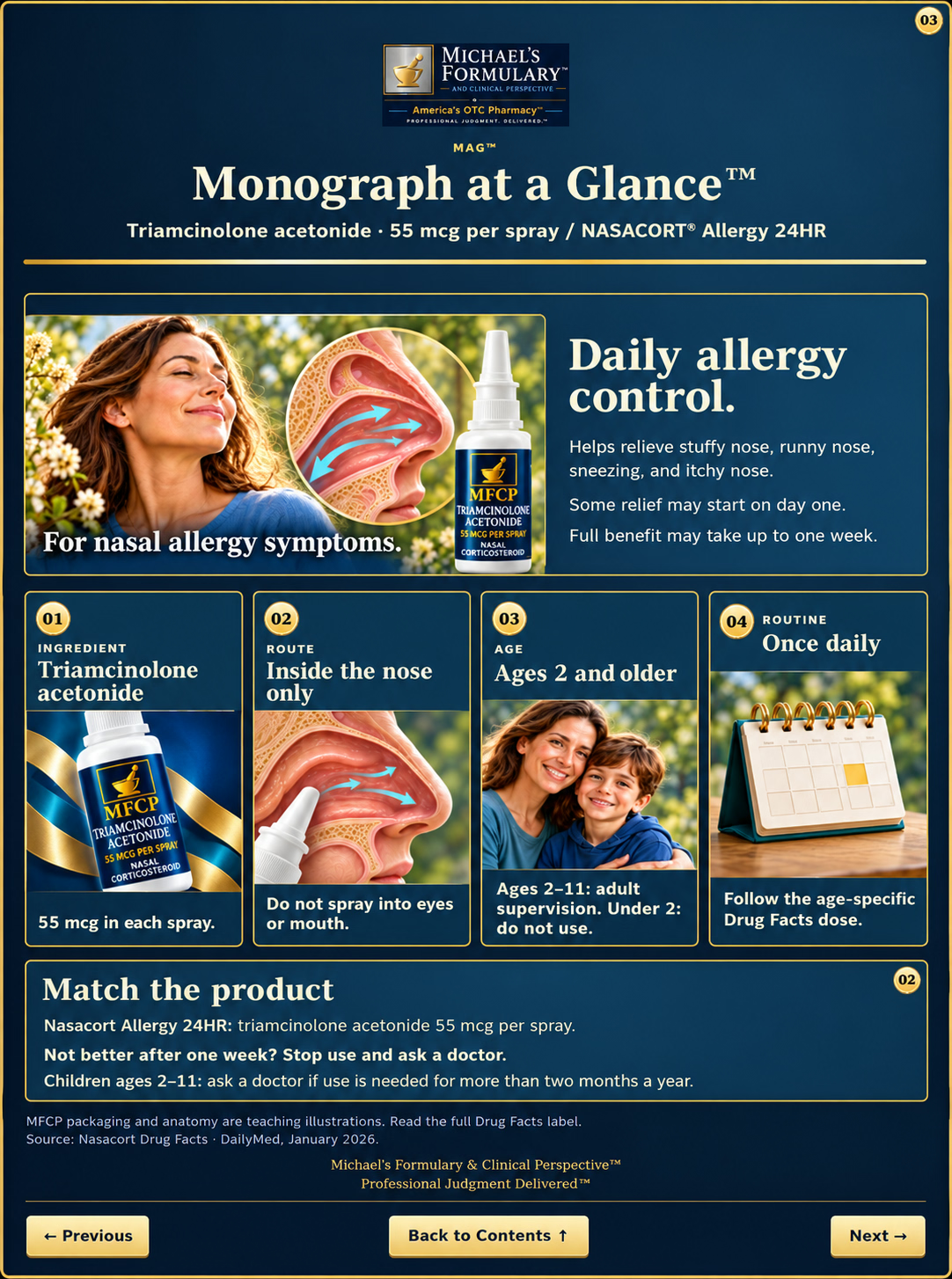

Triamcinolone Acetonide
55 mcg per spray · intranasal corticosteroid

Identity control
55 mcg per sprayNasacort Allergy 24HR, Children’s Nasacort, and properly matched equivalents.
Expected response
First day → up to one weekSome relief may begin on day one; maximum relief may require one week.
BUYING CONTROL: Match the full ingredient name, 55 mcg strength, intranasal route, age statement, and current Drug Facts label.
Where It Fits
04Therapeutic Domain Indicator™
TRIAMCINOLONE ACETONIDE
THERAPEUTIC DOMAIN INDICATOR™MFCP navigation groups the nasal-allergy indication. Domain ranking is an editorial organization, not an FDA designation.
CONTROLLED DOMAIN ASSIGNMENT
05Drug Identity and Chemistry
C₂₄H₃₁FO₆
Average molecular mass: 434.504 g/mol (434.50 rounded).
Fluorinated glucocorticoid with a cyclic acetal. This identity panel makes no claim to validate a rendered molecular model.
Generic name
Triamcinolone acetonide.
Brands
Nasacort Allergy 24HR, Children’s Nasacort, and generics.
Class
Fluorinated synthetic intranasal glucocorticoid; C-16/17 cyclic acetal.
Formula
C₂₄H₃₁FO₆.
Molecular mass
434.50 g/mol.
Systemic exposure
Systemic absorption is low after recommended intranasal dosing, but systemic corticosteroid effects remain possible with excessive or prolonged exposure.
 06
How It Works
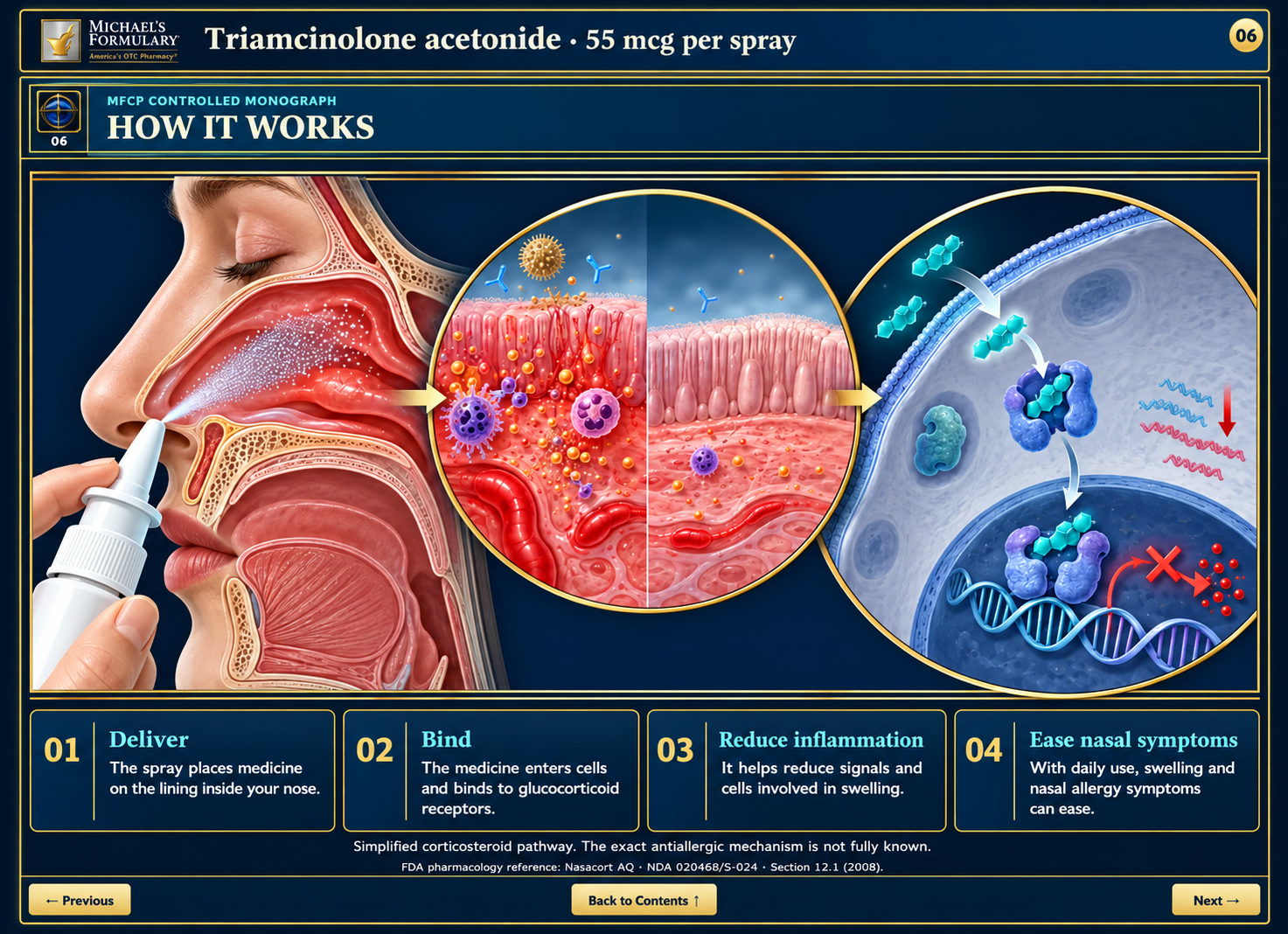
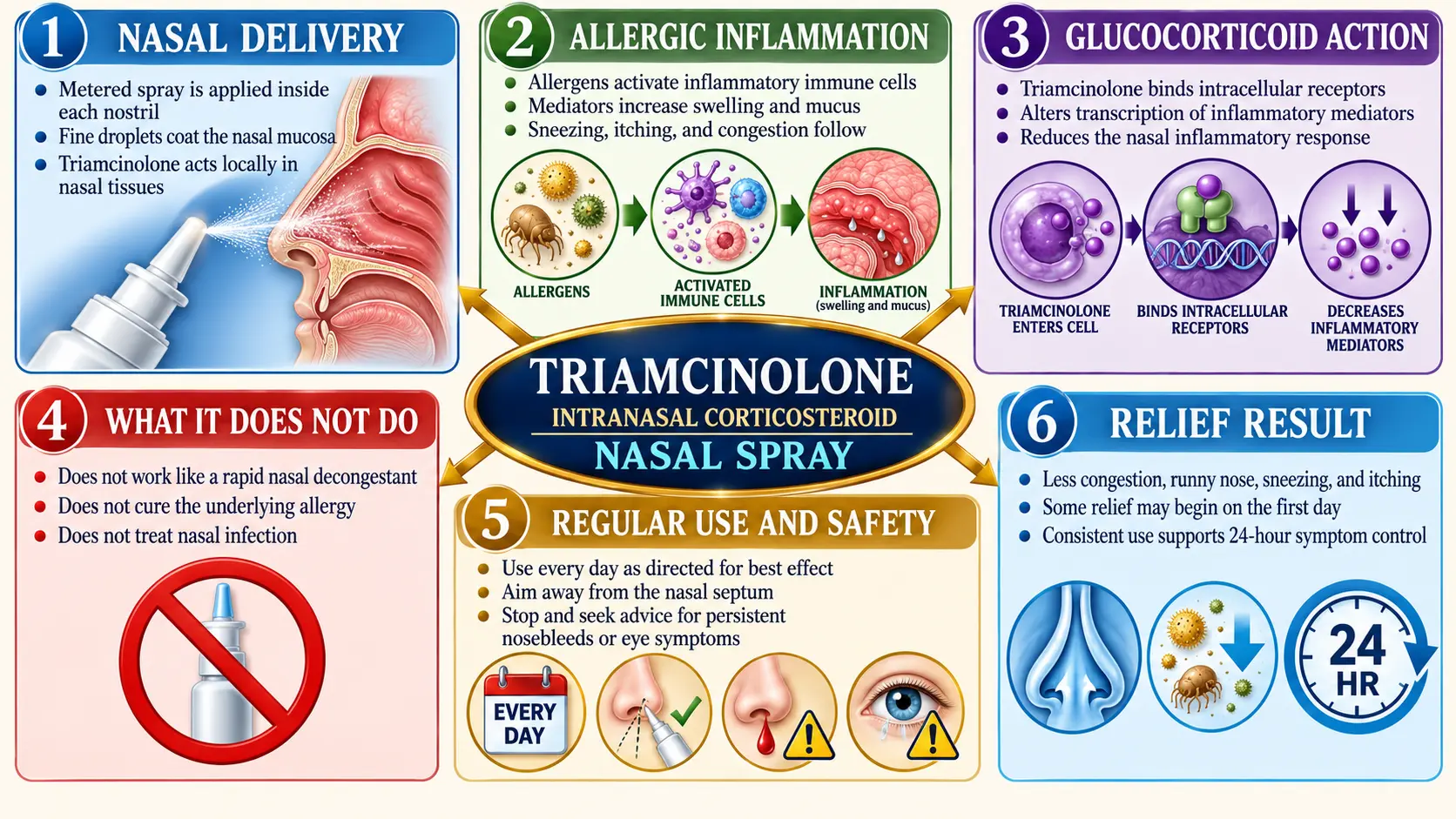
Fine droplets coat the nasal lining.
Triamcinolone enters cells and binds glucocorticoid receptors.
Receptor signaling reduces inflammatory mediators, swelling, and mucus.
Consistent daily use supports 24-hour allergy control.
This is a simplified teaching model. The precise antiallergic mechanism is not fully established; corticosteroids act on multiple inflammatory cells and mediators.
Use It Right
07Who It Helps—and Who It Does Not
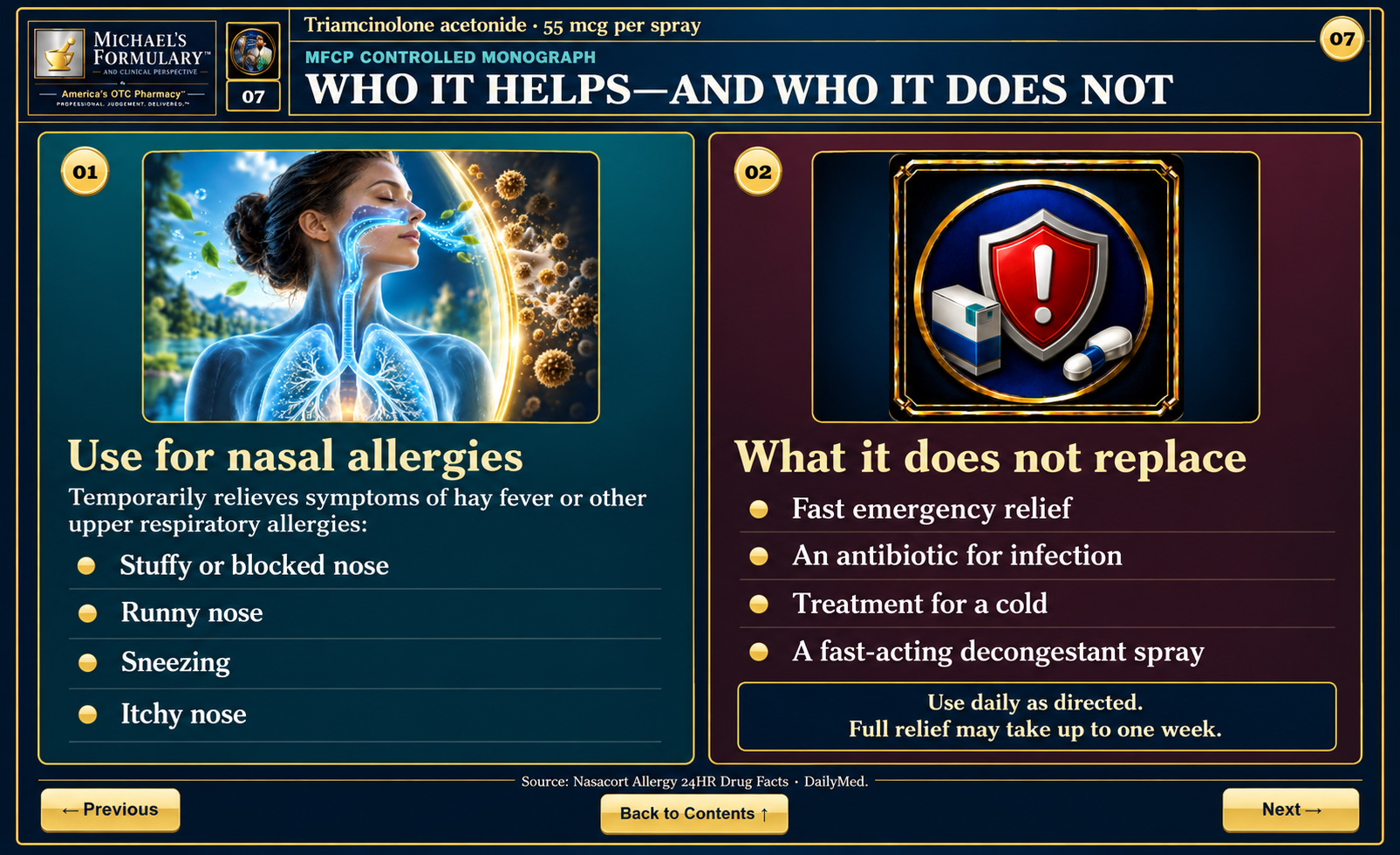
Use for allergic rhinitis
- Stuffy or blocked nose
- Runny nose
- Sneezing
- Nasal itching
Do not use as a substitute
- Not immediate rescue
- Not an antibiotic
- Not an asthma treatment or rescue inhaler
- Not treatment for a cold
- Not a rebound-producing topical decongestant
 08
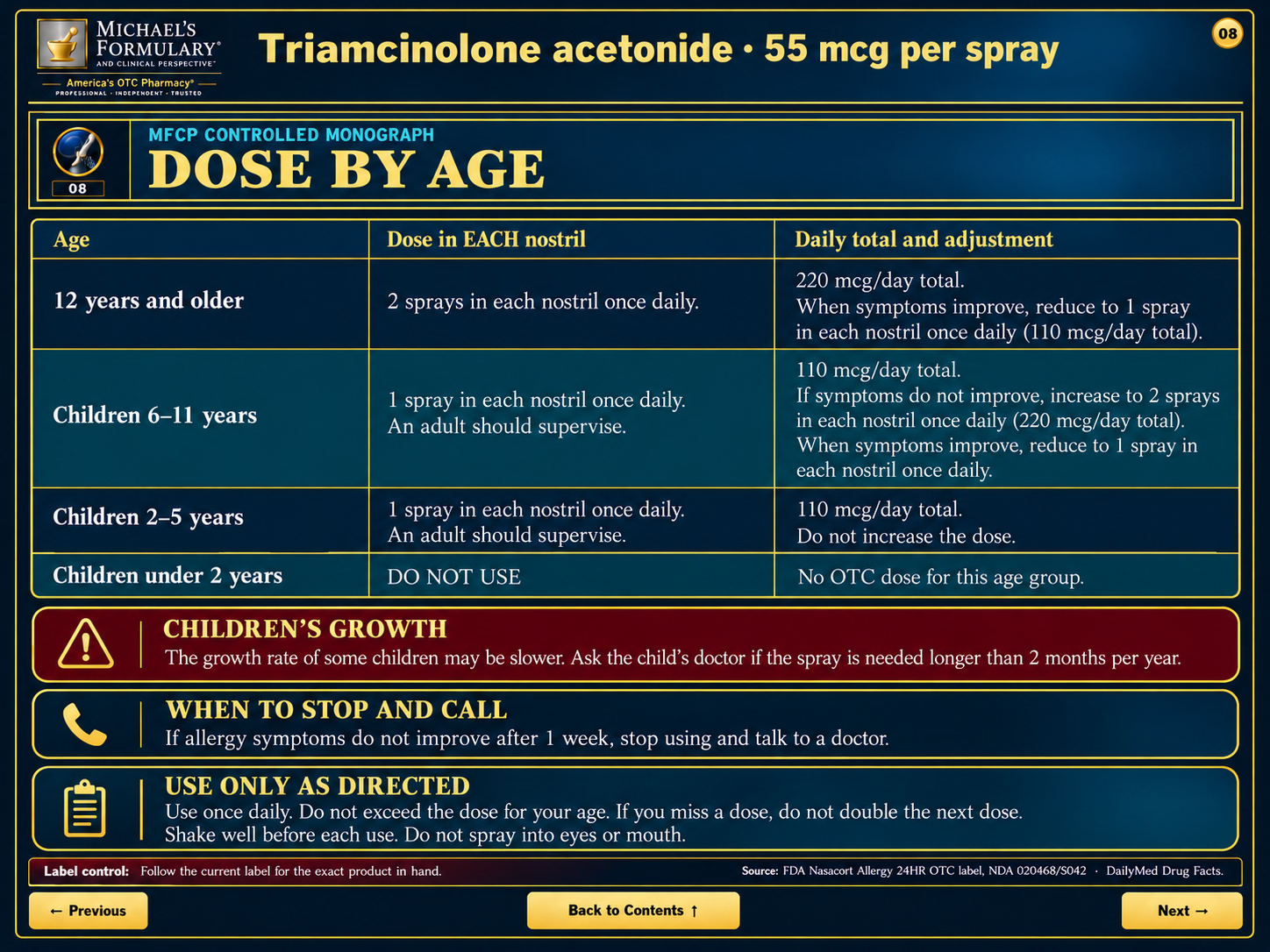
Dose by Age
| Who | Starting dose | Step-down and limit |
|---|---|---|
| Adults and ages 12+ | 2 sprays in each nostril once daily (220 mcg/day). | When controlled, step down to 1 spray in each nostril once daily (110 mcg/day). Maximum 220 mcg/day. |
| Children 6–11 | Start with 1 spray in each nostril once daily (110 mcg/day). | If symptoms do not improve, the current label permits 2 sprays in each nostril once daily. Step down to 1 spray when controlled. If use is needed for more than 2 months per year, ask a clinician. |
| Children 2–5 | 1 spray in each nostril once daily (110 mcg/day). | Do not increase. Ask a clinician if use is needed for more than 2 months per year. |
| Under age 2 | Do not use. | Ask a pediatric clinician. |
 09
How to Use the Spray
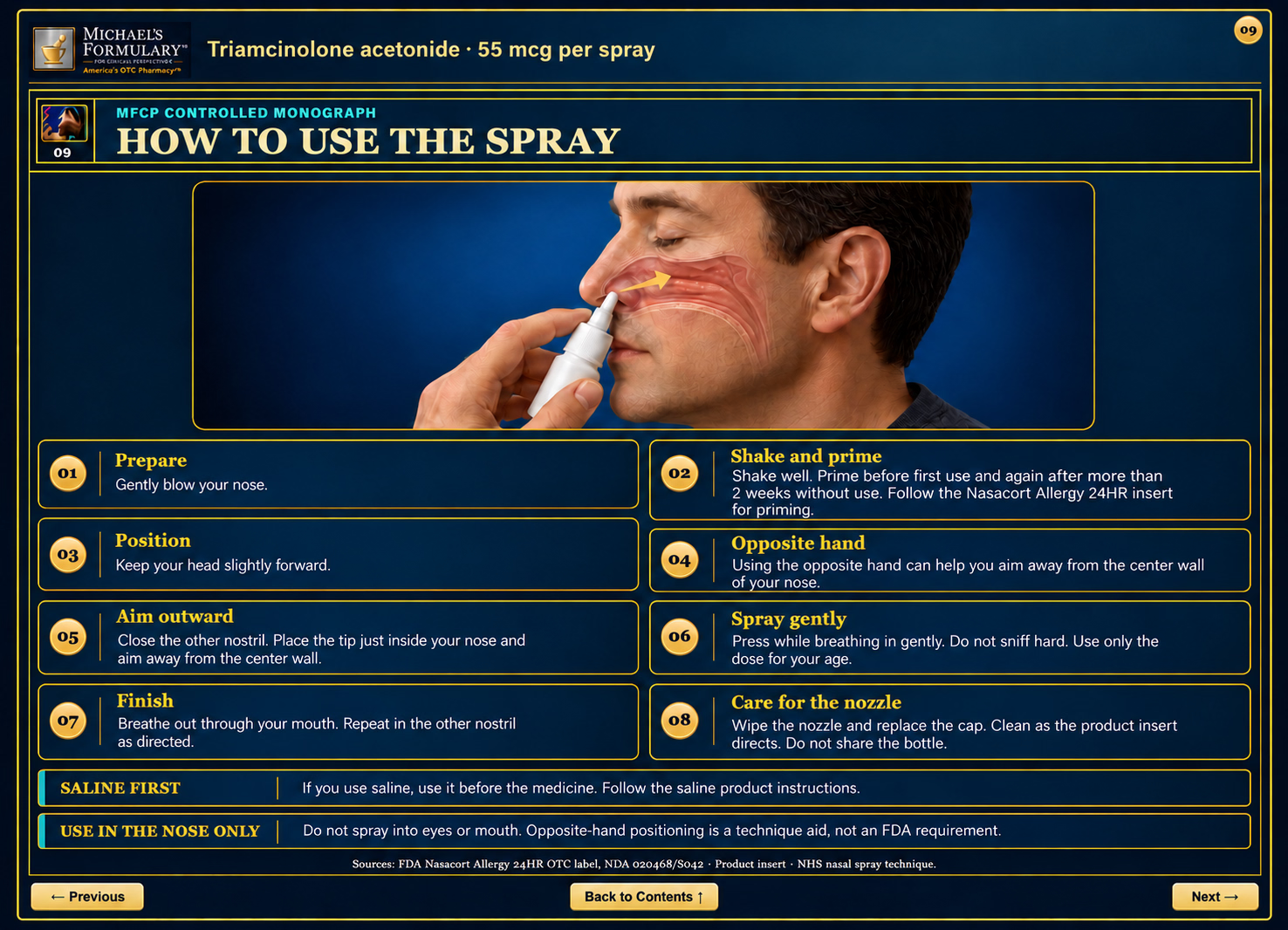
- PrepareBlow your nose gently.
- PrimeShake the bottle. For Nasacort Allergy 24HR, pump until a fine mist appears. Follow the exact package guide.
- ReprimeIf not used for more than two weeks, repeat the priming steps until a fine mist appears. Follow your product guide.
- PositionKeep your head upright or slightly forward.
- Aim outwardUse the opposite hand and aim toward the outer eye or ear, away from the septum.
- Gentle inhalePress once while breathing in gently. Do not snort.
- FinishBreathe out through your mouth. Repeat only as directed.
- CleanWipe the nozzle, replace the cap, and do not share the bottle.
10Timing and Expectations
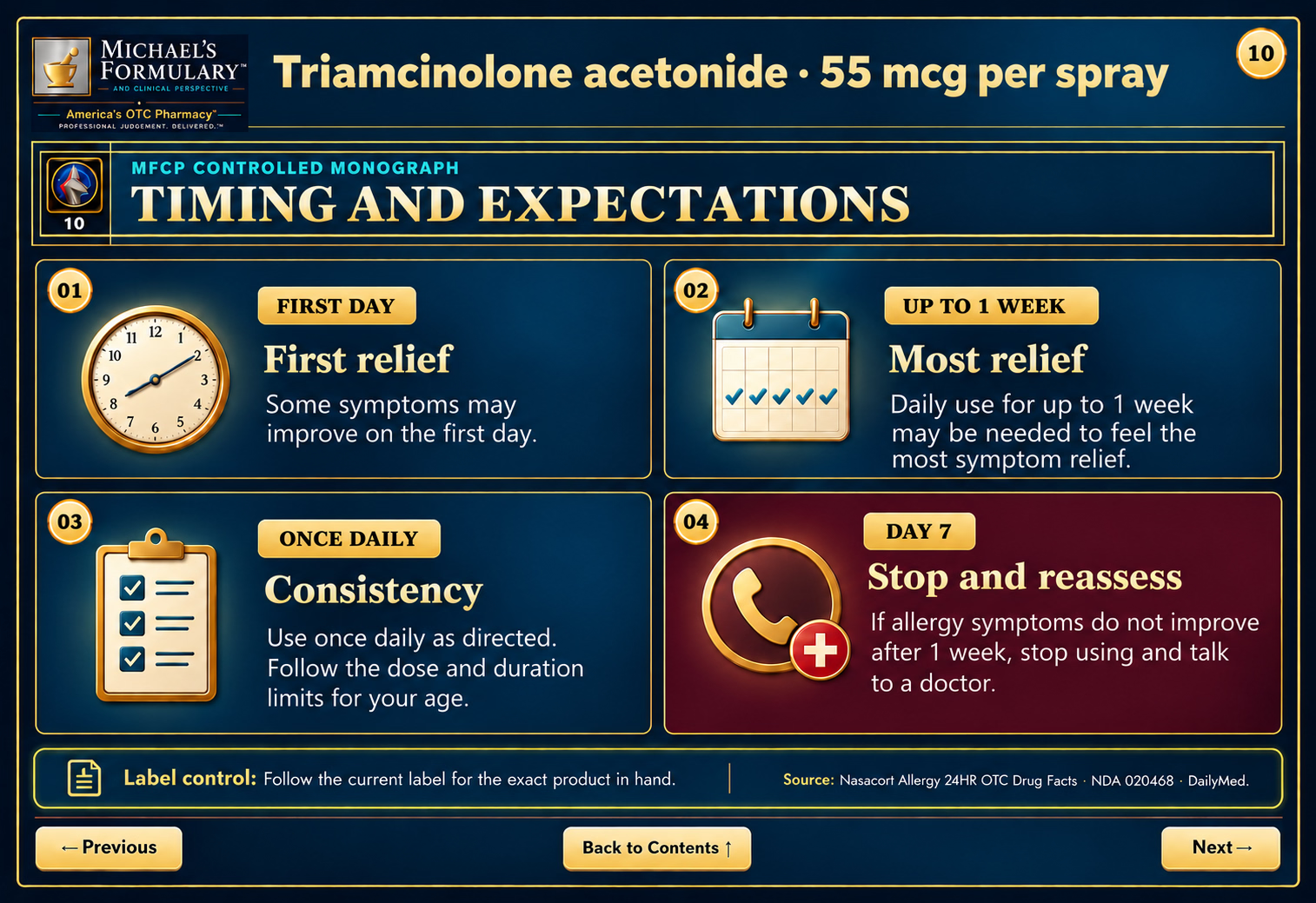
First relief
Some symptoms may begin to improve on the first day.
Maximum relief
Maximum relief may require up to one week.
Consistency
Use it every day as directed for the best effect.
Reassess
If symptoms do not improve after one week, stop and ask a clinician.
Stay Safe
Product & Safety Check
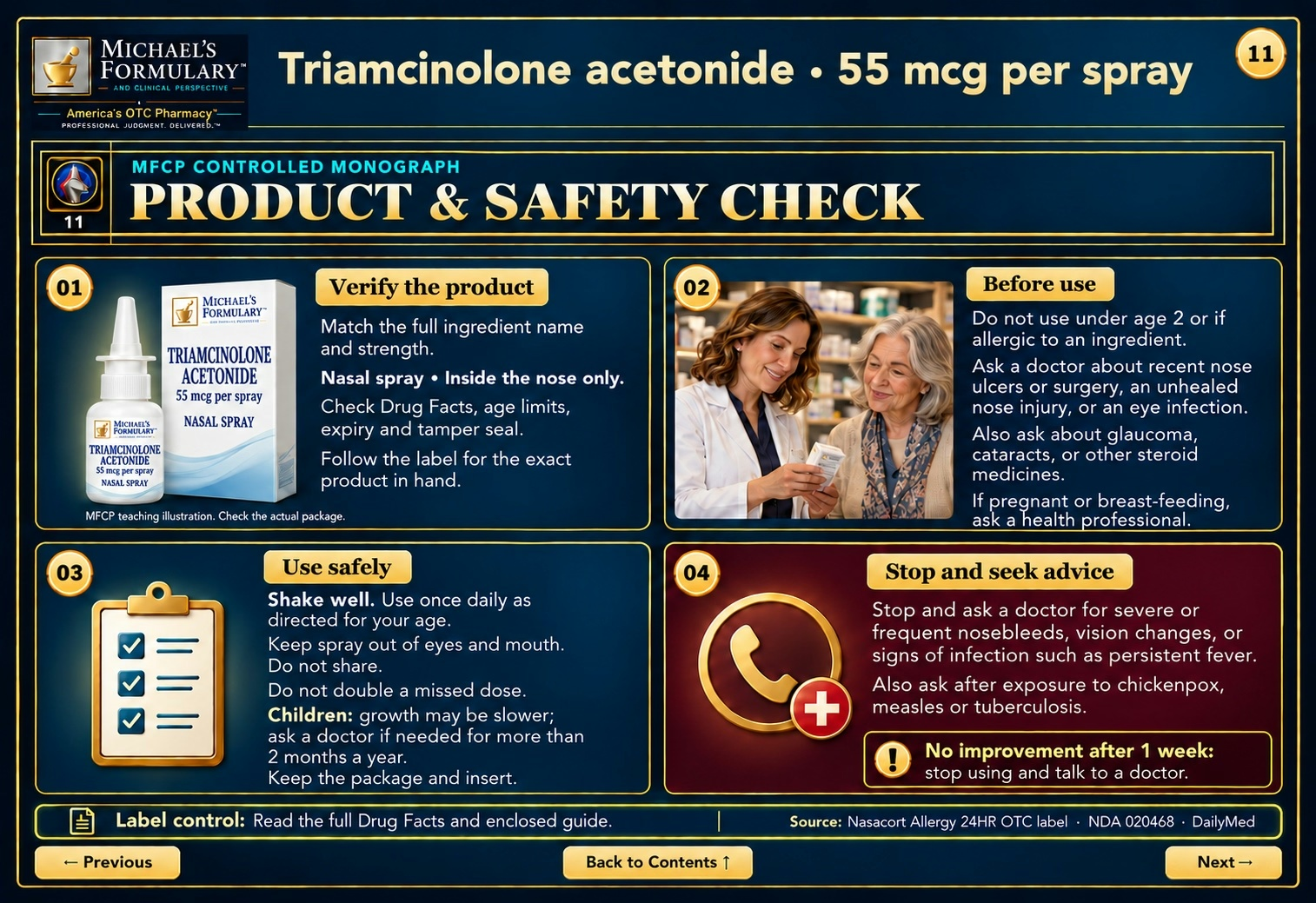
Verify the product
Match the full drug name and strength. Check the seal, expiry date and Drug Facts. Use only inside the nose.
Before use
Do not use under age 2 or after an allergy to an ingredient. Ask a doctor about a recent nose ulcer, surgery or an injury that has not healed. Ask about eye infection, glaucoma, cataracts and other steroid medicines. If pregnant or nursing, ask a health professional.
Use safely
Shake before use. Follow the daily dose for your age. Keep spray out of your eyes and mouth. Do not share the bottle. Do not double a missed dose. Keep the package and guide.
Stop and seek advice
Stop and ask a doctor for severe or frequent nosebleeds, a vision change, or signs of infection such as a lasting fever. Also stop and ask after contact with chickenpox, measles or tuberculosis. If there is no improvement after one week, stop and talk to a doctor.
Children may grow more slowly. Talk to the child's doctor if use is needed for more than two months a year.
 12
Local Safety
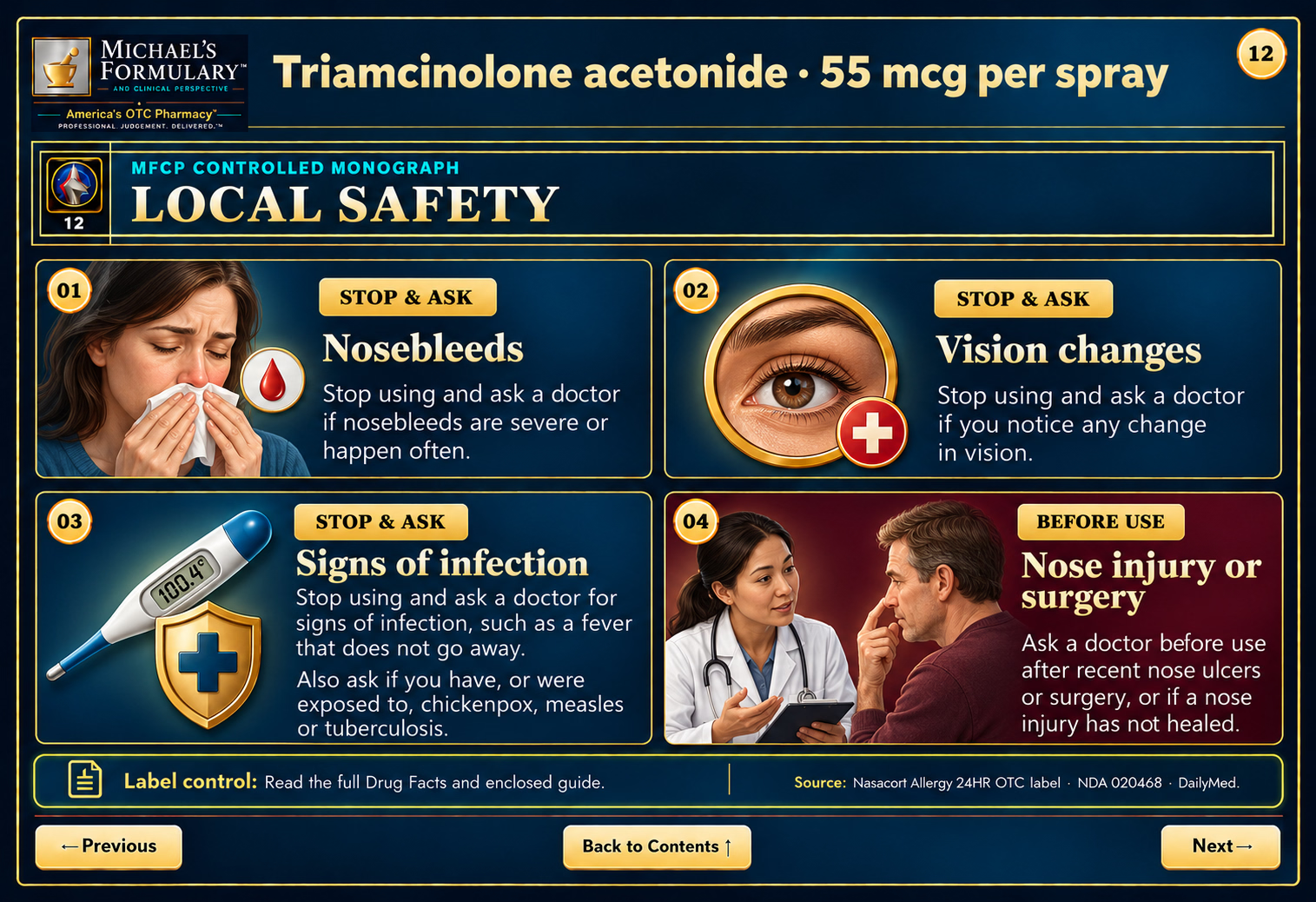
Nosebleed
Stop and ask a clinician about severe or frequent nosebleeds. Correct outward aim reduces septal exposure.
Dryness or injury
Stop for severe crusting, pain, or a whistling sound.
Infection, allergy, or vision
Get prompt help for white patches, an allergic reaction, eye pain, vision change, or persistent fever.
 13
Drug and Substance Interactions
Other steroid medicines
Ask a doctor before use if you use a steroid for asthma, allergies or a skin rash. Bring all inhalers, nasal sprays, creams, pills and injections to the review.
Your complete medicine list
Tell your doctor about all medicines you take, including this spray. Have a pharmacist check each medicine against current references.
Before adding another medicine
Ask a pharmacist to review all steroid medicines and other nasal sprays. Do not add a second steroid spray on your own.
Bring prescription medicines, OTC products, supplements and the package for this spray. A pharmacist must check the exact combination; this panel does not give personalized interaction results.
Current Nasacort Allergy 24HR Drug Facts: other steroid medicines
OTC warnings above are label-based. Additional drug-specific interactions require separate verification; absence from the OTC label does not establish absence of an interaction.
 15
Special Populations
Selected for this monograph

Children
Ages 2–11 · Adult supervision
Pregnancy & breastfeeding
A conversation before use
Older adults
Eyes · Medicines · Nosebleeds
 Liver health
 Eye conditions
 Kidney health
 Diabetes
 Heart health
 Caregivers

The selected cards open guidance below. Other conditions may also need review. Tell your clinician about other health concerns.
Children
Label guidance
An adult must supervise use in children ages 2–11. For ages 2–5, use one spray in each nostril daily; do not increase. For ages 6–11, start with one spray in each nostril daily. If needed, increase to two; reduce to one when symptoms improve. Do not use under age 2. Growth may slow. Review use beyond two months a year with the child’s doctor.
Pregnancy & breastfeeding
Label guidance
Ask a health professional before use during pregnancy or breastfeeding.
Older adults
Label guidance
Adults start with two sprays in each nostril once daily. Reduce to one when symptoms improve. Review all steroid medicines and eye conditions. Stop for a vision change or severe or frequent nosebleeds.
Evidence behind the population guidance
Pregnancy
A 2016 observational study found no significant association with overall birth defects, miscarriage or small-for-gestational-age birth. A respiratory-defect signal involved five exposed cases (OR 2.71; 95% CI 1.11–6.64). Chance could not be excluded. This is an association, not proof of causation. Discuss the treatment choice before use. Bérard et al., 2016.
Breastfeeding
LactMed expects no adverse infant effects from nasal triamcinolone. Direct nasal-use milk-level data are lacking; this is expert assessment rather than a measured guarantee. The OTC instruction to ask a health professional before use still applies. LactMed: Triamcinolone.
Older adults
Historical nasal-spray trials included too few adults aged 65 or older to establish whether their response differs from younger adults. No separate OTC geriatric dose is stated; use adult label directions with medication and eye-safety review. Prescribing information, Section 8.5.
The research layer adds context. The current OTC label controls dosing and stop-use instructions. Gallery portraits are illustrations.
Buy the Right Bottle
 14
MFCP Buying Standard™ · Product Identifier™
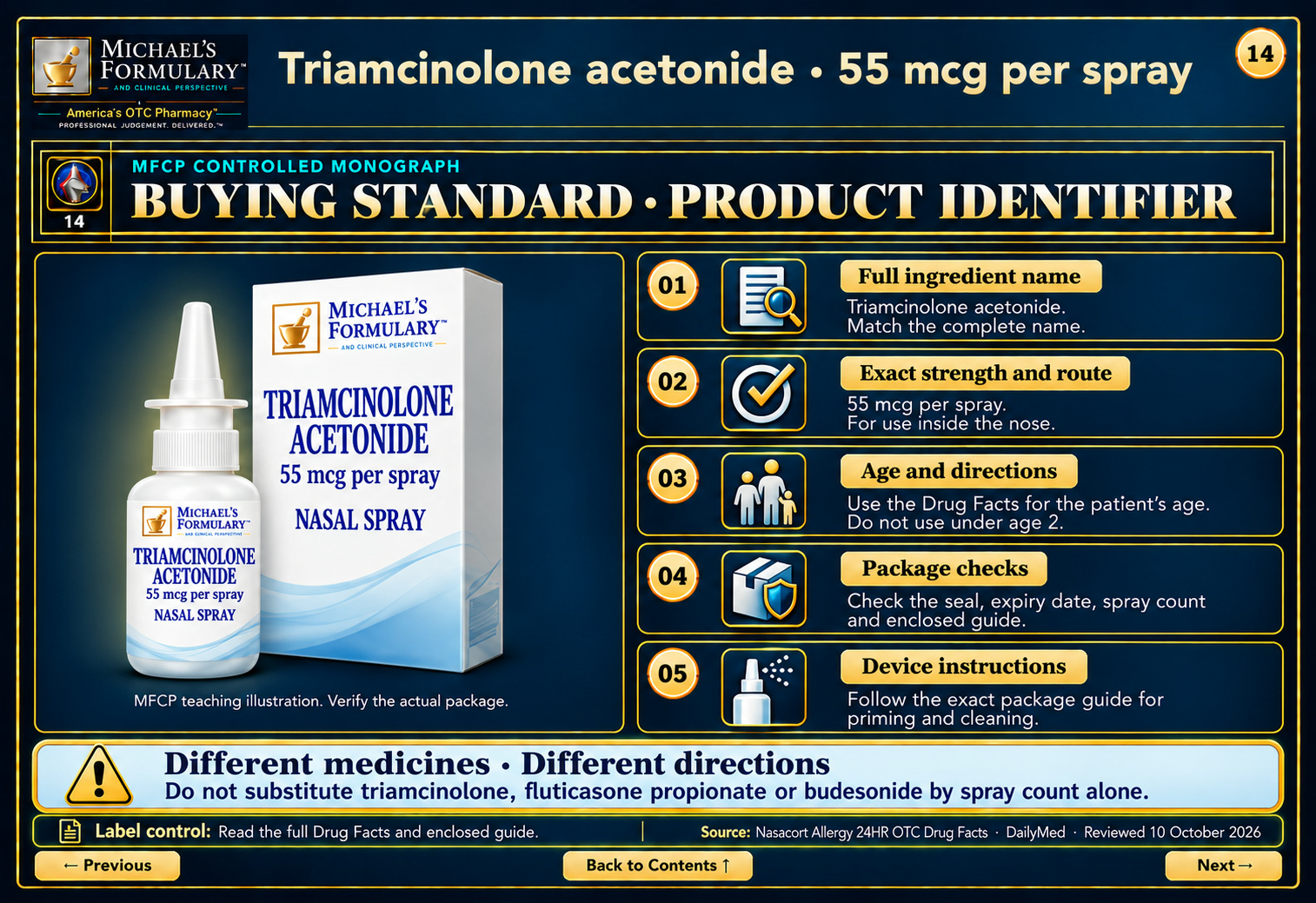
TRIAMCINOLONE ACETONIDE
55 MCG PER SPRAY
Brand examples
Nasacort Allergy 24HR, Children’s Nasacort, or a clearly labeled generic equivalent.
Formulation
Water-based, alcohol-free, scent-free metered intranasal pump.
Buying rule
Match the full name and strength. Never substitute by spray count alone.
 16
Clinical Comparison · Three Nasal Sprays
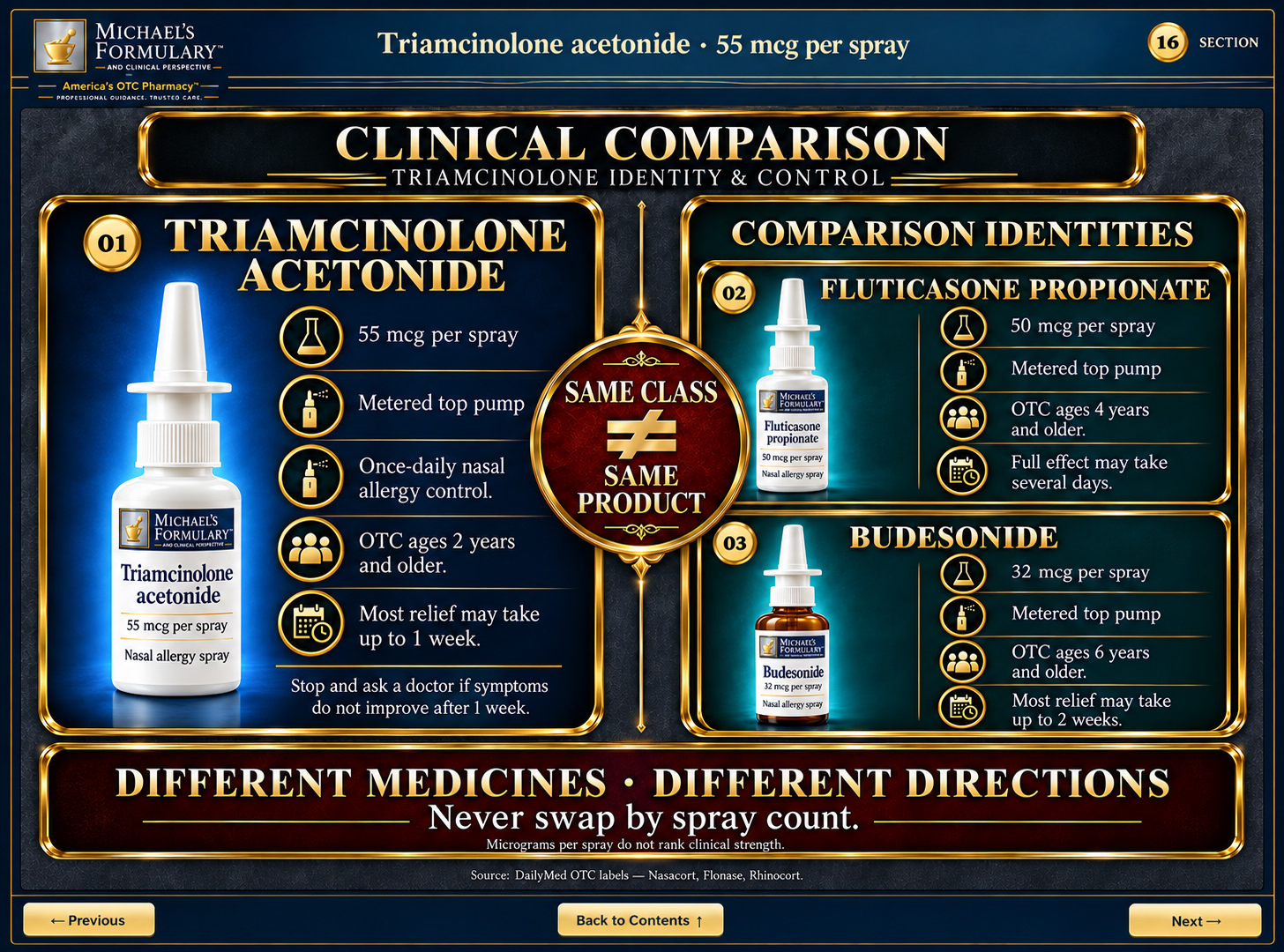
Three distinct nasal-spray identities
Different medicines. Different strengths. Different age directions.
| Product | Strength per spray | Minimum OTC age | If not better |
|---|---|---|---|
| Budesonide | 32 mcg | 6 years | Stop use and ask a doctor after two weeks. |
| Fluticasone propionate | 50 mcg | 4 years | Stop use and ask a doctor after seven days. |
| Triamcinolone acetonide | 55 mcg | 2 years | Stop use and ask a doctor after one week. |
Do not switch by spray count. Match the full drug name, strength, age and package guide. Micrograms per spray do not rank clinical benefit. See Stop 05 (Use It Right) for each age group's dose.
Propionate and furoate are different. Fluticasone furoate is a separate product. Its directions are not the propionate directions shown here.
Decongestant boundary. Oxymetazoline is not a steroid. Its OTC limit is three days.
Controls: the current Drug Facts sources in Stop 08 (Ask and Verify) for each named product. Check the exact package in hand.
Ask and Verify
 17
Triamcinolone acetonide — Safe Use and When to Seek Care
55 mcg per spray · Intranasal
| Finding / check | Action |
|---|---|
Is this an allergy pattern? | Review the symptoms and how long they have lasted. Seek assessment if infection or another cause is likely. |
Is the exact product correct? | Check triamcinolone acetonide, 55 mcg per spray, and the current Drug Facts. |
Is technique correct? | Keep the head slightly down. Aim away from the wall between the nostrils and sniff gently. The opposite hand can help with outward aim. |
No improvement after one week of daily use | Stop and ask a doctor. Review the cause, daily use and spray technique. |
Severe or frequent nosebleeds | Stop and ask a doctor. |
New nasal whistling or a suspected hole | Stop and seek assessment for damage to the wall between the nostrils. |
White patches in the nose or throat | Seek prompt assessment for a possible fungal infection. |
Eye pain or any change in vision | Stop and seek prompt medical assessment. |
Lasting fever or contact with chickenpox, measles or tuberculosis | Stop and ask a doctor about infection signs or exposure. |
An allergic reaction | Stop use. Seek emergency help for trouble breathing or swelling of the face, lips or tongue. |

OTC label warnings control the one-week, infection, vision and nosebleed actions. Septal injury and fungal infection are supported by nasal-spray prescribing information. Opposite-hand use is a teaching aid.
 18
Triamcinolone acetonide — Evidence and Source Control
Triamcinolone acetonide · 55 mcg per spray
- Current OTC labelNasacort Allergy 24HR · Triamcinolone acetonide · 55 mcg per spray. Drug Facts updated 14 January 2026.
- Product instructionsUse the guide for the exact product in hand. Padagis OTC label and consumer guide · 25 August 2025.
- Supporting clinical evidencePrescription information, pregnancy research and LactMed provide clinical context. Historical prescription directions do not replace the OTC label.
- Comparison controlsFluticasone propionate · 50 mcg per spray. Budesonide · 32 mcg per spray. Use each product’s own OTC Drug Facts.
Clinical sources and their roles
- Chattem, Inc. (2026, January 14). Nasacort Allergy 24HR [OTC Drug Facts]. DailyMed.Ingredient, 55 mcg strength, indication, ages, dosing, warnings and package control.
- Padagis Israel Pharmaceuticals Ltd. (2025, August 25). Triamcinolone acetonide nasal [OTC label and consumer guide]. DailyMed.Supporting generic control for administration, priming, cleaning and exact-product package instructions.
- Triamcinolone acetonide nasal spray [Historical prescription information]. DailyMed.Sections 5 and 8: local nasal effects, eye safety, growth and geriatric evidence. Historical background; not the OTC age or dosing control.
- Bérard, A., Sheehy, O., Kurzinger, M.-L., & Juhaeri, J. (2016). Intranasal triamcinolone use during pregnancy and the risk of adverse pregnancy outcomes. Journal of Allergy and Clinical Immunology, 138(1), 97–104.e7.Observational pregnancy evidence; DOI 10.1016/j.jaci.2016.01.021. Association and chance limitations retained.
- National Library of Medicine. (n.d.). Triamcinolone. Drugs and Lactation Database (LactMed).Nasal-use breastfeeding assessment. Direct nasal milk measurements are not established.
- Haleon. Flonase Allergy Relief [OTC Drug Facts]. DailyMed.Comparison control: fluticasone propionate 50 mcg, minimum age 4, seven-day review.
- Rhinocort Allergy [OTC Drug Facts]. DailyMed.Comparison control: budesonide 32 mcg, minimum age 6, two-week review.
Clinical sources reviewed 10 October 2026. Use the current Drug Facts and guide for the product in hand.
The interaction checker remains a design preview. No unverified drug-pair result is presented.
Readability and literacy
 19
Health Literacy and Readability Control
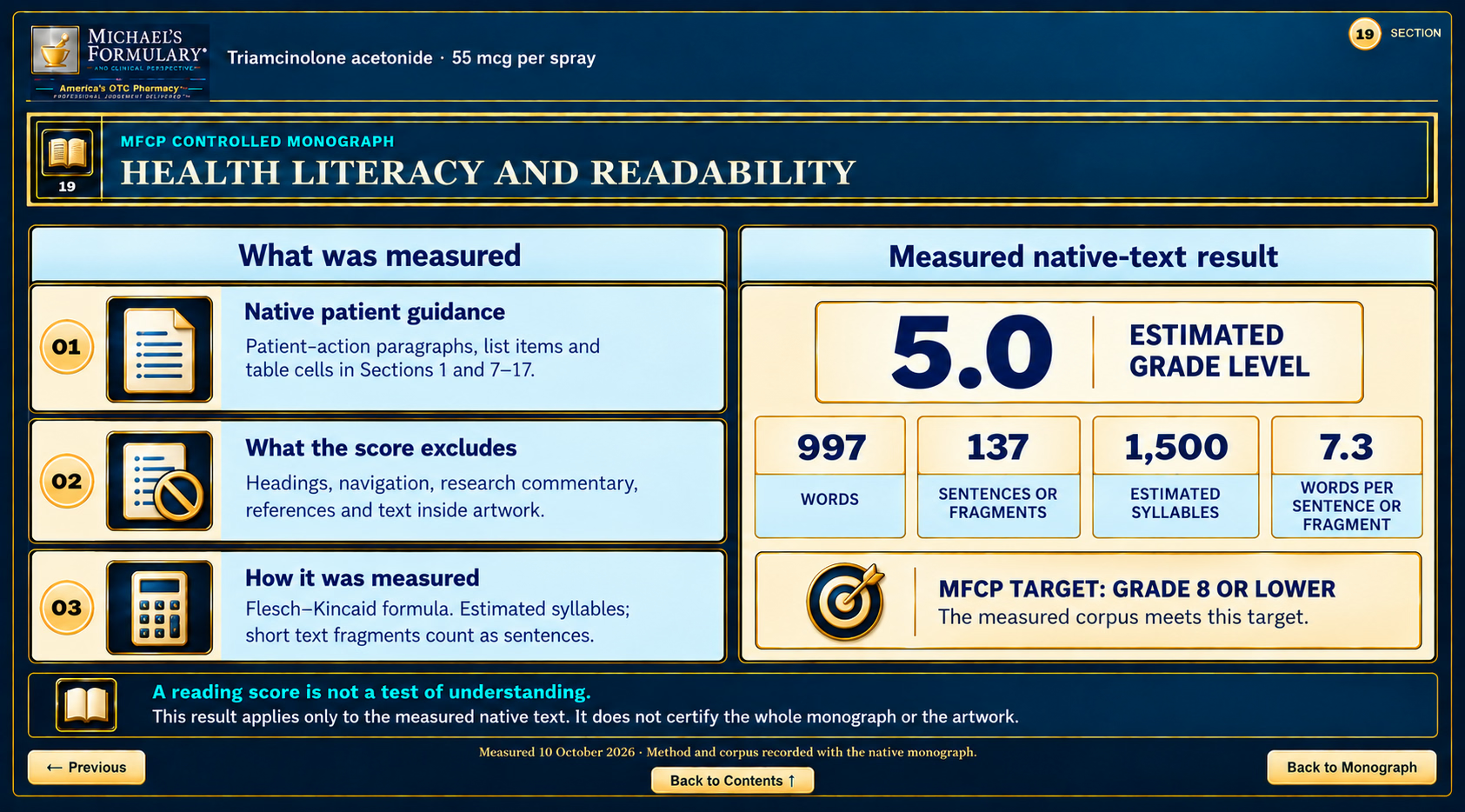
The readability score measures selectable clinical text. It does not measure words embedded in artwork.
HEALTH LITERACY & READABILITY CONTROL
MICHAEL’S FORMULARY™— AND CLINICAL PERSPECTIVE —HEALTH LITERACY
CAMPAIGN
Patient-first by design.EXACT MEASUREMENT SCOPE
Native paragraphs, leaf list items and table cells marked patient-action in Sections 1 and 7–17. Headings, navigation, research commentary, sources, disclosure and artwork lettering are excluded. Drug names remain; numbers are not counted as words.
METHODS & CONTROLS
The versioned audit counts alphabetic words and sentences or fragments, estimates syllables with vowel groups, and applies the Flesch–Kincaid formula. This is an estimate, not a test of understanding.
CONTROLLED TARGET
The measured patient-action text must remain at Grade 8 or lower.
UNDERSTANDING AND INFORM DECISIONS.
READABILITY DISCLOSURE
Reproducible measurement of the current native-text corpus.
GRADE LEVEL5.3CALCULATED
CORPUS1,166WORDS
COUNT160SENTENCES
COUNT1,784ESTIMATED
SENTENCE LENGTH7.3WORDS
Formula: 0.39 × (words ÷ sentences) + 11.8 × (syllables ÷ words) − 15.59. The audit algorithm and scope are versioned with this page.
MFCP GRADE 8 TARGET
Measured native patient-action text meets the Grade 8-or-lower target. This does not validate artwork lettering or comprehension.
⚖ TECHNICAL CLINICAL / LEGAL LAYER
Brand labels, ingredient names, doses, citations, and technical terms are retained for accuracy and disclosed separately.