
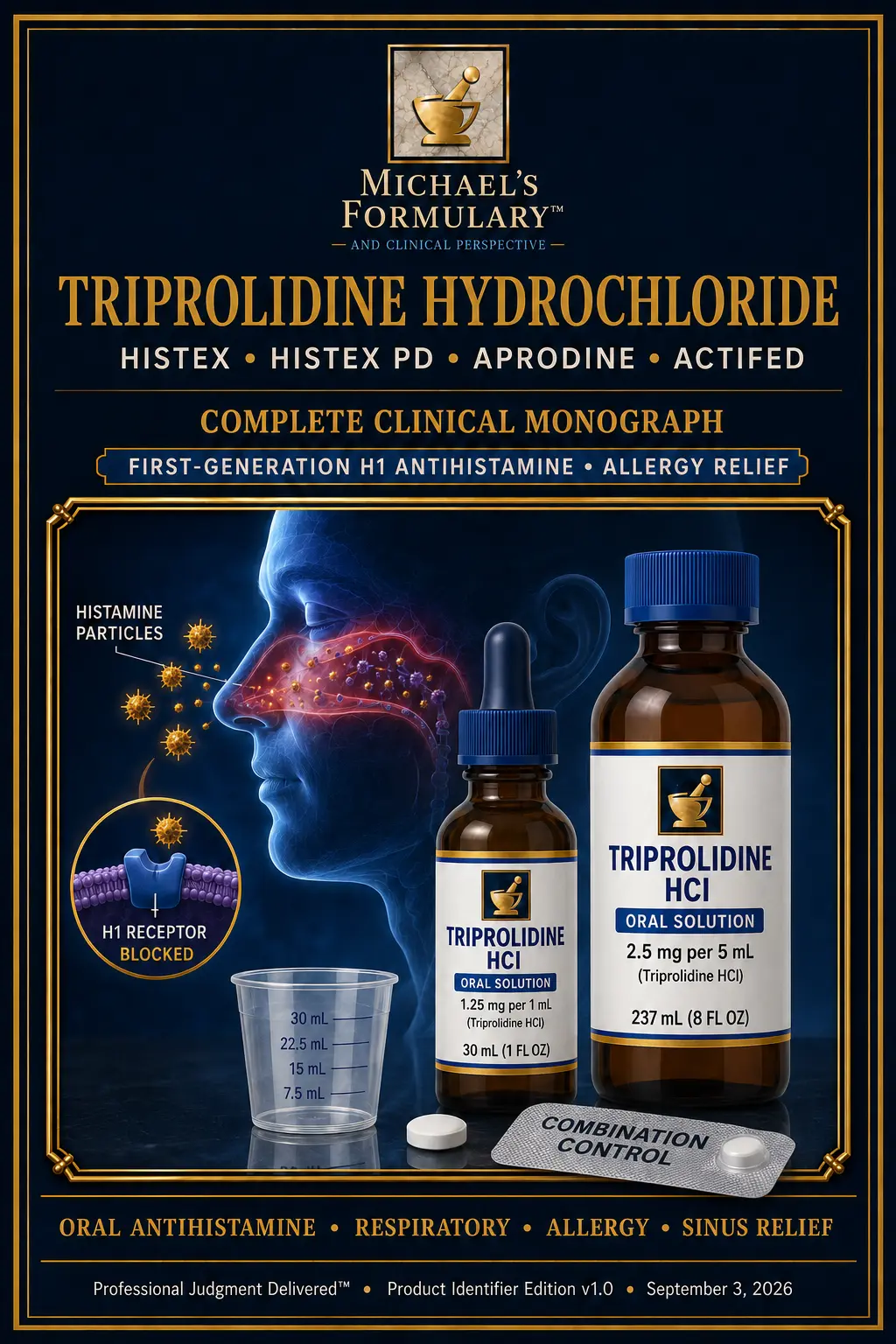
Triprolidine Hydrochloride
Short-Acting Allergy Relief
First-generation H₁ blockade with clinically important drowsiness and drying effects.
 02
Production Mandate and Bottom Line
Triprolidine Hydrochloride
Monograph at a Glance · allergy relief · short-acting control · alertness screen
First-generation antihistamine
Triprolidine blocks H1 histamine receptors. It temporarily relieves runny nose, sneezing, itchy or watery eyes, and itching of the nose or throat.
Main tradeoff
Drowsiness, slowed reactions, and drying can occur. A less-sedating antihistamine is often a better daytime choice.
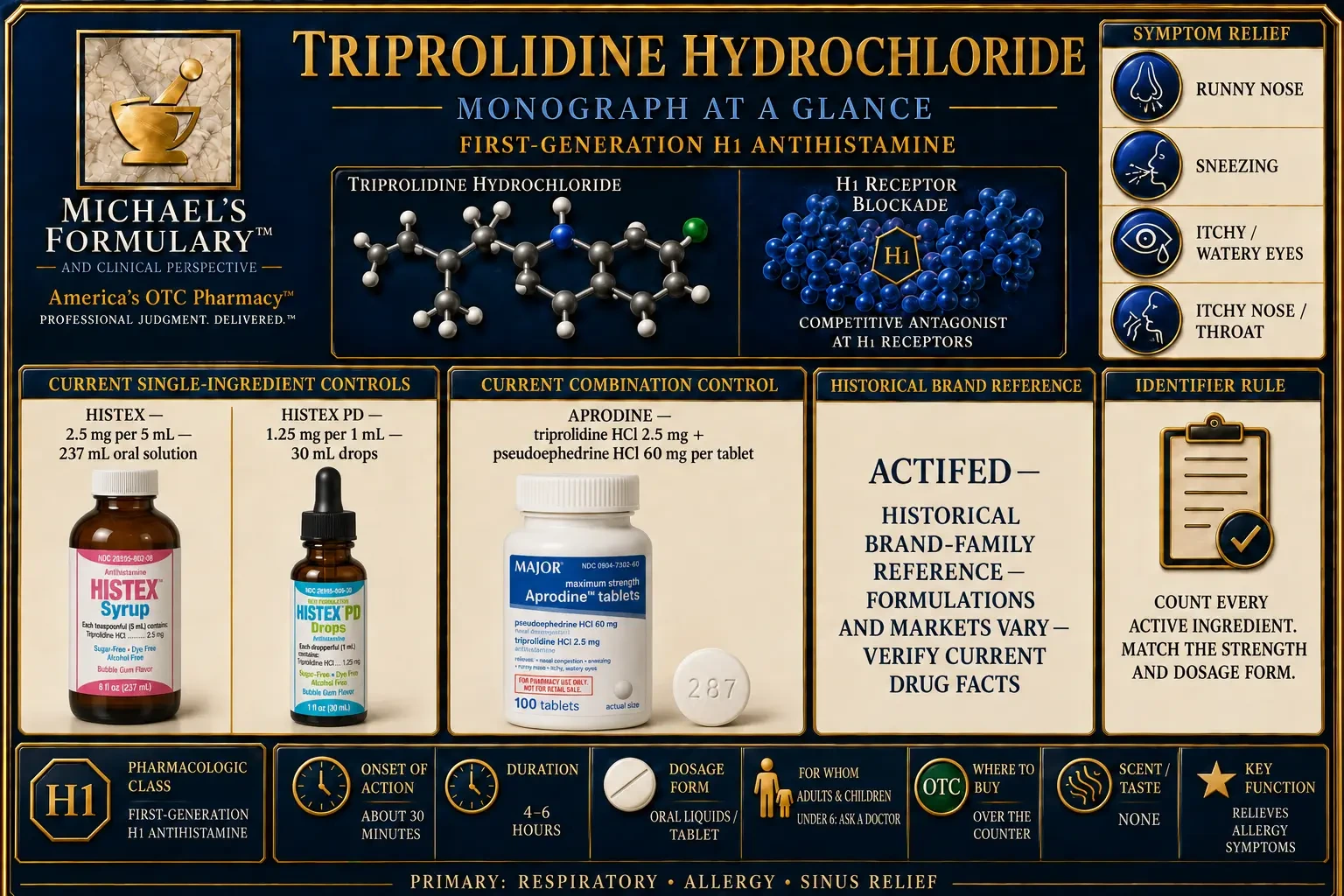
Histex liquids contain triprolidine alone. Aprodine combines triprolidine with pseudoephedrine. Actifed is a historical brand-family reference whose formulations have varied.
PATIENT ACTIONCheck the drug name first. Use this medicine only for allergy signs.
 03
Who It Is For
May fit
- Temporary upper-respiratory allergy symptoms
- A person who can avoid driving and alcohol
- A child age 6 or older when the current OTC label permits use
Choose another path or ask first
- Routine daytime allergy control
- Age 65 or older
- Glaucoma, urinary difficulty, or chronic breathing disease
- Use with sedatives, tranquilizers, or another antihistamine
PATIENT ACTIONChoose a less sleepy drug when you must drive, work, or stay alert.
 04
Label & Dosage-Form Control
Histex
Triprolidine HCl 2.5 mg per 5 mL. Bubble-gum-flavored, sugar-free, dye-free, alcohol-free oral solution in a 237 mL bottle.
Histex PD
Triprolidine HCl 1.25 mg per 1 mL dropperful in a 30 mL bottle. It is not interchangeable milliliter-for-milliliter with Histex syrup.
Aprodine
Each tablet contains triprolidine HCl 2.5 mg plus pseudoephedrine HCl 60 mg. It adds decongestant risks and an MAOI prohibition.
Count every active ingredient. Match the exact strength, dosage form, and label. Treat Actifed as a brand-family clue—not proof of a current formulation.
PATIENT ACTIONRead every active drug. Match the strength and the form before each dose.
 05
Dose and Administration
| Verified product | Age | Label dose | 24-hour maximum |
|---|---|---|---|
| Histex 2.5 mg/5 mL | 12 years and older | 5 mL every 4–6 hours | 20 mL |
| Histex 2.5 mg/5 mL | 6 to under 12 years | 2.5 mL every 4–6 hours | 10 mL |
| Histex PD 1.25 mg/mL | 12 years and older | 2 mL every 4–6 hours | 8 mL |
| Histex PD 1.25 mg/mL | 6 to under 12 years | 1 mL every 4–6 hours | 4 mL |
| Either verified liquid | Under 6 years | Consult a doctor | Follow clinician direction |
| Aprodine tablet | 12 years and older | 1 tablet every 4–6 hours | 4 tablets |
| Aprodine tablet | Under 12 years | Do not use | — |
Use only the measuring device supplied for that product. The drops are more concentrated than the oral solution.
PATIENT ACTIONUse the cup or dropper that came with the product. Measure in milliliters.
 06
What It Treats
- Runny nose
- Sneezing
- Itching of the nose or throat
- Itchy, watery eyes due to hay fever
Anaphylaxis, asthma attacks, bacterial infection, or the cause of an allergy.
PATIENT ACTIONUse this drug for runny nose, sneezing, nose itch, or watery eyes.
 07
How It Works
How Triprolidine Works
Six controlled steps from an oral dose to relief, sleepiness, and drying effects
Absorption
The dose is absorbed and reaches peripheral tissues and the central nervous system.
Allergy and wakefulness
Histamine activates H₁ receptors during allergy and also supports alertness in the brain.
Symptom relief
Blocking H₁ signaling can reduce sneezing, runny nose, itching, and watery eyes.
Central sedation
Central H₁ blockade can cause drowsiness and impair driving or other alert tasks.
Drying burden
Dry mouth, blurred vision, constipation, or urinary difficulty can occur.
Use the tradeoff
Relief must be weighed against sedation, drying, age, other medicines, and the current label.
Histamine signal
Histamine activates H1 receptors during an allergic response.
Competitive blockade
Triprolidine occupies H1 receptors and reduces histamine-driven symptoms.
Brain and drying effects
Central H1 and anticholinergic activity can cause drowsiness, dry mouth, blurred vision, constipation, or urinary difficulty.
PATIENT ACTIONThis drug blocks an allergy signal. It may also make you sleepy or dry.
 08
Drowsiness and Drying
Drowsiness may occur. Alcohol, sedatives, and tranquilizers can increase it. Excitability may occur, especially in children.
PATIENT ACTIONDo not drive until you know how the drug affects you. Avoid alcohol.
 09
Warnings and Ask-First Screen
- Ask a doctor first with glaucoma, trouble urinating from an enlarged prostate, emphysema, or chronic bronchitis.
- Ask before use with sedatives or tranquilizers.
- Do not exceed the labeled dose.
- Aprodine: do not use during MAOI therapy or within 14 days after stopping an MAOI.
- Keep out of reach of children.
PATIENT ACTIONAsk first if you have eye pressure, lung disease, or trouble passing urine.
 10
Drug and Alcohol Interactions
| Check | Why | Action |
|---|---|---|
| Alcohol | More drowsiness and impairment | Avoid |
| Sedatives or tranquilizers | Additive central nervous system depression | Ask a doctor or pharmacist first |
| Another antihistamine or night product | Duplicate dosing and drying | Check all active ingredients |
| MAOI | Aprodine contains pseudoephedrine | Do not use during therapy or for 14 days after stopping |
| Another decongestant | Duplicate sympathomimetic effects with Aprodine | Avoid duplication; ask first |
PATIENT ACTIONDo not mix this drug with alcohol, sleep drugs, or another allergy drug.
 11
Children and Older Adults
Children
Verified Histex labels direct caregivers to consult a doctor for children under 6. Aprodine is not for children under 12. Excitability may occur.
Older adults
First-generation antihistamines raise concern for confusion, dry mouth, constipation, urinary retention, and falls. A safer alternative is usually preferred.
PATIENT ACTIONFor a child, follow the exact age rule. Older adults should ask first.
 12
Pregnancy and Breastfeeding
If pregnant or breastfeeding, ask a health professional before use. Do not assume that a prescription combination has the same guidance as the OTC single-ingredient liquid.
PATIENT ACTIONIf you are pregnant or nursing, ask your health care team before use.
 13
Overdose and Red Flags
Contact Poison Control at 1-800-222-1222 or seek emergency help. Severe sleepiness, agitation, hallucinations, seizures, breathing trouble, abnormal heart rhythm, or loss of consciousness require urgent care.
PATIENT ACTIONFor too much medicine, call Poison Control at 1-800-222-1222 right away.
 14
Brand-Control Record
| Name | Verified identity | MFCP use |
|---|---|---|
| Histex | Current OTC single-ingredient 2.5 mg/5 mL oral solution | Primary liquid control |
| Histex PD | Current OTC single-ingredient 1.25 mg/mL drops | Concentrated-drop control |
| Aprodine | Current OTC pseudoephedrine 60 mg/triprolidine 2.5 mg tablet | Combination control |
| Actifed | Historical/well-known brand family; formulations and markets vary | Brand-history warning only |
PATIENT ACTIONBrand names can change. Trust the active-drug box on the current label.
 15
Buying Standard
- Find triprolidine hydrochloride. Confirm the strength per milliliter or tablet.
- Count every active ingredient. Aprodine also contains pseudoephedrine.
- Match the concentration. Histex and Histex PD use different milliliter doses.
- Match the age. Under 6 requires clinician direction for verified liquids; Aprodine is not for under 12.
- Screen for drowsiness, drying, MAOIs, and decongestant risk.
- Check the seal, lot, and expiration. Omit—not invent—when identity cannot be verified.
PATIENT ACTIONBuy only a product whose drug, strength, seal, lot, and date you can check.
 16
Use Checklist
PATIENT ACTIONBefore each dose, check the person, drug, strength, amount, and time.
 17
Clinical Comparison
| Medicine | Typical position | Key distinction |
|---|---|---|
| Triprolidine | First generation | Short-acting; drowsiness and drying |
| Chlorpheniramine | First generation | Similar class; products and concentrations differ |
| Diphenhydramine | First generation | Often more sedating |
| Loratadine or fexofenadine | Second generation | Often preferred when alertness matters |
PATIENT ACTIONA newer allergy drug may be a better choice when alertness matters.
18Glossary
- Antihistamine
- A medicine that reduces histamine effects.
- H1 receptor
- A histamine target involved in itching, sneezing, runny nose, and watery eyes.
- Anticholinergic
- A drying effect that can also blur vision, slow the bowel, or make urination difficult.
- Combination product
- One package containing more than one active drug.
19Evidence and References
Evidence & Source Control
Current labels govern the exact ingredient, strength, dose, age, warning, and use
- DailyMed: Histex 2.5 mg/5 mL oral solution.
- DailyMed: Histex PD Drops 1.25 mg/mL.
- DailyMed: Aprodine pseudoephedrine/triprolidine tablets.
- FDA OTC Monograph M012.
- American Geriatrics Society. 2023 AGS Beers Criteria®.