
Sulfur–Resorcinol Combination Systems
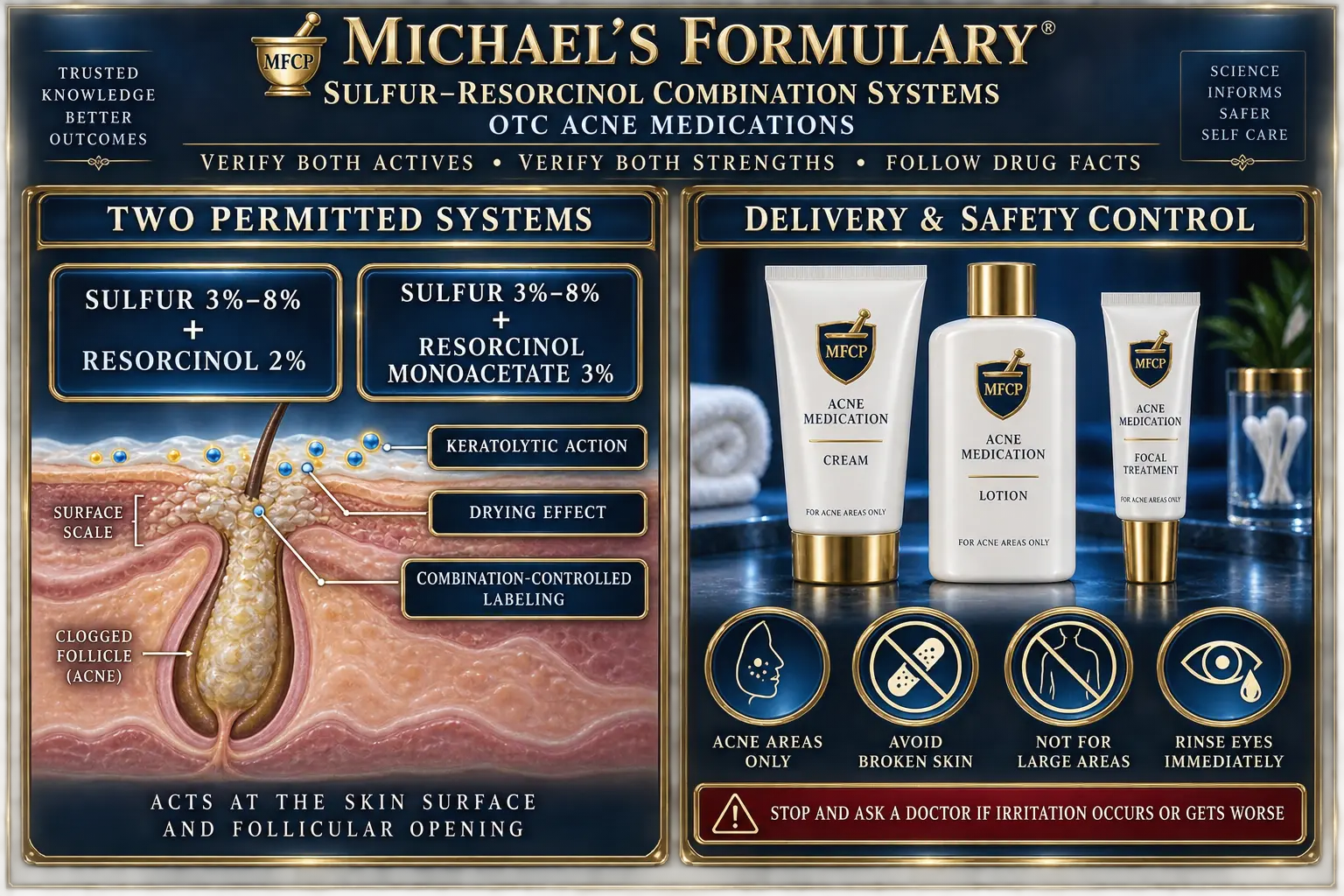
Two precisely defined OTC acne combinations requiring verification of both active ingredients, both strengths, dosage form, and label-directed use.
01 · Controlled Clinical PositionPharmacist Bottom Line™
Sulfur–resorcinol products are dual-active OTC acne medications, not sulfur monotherapy and not interchangeable “drying lotions.” Their regulatory identity depends on the exact active pair and strengths. Current retail availability may be limited even though the systems remain permitted by FDA OTC Monograph M006.
02 · Active-Ingredient ControlIdentity, Chemistry & Regulatory Position
| System 1 | Sulfur 3%–8% + resorcinol 2% |
| System 2 | Sulfur 3%–8% + resorcinol monoacetate 3% |
| Drug role | Combination topical acne medication |
| Current pathway | FDA OTC Monograph M006 §§ M006.10 and M006.20 |
| Historical citation | Formerly codified at 21 C.F.R. Part 333, Subpart D; M006 is the current controlling monograph. |
| Market status principle | Monograph permission does not prove that a particular product is currently marketed, available, or compliant. |
03 · Monograph at a Glance™MAG™
04 · Pharmacologic FoundationComplementary Surface and Follicular Effects
Do not extrapolate: Laboratory antiseptic properties do not authorize use for infection, fungal disease, rosacea, scabies, eyelid disease, or wounds.
05 · Exact Pairing DisciplineThe Two Permitted Systems
| Package finding | Classification | Action |
|---|---|---|
| Sulfur 3%–8% + resorcinol 2% | Permitted M006 combination | Proceed with label and patient screening. |
| Sulfur 3%–8% + resorcinol monoacetate 3% | Permitted M006 combination | Proceed with label and patient screening. |
| Sulfur alone | Monotherapy, not this combination system | Use the Sulfur 3%–10% monograph. |
| Different active or strength pairing | Not one of the two M006 combinations | Do not classify by analogy; investigate the product’s legal pathway. |
06 · Product RealityDosage Forms, Vehicles & Availability
| Control point | Clinical meaning |
|---|---|
| Dosage form | Cream, lotion, ointment, mask, or another compliant topical form may differ substantially in residue, drying, contact, and removal. |
| Inactive ingredients | Alcohol, fragrance, clays, pigments, propylene glycol, and emollients may change irritation and acceptability. |
| Tinted products | Pigment can mask redness or leave transferable residue; tint does not change the approved indication. |
| Removed products | Soaps, masks, and other removed forms require product-specific directions; no universal dwell time applies. |
| Availability | Confirm a current Drug Facts label and active NDC or retail listing; avoid relying on discontinued historical packages. |
07 · Label-Directed AdministrationOTC Directions & Mandatory Warnings
| Applied and left on | Clean skin thoroughly; cover the entire affected area with a thin layer one to three times daily. |
| Initiation | Start once daily, then increase gradually only if needed or directed. |
| Dryness or peeling | Reduce to once daily or every other day. |
| Removed forms | Follow the finished product’s specific application and removal directions. |
| Concurrent acne drugs | If irritation occurs, use only one topical acne medication at a time. |
| Sulfur warnings | Do not use on broken skin or large areas; apply only to areas with acne. |
| Combination warnings | Rinse immediately with water if product enters the eyes; stop use and ask a doctor if irritation occurs or worsens. |
08 · Practical TechniqueControlled Application
- Confirm the condition.Blackheads, whiteheads, and superficial acne pimples fit the labeled pathway; uncertain or atypical eruptions require diagnostic separation.
- Read both active lines.Verify sulfur strength and the exact resorcinol ingredient before use.
- Limit the field.Apply only to acne-affected skin; never to broken skin or large areas.
- Begin once daily.Do not introduce another drying acne medicine simultaneously.
- Reassess irritation.For these combinations, irritation that occurs or worsens triggers the labeled stop-and-ask-a-doctor rule.
09 · Regimen EngineeringConcurrent Products & Barrier Control
| Benzoyl peroxide | Concurrent use can compound burning, redness, and peeling. Do not stack routinely at initiation. |
| Salicylic acid | Additional keratolysis may impair the barrier; use one primary exfoliating system at a time when irritation develops. |
| Adapalene | Introduce sequentially and reduce frequency if dryness or inflammation appears. |
| Abrasive scrubs and alcohol toners | Avoid combining with an already drying vehicle. |
| Moisturizer and sunscreen | Use compatible non-comedogenic supportive care when needed; follow the selected product’s directions. |
10 · TolerabilityAdverse Effects & Product Limitations
11 · Special ConsiderationsAge, Pregnancy, Allergy & Skin Tone
| Children | Follow the exact product’s age directions; avoid unsupervised large-area or damaged-skin use. |
| Pregnancy or breast-feeding | M006 does not establish a combination-specific pregnancy contraindication. Seek individualized advice before extensive, prolonged, occluded, or non-acne use; prevent infant contact with treated skin. |
| “Sulfa” allergy | Elemental sulfur is chemically distinct from sulfonamide antimicrobials and sulfites; nevertheless, evaluate any prior reaction to the product, resorcinol, or vehicle ingredients. |
| Sensitive skin | Combination keratolysis may be poorly tolerated despite a familiar OTC package; start conservatively. |
| Deeper skin tones | Prevent irritation because treatment-induced inflammation can worsen post-inflammatory discoloration. |
| Eyes and eyelids | Do not use on ocular surfaces or eyelids; rinse immediately with water after accidental eye exposure. |
12 · Safety GateStop, Refer & Reassess
13 · Product SelectionMFCP Buying Standard™
- Drug Facts identifies one of the two permitted active systems exactly.
- Sulfur is 3%–8%; resorcinol is 2%, or resorcinol monoacetate is 3%.
- The package clearly identifies whether the product is left on or removed.
- Directions, age labeling, warnings, and inactive ingredients are readable before purchase.
- The NDC or current retail listing is active; an archived label alone is not proof of availability.
- The vehicle is acceptable for odor, residue, pigment transfer, alcohol, fragrance, and drying.
- “Maximum strength” never substitutes for reading both active lines.
14 · Evidence ControlPrimary Sources & Readability Disclosure
- FDA OTC Monograph M006: Topical Acne Drug Products
- DailyMed Archived Example: Resorcinol 2% / Sulfur 8% Cream
- Gupta and Nicol: The Use of Sulfur in Dermatology
- Resorcinol in Dermatology: Reassessing a Legacy Topical Therapy
Evidence control: M006 defines the permitted active systems and required labeling. Archived product labels illustrate dosage-form implementation but do not establish current availability, superiority, or a universal schedule.
Readability disclosure: This educational monograph supports product identification, counseling, and referral. It does not diagnose acne or replace individualized care.
← Return to Acne & Keratolytic Therapy