
Sulfur 3%–10%
OTC acne medication requiring control of concentration, dosage form, application area, frequency, and concurrent irritants.
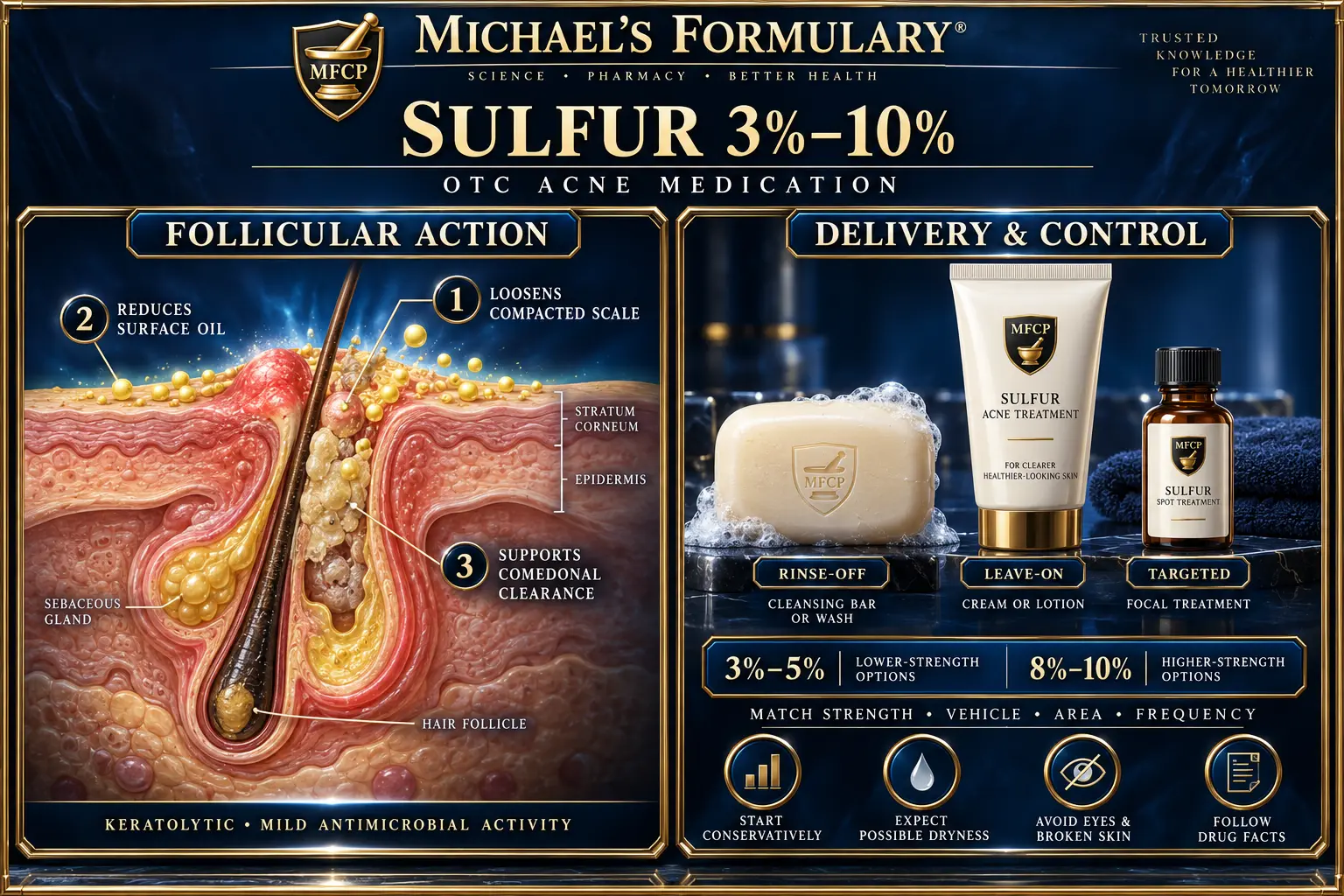
01 · Controlled Clinical PositionPharmacist Bottom Line™
Sulfur is an FDA-monographed topical acne active at 3% to 10% as a single ingredient and at 3% to 8% when combined with resorcinol 2% or resorcinol monoacetate 3%. It can support acne care through keratolytic and drying effects, but it is not automatically gentler, stronger, or more appropriate than benzoyl peroxide, salicylic acid, or adapalene.
02 · Active Ingredient ControlIdentity, Chemistry & Regulatory Position
| Established name | Sulfur; elemental sulfur |
| Common formulated material | Finely divided or precipitated sulfur dispersed in a cleanser, cream, lotion, mask, soap, or other topical vehicle |
| Physical character | Yellow solid; essentially insoluble in water |
| Single-active range | 3% to 10% |
| Permitted combinations | Sulfur 3% to 8% with resorcinol 2% or resorcinol monoacetate 3% |
| Current pathway | FDA OTC Monograph M006 |
| Historical citation | Formerly codified at 21 C.F.R. Part 333, Subpart D; M006 is the current controlling monograph. |
03 · Monograph at a Glance™MAG™
04 · Pharmacologic FoundationWhat Sulfur Does, and What Remains Uncertain
Boundary: Laboratory, historical, or off-label activity against fungi or Demodex does not expand the M006 acne indication and does not authorize eyelid or ocular application.
05 · Concentration Discipline3%–10% Is a Permitted Range, Not a Potency Ladder
| Label finding | Regulatory meaning | Clinical control |
|---|---|---|
| Sulfur 3%–10%, single active | Permitted M006 acne-active range. | Choose by the finished product’s form, directions, area, and tolerability; do not assume 10% is more effective. |
| Sulfur 3%–8% + resorcinol 2% | Permitted combination. | Use combination-specific eye and irritation warnings. |
| Sulfur 3%–8% + resorcinol monoacetate 3% | Permitted combination. | Verify both actives and strengths on Drug Facts. |
| Higher concentration | Not a monograph-defined severity tier. | May increase dryness, residue, odor, or irritation depending on vehicle and use. |
06 · Dosage-Form EngineeringRinse-Off, Leave-On & Targeted Products
| Dosage form | Control point | MFCP rule |
|---|---|---|
| Cleanser, soap, or bar | Wet application, coverage, contact, removal | Use the exact label; M006 provides no universal dwell time. |
| Mask or clay-based product | Layer thickness, drying time, prompt removal if uncomfortable | Mask directions are product-specific, not a class-wide schedule. |
| Cream, lotion, or ointment | Thin-layer field application | For applied products, start once daily and increase only if needed and tolerated. |
| Focal suspension or drying lotion | Whether the package directs shaking, mixing, or sediment application | Do not invent an “unshaken” technique; the finished-product label controls. |
| Combination product | All actives and warnings | Confirm sulfur plus resorcinol or resorcinol monoacetate strengths. |
07 · Label-Directed AdministrationOTC Directions
| Applied and left on | Clean skin thoroughly; cover the entire affected area with a thin layer one to three times daily. |
| Initiation | Start with one application daily, then increase gradually only if needed or directed. |
| Dryness or peeling | Reduce to once daily or every other day. |
| Applied and removed | Follow the product-specific directions for soaps, cleansers, masks, and other removed forms. |
| New-user test | A label may optionally direct sparse use on one or two small acne areas during the first three days. |
| Concurrent acne drugs | If irritation occurs, use only one topical acne medication at a time. |
08 · Practical TechniqueControlled Application
- Confirm acne.Do not treat an uncertain rash, folliculitis, rosacea, dermatitis, or eyelid condition as acne by default.
- Read Drug Facts.Confirm active ingredient, strength, dosage form, directions, warnings, and whether the product is removed or left on.
- Limit the field.Use only on acne-affected areas; do not apply to broken skin or large areas.
- Start low in frequency.For leave-on use, begin once daily; do not start multiple drying acne products simultaneously.
- Watch the barrier.Scale, tightness, burning, redness, or worsening itch means reduce frequency or stop according to the label.
09 · Regimen EngineeringUsing Sulfur with Other Acne Actives
| Sulfur + benzoyl peroxide | Both can dry and irritate. Separate products by time or alternate days only after tolerability is established; do not assume added efficacy. |
| Sulfur + salicylic acid | Compounded desquamation may impair the barrier. Prefer one primary keratolytic at initiation. |
| Sulfur + adapalene | Introduce sequentially, not simultaneously on day one. Use a bland moisturizer and reduce frequency if irritation develops. |
| Sulfur + resorcinol system | Use only a finished product with M006-compliant concentrations and combination warnings. |
| Moisturizer and sunscreen | Use non-comedogenic supportive care as needed; these reduce regimen friction but do not replace the acne medication. |
10 · TolerabilityAdverse Effects & Product Limitations
Comparison control: Sulfur does not have benzoyl peroxide’s oxidant textile-bleaching warning, but it can still stain, leave residue, or damage jewelry depending on formulation.
11 · Special ConsiderationsAllergy Language, Pregnancy & Off-Label Boundaries
| “Sulfa” antibiotic allergy | Elemental sulfur is chemically distinct from sulfonamide antimicrobials and sulfites. A sulfonamide label alone does not establish sulfur allergy, but prior severe or uncertain reactions warrant clinician review. |
| Pregnancy or breast-feeding | M006 does not create a sulfur-specific pregnancy contraindication. Seek individualized advice for extensive, prolonged, occluded, or non-acne use; avoid infant contact with treated skin. |
| Children | Follow the exact product’s age directions and avoid unsupervised use over large or damaged areas. |
| Deeper skin tones | Prevent irritation deliberately because inflammation from overuse can worsen post-inflammatory discoloration. |
| Rosacea or Demodex | Potential off-label roles do not belong to self-directed M006 acne treatment; persistent facial papules require diagnostic separation. |
| Eyelids and eyes | Do not apply an acne product to eyelids or ocular surfaces. Combination labels direct immediate rinsing if product enters the eyes. |
12 · Safety GateStop, Refer & Reassess
13 · Product SelectionMFCP Buying Standard™
- Drug Facts identifies sulfur 3% to 10% as an acne active, or a permitted sulfur/resorcinol combination.
- The package clearly states whether the product is leave-on or removed.
- Directions specify frequency, removal, and any product-specific contact time.
- The treatment area is small enough to comply with the warning against large-area use.
- The vehicle is acceptable for odor, residue, dryness, fragrance, and routine adherence.
- No “maximum strength” claim substitutes for comparing the active concentration and directions.
- Ocular, rosacea, antifungal, or antiparasitic claims are not inferred from an acne label.
14 · Evidence ControlPrimary Sources & Readability Disclosure
- FDA OTC Monograph M006: Topical Acne Drug Products
- DailyMed: Sulfur 3.5% Acne Treatment Mask
- Gupta and Nicol: The Use of Sulfur in Dermatology
- Sulfur Revisited
- Cochrane Review: Topical Sulfur and Other Agents for Acne
Evidence control: M006 and the finished-product Drug Facts label control permitted strengths, indications, directions, and warnings. Literature does not create a universal dwell time, concentration-to-severity ladder, sediment technique, or non-acne indication.
Readability disclosure: This educational monograph supports product selection, counseling, and referral. It does not diagnose acne or replace individualized care.
← Return to Acne & Keratolytic Therapy