
Salicylic Acid 0.5%–2%
Beta-hydroxy-acid acne active for comedonal clearance through controlled keratolysis, vehicle selection, and deliberate irritation management.
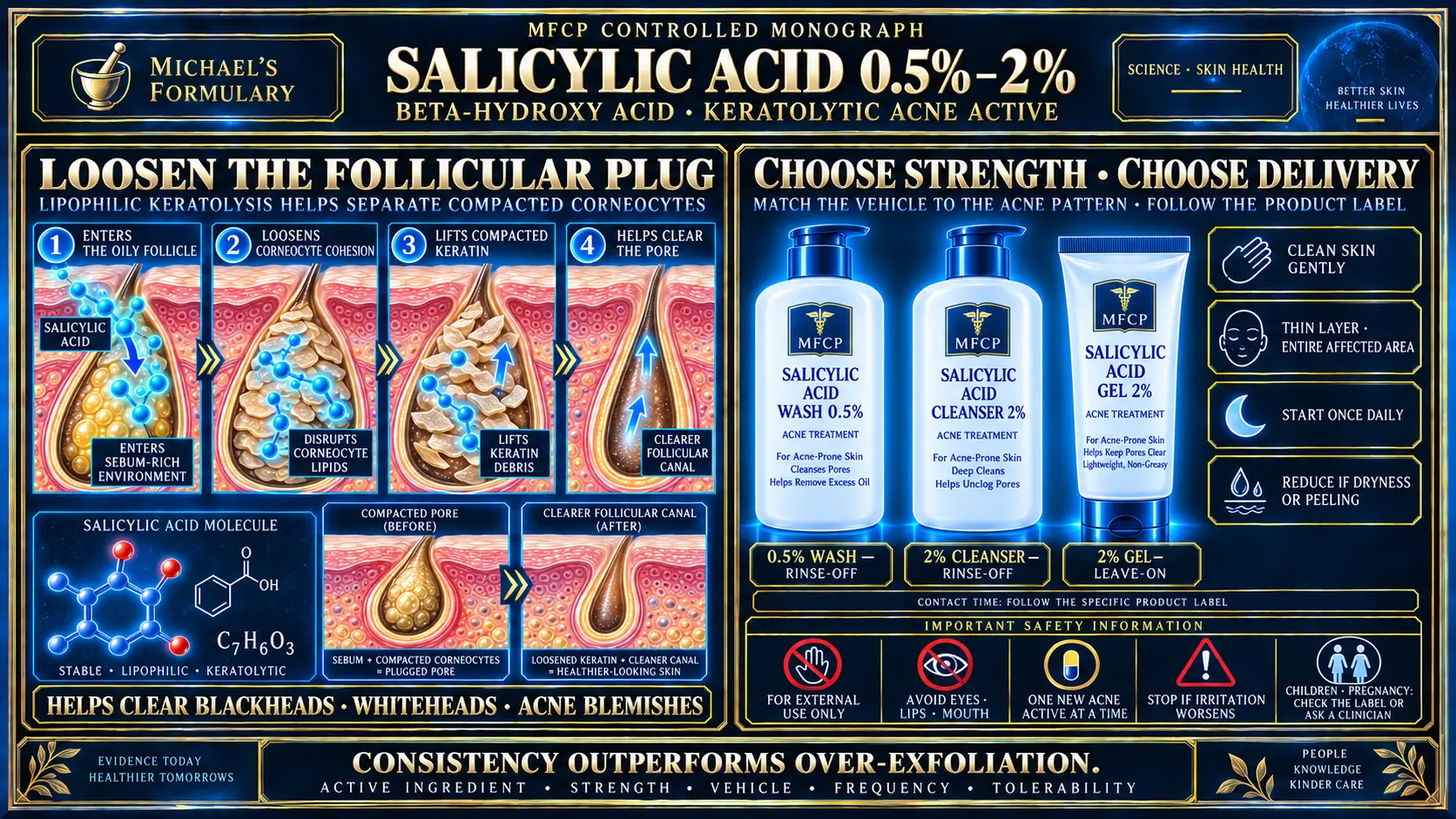
01 · Controlled Clinical PositionPharmacist Bottom Line™
Salicylic acid is an FDA OTC acne active at 0.5% to 2%. It reduces cohesion among compacted corneocytes so follicular plugs can loosen and comedones can clear. It is not a substitute for benzoyl peroxide when antimicrobial oxidation is the main objective, or for referral when acne is deep, painful, draining, or scar-forming.
02 · Active Ingredient ControlIdentity, Chemistry & Regulatory Position
| Established name | Salicylic acid; 2-hydroxybenzoic acid |
| Formula / molecular weight | C7H6O3 / 138.12 g/mol |
| pKa | Approximately 2.97 |
| Drug role | Lipophilic beta-hydroxy-acid keratolytic acne medication |
| OTC acne range | 0.5% to 2% |
| Current pathway | FDA OTC Monograph M006 |
| Historical citation | Formerly 21 C.F.R. Part 333, Subpart D; M006 is the current controlling monograph. |
03 · Monograph at a Glance™MAG™ Clinical Snapshot
04 · Follicular KeratolysisMechanism · Corneocyte-Cohesion Control
Salicylic acid partitions into lipid-rich surface and follicular environments. It reduces cohesion among corneocytes, including compacted follicular keratin, promoting desquamation and gradual comedonal clearance. Any direct antimicrobial effect is secondary and weaker than benzoyl peroxide’s oxidizing action.
05 · Concentration Discipline0.5% vs. 1% vs. 2%
| Strength | Typical placement | Interpretation | Control |
|---|---|---|---|
| 0.5% | Some cleansers, lotions, and lower-strength leave-on products | Lower labeled concentration for gradual initiation. | Vehicle still determines irritation and frequency. |
| 1% | Some cleansers, lotions, and gels | Intermediate concentration; not a separate regulatory subclass. | Confirm drug indication and exact label. |
| 2% | Cleansers, gels, solutions, and medicated pads | Maximum M006 acne concentration. | Alcohol-rich pads and leave-on vehicles may irritate more. |
No vehicle stereotype: Do not infer contact time, frequency, alcohol content, or tolerability from concentration alone.
06 · Dosage-Form DisciplineRinse-Off, Leave-On & Pad Systems
| System | Behavior | MFCP rule |
|---|---|---|
| Cleanser or wash | Surfactant-assisted coverage followed by removal. | Dampen, massage, rinse, and dry as the label directs; no universal dwell time applies. |
| Gel or lotion | Leave-on field exposure with sustained keratolysis. | Use a thin layer and reduce frequency for peeling. |
| Solution or pad | Rapid spreading; alcohol and friction may add dryness. | Use light pressure, avoid repeated scrubbing, and close the container. |
| Patch or specialty vehicle | Delivery depends on the finished Drug Facts label. | Verify active, strength, indication, and directions; not every hydrocolloid disc is medicated. |
07 · Label-Directed AdministrationOTC Directions
| Preparation | Clean skin before a leave-on product; follow dampening and rinsing instructions for a cleanser. |
| Coverage | Cover the entire affected area with a thin layer for leave-on use. |
| Start | Begin once daily, then increase only if needed and tolerated. |
| Frequency | Many applied products permit one to three times daily; the exact label controls. |
| Dryness | Reduce to once daily or every other day. |
| Rinse-off time | Follow the selected cleanser label; M006 gives no universal dwell time. |
| Eyes | Rinse immediately and thoroughly with water when directed. |
08 · Technique ControlPreserve the Barrier
- Confirm a comedonal or mild mixed-acne pattern rather than dermatitis, rosacea, or folliculitis.
- Choose one salicylic-acid vehicle and document baseline dryness and other acne products.
- Start once daily unless the selected product differs.
- Use a thin layer or gentle cleanser contact; do not scrub with a medicated pad.
- Avoid eyes, lips, mouth, and irritated or eroded skin.
- Use moisturizer and sunscreen when compatible with the regimen.
- Reduce frequency before escalating strength when peeling appears.
09 · Deliberate Combination TherapyRegimen Engineering
| Combination | Role | Control |
|---|---|---|
| Salicylic acid + benzoyl peroxide | Keratolytic plus oxidizing pathways. | Do not automatically layer two leave-ons; establish tolerance and separate timing if needed. |
| Salicylic acid + adapalene | Comedolytic support plus follicular normalization. | Simultaneous leave-on initiation may amplify irritation; consider rinse-off morning use and nighttime adapalene. |
| Salicylic acid + abrasive scrub | No routine advantage. | Friction plus chemical exfoliation increases barrier injury. |
| Salicylic acid + moisturizer | Supports tolerability. | Choose noncomedogenic support and introduce one change at a time. |
10 · Tolerability ControlAdverse Effects & Overexposure
11 · Population SafeguardsAge, Pregnancy & Salicylate History
| Children | Follow exact age directions; avoid extensive, occluded, or unsupervised use on damaged skin. |
| Pregnancy or breast-feeding | M006 has no universal pregnancy contraindication. Ask a clinician before large-area, prolonged, occluded, or non-acne use. |
| Serious aspirin or salicylate reaction | Do not assume universal cross-reactivity; obtain guidance when history includes anaphylaxis, angioedema, or bronchospasm. |
| Barrier-impaired skin | Avoid routine application to eroded, inflamed, or extensively eczematous skin. |
| Large trunk area | Prefer controlled rinse-off use or professional guidance over unrestricted leave-on coverage. |
| Hyperpigmentation-prone skin | Prevent irritation deliberately because inflammation can worsen discoloration. |
12 · Safety & EscalationWarnings, Toxicity Signals & Referral
- For external use only. Concurrent topical acne medicines increase dryness and irritation.
- Follow exact eye-contact, application-area, and stop-use warnings.
- If swallowed, obtain medical help or contact Poison Control promptly.
- Stop for persistent irritation, swelling, hives, wheezing, or widespread eruption.
- Urgently assess tinnitus, repeated vomiting, rapid breathing, confusion, or unusual lethargy after excessive use.
- Refer deep nodules, cysts, drainage, scarring, severe pain, rapid worsening, uncertain diagnosis, or treatment failure.
13 · Shelf VerificationMFCP Buying Standard™
| Active | Salicylic acid |
| Acne strength | 0.5%–2% |
| Purpose | Acne medication or acne treatment |
| Form | Confirm rinse-off cleanser versus leave-on gel, lotion, solution, or pad |
| Directions | Verify coverage, frequency, rinse instructions, and dryness-reduction steps |
| Inactive ingredients | Check alcohol, fragrance, surfactants, and potential irritants |
| Quality | Reject expired, opened, leaking, dried-out, contaminated, or improperly stored product |
14 · Evidence ControlPrimary Sources & Readability Disclosure
- FDA OTC Monograph M006: Topical Acne Drug Products
- DailyMed: Salicylic Acid 2% Acne Cleanser
- DailyMed: Salicylic Acid 2% Acne Treatment Pads
- NLM PubChem: Salicylic Acid
- Arif: Salicylic Acid as a Peeling Agent
Evidence control: M006 and the finished-product Drug Facts label control strength, indication, directions, warnings, and stop rules. Literature does not create a universal pH, contact time, or schedule.
Readability disclosure: This educational monograph supports selection and referral. It does not diagnose acne or replace individualized care.
← Return to Acne & Keratolytic Therapy