
Benzoyl Peroxide 2.5%–10%
Non-antibiotic oxidizing acne active with rinse-off and leave-on pathways controlled by strength, vehicle, frequency, tolerability, and the finished-product label.
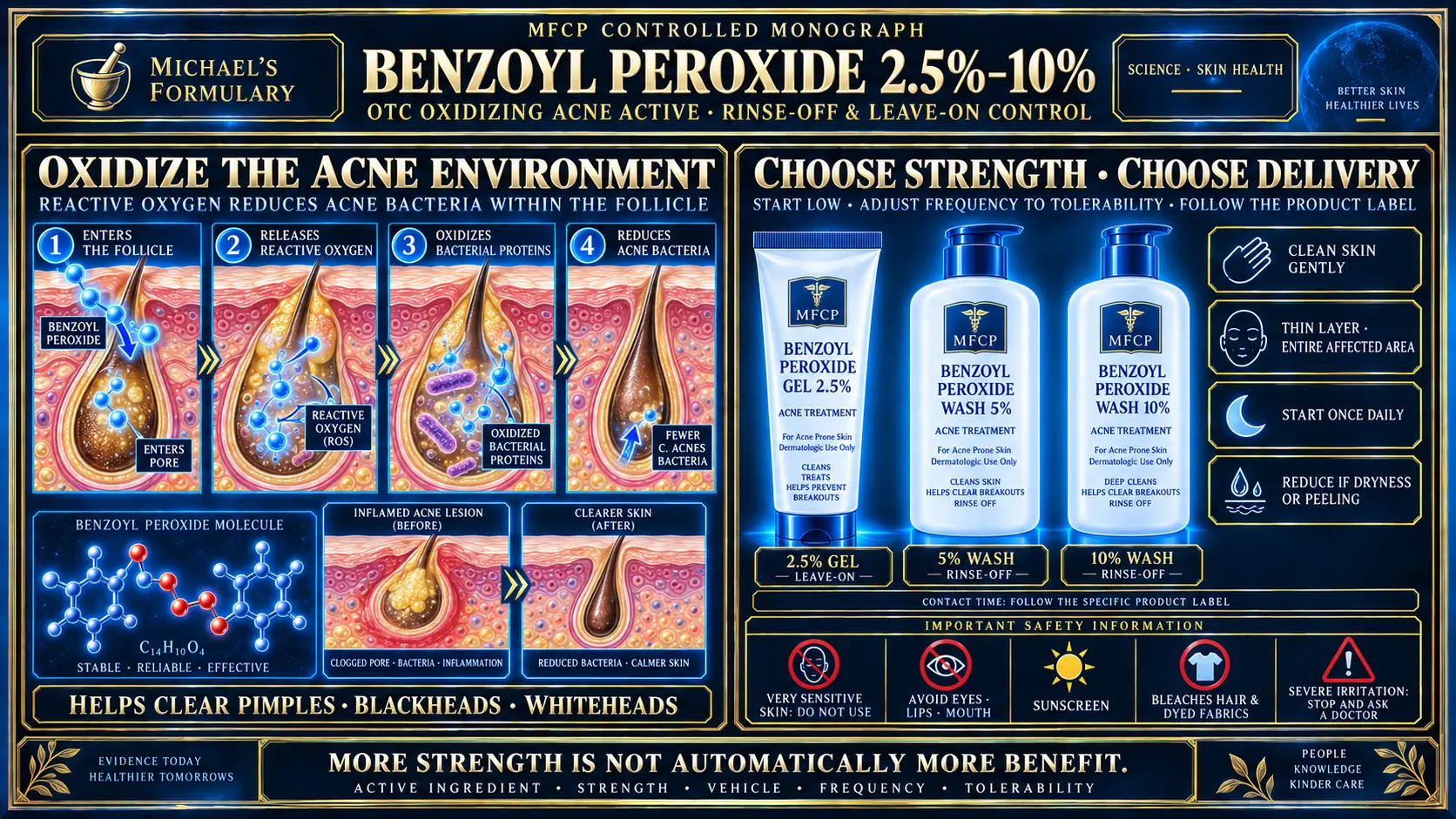
01 · Controlled Clinical PositionPharmacist Bottom Line™
Benzoyl peroxide is an OTC acne medication at 2.5% to 10%. It reduces acne-associated bacteria through oxidative activity and provides mild comedolytic effects without functioning as an antibiotic. Lower concentrations may perform as well as higher concentrations for inflammatory acne while causing less irritation; vehicle and adherence often matter more than selecting the largest number on the package.
02 · Active Ingredient ControlIdentity, Chemistry & Regulatory Position
| Established name | Benzoyl peroxide |
| Formula / molecular weight | C14H10O4 / 242.23 g/mol |
| Drug role | Topical oxidizing acne medication; non-antibiotic antimicrobial and mild comedolytic active |
| OTC range | 2.5% to 10% |
| Current regulatory pathway | FDA OTC Monograph M006, Topical Acne Drug Products for OTC Human Use |
| Historical citation | Formerly codified in 21 C.F.R. Part 333, Subpart D; M006 is the current controlling OTC monograph. |
03 · Monograph at a Glance™MAG™ Clinical Snapshot
04 · Oxidizing ActionMechanism · Follicular Reactive-Oxygen Delivery
Benzoyl peroxide decomposes in skin to benzoic acid and reactive oxygen intermediates. Oxidative damage to microbial proteins and other cellular components lowers the burden of Cutibacterium acnes within the follicular environment. Mild desquamative activity can also help loosen follicular keratin.
05 · Concentration Discipline2.5% vs. 5% vs. 10%
| Strength | Clinical interpretation | Irritation burden | Selection control |
|---|---|---|---|
| 2.5% | Established strength with comparative efficacy against inflammatory acne. | Usually lowest. | Practical facial starting point when the label fits. |
| 5% | Intermediate strength in leave-on and removed products. | Moderate and vehicle-dependent. | Consider after 2.5% tolerance or for a preferred vehicle. |
| 10% | Highest M006 concentration; common in washes and some leave-on products. | Greater potential for dryness and stinging. | Often used for trunk or rinse-off delivery; not automatically superior. |
Comparative efficacy does not make all products interchangeable. Vehicle, application area, adherence, contact time, lesion pattern, and study design affect outcomes.
06 · Dosage-Form DisciplineLeave-On and Removed Delivery Systems
| System | Behavior | MFCP rule |
|---|---|---|
| Leave-on gel, cream, lotion | Sustained field contact with greater cumulative exposure. | Use a thin layer at the labeled frequency. |
| Wash or cleanser | Broad face or trunk coverage with removal by water. | Follow exact wetting, massage, timing, rinse, and drying directions. |
| Soap or mask | Product-specific removed dosage form. | M006 requires appropriate directions; it provides no universal contact time. |
| Focal product | Targets limited visible lesions. | Do not substitute spot treatment for field control or referral. |
Short-contact evidence: One controlled study found a two-minute 9.8% foam regimen reduced C. acnes on the back; a current 10% wash label directs one to two minutes. These do not authorize one timing rule for every wash.
07 · Label-Directed AdministrationOTC Directions
| New-user test | When labeled, use one or two small affected areas for the first three days. |
| Preparation | Clean skin before leave-on use; follow shaking and wetting directions for washes. |
| Coverage | For leave-on products, cover the entire affected area with a thin layer. |
| Start | Begin once daily, then increase only if needed and tolerated. |
| Dryness or peeling | Reduce to once daily or every other day. |
| Rinse-off time | Use the exact timing on the selected product. |
| Outdoor use | Apply sunscreen after use as directed; stop both products if sensitivity develops. |
08 · Technique ControlProtect Skin, Hair & Textiles
- Confirm an acne-compatible pattern and assess pain, nodules, drainage, scarring, and skin integrity.
- Start with one benzoyl peroxide product and one defined delivery route.
- Keep away from eyes, lips, mouth, and other mucosa.
- Wash hands and allow treated skin to dry before touching fabrics.
- Use white towels and light linens when practical; the active can bleach hair and dyes.
- Avoid aggressive scrubbing and simultaneous initiation of several irritating actives.
- Follow labeled storage and discard expired or heat-damaged products.
09 · Deliberate Combination TherapyRegimen Engineering
| Combination | Value | Control |
|---|---|---|
| BPO + adapalene | Oxidizing antimicrobial plus follicular normalization; fixed-dose prescription products establish compatibility. | Introduce deliberately; separate times or use a wash if irritation limits adherence. |
| BPO + antibiotic | Helps reduce selection pressure for antibiotic-resistant acne organisms. | Antibiotics require clinician-directed stewardship and duration. |
| BPO + salicylic acid | Complementary oxidizing and keratolytic activity. | Concurrent leave-on use may compound irritation; establish tolerance first. |
| BPO + harsh exfoliation | No routine advantage. | Scrubs, peels, or multiple acids may damage the barrier. |
10 · Tolerability ControlAdverse Effects & Hypersensitivity
11 · Outcome ControlExpected Response & Referral
| Mild dryness | Reduce frequency, simplify the regimen, and support the barrier. |
| Gradual improvement | Continue consistent label-directed use rather than increasing strength. |
| No meaningful improvement | Verify diagnosis, adherence, vehicle, and tolerance; refer after an adequate trial fails. |
| Deep nodules, cysts, drainage, scarring | Refer promptly. |
| Monomorphic itchy bumps | Reassess for folliculitis or another diagnosis. |
| Hives, swelling, breathing difficulty | Stop immediately and seek emergency care. |
12 · Safety & EscalationWarnings, Product Quality & Referral
- External use only. Do not use with very sensitive skin or known benzoyl peroxide sensitivity.
- Concurrent topical acne medicines increase dryness and irritation.
- Avoid unnecessary sun; use sunscreen and protective measures.
- Avoid eyes, lips, mouth, hair, and dyed fabrics.
- If swallowed, obtain medical help or contact Poison Control promptly.
- Refer severe, painful, rapidly worsening, scar-forming, draining, or uncertain disease.
- FDA testing reported in 2025 found more than 90% of 95 tested products had undetectable or extremely low benzene; six had elevated levels and prompted limited retail-level recalls.
13 · Shelf VerificationMFCP Buying Standard™
| Active | Benzoyl peroxide |
| Strength | 2.5%–10%; select deliberately |
| Form | Confirm leave-on versus removed system |
| Directions | Verify frequency, contact time, removal, sunscreen, and new-user test |
| Warnings | Very sensitive skin, other acne medicines, sun, mucosa, irritation, and bleaching |
| Storage | Follow labeled temperature and avoid excessive heat |
| Quality | Reject expired, recalled, opened, leaking, contaminated, or heat-damaged product |
14 · Evidence ControlPrimary Sources & Readability Disclosure
- FDA OTC Monograph M006: Topical Acne Drug Products
- DailyMed: Benzoyl Peroxide 2.5% Gel
- DailyMed: Benzoyl Peroxide 10% Wash
- Mills et al.: Comparing 2.5%, 5%, and 10%
- Leyden and Del Rosso: Short-Contact Therapy
- Walsh et al.: Antibiotic Resistance in Acne
- DailyMed: Adapalene/Benzoyl Peroxide Combination
- FDA: Rare Serious Hypersensitivity Reactions
- FDA: 2025 Product Testing and Limited Recalls
Evidence control: FDA M006 and the exact Drug Facts label control strengths, uses, directions, warnings, and stop rules. Trials support interpretation but do not override product labeling.
Readability disclosure: This educational monograph supports selection and referral. It does not diagnose acne or replace the current label and individualized care.
← Return to Acne & Keratolytic Therapy