
Polyol Ophthalmic Lubricants PEG 400 0.4% + Propylene Glycol 0.3% · Propylene Glycol 0.6%
Separate the active identity from the vehicle: aqueous gel-forming systems and lipid-support emulsions can share a clinical aisle without being one fixed formulation.
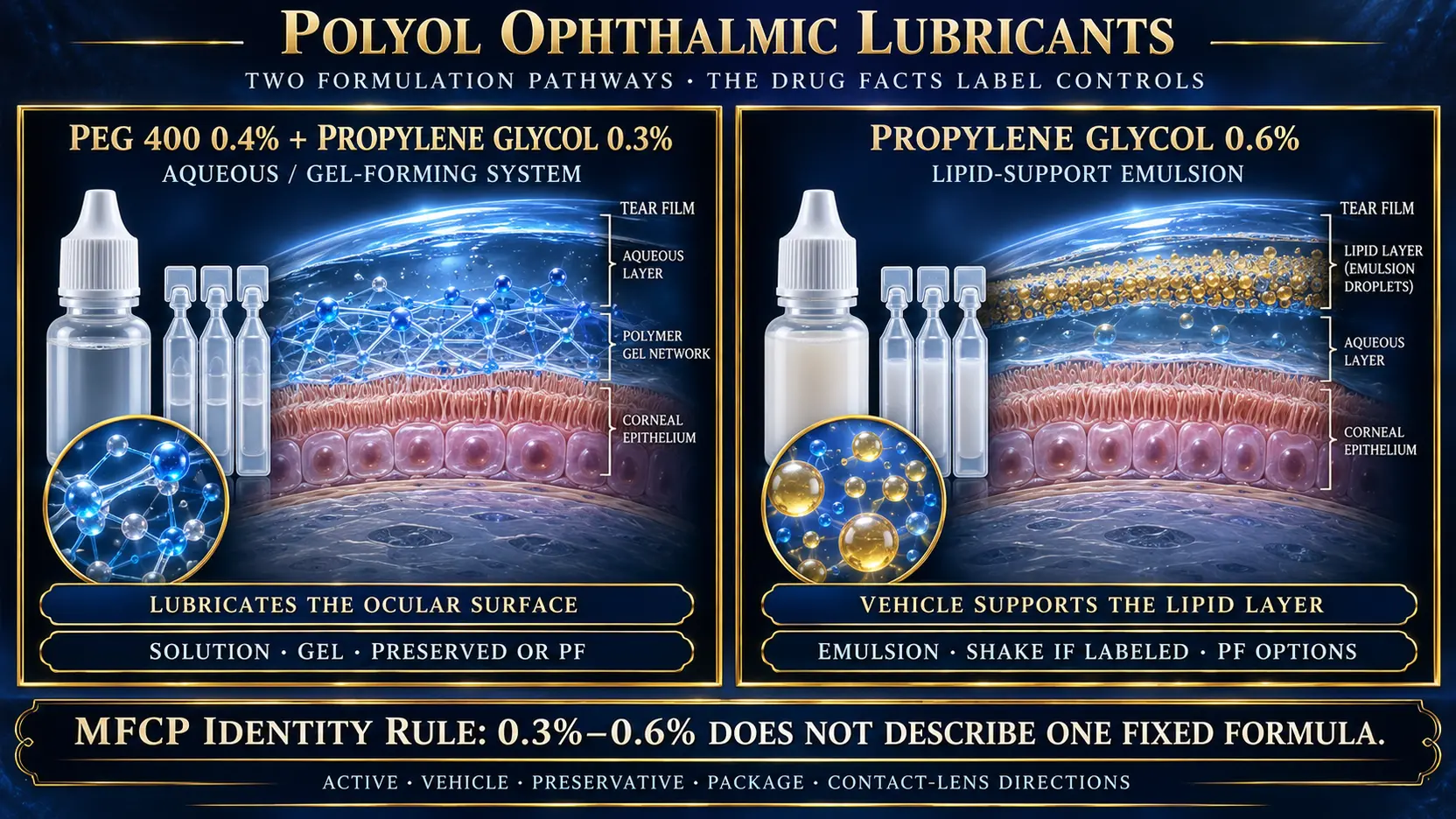
Regulatory and Chemical IdentityTwo Demulcents, Multiple Finished-Product Architectures
PEG 400 is a mixture of relatively low-molecular-weight polyethylene glycols. Its ether oxygens and terminal hydroxyl groups associate with water, supporting wetting and lubrication in the finished ophthalmic vehicle.
Propylene glycol is a water-miscible diol used as an ophthalmic demulcent. Within a sterile formulation it contributes lubrication and water retention at the ocular surface.
FDA OTC Monograph M018 permits PEG 400 and propylene glycol individually within this range and permits combinations of specified demulcents. The finished label—not a family shorthand—establishes the actual active set and strength.
Molecular and Tear-Film FrameworkHydration, Lubrication & Vehicle-Dependent Residence
PEG 400 and propylene glycol contain oxygen-bearing groups that interact with water. In a finished sterile drop, these interactions help create a lubricating aqueous film over the corneal and conjunctival surfaces.
The lubricating film reduces direct interaction between the lid and ocular surface and helps protect against further minor irritation. The magnitude and duration depend on viscosity, polymers, salts, lipids, and dosing.
Clinical studies of particular PEG/PG–HP-guar products report improved symptoms or tear-film measures. Those results cannot be transferred unchanged to every product sharing the same active percentages.
Formulation ArchitectureSolution, HP-Guar Matrix & Lipid Emulsion
A water-rich formulation provides immediate lubrication with comparatively low instillation resistance. Electrolytes, buffering, tonicity, and preservative architecture vary by product.
Some products contain hydroxypropyl guar and borate. Changes in tear chemistry after instillation promote a more structured viscoelastic network that can increase surface residence. It is cross-linking or complexation—not polymerization—and exact pH values are formulation-specific.
Emulsion products may pair the labeled demulcent with mineral oil, phospholipids, surfactants, hyaluronate, or related inactive ingredients. These vehicle components distribute lipid droplets and support the tear-film lipid phase; propylene glycol alone should not receive that claim.
Package and Excipient ControlSolutions, Emulsions, Gels & Sterile Delivery
Some PEG 400/propylene glycol multidose solutions use polyquaternium-1. Other products use different preservatives. Read the inactive-ingredient panel; do not assign Polyquad to the active pair itself.
A valve, filter, tip-seal, or related package can protect the contents without a conventional chemical preservative. Priming, handling, and after-opening discard instructions depend on the exact device.
Single-dose vials avoid routine preservative exposure. Do not reuse an opened vial; discard it according to its labeling even when liquid remains.
Lower-viscosity solutions generally interfere less with vision. Structured or gel-forming vehicles may increase residence and temporary blur.
Oil droplets and emulsifiers can supplement the tear-film lipid phase and may suit evaporative symptoms. Shake only when the specific label directs it.
Do not touch the tip, share the container, use a damaged vial, or continue a product that changes color or becomes cloudy when its label prohibits use.
Pattern Before PackageAqueous-Deficient and Evaporative Dryness
| Control Point | Aqueous / Gel-Forming Pathway | Lipid-Support Emulsion Pathway |
|---|---|---|
| Primary formulation goal | Hydrate and lubricate the aqueous-mucin environment; some vehicles form a more persistent polymer matrix. | Lubricate while delivering oil-phase excipients intended to supplement or stabilize the outer lipid layer. |
| Useful symptom pattern | Dry, gritty, burning eyes where a water-rich drop or gel is preferred. | Evaporative symptoms, rapid tear breakup, or meibomian-gland-related lipid deficiency may favor a lipid-containing vehicle after appropriate assessment. |
| Visual trade-off | Solutions usually clear rapidly; thicker or gel-forming systems may blur temporarily. | Emulsions may look milky and can blur temporarily; appearance alone does not indicate contamination when it matches the label. |
| Dosing | Representative Drug Facts labeling directs 1 or 2 drops in affected eye(s) as needed. Use the specific label and clinician instructions. | |
| Claim boundary | OTC labeling supports temporary relief of dryness-related burning and irritation. It does not independently diagnose the dry-eye subtype or establish treatment of corneal disease. | |
Administration and IntegrationRegimen Controls Without False Precision
Representative labels use as-needed dosing rather than a universal BID, TID, QID, or bedtime schedule. Do not infer frequency from concentration or vehicle alone.
Follow the medicated-drop label and clinician instructions. When sequencing is not specified, professional guidance is preferable; thicker gels and ointments are commonly placed after thinner drops.
Neither an aqueous PEG/PG solution nor a preservative-free package automatically authorizes use over lenses. Remove lenses and observe the exact reinsertion interval unless that product is specifically labeled for lens wear.
Short tear break-up time can support evaporative instability, but fixed TBUT and Schirmer cutoffs do not reliably select a retail product without symptoms, examination, technique, and device context.
Transient blur varies with drop volume, polymer and lipid load, blink behavior, ocular surface, and individual perception. Exact 10–30-second or 2–5-minute promises are not transferable.
LASIK, PRK, cataract surgery, neurotrophic keratitis, recurrent erosion, and exposure keratopathy require individualized care. A preservative-free package does not turn self-care into a treatment plan.
Drug Facts and Device BoundariesFive Controls That Do Not Transfer Between Products
PEG 400 0.4% + propylene glycol 0.3% and propylene glycol 0.6% are separate labeled pathways.
Preserved, multidose preservative-free, and unit-dose preservative-free versions require different handling.
An ocular lubricant is not automatically a contact-lens rewetting drop. Remove lenses and observe the stated interval unless the exact product authorizes instillation during wear.
Some emulsions require shaking; clear aqueous solutions may not. Follow the package rather than transferring technique.
Follow therapeutic product directions and professional advice. Thicker gels or ointments are generally placed after thinner medicated drops.
Stop use and ask a doctor for eye pain, vision changes, continued redness or irritation, worsening, or symptoms persisting beyond the labeled interval.
Controlling SourcesEvidence & Labeling
- U.S. Food and Drug Administration. OTC Monograph M018: Ophthalmic Drug Products for OTC Human Use.
- DailyMed. PEG 400 0.4% / propylene glycol 0.3% Polyquad-preserved multidose lubricant solution.
- DailyMed. PEG 400 0.4% / propylene glycol 0.3% preservative-free single-use lubricant solution.
- DailyMed. Propylene glycol 0.6% preservative-free ophthalmic emulsion.
- Uchiyama E, et al. Randomized crossover study of an HP-guar-containing artificial tear and ocular-surface evaporation.
- Bustamante-Arias A, et al. ENRICHED prospective single-arm study of preservative-free PEG 400 / propylene glycol lubricant drops.
- Multicenter prospective study of a phospholipid nanoemulsion-based ocular lubricant across dry-eye subtypes.