OPHTHALMIC SOLUTION / DROPS
Supported by current official labeling.

One active ingredient. Three concentrations. The package label controls the schedule.
Supported by current official labeling.
Explicitly excluded from this controlled presentation.
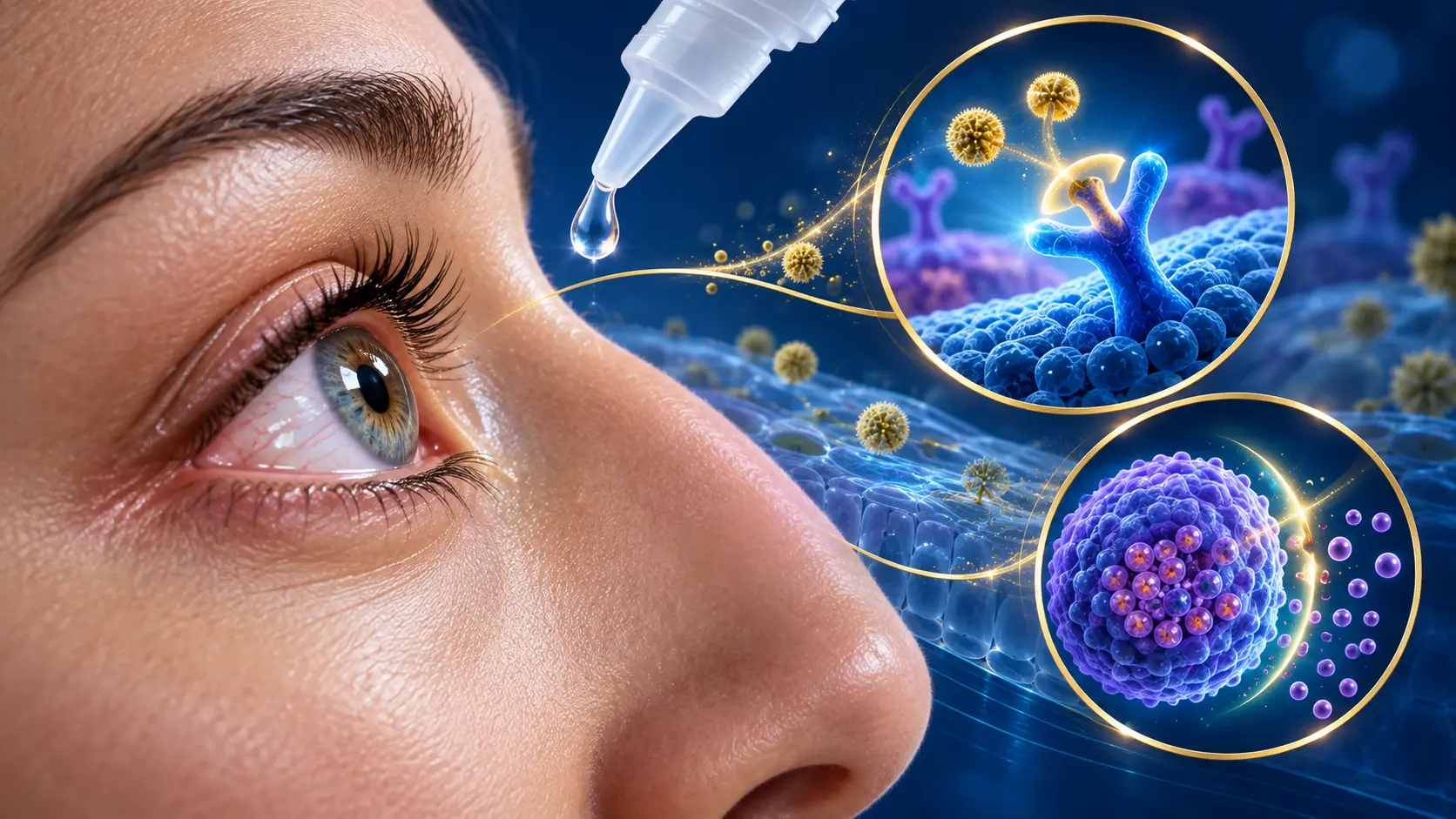

A sterile drop spreads across the ocular surface.
Allergen exposure activates mast cells and histamine signaling.
Olopatadine blocks ocular H1-receptor signaling.
It also inhibits histamine release from mast cells.
Strength, schedule, contact lenses, and the current label control use.
Dual action temporarily relieves itchy allergic eyes.
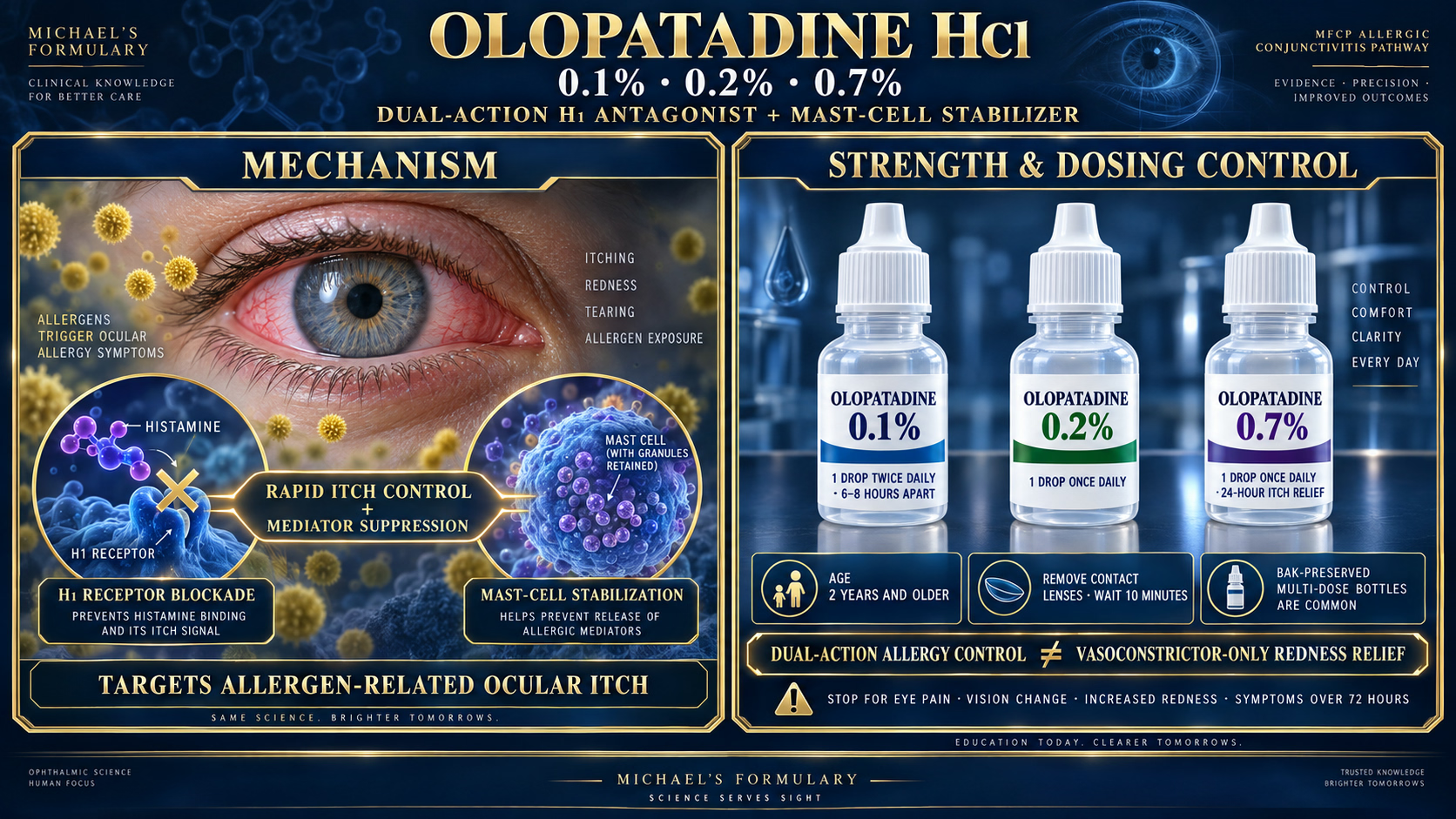
Antihistamine · Mast-cell stabilizer
Temporary relief of ocular itching due to common allergens.
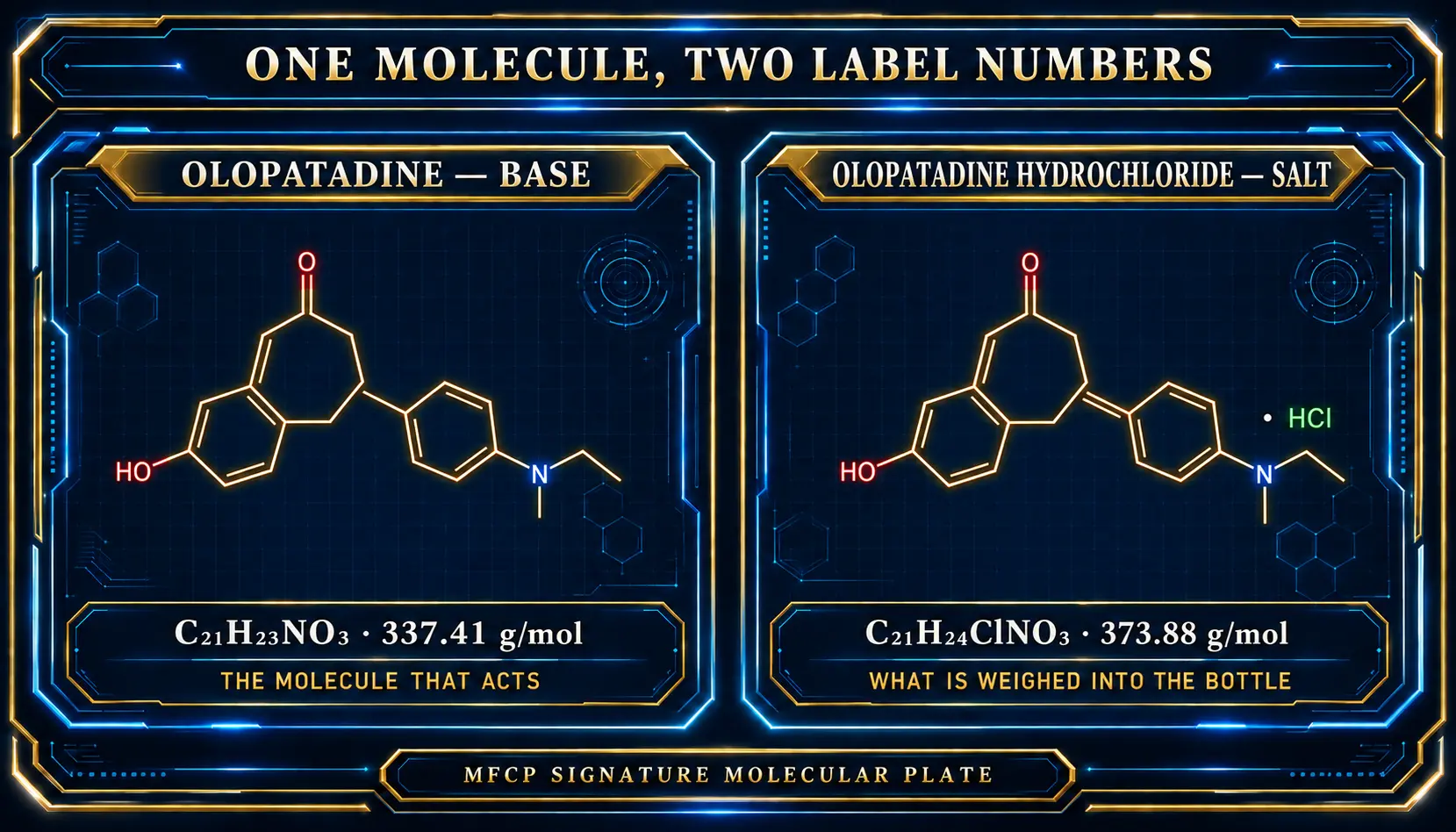
Formula: C₂₁H₂₃NO₃
Molecular weight: 337.41 g/mol
This is the active amount declared by the Drug Facts strength.
Formula: C₂₁H₂₄ClNO₃
Molecular weight: 373.88 g/mol
This is the hydrochloride equivalent used in the formulation statement.
| Drug Facts base strength | Hydrochloride equivalent | Base concentration |
|---|---|---|
| 0.1% | 0.111% | 1 mg/mL |
| 0.2% | 0.222% | 2 mg/mL |
| 0.7% | 0.776% | 7 mg/mL |
The base strength and hydrochloride equivalent describe the same medicine. They are not two doses.
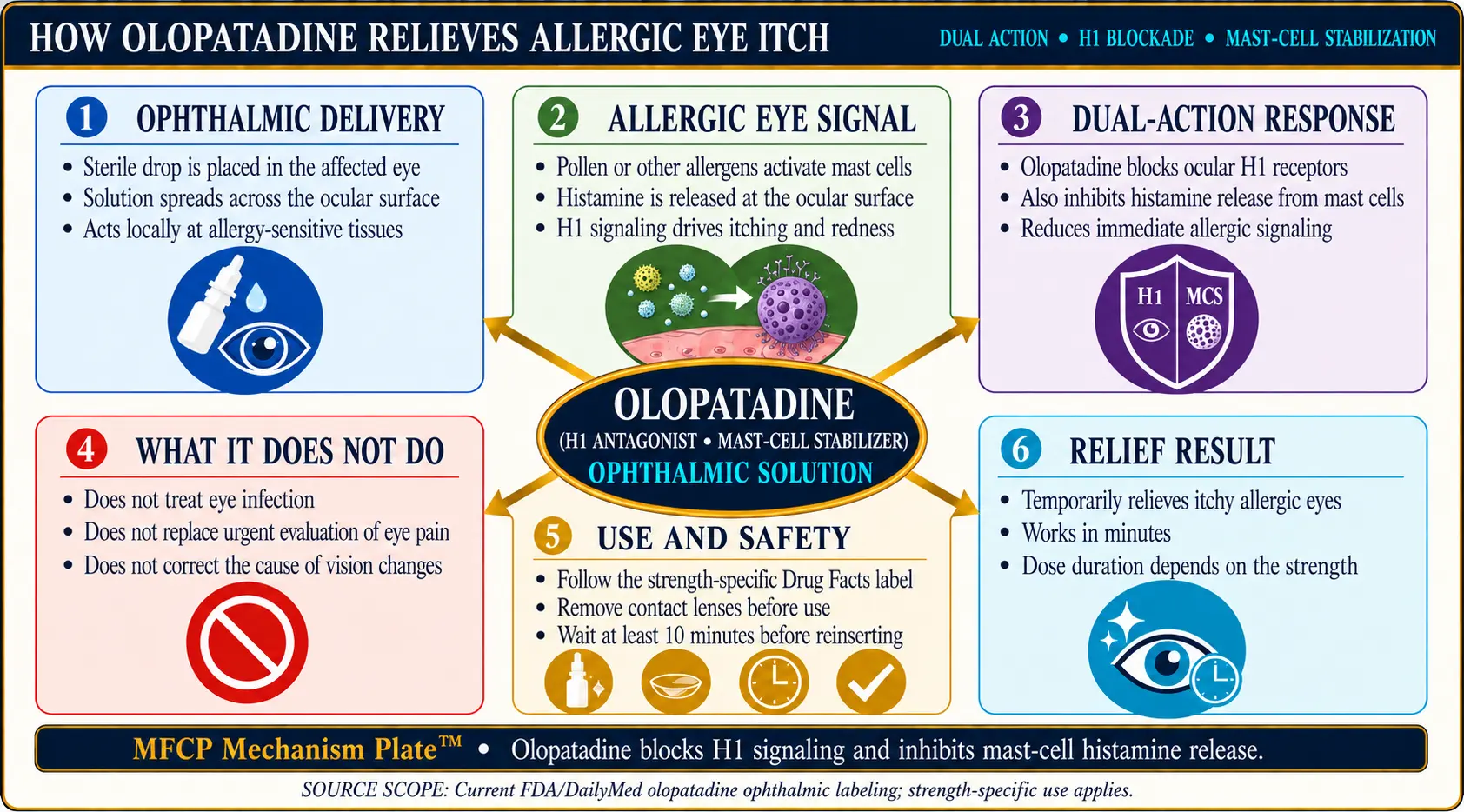
Olopatadine is a relatively selective H1-receptor antagonist and inhibits histamine release from mast cells. These actions reduce the allergic response on the ocular surface.
H1 blockade reduces histamine signaling. Mast-cell inhibition reduces mediator release.
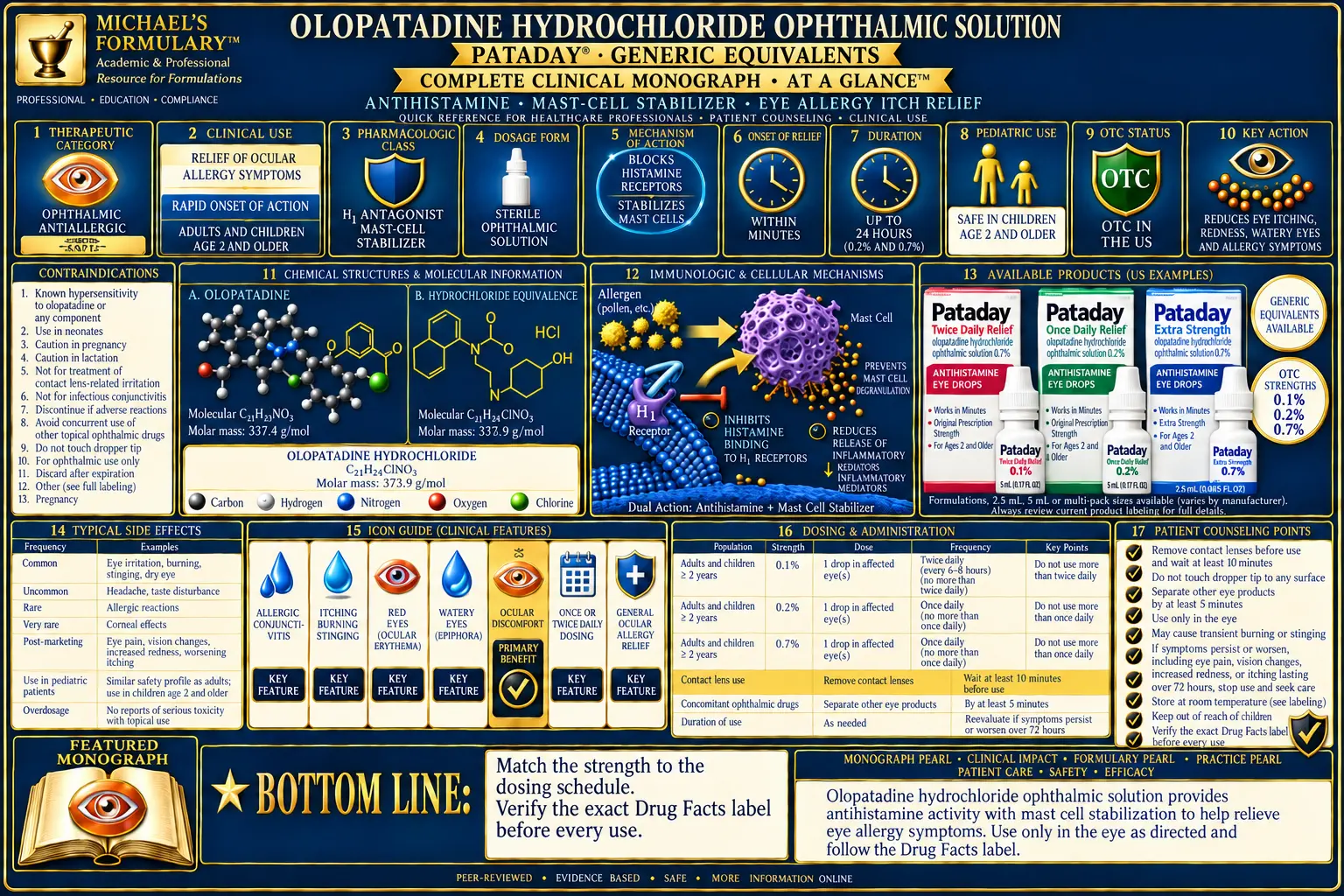
This controlled monograph covers OTC olopatadine ophthalmic solution in 0.1%, 0.2%, and 0.7% strengths, including Pataday® and current generic equivalents. The exact Drug Facts label on the selected bottle controls.
Match the bottle strength to its dosing schedule. The three concentrations are not interchangeable.
| Active strength | Hydrochloride equivalent | Drug Facts schedule for adults and children 2 years and older |
|---|---|---|
| Olopatadine 0.1% | Olopatadine hydrochloride 0.111% | Put 1 drop in the affected eye(s) twice daily, every 6 to 8 hours; do not use more than twice daily. |
| Olopatadine 0.2% | Olopatadine hydrochloride 0.222% | Put 1 drop in the affected eye(s) once daily; do not use more than once daily. |
| Olopatadine 0.7% | Olopatadine hydrochloride 0.776% | Put 1 drop in the affected eye(s) once daily; do not use more than once daily. |
Olopatadine dosing is controlled by strength. Do not transfer the schedule from one bottle to another.
| Strength | Frequency | Daily ceiling |
|---|---|---|
| 0.1% | Twice daily, 6–8 hours apart | 2 drops per affected eye per day |
| 0.2% | Once daily | 1 drop per affected eye per day |
| 0.7% | Once daily | 1 drop per affected eye per day |
Some liquid may drain through the tear duct into the nose. Closing the eye gently after instillation can reduce overflow.
| Property from FDA labeling | Controlled finding |
|---|---|
| Systemic exposure | Low after topical ocular administration |
| Measured plasma levels | Often below 0.5 ng/mL; quantifiable values in an older 0.15% study were 0.5–1.3 ng/mL |
| Plasma half-life | About 3 hours |
| Elimination | Predominantly renal; about 60–70% recovered in urine as parent drug |
Close the eye gently after the drop. Do not squeeze the lids.
| Who | 0.1% | 0.2% or 0.7% |
|---|---|---|
| Adults and children 2+ | 1 drop in affected eye(s) twice daily, every 6–8 hours; no more than twice daily | 1 drop in affected eye(s) once daily; no more than once daily |
| Children under 2 | Consult a doctor | |
Current OTC ophthalmic Drug Facts labeling directs adults and children 2 years and older to use the labeled strength-specific dose. For a child under 2, consult a doctor.
Age eligibility does not make 0.1%, 0.2%, and 0.7% schedules interchangeable.
If swallowed, get medical help or contact Poison Control at 1-800-222-1222.
Current multidose labels use benzalkonium chloride as a preservative. The listed concentration varies by product and strength.
Remove contact lenses before use. Wait at least 10 minutes before putting lenses back in.
Do not wear a contact lens while the eye is red.
| Stop condition | Required action |
|---|---|
| Eye pain | Stop use and ask a doctor |
| Changes in vision | Stop use and ask a doctor |
| Increased redness | Stop use and ask a doctor |
| Itching worsens or lasts more than 72 hours | Stop use and ask a doctor |
Match the exact front-label strength, relief schedule, purpose, bottle size, and NDC. Color alone is never sufficient.
| Branded package | Front-label identity | Verified bottle / carton | Schedule |
|---|---|---|---|
|
Pataday® Twice Daily Relief
0.1% |
Olopatadine hydrochloride ophthalmic solution 0.1% Antihistamine and Redness Reliever Eye Allergy Itch & Redness Relief |
5 mL (0.17 fl oz) NDC 0065-4274-01 |
1 drop in affected eye(s) twice daily, every 6–8 hours; no more than twice daily |
|
Pataday® Once Daily Relief
0.2% |
Olopatadine hydrochloride ophthalmic solution 0.2% Antihistamine Eye Allergy Itch Relief |
2.5 mL (0.085 fl oz) single bottle NDC 0065-8150-01 Multipacks and a 0.5 mL presentation are also listed |
1 drop in affected eye(s) once daily; no more than once daily |
|
Pataday® Extra Strength Once Daily Relief
0.7% |
Olopatadine hydrochloride ophthalmic solution 0.7% Antihistamine Eye Allergy Itch Relief · Full 24 Hour |
2.5 mL (0.085 fl oz) single bottle NDC 0065-0816-04 Multipacks and a 0.5 mL presentation are also listed |
1 drop in affected eye(s) once daily; no more than 1 drop in each eye per day |
| Situation | Controlled response |
|---|---|
| Soft contact lenses | Remove before use; wait at least 10 minutes |
| Other eye products | Wait at least 5 minutes between products |
| Red eye while wearing contacts | Do not wear the lens |
| Recent eye surgery or diagnosed eye disease | Use the clinician’s plan |
Olopatadine and ketotifen are antihistamine eye drops with mast-cell effects. Strength and schedule distinguish the current products. Redness-reliever combinations and artificial tears address different problems.
| Main symptom | Product family to examine |
|---|---|
| Allergy itch | Olopatadine or ketotifen antihistamine eye drops |
| Dry, gritty or burning eyes | Lubricating/artificial tears |
| Pain, light sensitivity, thick discharge, or vision change | Clinical assessment—not self-treatment |
Itching supports allergy. Pain, vision change, marked light sensitivity, or thick discharge requires assessment.
Confirm age 2 or older, bottle strength, contact-lens status, and absence of ingredient sensitivity.
0.1% is twice daily. 0.2% and 0.7% are once daily. Reassess worsening or persistent symptoms.
Match the symptom, strength, and dosing schedule before the bottle is used.
FDA approved OTC switches for olopatadine ophthalmic products in 2020. The switch brought 0.1%, 0.2%, and 0.7% products to nonprescription self-care.
The Drug Facts label—not the former prescription schedule—controls self-care.
Links already cited on this page.