
White Petrolatum & Mineral Oil White Petrolatum 57.3%–85% · Mineral Oil 15%–42.5% · Lanolin Pathways
Non-aqueous semisolid lubricant systems organized by active identity, petrolatum-to-oil ratio, optional lanolin chemistry, tube handling, visual demands, and the controlling Drug Facts label.
MFCP At-a-GlanceMAG™ — Clinical Identity Before Product Choice
Temporary relief of dryness, burning, irritation, and protection against further irritation.
Oleaginous fats and oils formulated as sterile ophthalmic ointments.
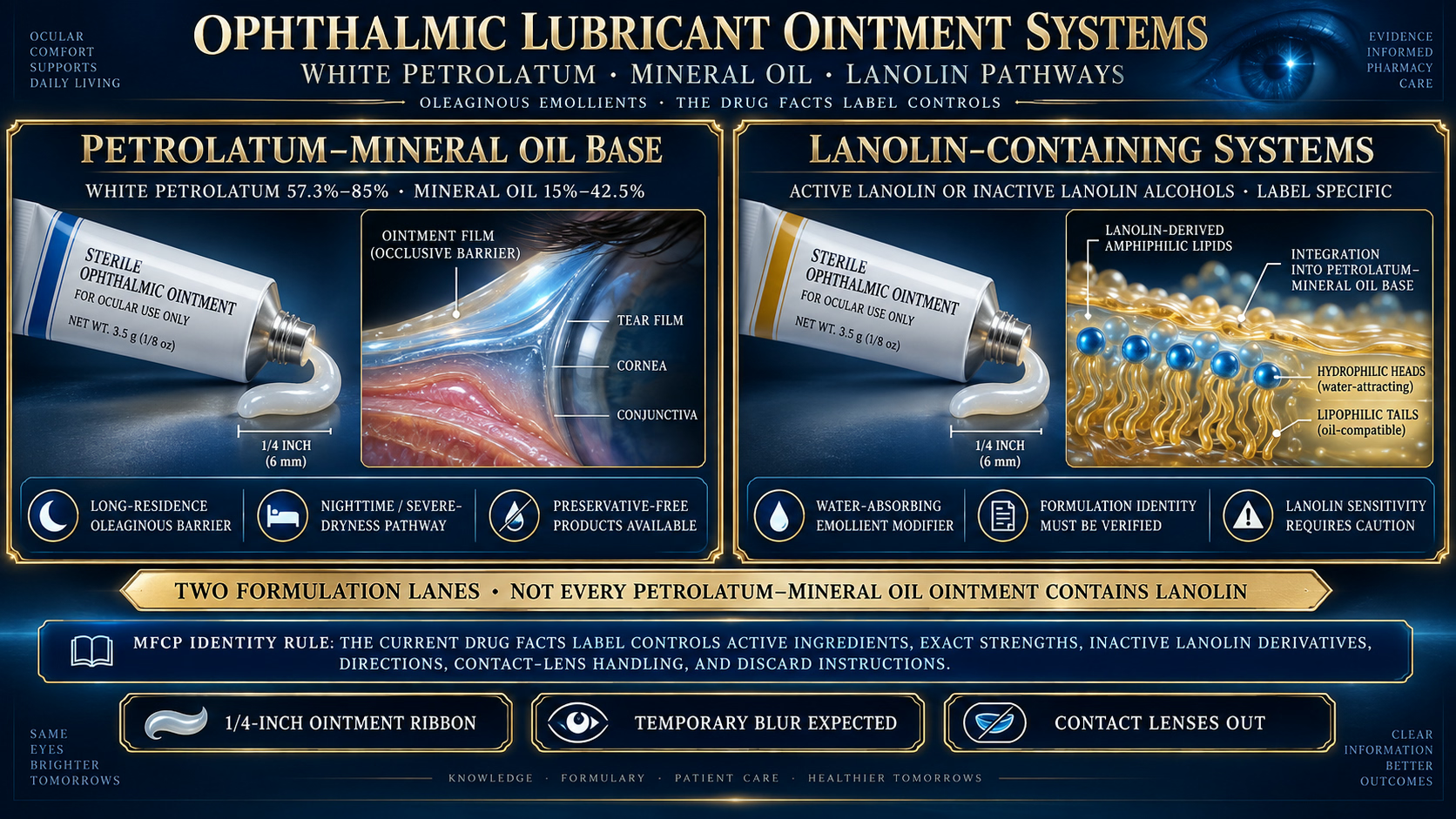
Representative white-petrolatum/mineral-oil ratios from current labels.
White petrolatum may reach 100%; mineral oil requires another permitted emollient.
Lanolin or anhydrous lanolin; inactive lanolin alcohols are a separate label identity.
Semisolid, non-aqueous base in a narrow-tip ophthalmic tube.
Apply a small ribbon inside the lower eyelid according to the product label.
Oily surface coating can temporarily impair visual clarity.
Use with lenses only if the specific label expressly permits it.
Stop for pain, vision change, persistent redness, worsening, or symptoms beyond 72 hours.
M018 and Current-Label ControlActive Ingredients, Ratios & Lanolin Identity
M018 permits up to 100%. Current combination labels include 85% and 57.3% white petrolatum.
M018 permits up to 50% when combined with another emollient. Current examples include 15% and 42.5%.
Active lanolin or anhydrous lanolin is permitted at 1%–10% in combination. Some other ointments instead list lanolin alcohols only as inactive ingredients.
Component-by-Component FunctionSemisolid Barrier, Plasticization & Tear Interaction
The liquid hydrocarbon fraction lowers stiffness and supports delivery through a narrow ophthalmic tip.
Warmth and eyelid movement spread the petrolatum-oil ribbon across the ocular surface.
The hydrophobic coating reduces friction and helps limit drying longer than many aqueous drops.
Purified semisolid hydrocarbons provide body, adhesion, and extended surface coverage. Exact softening and flow depend on compendial grade and the finished ratio.
Lanolin-derived sterols and esters can increase water-accepting behavior within an oleaginous base. This role is formulation specific and does not prove greater clinical efficacy.
Three Label RealitiesFormulation-System Comparison
| Representative system | Ingredient architecture | Formulation implication | Control point |
|---|---|---|---|
| Petrolatum-rich ointment | White petrolatum 85% + mineral oil 15% | Stiffer, petrolatum-dominant semisolid pathway. | A current label lists lanolin alcohols as inactive; the product is preservative free. |
| Higher-oil ointment | White petrolatum 57.3% + mineral oil 42.5% | Greater liquid-oil fraction and different extrusion/spreading behavior. | The current label also lists lanolin alcohols as inactive. |
| Active-lanolin pathway | Lanolin 1%–10% with permitted oleaginous emollients | Distinct M018 active-ingredient route with water-accepting formulation potential. | Verify the exact active strengths; one current label uses lanolin 6.9% in a multicomponent base. |
OTC Use Versus Clinician-Directed CareClinical Placement
Temporary relief of burning or irritation due to dryness and protection against further irritation.
Because ointments blur vision, many people prefer bedtime use. Bedtime-only dosing is not universal; the current product directions control.
Incomplete lid closure, facial nerve dysfunction, proptosis, intensive-care exposure, and severe surface disease require clinician-directed management.
Nighttime lubrication may be included in a clinician’s plan, but recurrent corneal erosion requires diagnosis and follow-up.
Sjögren disease, neurotrophic keratopathy, Stevens–Johnson syndrome, and persistent epithelial defects require specialty care beyond OTC selection.
Use only when the person can tolerate temporary blur and avoid driving or hazardous tasks until vision clears.
Tube TechniqueApplication, Contact Lenses & Sequencing
- Wash and dry hands.
Inspect the tube and confirm the correct ophthalmic product before opening. - Pull down the lower lid.
Create a small conjunctival pocket without touching the eye with fingers or the tube. - Apply one-fourth inch.
Place a small ribbon inside the lower eyelid. Do not enlarge the dose to one-half inch unless the specific label or clinician directs it. - Close gently.
Allow normal blinking and eye movement to distribute the ointment; forceful rubbing is unnecessary. - Protect the tip.
Never touch the nozzle to the eye, lashes, fingers, or another surface; replace the cap promptly. - Remove contact lenses.
Oily ointment can coat lens surfaces. Reinsertion timing is product- and clinician-specific. - Use ointment last.
When drops and ointment are both used, instill the drops first and the ointment last so the semisolid film does not obstruct earlier distribution. - Do not invent a fixed interval.
A 15-minute gap may be used in some regimens, but the therapeutic labels and prescriber’s instructions control.
Warning GateLanolin Sensitivity, Contamination & Referral
Persistent visual change, marked photophobia, or significant pain is not routine lubricant use.
Stop and consult a doctor for continued redness or irritation, worsening, or symptoms lasting more than 72 hours.
Periocular dermatitis or blepharitis after use warrants discontinuation and ingredient review. Wool allergy and lanolin contact allergy should not be treated as automatically identical.
A contaminated or damaged nozzle can introduce organisms or abrade the ocular surface.
Do not drive, operate equipment, or perform precision work while ointment-related blur persists.
If lanolin sensitization is established or suspected, select a product whose complete active and inactive ingredient panels exclude lanolin derivatives.
Controlling SourcesEvidence & Labeling
- U.S. Food and Drug Administration. OTC Monograph M018: Ophthalmic Drug Products for OTC Human Use.
- DailyMed. Mineral oil 15% / white petrolatum 85% ophthalmic ointment—current labeling.
- DailyMed. Mineral oil 42.5% / white petrolatum 57.3% ophthalmic ointment—current labeling.
- DailyMed. Lanolin-containing ophthalmic ointment—current labeling.