
Glycerin 0.2%–1% · Hypromellose and Polysorbate 80 Pathways
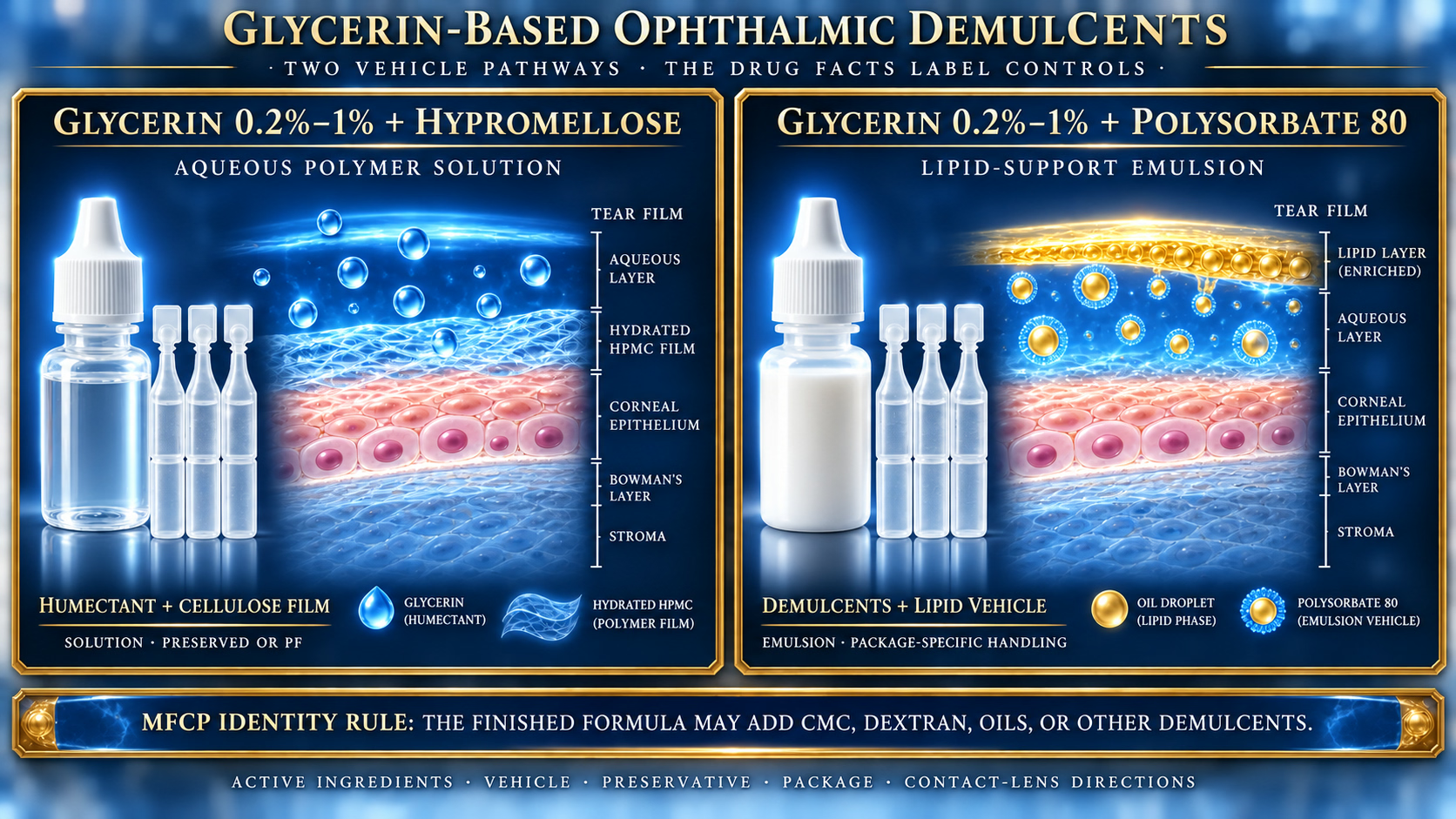
One shared liquid polyol, two formulation architectures: a hydrated cellulose-polymer solution and a surfactant-enabled lipid-support emulsion.
Monograph at a Glance™MAG™ · Controlled Snapshot
Regulatory IdentityWhat the Active Ingredients and Label Establish
FDA OTC Monograph M018 defines an ophthalmic demulcent as an agent, usually a water-soluble polymer, applied topically to protect and lubricate mucous-membrane surfaces and relieve dryness and irritation. It permits glycerin at 0.2% to 1%, hypromellose at 0.2% to 2.5%, and polysorbate 80 at 0.2% to 1%. Any two or three listed ophthalmic demulcents may be combined when each remains within its established range.
A small, hydrophilic polyol that participates in water retention and lubrication within the finished aqueous vehicle. Its percentage does not independently establish osmolarity, viscosity, or duration.
Hydroxypropyl methylcellulose increases viscosity and supports a hydrated lubricating film. Polymer grade, molecular weight, concentration, salts, and co-polymers determine actual rheology.
A nonionic surfactant listed as an M018 demulcent active. In emulsion products it may also help disperse lipid ingredients, but lipid-layer performance belongs to the complete formula.
Mechanistic FrameworkHydration, Polymer Film and Emulsion Support
Glycerin is strongly hydrophilic and can bind water; however, the OTC indication is demulcent lubrication. Claims of cellular osmoprotection, corneal penetration, or sustained hyperosmolar correction require formula-specific evidence.
Hypromellose can increase apparent viscosity and slow immediate clearance relative to saline-like fluids. Artificial tears vary from Newtonian to shear-thinning behavior; concentration alone does not predict blink comfort or residence.
The hydrophilic head and lipophilic chain of polysorbate 80 support oil-in-water dispersion. This can enable lipid-support formulations, but polysorbate 80 alone should not be described as rebuilding meibomian glands or permanently repairing the tear-film lipid layer.
Aqueous, mucin-associated, and lipid components interact dynamically. “Aqueous-deficient” and “evaporative” patterns often overlap, so product selection should not rely on a rigid three-layer diagram alone.
Formulation ArchitectureGlycerin + HPMC Versus Glycerin + Polysorbate 80
| Control Point | Glycerin + Hypromellose Pathway | Glycerin + Polysorbate 80 Pathway |
|---|---|---|
| Typical architecture | Aqueous polymer solution; marketed formulas may add dextran 70, PEG 400, electrolytes, buffers, and a preservative. | Solution or oil-in-water emulsion; current lipid-support formulas may also contain CMC, castor oil, flaxseed oil, osmolytes, antioxidants, and emulsion stabilizers. |
| Primary formulation job | Increase hydration, viscosity, lubrication, and ocular-surface residence. | Provide demulcent lubrication while enabling dispersion of lipid-phase ingredients. |
| Appearance | Commonly clear; the exact product label controls acceptable clarity and color. | May be milky or opalescent by design; unexpected change in color or appearance remains a warning sign. |
| Handling | Some representative labels direct shaking; do not generalize that instruction to every clear solution. | Emulsions may require package-specific priming or shaking. Follow the carton and Instructions for Use. |
| Preservation | Available in preserved multidose and preservative-free presentations. | Available in preservative-free unit-dose and specialized preservative-free multidose systems; other formulas may be preserved. |
| Selection principle | Reasonable when a polymeric aqueous lubricant and added viscosity are desired. | Reasonable when evaporation or lipid-layer insufficiency is suspected and the complete product contains a meaningful lipid-support vehicle. |
Dosage Form and PackageDelivery-System Architecture
A preservative supports microbial control during repeated opening. Representative glycerin/HPMC labeling may include benzalkonium chloride. Tip hygiene, recapping, and the labeled discard period control safe use.
Current lipid-support products may use mechanical contamination controls and a defined after-opening discard interval. Correct priming and bottle technique are essential.
Unit-dose packaging avoids repeated-container preservation. M018 directs users not to reuse the vial and to discard it once opened.
Often clear and relatively easy to instill. Perceived blur and residence depend on HPMC grade, total polymer load, electrolytes, and the complete formula.
Dispersed oil droplets may cause brief haze or a milky appearance. The label determines whether shaking is required and what appearance is normal.
Do not use a damaged vial, contaminated tip, broken tamper seal, or product whose appearance has changed contrary to labeling.
Vehicle and Excipient ControlOsmolarity, Preservatives, Lipids and Rheology
Glycerin, HPMC, or polysorbate 80 concentration alone does not prove that a product corrects tear hyperosmolarity. Tonicity agents, electrolytes, buffers, osmolytes, instilled volume, and tear turnover shape the effect.
Preserved multidose products are not interchangeable with preservative-free systems. Frequency of use, concurrent preserved medications, ocular-surface disease, sensitivity, cost, and dexterity inform package selection.
Castor oil, flaxseed oil, mineral oil, phospholipids, or other lipids may be inactive ingredients that determine emulsion behavior. The presence of polysorbate 80 does not guarantee any specific oil blend.
Polymer molecular weight, substitution, temperature, shear, salts, carbomers, and co-polymers determine flow. A lower-strength formula can be more viscous than a higher-strength formula built differently.
Administration and IntegrationRegimen Controls
Warnings and ReferralSafety Gate
Stop and ask a doctor for eye pain, changes in vision, continued redness or irritation, worsening symptoms, or persistence for more than 72 hours.
Remove lenses and seek prompt assessment. Contact-lens-associated keratitis can progress rapidly and is not routine dryness.
Do not touch the container tip to any surface. Replace the cap after use. Do not reuse a single-use vial and never share ophthalmic containers.
Do not use a solution that changes color or becomes cloudy. For emulsions, distinguish the product’s normal labeled appearance from a new or abnormal change.
Unilateral symptoms, discharge, trauma, marked redness, severe headache, halos, corneal pain, or meaningful vision change require evaluation rather than repeated lubricant switching.
Glycerin, HPMC, and polysorbate 80 occur in non-ophthalmic products. Only a sterile product specifically labeled for ophthalmic use belongs in the eye.
Controlling SourcesEvidence & Labeling
- U.S. Food and Drug Administration. OTC Monograph M018: Ophthalmic Drug Products for OTC Human Use.
- DailyMed. Dextran 70 0.1% / glycerin 0.2% / hypromellose 0.3% preserved ophthalmic solution.
- DailyMed. Carboxymethylcellulose sodium 0.5% / glycerin 1% / polysorbate 80 0.5% preservative-free lipid-support formulation.
- Review of hydroxypropyl methylcellulose in artificial tears for dry-eye disease.
- Arshinoff SA, Hofmann I, Nae H. Rheological behavior of commercial artificial tear solutions.
- Tear Film & Ocular Surface Society. TFOS DEWS II report.