
Entry
UVB exposure can initiate D3 synthesis in skin; foods and supplements provide D2 or D3.

Cholecalciferol D3 · Ergocalciferol D2 · activation, dose, status and safety
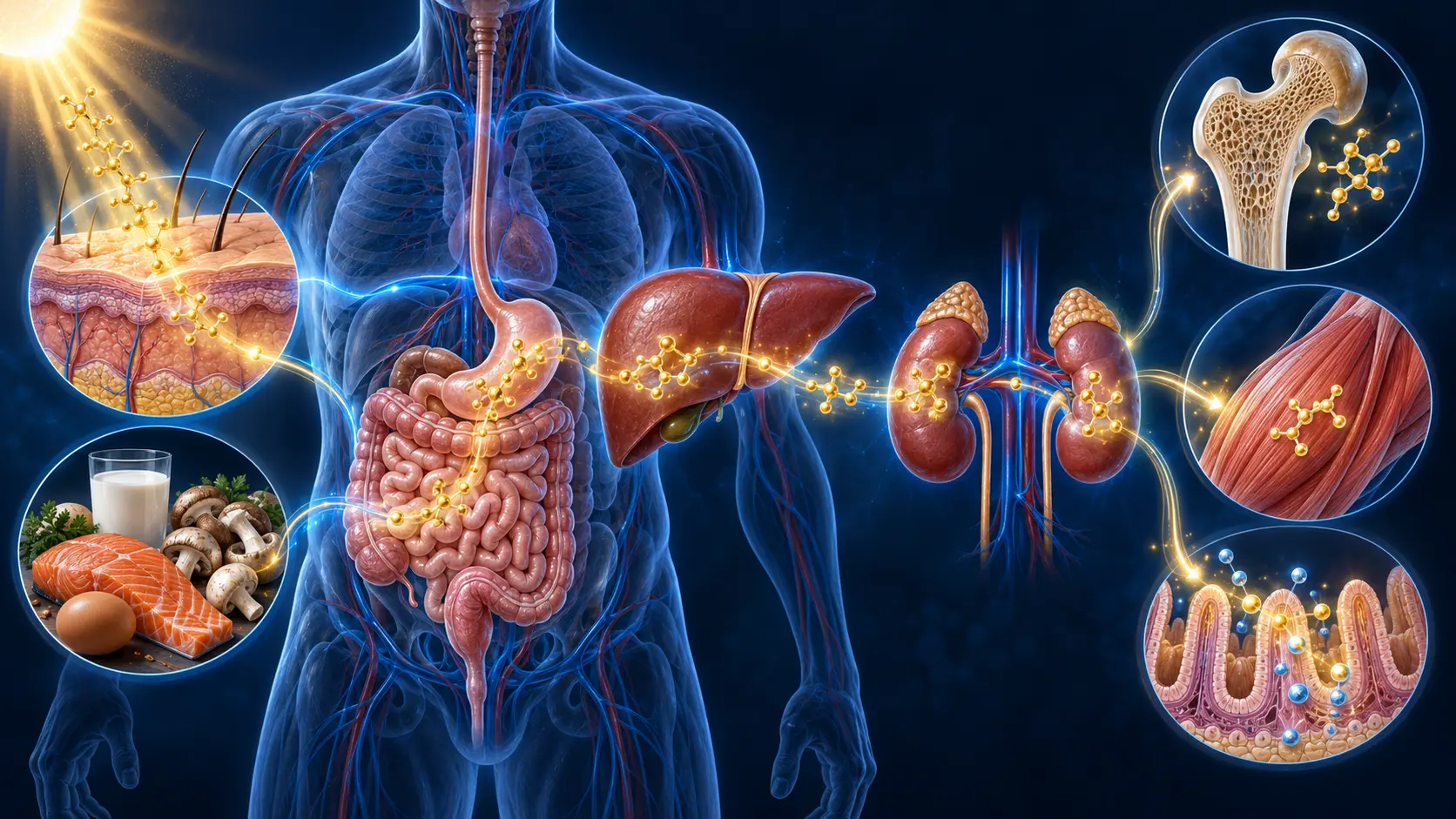
UVB exposure can initiate D3 synthesis in skin; foods and supplements provide D2 or D3.
First hydroxylation produces 25-hydroxyvitamin D, the usual circulating status marker.
Second hydroxylation produces active 1,25-dihydroxyvitamin D under physiologic control.
Active vitamin D supports intestinal calcium absorption and calcium-phosphate balance for bone.
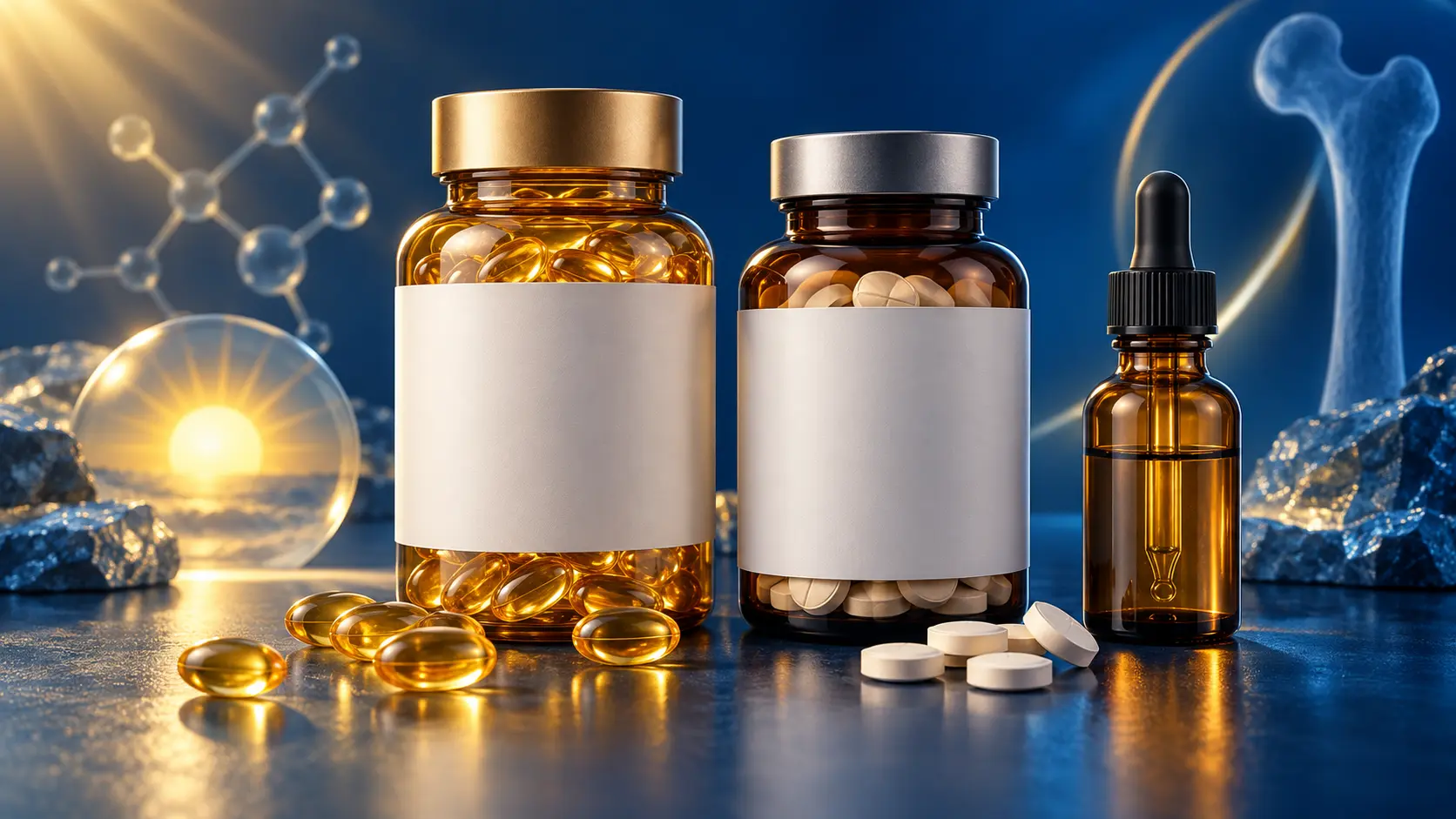
Both forms can raise 25(OH)D. D3 may raise and maintain concentrations more effectively in some comparisons, but the dose, regimen, patient, and indication still control.
Twenty-five mcg equals 1,000 IU; 50 mcg equals 2,000 IU; 100 mcg equals 4,000 IU. Never add IU and mcg as though they were separate ingredients.
Laboratory method, clinical indication, age, calcium, kidney function, absorption, and medicines matter. A consumer-selected “optimal” target is not a universal treatment goal.
Vitamin D from skin, foods, and supplements must be activated before it exerts its major physiologic effects.
Active vitamin D promotes intestinal calcium absorption and helps maintain mineral balance needed for normal bone mineralization.
Meeting an intake recommendation is not the same as treating documented deficiency, osteomalacia, osteoporosis, malabsorption, or another medical condition.
Receptors and observational associations do not establish that extra vitamin D prevents cancer, cardiovascular disease, depression, infection, diabetes, or falls in every person.
| Stage | Controlled identity | Clinical meaning |
|---|---|---|
| Skin / intake | D3 from skin and animal-derived sources; D2 from irradiated fungi/yeast and selected products | These are precursors, not the final active hormone. |
| Liver | 25-hydroxyvitamin D [25(OH)D, calcidiol] | Main circulating marker used to assess status; reflects endogenous and consumed vitamin D. |
| Kidney and other tissues | 1,25-dihydroxyvitamin D [1,25(OH)2D, calcitriol] | Active hormone; tightly regulated and generally not the correct routine status test. |
| Target tissues | Vitamin D receptor–mediated gene regulation | Coordinates intestinal mineral absorption and contributes to bone, muscle, and other cell functions. |
D2 and D3 are absorbed in the small intestine. Dietary fat can enhance absorption, although some absorption occurs without it.
D2 and D3 can both increase 25(OH)D; comparative persistence can differ. The prescribed or labeled regimen controls.
| Form | What to verify | Frequent failure mode | MFCP control |
|---|---|---|---|
| D3 softgel or tablet | mcg and IU per serving; units per serving | Front-panel IU mistaken for a one-capsule dose | Read Supplement Facts and serving size |
| D2 tablet/capsule | Strength, frequency, and whether it is prescription-directed | A weekly high-dose regimen copied into daily use | Keep the exact interval attached to the exact strength |
| Infant or adult liquid drops | Concentration per drop or mL and calibrated device | Confusing one drop with one dropperful | Use only the supplied device and current label |
| Calcium + D combination | Both calcium and vitamin D totals, plus serving size | Counting only the standalone vitamin D product | Total every supplement and fortified source |
| Multivitamin / specialty blend | D form, amount, duplicate ingredients | Stacking multiple low-visibility sources | Build one daily ingredient inventory |
The Food and Nutrition Board RDA is 15 mcg (600 IU) for adults ages 19–70 and 20 mcg (800 IU) for adults older than 70, assuming minimal sun exposure.
The adult UL is 100 mcg (4,000 IU) daily. A UL is not a recommended target, and clinician-directed treatment may differ.
It has a longer circulating half-life and integrates skin production, food, and supplements. Assay variability and clinical context still matter.
The 2024 Endocrine Society guideline suggests against routine 25(OH)D screening in healthy adults without an established indication.
| Reference value | Amount | Correct interpretation |
|---|---|---|
| 1 mcg | 40 IU | A unit conversion—not a dose recommendation |
| 25 mcg | 1,000 IU | Common retail strength; compare with total daily intake |
| 50 mcg | 2,000 IU | Below the adult UL but above the adult RDA |
| 100 mcg | 4,000 IU | Adult UL, not a universal goal |
| Clinical question | Evidence position | Controlled interpretation |
|---|---|---|
| Prevent rickets/osteomalacia and support normal mineral metabolism | Established essential-nutrient role | Meet age-appropriate intake and treat deficiency under an appropriate plan. |
| Correct documented low status | Supplementation can raise serum 25(OH)D | Cause, severity, absorption, adherence, calcium, kidney function, and follow-up define treatment. |
| Prevent fractures or falls in generally healthy adults | Benefits are not established as a universal high-dose strategy | Do not use high-dose or intermittent bolus regimens as a self-selected shortcut. |
| Prevent cancer or cardiovascular disease | Large clinical trials have not shown routine supplementation reduces incidence in vitamin-D-replete populations | Observational associations are not equivalent to prevention efficacy. |
| Prevent or treat depression | Clinical trials have not shown consistent benefit | Do not replace mental-health assessment or established treatment. |
| Prevent diabetes or promote weight loss | Routine supplementation is not established for these purposes | Identify baseline status and the actual metabolic treatment plan. |
Nausea, vomiting, poor appetite, constipation, weakness, confusion, excessive thirst, and frequent urination can reflect hypercalcemia.
Hypercalcemia and hypercalciuria can contribute to kidney stones; severe toxicity can progress to renal failure.
Extreme excess can calcify soft tissues and vessels, disturb cardiac rhythm, and become life-threatening.
| Medicine or condition | Why it matters | Controlled action |
|---|---|---|
| Thiazide diuretic | Reduces urinary calcium excretion; vitamin D increases calcium absorption | Review calcium, kidney function, dose, and hyperparathyroidism risk |
| Orlistat or fat malabsorption | Can reduce vitamin D absorption | Coordinate intake, status assessment, and treatment with a clinician |
| Systemic corticosteroid | Can impair vitamin D metabolism and calcium absorption | Review long-term bone-health plan rather than self-escalating dose |
| Selected statins | High supplemental intakes may interact with shared metabolic pathways | Pharmacist review before high-dose use |
| Hyperparathyroidism, granulomatous disease, lymphoma | Can alter active-vitamin-D or calcium regulation | Clinician-directed dosing and monitoring only |
Infants have a 10 mcg (400 IU) adequate intake, but product concentration varies. Caregiver measurement errors can cause major overdoses.
The RDA for pregnancy and lactation is 15 mcg (600 IU). Add prenatal, standalone, fortified-food, and calcium-product sources before changing intake.
Adults over 70 have an RDA of 20 mcg (800 IU). More is not automatically better; the 2024 guideline favors daily lower-dose over intermittent high-dose treatment when supplementation is indicated in adults 50 and older.
Fat-malabsorption disorders, bariatric surgery, liver disease, and obesity may alter status or treatment needs. Dosing and monitoring should be individualized.
Record D2 or D3, mcg, IU, serving size, dosage form, and intended user before comparing products.
Include multivitamins, calcium combinations, standalone vitamin D, drops, and fortified foods. Convert mcg and IU into one common unit.
Look for an intact seal, lot and expiration information, storage instructions, precise liquid concentration, and credible independent quality verification when available.
A routine dietary supplement, clinician-directed deficiency regimen, and prescription vitamin D product are not interchangeable plans.
| Source | Controls used in this monograph | Open source |
|---|---|---|
| NIH Office of Dietary Supplements · Vitamin D | Physiology, forms, absorption, status, RDA/UL, evidence, toxicity, and medicine interactions | NIH evidence summary ↗ |
| Endocrine Society · Vitamin D for Prevention of Disease (2024) | Routine testing boundary, prevention dosing, and daily lower-dose guidance for indicated older adults | Clinical practice guideline ↗ |
| FDA · Dietary Supplement Labeling Guide | Supplement Facts identity and current-label control | FDA labeling guide ↗ |
Links already cited on this page.
 Plain Talk · What Vitamin D Is and Is Not
 Identity · D2, D3 and the Two-Hydroxylation Pathway
 Forms & Shelf Roles · Softgels, Tablets, Drops and Combinations
 Intake & Status · RDA, UL and Laboratory Interpretation
 Evidence by Clinical Purpose · Keep the Questions Separate
 Safety Gate · Hypercalcemia, Toxicity and Medicine Review
 Special Populations · Infants, Pregnancy, Older Adults and Malabsorption
 MFCP Buying Standard™ & Evidence Map