
Mineral Oil & Light Mineral Oil Mineral Oil 4.5% · Light Mineral Oil 1.0%
A product-specific oil-in-water emulsion pathway for temporary relief and protection in ocular dryness—organized by active identity, droplet architecture, complete vehicle, package, and label.
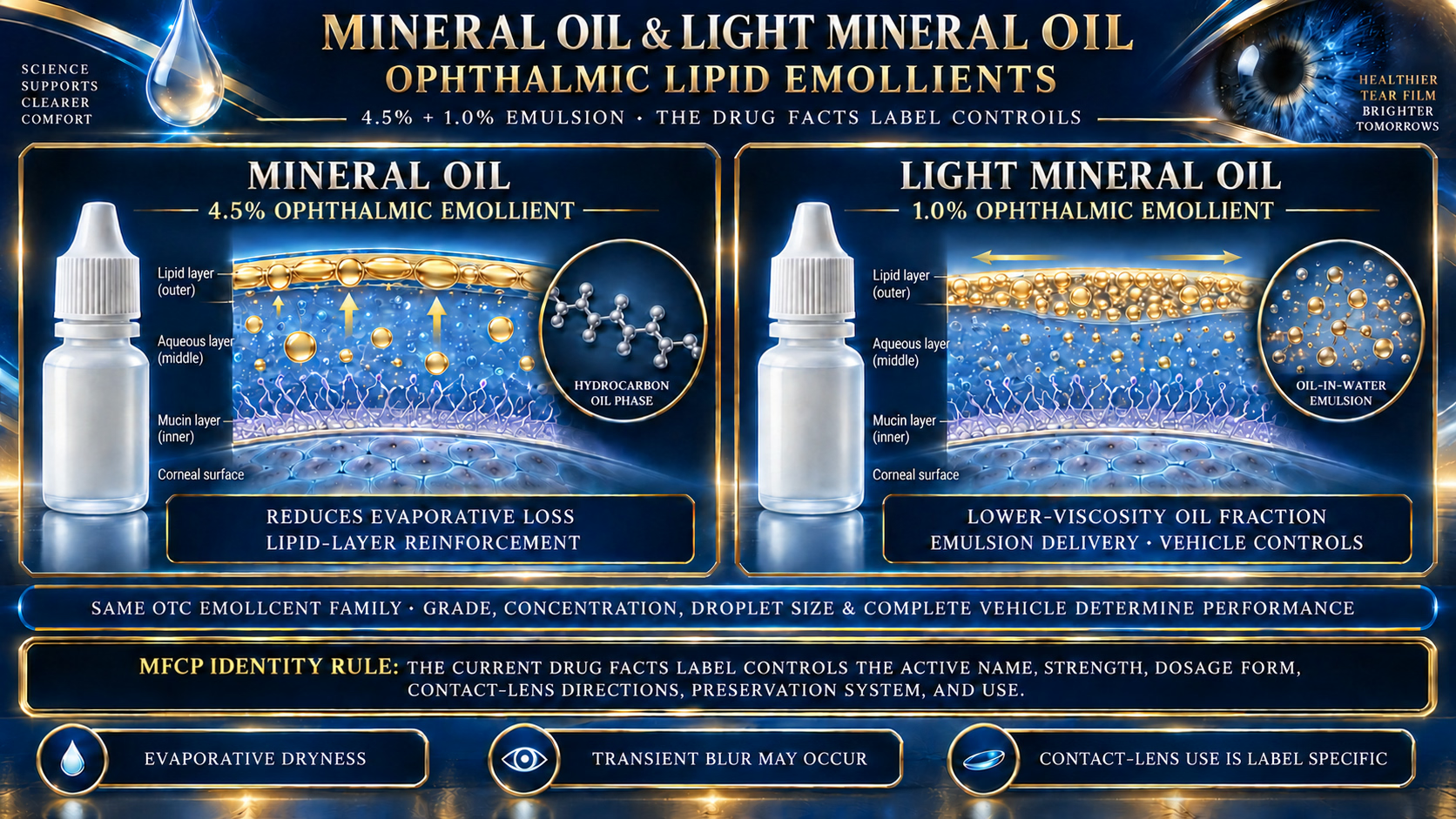
MFCP At-a-GlanceMAG™ — Clinical Identity Before Product Choice
Temporary relief of burning, irritation, and dryness; protection against further irritation.
Highly refined hydrocarbon oils, not aqueous polymeric demulcents.
Mineral oil 4.5% with light mineral oil 1.0%.
Each oil must be combined with another permitted emollient.
The complete surfactant, buffer, preservative, and droplet system controls performance.
Oil droplets spread through the tear system and may reduce evaporative loss.
For the featured product: shake well and remove contact lenses before use.
The current label describes a milky white solution and temporary blur on application.
Do not invent a reinsertion interval absent from the product label.
Stop for eye pain, vision change, persistent redness, worsening, or symptoms beyond 72 hours.
M018 and Current-Label ControlActive Identity, Range & Combination Logic
The heavier labeled fraction contributes the larger share of the oil phase in the current dual-active emulsion.
The lower-viscosity labeled fraction complements the oil phase; performance cannot be inferred from the adjective “light” alone.
M018 lists both oils up to 50% in combination and permits two or more ophthalmic emollients as needed for proper consistency.
Mechanistic ModelFrom Dispersed Droplet to Tear-Film Interface
Agitation redistributes the oil phase before a drop is delivered.
Surfactants and the aqueous vehicle support distribution of oil droplets after instillation.
Oil-phase material can migrate toward the air–tear interface and supplement lipid coverage.
Both actives are mixtures rather than single discrete molecules. Refining specifications, viscosity grade, concentration, and the complete vehicle shape clinical behavior.
Lipid-support drops are rational when an unstable outer tear-film layer contributes to symptoms, but the OTC label relieves dryness; it does not diagnose or cure meibomian gland dysfunction.
Complete Vehicle ControlsOil-in-Water Emulsion Architecture
| Formulation element | Technical job | Clinical consequence |
|---|---|---|
| Mineral-oil phase | Provides nonpolar lipid material for ocular-surface lubrication and interface support. | May improve comfort where rapid aqueous evaporation contributes to dryness. |
| Surfactant system | Disperses otherwise water-insoluble oils and stabilizes droplets. | Controls spreading, appearance, tolerability, and physical stability. |
| Droplet-size distribution | Influences emulsion opacity, coalescence, and optical disturbance. | Cannot be inferred from “mineral oil” or “light mineral oil” on the label. |
| Preservative and chelator | Controls microbial growth in a multidose bottle. | The current featured label uses polyquaternium-1; BAK is not categorically prohibited by M018. |
| Package architecture | Preserved multidose, preservative-free multidose, and unit-dose systems manage sterility differently. | Tip hygiene, priming, storage, and after-opening discard remain product specific. |
Administration ArchitectureUse, Sequencing & Adjunctive Care
- Shake well.
The current 4.5%/1.0% label directs shaking before each use because the product is an emulsion. - Instill 1–2 drops as needed.
Use the labeled frequency and do not let a general pathway override the specific Drug Facts directions. - Remove contact lenses first.
The current label requires removal. It does not establish a universal 15-minute reinsertion interval. - Use therapeutic drops first.
When other ocular medicines are prescribed, follow their labels and clinician instructions; administer the emulsion after them when directed to avoid washout or a surface barrier. - Expect temporary blur.
The labeled milky emulsion may blur vision briefly; wait for vision to clear before driving or precision work. - Address eyelid disease separately.
Warm compresses and lid hygiene may accompany professional MGD care, but mineral-oil drops do not mechanically clear obstructed glands.
Warning GateStop, Refer & Prevent Contamination
New pain, persistent visual change, or pronounced photophobia is not routine dry-eye self-care.
Stop and ask a doctor if symptoms worsen or persist for more than 72 hours.
Do not touch the container tip to any surface; replace the cap after use and never share the bottle.
Do not use if the solution changes color. Milky-white appearance is expected for the featured labeled emulsion.
Do not drive, operate equipment, or perform precision tasks while application-related blur persists.
A contact-lens wearer with pain, marked redness, discharge, or light sensitivity needs prompt evaluation.