
Scalp Salicylic Acid 1.8%–3%
Controlled OTC scale removal across labeled dandruff, seborrheic-dermatitis, and psoriasis pathways.
01 · Controlled Clinical PositionPharmacist Bottom Line™
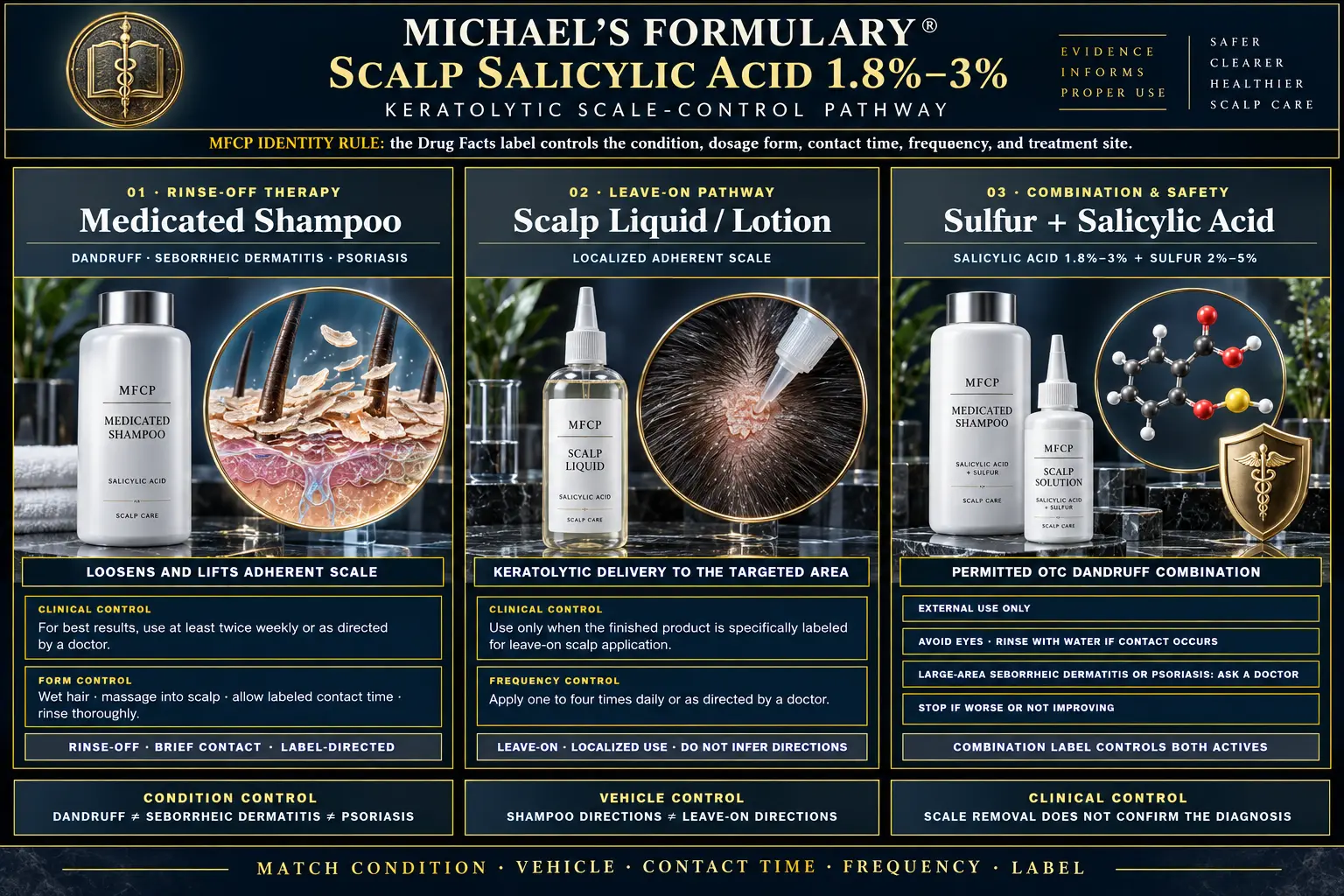
Salicylic acid 1.8%–3% is an OTC M032 keratolytic active for labeled dandruff, seborrheic dermatitis, and psoriasis products. Its central job is to loosen adherent scale; it is not an antifungal and does not establish which scalp disorder is present.
02 · Active Ingredient ControlIdentity, Structure & Acid–Base Behavior
| Attribute | MFCP controlled statement |
|---|---|
| Chemical identity | Salicylic acid; 2-hydroxybenzoic acid (ortho-hydroxybenzoic acid) |
| Formula / molecular mass | C7H6O3 · approximately 138.12 g/mol |
| Acid dissociation | pKa approximately 2.97; formulation pH influences the proportion of unionized free acid |
| M032 range | 1.8%–3% for dandruff, seborrheic dermatitis, or psoriasis |
| Primary role | Keratolytic / desquamating active |
| Route | Topical rinse-off or leave-on only as directed by the finished-product label |
03 · Monograph at a Glance™MAG™ Clinical Snapshot
04 · Scale BiologyMechanism · Corneocyte Cohesion Control
Salicylic acid reduces cohesion within the stratum corneum and promotes shedding of retained corneocytes. This keratolytic effect softens and removes scale, which may improve access to the scalp surface. It does not independently prove a fungal, psoriatic, allergic, or bacterial diagnosis.
05 · Condition Before ProductConfirm the Treatment Pathway
| Pattern | Controlled interpretation |
|---|---|
| Loose flakes with mild itching | May fit a dandruff-labeled product when no red flags are present. |
| Greasy scale with erythema | May fit seborrheic dermatitis; verify the exact indication and site. |
| Thick, sharply defined plaques | May fit psoriasis, but diagnosis, extent, site, and concurrent therapy govern self-care suitability. |
| Dense adherent scale | Salicylic acid can debulk scale; do not force removal or scratch the scalp. |
| Broken hairs, patchy hair loss, pustules, boggy swelling, crust, drainage, or fever | Refer for evaluation; do not manage as routine scale alone. |
| Infant scalp scale | Do not extrapolate adult medicated-product directions to cradle cap. |
06 · Vehicle ScienceFormulation & Delivery Chemistry
pH & Free Acid
With a pKa near 2.97, salicylic acid becomes progressively more ionized as pH rises. Lower-pH systems can increase the unionized fraction, but M032 does not impose a universal product pH and pH alone does not establish clinical potency.
Solubilization
Alcohol, glycols, water, surfactants, and other excipients may dissolve or disperse the active. Hydroalcoholic products can sting excoriated skin; nonalcoholic systems still require stability and crystallization control.
Whole-System Stability
Solubility and precipitation depend on the full pH–solvent–electrolyte–surfactant system. Anionic, amphoteric, amine-oxide, and nonionic materials cannot be judged in isolation from the finished formula.
07 · Three-Pathway ArchitectureRinse-Off, Leave-On & Combination Systems
Shampoo / Scalp Wash
Brief contact followed by thorough rinsing. The finished label controls lathering, exposure time, repeat cycle, and frequency.
Liquid, Lotion or Ointment
Applied to the labeled affected area and left in place. Do not convert a shampoo into leave-on therapy or transfer scalp directions to another site.
Salicylic Acid + Sulfur
M032 permits salicylic acid 1.8%–3% with sulfur 2%–5% for dandruff when both remain within their established ranges.
08 · Label-Directed AdministrationContact Time, Frequency & Site
| Pathway | M032 direction | Finished-label control |
|---|---|---|
| Rinse-off | For best results, use at least twice a week or as directed by a doctor. | Follow exact wetting, amount, lathering, brief exposure, rinse, and repeat directions. A representative 3% shampoo says several minutes; that is not universal. |
| Leave-on | Apply to affected areas one to four times daily or as directed by a doctor. | Confirm authorized site, amount, frequency, and any later wash-off instruction. |
| Soap for skin disease | Use on affected areas in place of regular soap when labeled for seborrheic dermatitis or psoriasis of the skin. | Do not infer scalp use or a condition claim absent from Drug Facts. |
09 · Combination ControlSalicylic Acid + Sulfur
10 · Outcome & Tolerability ControlExpected Response, Effects & Reassessment
| Finding | MFCP action |
|---|---|
| Scale loosens | Continue only within the label; remove loosened scale gently. |
| Scale improves but redness or itch persists | Reassess the underlying condition and whether another labeled active or clinician evaluation is needed. |
| Dryness, peeling, stinging, or burning | Reduce exposure only as permitted by the label or stop and reassess; do not interpret irritation as proof of efficacy. |
| No improvement after regular directed use | Consult a doctor; do not simply increase concentration, frequency, or contact time. |
| Worsening, swelling, weeping, or marked pain | Stop use and obtain clinical assessment. |
11 · Population SafeguardsAge, Area, Barrier & Exposure
| Factor | MFCP position |
|---|---|
| Children / infants | M032 does not create one universal pediatric age direction. Follow the exact label; infant cradle cap requires a separate pathway. |
| Pregnancy / breastfeeding | Follow product-specific labeling and seek professional guidance for prolonged, extensive, occluded, or breast-area use. |
| Large body area | Consult a doctor before use when seborrheic dermatitis or psoriasis covers a large area. |
| Damaged barrier | Avoid unsupervised application to severely inflamed, eroded, infected, or extensively excoriated skin. |
| Kidney or liver impairment | Lower the threshold for professional review before prolonged or large-area salicylate exposure. |
| Multiple salicylate products | Review the complete regimen rather than evaluating the scalp product alone. |
12 · Referral ThresholdsWarnings, Systemic Risk & Escalation
13 · Monograph PositioningM032 Active-Family Comparison
| Active | Range / pathway | Established conditions | Primary role |
|---|---|---|---|
| Salicylic acid | 1.8%–3% | Dandruff, seborrheic dermatitis, psoriasis | Keratolytic scale removal; not an antifungal |
| Pyrithione zinc | Dandruff: 0.3%–2% rinse-off; seborrheic dermatitis: 0.95%–2% rinse-off; both: 0.1%–0.25% leave-on | Dandruff, seborrheic dermatitis | Antimicrobial / cytostatic pathway |
| Selenium sulfide | 1%; micronized 0.6% for dandruff | Dandruff and seborrheic dermatitis at 1%; dandruff at micronized 0.6% | Cytostatic / anti-Malassezia; suspension and rinsing matter |
| Coal tar | 0.5%–5%; source identity and final concentration disclosed when applicable | Dandruff, seborrheic dermatitis, psoriasis | Keratoplastic / antiproliferative; odor, stain, and sunlight burden |
| Sulfur | 2%–5% | Dandruff | Keratolytic / antimicrobial; may combine with salicylic acid for dandruff |
| Ketoconazole 1% | Separate approved OTC drug-label pathway; not an M032 active | Dandruff under the approved label | Imidazole antifungal targeting fungal lanosterol 14α-demethylase |
14 · Shelf VerificationMFCP Buying Standard™
| Checkpoint | Verification standard |
|---|---|
| Active / strength | Salicylic acid 1.8%–3% for the M032 pathway |
| Condition claim | Dandruff, seborrheic dermatitis, and/or psoriasis exactly as stated |
| Dosage form | Rinse-off, leave-on, or soap clearly identified |
| Treatment site | Scalp and/or skin site authorized by the label |
| Directions | Frequency, contact, rinse, repeat, and leave-on instructions verified |
| Combination | If sulfur is present, verify both active percentages and the dandruff indication |
| Warnings / package | Eye and worsening/nonresponse warnings present; package intact and unexpired |
15 · Evidence ControlPrimary Sources & Readability Disclosure
- U.S. Food and Drug Administration: OTC Monograph M032
- DailyMed: Representative Salicylic Acid 3% Shampoo Drug Facts
- NIH PubChem: Salicylic Acid Chemical Record
Evidence control: M032 establishes the range, conditions, warnings, route-dependent directions, and sulfur combination. The DailyMed entry illustrates one 3% shampoo’s product-specific directions; it is not a universal substitute for every package.
Readability disclosure: Formulation concepts explain why pH, solvent, and vehicle matter. They do not authorize home compounding, predict potency from pH alone, or supersede Drug Facts and individualized care.
← Return to Dandruff, Seborrheic Dermatitis & Psoriasis