Skip to content
MFCP mortar and pestle emblemMichael’s FormularyCLINICAL PERSPECTIVE™

Clinical library / Pain & fever

On this page
The People's Monograph · Controlled Clinical Reference

Acetaminophen / Aspirin / Caffeine250 mg / 250 mg / 65 mg · Triple-combination analgesic

MFCP
Michael's Formulary™PROFESSIONAL JUDGMENT. DELIVERED.™
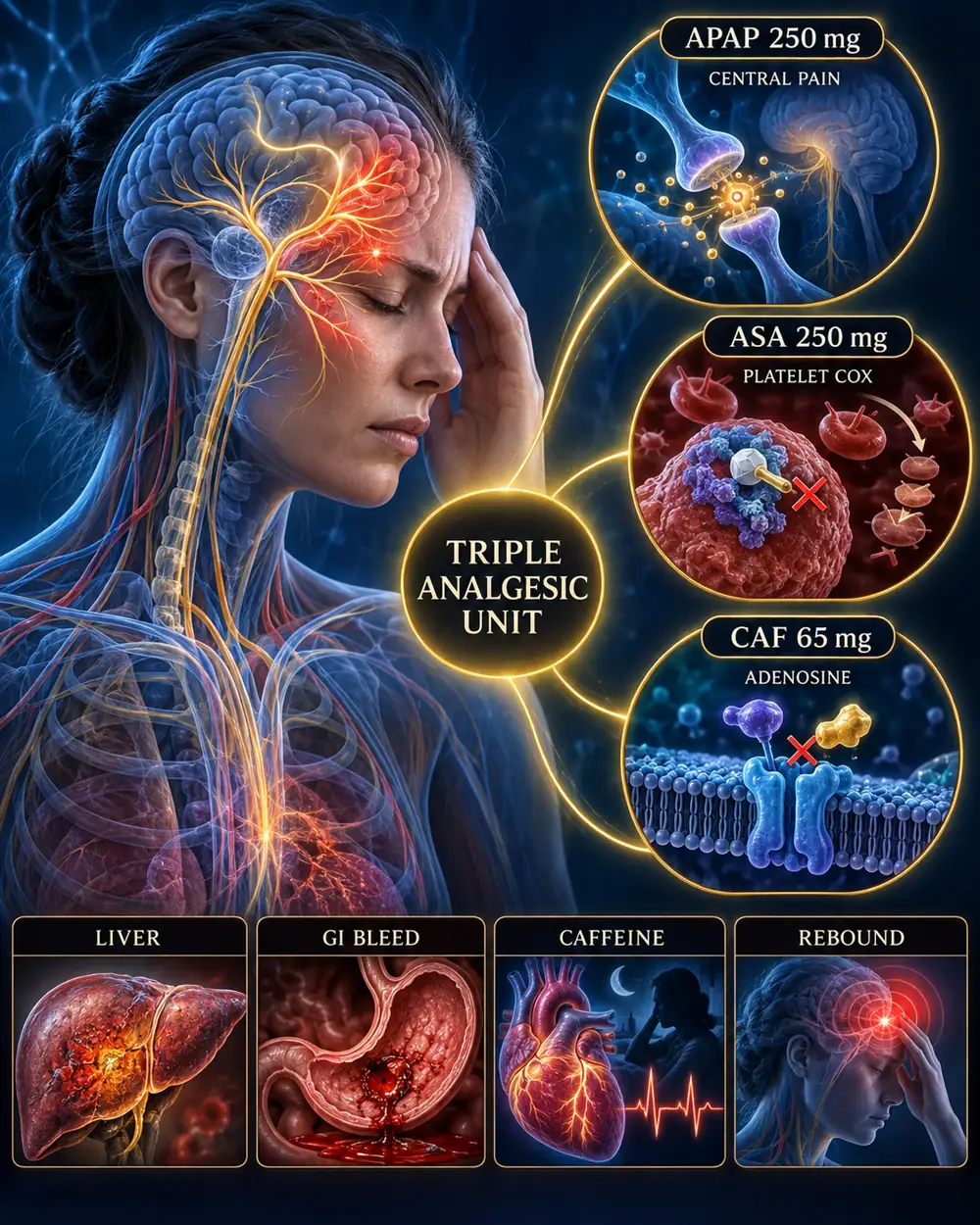
Proportional organismal view of migraine pathways with membrane inserts for acetaminophen, aspirin, and caffeine plus liver, bleeding, stimulant, and rebound controls
01 · THREE-PATHWAY CONTROLCentral pain, platelet COX, and adenosine signaling
Pathophysiology: Three mechanisms converge on relief while liver, bleeding, stimulant, and medication-overuse risks remain distinct.
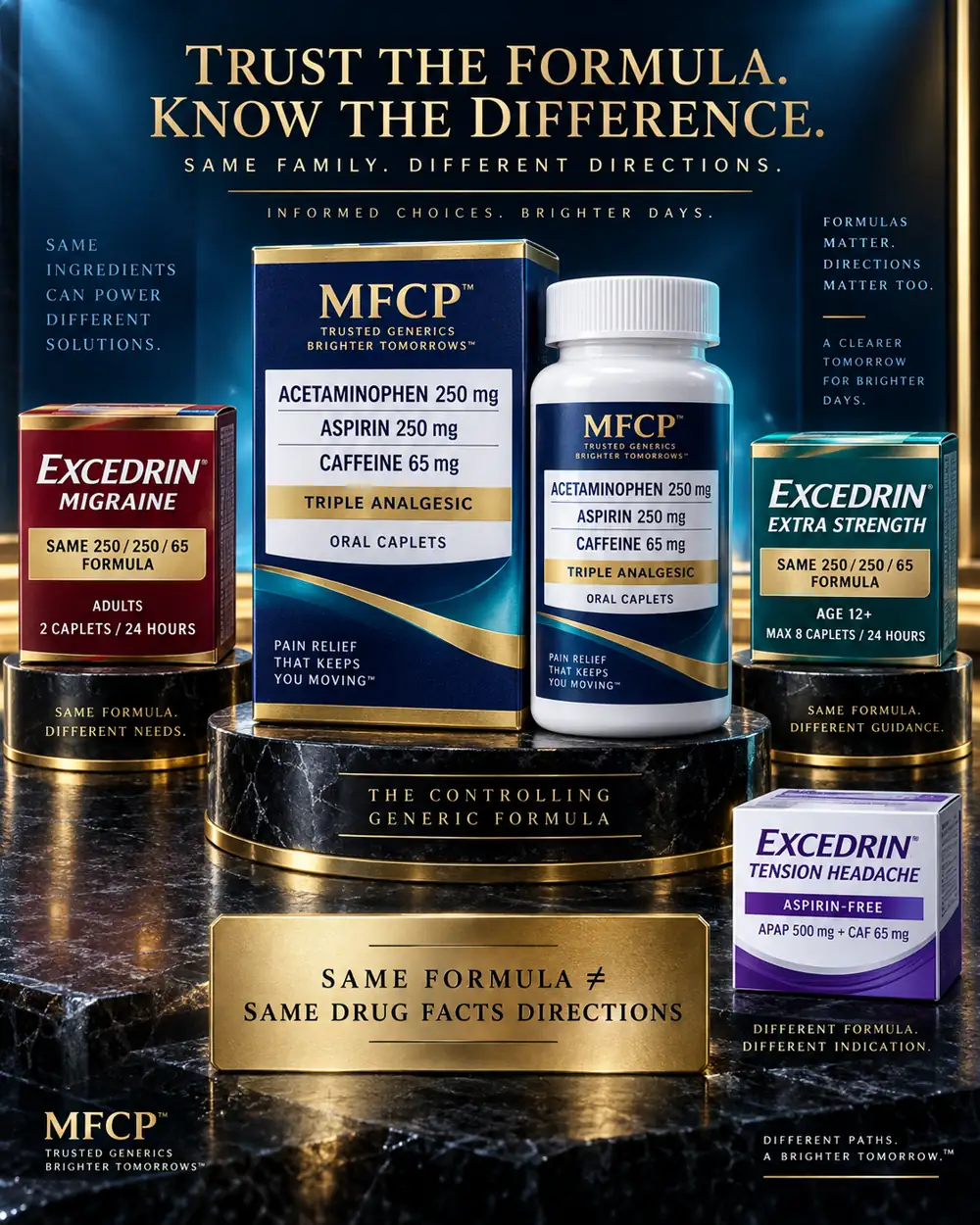
MFCP generic acetaminophen aspirin caffeine combination with Excedrin Migraine, Extra Strength, and aspirin-free Tension Headache compared
02 · LABEL IDENTITY CONTROLSame formula does not mean same directions
Package discipline: Migraine and Extra Strength share 250/250/65, but age gates and daily ceilings differ. Tension Headache omits aspirin.

Acetaminophen 250 mg + aspirin 250 mg + caffeine 65 mg is a three-drug analgesic combination. Excedrin is the reference-brand family—not a single interchangeable formula or instruction set.

ACETAMINOPHEN · APAP250 mg per unit
ASPIRIN · ASA250 mg per unit
CAFFEINE65 mg per unit
PRIMARY CONTROLFormula + exact label + frequency
01
CLINICAL DECISION CONTROL

Pharmacist Bottom Line™

Three ingredients. One label-specific decision.

FIRST

Name all three drugs

Acetaminophen 250 mg + aspirin 250 mg + caffeine 65 mg in each unit.

THEN

Name the exact product

Migraine and Extra Strength share a formula but not directions.

COUNT

Every outside source

APAP, aspirin, NSAIDs, salicylates, and caffeine can hide in other products.

STOP

Screen the headache

New, severe, unusual, progressive, or neurologic headache needs assessment.

★ BOTTOM LINE: The unit formula is only the beginning. Indication, age gate, interval, 24-hour ceiling, contraindications, and frequency of use remain product-label decisions.
Return to cover ↑
02
CONTENTS

Twenty Clinical Decision Modules

Generic identity first; brand family second.

IDENTITY

Three active drugs

Separate each ingredient, mechanism, dose, and toxicity system.

LABEL

One product at a time

Never transfer the Migraine directions to Extra Strength—or the reverse.

RISK

Three exposure ledgers

Count acetaminophen, aspirin/NSAID, and caffeine across the full regimen.

Navigation control: The rail, Previous and Next controls, and Return links move through one disciplined pathway. Proximity illumination resets immediately between elements.
Return to cover ↑
03
TRIPLE DRUG IDENTITY

250 mg + 250 mg + 65 mg

The combination—not the brand name—is the drug.

ACETAMINOPHEN · APAP

250 mg

Analgesic and antipyretic; excess total exposure can cause severe liver injury.

ASPIRIN · ASA

250 mg

Salicylate NSAID with irreversible platelet inhibition and GI bleeding risk.

CAFFEINE

65 mg

Adenosine-receptor antagonist and analgesic adjuvant with stimulant exposure.

APAP and acetaminophen are the same drug. ASA and aspirin are the same drug. Count aliases as the same exposure.
Return to cover ↑
04
REGULATORY · CLINICAL STATUS

One FDA-Approved Combination; Multiple Decision Lanes

Approval does not erase diagnostic responsibility.

OTC STATUS

Nonprescription

Use is governed by the current Drug Facts label for the exact package.

MIGRAINE

Established diagnosis

The Migraine label directs users to ask a doctor if they have never had migraines diagnosed.

EVIDENCE

Level A efficacy

The 2015 American Headache Society assessment found established efficacy for acute migraine.

NOT UNIVERSAL

Not every headache

Diagnosis, phenotype, contraindications, and frequency determine fit.

Return to cover ↑
05
FORMULA · LABEL PARADOX

Same Formula Does Not Mean Same Directions

Excedrin is a family name, not an interchangeable instruction set.

ProductActive ingredients per unitAge gateDirections24-hour ceiling
Excedrin MigraineAPAP 250 + ASA 250 + caffeine 65 mgAdults; under 18 ask a doctor2 caplets with water2 caplets unless a doctor directs otherwise
Excedrin Extra StrengthAPAP 250 + ASA 250 + caffeine 65 mg12 years and older2 caplets every 6 hours8 caplets
Excedrin Tension HeadacheAPAP 500 + caffeine 65 mg; no aspirin12 years and older2 caplets every 6 hours6 caplets
Never infer ingredients or directions from the word “Excedrin.” Read the active-ingredient panel and directions on the package in hand.
Return to cover ↑
06
TRIPLE MECHANISM

Three Pathways Converge on Pain Relief

Benefit and toxicity remain ingredient-specific.

ACETAMINOPHEN

Central analgesia

Reduces central pain and fever signaling with little peripheral anti-inflammatory effect.

ASPIRIN

Irreversible COX acetylation

Suppresses prostaglandins and irreversibly changes platelet function for the platelet lifespan.

CAFFEINE

Adenosine antagonism

Modulates arousal and vascular signaling and can enhance analgesic response.

Mechanism control: Synergy in efficacy does not merge liver, bleeding, renal, allergy, stimulant, and rebound risks into one warning.
Return to cover ↑
07
KINETICS · FORMULATION

Fast Absorption Does Not Shorten the Safety Ledger

Each ingredient follows its own disposition.

FORM

Oral caplet

Swallow with water and follow the exact package directions.

ACETAMINOPHEN

Hepatic metabolism

Toxic reactive metabolite burden rises when safe total exposure is exceeded.

ASPIRIN

Rapid hydrolysis

Short plasma presence does not reverse the platelet effect already produced.

CAFFEINE

Longer stimulant tail

Late dosing and other caffeine sources can disturb sleep and reinforce headache cycles.

Return to cover ↑
08
EVIDENCE · CLINICAL FIT

Use the Combination Where the Diagnosis Fits

Efficacy is not a substitute for triage.

BEST-DEFINED LANE

Acute migraine

The combination has established efficacy in the cited AHS evidence assessment.

OTHER LABELED PAIN

Extra Strength indications

Follow the current package’s labeled uses and directions; do not borrow the migraine regimen.

POOR FIT

Uncertain or changing headache

A new pattern, progressive frequency, trauma, systemic illness, or neurologic symptom needs assessment.

Return to cover ↑
09
MIGRAINE DRUG FACTS

Two Caplets—Once in 24 Hours

The current Migraine label is deliberately restrictive.

AGE

Adults

Persons under 18 years: ask a doctor.

DOSE

2 caplets

Take with a glass of water.

CEILING

2 in 24 hours

Do not take more unless directed by a doctor.

FREQUENCY

Track days used

Using headache medicine 10 or more days per month can worsen headaches.

Do not substitute the Extra Strength ceiling merely because the unit formula is identical.
Return to cover ↑
10
EXTRA STRENGTH DRUG FACTS

Two Caplets Every Six Hours

A different label creates a different dosing lane.

AGE

12 years and older

Children under 12: ask a doctor.

DOSE

2 caplets

Take with a full glass of water.

INTERVAL

Every 6 hours

Do not compress the interval.

CEILING

8 in 24 hours

Do not exceed the current package limit.

This regimen belongs to the Extra Strength label—not to Excedrin Migraine.
Return to cover ↑
11
FREQUENCY · REBOUND

Medication-Overuse Headache Is a Use-Pattern Signal

Count treatment days, not just caplets.

LABEL THRESHOLD

10+ days per month

The Migraine warning states headaches may worsen when headache medicine is used this often.

CLUE

Relief gets shorter

Escalating frequency, morning headache, or recurrent return after dosing warrants review.

ACTION

Do not chase the cycle

More frequent self-dosing can compound APAP, aspirin, caffeine, and rebound risk.

Frequency control: A “two days per week” teaching rule can be useful, but it is not interchangeable with the exact 10-days-per-month Drug Facts warning.
Return to cover ↑
12
YOUTH · VIRAL ILLNESS

Aspirin Activates the Reye Syndrome Warning

The warning follows ASA, even inside a combination.

MIGRAINE PRODUCT

Under 18: ask a doctor

The adult-only direction is product-specific.

CHICKEN POX OR FLU

Do not use

Children and teenagers with or recovering from these viral illnesses should not use aspirin-containing products.

EARLY SIGNAL

Behavior change + vomiting

This combination can signal Reye syndrome and requires prompt medical attention.

Return to cover ↑
13
ACETAMINOPHEN SAFETY

Count Every APAP Source Before Every Dose

Hidden duplication is the preventable liver danger.

SAME DRUG

APAP = acetaminophen

Cold, flu, sleep, prescription, and pain products may contain it.

DO NOT COMBINE

Another APAP product

The label warns against taking with another acetaminophen-containing medicine.

ALCOHOL

3+ drinks daily

Ask a doctor before use.

OVERDOSE

Act immediately

Get medical help or contact Poison Control even if no symptoms are present.

Follow the exact label ceiling. Do not replace a product-specific limit with a remembered “general maximum.”
Return to cover ↑
14
ASPIRIN · NSAID SAFETY

Platelets, Stomach, Kidney, and Allergy All Matter

A 250 mg aspirin unit is not “just another ingredient.”

PLATELETS

Irreversible effect

Bleeding risk persists beyond aspirin’s short plasma presence.

GI BLEED

Higher-risk patient

Age 60+, ulcer history, anticoagulants, steroids, other NSAIDs, and regular alcohol increase concern.

KIDNEY

Perfusion risk

Dehydration, renal disease, heart failure, and interacting drugs reduce the safety margin.

ALLERGY

Aspirin/NSAID reaction

Hives, facial swelling, wheezing, or shock requires emergency care.

Black stool, vomiting blood, faintness, or persistent stomach pain requires immediate medical attention.
Return to cover ↑
15
CAFFEINE SAFETY

The Analgesic Adjuvant Is Also a Stimulant

Add beverages, supplements, and medicines to the same ledger.

PER CAPLET

65 mg

The migraine dose contains 130 mg total caffeine.

LABEL CONTEXT

About a cup of coffee

The recommended dose is described as containing about this amount.

TOO MUCH

Nervousness or rapid heartbeat

Irritability and sleeplessness can also occur.

WITHDRAWAL

Headache can recur

Daily caffeine exposure and abrupt change can complicate headache patterns.

Return to cover ↑
16
PREGNANCY · LACTATION

Aspirin Changes the Pregnancy Decision

Gestational age and clinical direction control.

PREGNANT

Ask a professional

Review the headache, gestational age, dose, and alternatives before use.

20 WEEKS OR LATER

Do not use unless directed

NSAIDs can cause fetal kidney problems and low amniotic fluid.

LATE PREGNANCY

Additional risk

Fetal circulation and delivery-related bleeding concerns rise.

BREASTFEEDING

Review all three drugs

Infant exposure and maternal need require an individualized decision.

Return to cover ↑
17
OLDER ADULTS · FRAILTY

Three Ingredients Magnify Complexity

Bleeding and renal reserve often dominate.

GI

Occult bleeding

Weakness, fatigue, faintness, or dark stool may be the presentation.

RENAL

Lower reserve

Illness, poor intake, diuretics, ACE inhibitors, and ARBs amplify risk.

HEPATIC

Count APAP carefully

Multiple prescribers and combination products make duplication easy.

STIMULANT

Sleep and pulse

Caffeine may worsen insomnia, tremor, palpitations, or anxiety.

Return to cover ↑
18
DRUG · DISEASE · DUPLICATION

Run Three Interaction Screens

One safe ingredient does not make the combination safe.

ExposurePrimary concernControlled action
Another acetaminophen productDuplicate APAP and liver injuryDo not combine.
Aspirin, ibuprofen, naproxen, or other NSAIDBleeding, GI, renal, and allergy riskAvoid duplication unless directed.
Warfarin, DOAC, heparin, or antiplatelet drugBleedingProfessional review required.
Alcohol or corticosteroidLiver or GI harmAsk before use.
Coffee, energy products, stimulants, decongestantsExcess caffeine/stimulationCount the full daily exposure.
Gout, diabetes, arthritis, kidney, liver, or heart therapyDisease and drug interactionReview with a pharmacist or prescriber.
Return to cover ↑
19
COMPARATIVE · BUYING STANDARD

Verify the Formula, Label, and Indication Together

Packaging discipline prevents cross-product transfer.

ACTIVE INGREDIENTS

250 / 250 / 65

Confirm acetaminophen, aspirin, and caffeine per unit.

EXACT VARIANT

Migraine or Extra Strength

The same unit formula can carry different age gates and ceilings.

ASPIRIN-FREE VARIANT

Tension Headache

Do not assume the brand family always contains aspirin.

PACKAGE CONTROLS

Directions + warnings

Verify form, count, tamper evidence, lot, expiration, and current Drug Facts.

MFCP buying standard: Match active ingredients, strength per unit, dosage form, indication-specific directions, age gate, warnings, lot, and expiration. Brand similarity is never enough.
Return to cover ↑
20
TRIAGE · EVIDENCE · READABILITY

Close Every Headache Decision with a Stop Rule

The label is the dosing authority; the patient determines urgency.

EMERGENCY

Neurologic or explosive onset

Worst-ever sudden headache, weakness, confusion, seizure, fainting, or vision/speech change.

PROMPT ASSESSMENT

Systemic or positional clues

Fever, stiff neck, trauma, pregnancy, cancer, immune suppression, exertion, cough, or bending trigger.

DIAGNOSTIC CHANGE

New or different pattern

First headache after 50, progressive frequency, daily headache, or vomiting requires review.

TOXICITY

Do not wait

Suspected excess APAP or aspirin, bleeding, severe allergy, or concerning palpitations needs immediate help.

Final control: If the formula, exact variant, diagnosis, risk screen, frequency, or total exposure is uncertain, pause and ask a pharmacist or clinician.
Return to cover ↑
Michael's Formulary & Clinical Perspective™
America's OTC Pharmacy™ · Professional Judgment. Delivered.™
Always read and follow the current Drug Facts label. This educational reference does not replace diagnosis, individualized treatment, Poison Control, or emergency care.
Module 1 of 20
Contents
  1. Pharmacist Bottom Line™
  2. Twenty Clinical Decision Modules
  3. 250 mg + 250 mg + 65 mg
  4. One FDA-Approved Combination; Multiple Decision Lanes
  5. Same Formula Does Not Mean Same Directions
  6. Three Pathways Converge on Pain Relief
  7. Fast Absorption Does Not Shorten the Safety Ledger
  8. Use the Combination Where the Diagnosis Fits
  9. Two Caplets—Once in 24 Hours
  10. Two Caplets Every Six Hours
  11. Medication-Overuse Headache Is a Use-Pattern Signal
  12. Aspirin Activates the Reye Syndrome Warning
  13. Count Every APAP Source Before Every Dose
  14. Platelets, Stomach, Kidney, and Allergy All Matter
  15. The Analgesic Adjuvant Is Also a Stimulant
  16. Aspirin Changes the Pregnancy Decision
  17. Three Ingredients Magnify Complexity
  18. Run Three Interaction Screens
  19. Verify the Formula, Label, and Indication Together
  20. Close Every Headache Decision with a Stop Rule
  21. Source links

Source links

Links already cited on this page.