
Alcaftadine 0.25% Ophthalmic Solution
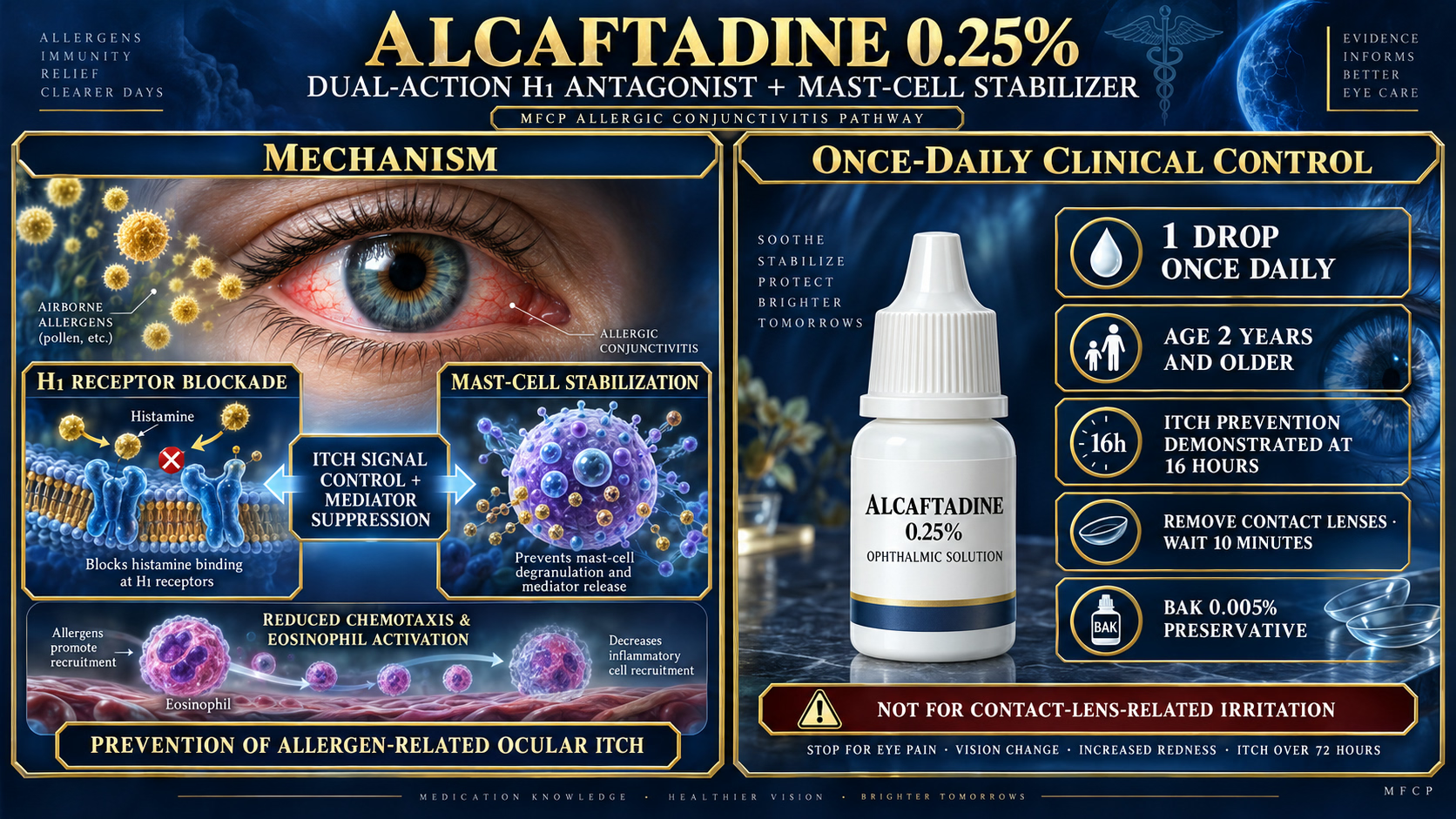
Controlled Bottom LineAlcaftadine 0.25% Ophthalmic Solution
Alcaftadine is a second-generation ophthalmic H1-receptor antagonist with mast-cell-stabilizing activity. Current over-the-counter labeling supports temporary relief of itchy eyes caused by pollen, ragweed, grass, animal hair, and dander. One drop is used once daily in affected eyes for adults and children two years of age and older.
NavigationContents
- 01 · Pharmacodynamics & Molecular Mechanisms
- 02 · Pharmacokinetic & Clinical Profile
- 03 · Dosing & Drug Facts Controls
- 04 · Comparative OTC Placement
- 05 · Packaging, Formulation & BAK
- 06 · Adverse Events & Tolerability
- 07 · Clinical Pearls & Regimen Strategy
- 08 · Safety & Referral Boundary
- 09 · Evidence & Source Control
01 · Three Complementary ActionsPharmacodynamics & Molecular Mechanisms
H1-receptor antagonism
Alcaftadine blocks histamine signaling at H1 receptors, interrupting the sensory and vascular pathways that produce ocular itching and allergic surface symptoms.
Mast-cell stabilization
Official pharmacology identifies alcaftadine as an inhibitor of histamine release from mast cells, reducing additional mediator release after allergen exposure.
Eosinophil and chemotaxis control
Decreased chemotaxis and inhibition of eosinophil activation have also been demonstrated, extending the mechanism beyond simple receptor blockade.
Barrier-function evidence
Experimental comparative studies have examined preservation of conjunctival epithelial tight-junction proteins, including ZO-1. This is supportive mechanistic evidence, not a separate OTC indication.
02 · Local Delivery, Low Systemic ExposurePharmacokinetic & Clinical Profile
| Active molecule | Alcaftadine 0.25% (2.5 mg/mL). |
| Clinical role | OTC antihistamine ophthalmic solution with mast-cell-stabilizing pharmacology. |
| Onset evidence | Prevention of allergen-challenge itching demonstrated at 3 minutes after dosing. |
| Duration evidence | Prevention of allergen-challenge itching demonstrated at 16 hours after dosing. |
| Standard direction | One drop in affected eye or eyes once daily. |
| Pediatric threshold | Adults and children two years of age and older; under two, consult a doctor. |
| Systemic exposure | After bilateral ocular dosing, mean parent-drug Cmax was approximately 60 pg/mL; the active carboxylic-acid metabolite reached approximately 3 ng/mL. No systemic accumulation was indicated with daily topical dosing. |
Controlled Clinical Snapshot
OTC antihistamine ophthalmic solution for temporary relief of itchy eyes caused by common environmental allergens.
Sterile multidose dropper bottle. When another ophthalmic product is used, separate administration by at least five minutes.
Conjunctival allergen-challenge studies demonstrated prevention of ocular itching at both 3 minutes and 16 hours after dosing.
For children under two years, consult a doctor. Safety and effectiveness below age two have not been established.
Benzalkonium chloride is present in representative current multidose labeling and may be absorbed by soft contact lenses.
Do not use for contact-lens-related irritation, and do not wear contact lenses while the eye is red.
04 · Allergy-Eye AisleComparative OTC Placement
| Active | Typical current schedule | Age threshold | Distinctive control |
|---|---|---|---|
| Alcaftadine 0.25% | Once daily | 2 years and older | Allergen-challenge itch prevention demonstrated at 3 minutes and 16 hours. |
| Olopatadine 0.2% / 0.7% | Once daily | 2 years and older | Strength-specific labeling; 0.7% provides a 24-hour once-daily pathway. |
| Olopatadine 0.1% | Twice daily, 6–8 hours apart | 2 years and older | Twice-daily dual-action pathway. |
| Ketotifen 0.025% | Every 8–12 hours; maximum twice daily | 3 years and older | Established dual-action pathway with a different pediatric threshold. |
05 · Finished-Product ArchitecturePackaging, Formulation & Preservative System
- Dosage form: Sterile ophthalmic solution in a multidose dropper bottle; a representative current OTC package contains 3 mL.
- Preservative: Benzalkonium chloride 0.005% in current representative labeling.
- Lens interaction: Benzalkonium chloride may be absorbed by soft contact lenses. Remove lenses before use and wait at least 10 minutes before reinsertion.
- Contamination control: Do not touch the dropper tip to the eyelid, surrounding tissue, fingers, or another surface; replace the cap after use.
- Storage: Follow the package, including the labeled 15°C to 25°C range where applicable.
06 · TolerabilityAdverse Events
Ocular effects
In prescription clinical-trial labeling, the most frequent ocular reactions occurred in fewer than 4% of treated eyes and included irritation, burning or stinging, redness, and ocular pruritus.
Non-ocular effects
Nasopharyngitis and headache occurred in fewer than 3% of subjects. Postmarketing reports also include discharge, swelling, blurred vision, increased tearing, hypersensitivity reactions, and somnolence.
Adverse-event rates from trials cannot be treated as precise predictions for an individual patient or directly compared across different drug trials.
07 · Regimen EngineeringClinical Pearls & Administration Strategy
- Use the once-daily schedule: More frequent dosing is not supported by current Drug Facts directions.
- Anticipated allergen exposure: The prevention language and mast-cell effects make scheduled daily use during a known exposure period rational; the OTC label does not require a multiweek loading period.
- Other ophthalmic products: Separate products by at least five minutes. If an ointment is also used, administer the ointment last.
- Contact lenses: Remove before instillation, wait 10 minutes, and do not wear a lens while the eye is red.
- Redness-only selection: Confirm that itching and an allergy pattern are present. A red eye without itch can reflect dryness, infection, injury, or another ocular disorder.