
Antihistamines and Mast-Cell Stabilizers for Allergic Conjunctivitis
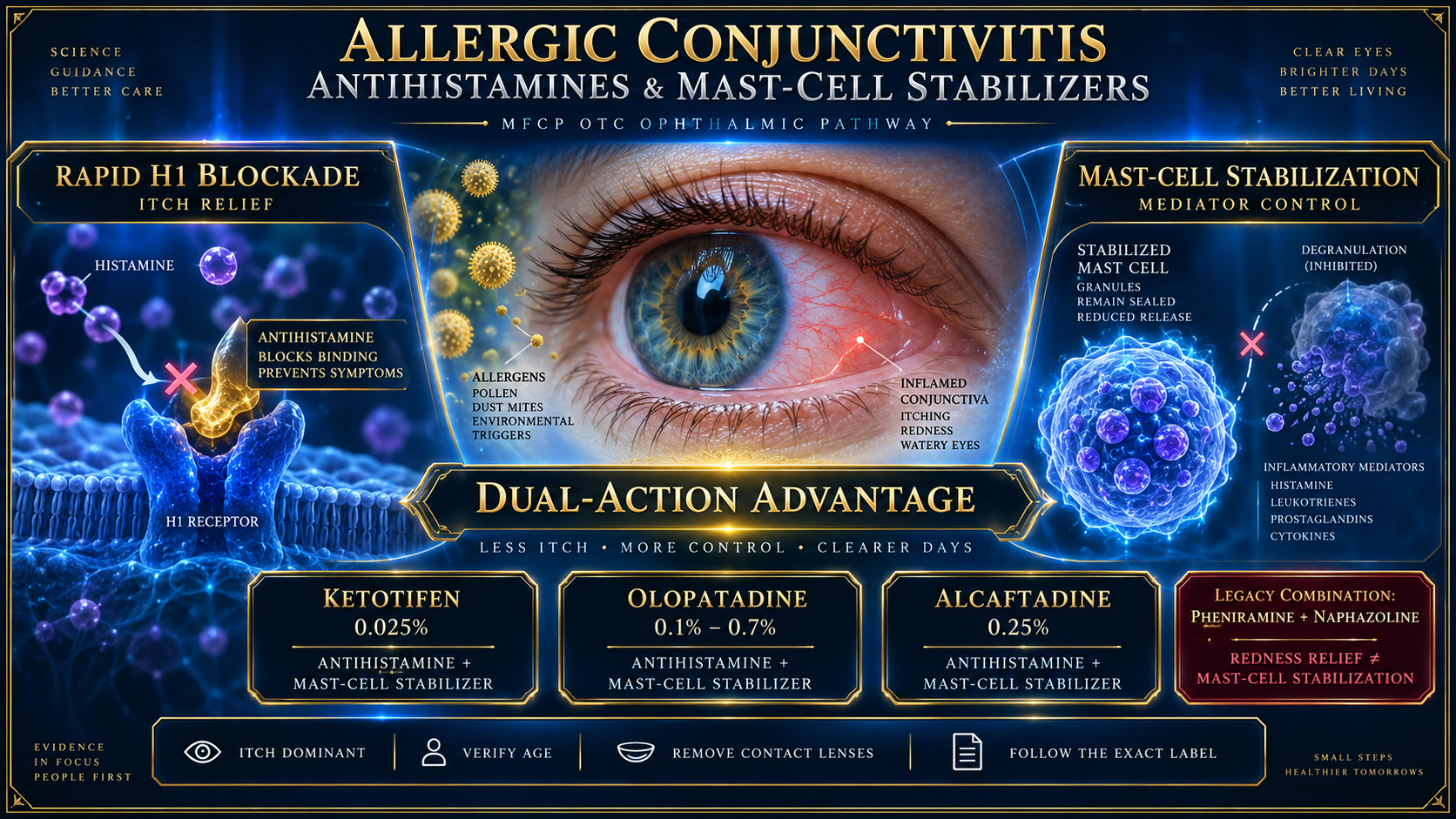
Mechanistic OverlapWhy Dual Action Is an Advantage
Histamine released after allergen exposure binds conjunctival H1 receptors and drives itch, vasodilation, and vascular leakage. Antihistamine activity interrupts that signal and is the fast-relief half of the pathway.
Stabilization reduces degranulation and downstream release of histamine and other inflammatory mediators. It adds control at the source instead of acting only after histamine has reached its receptor.
The clinical advantage: ketotifen, olopatadine, and alcaftadine occupy overlapping lanes because each provides antihistamine activity with mast-cell-stabilizing pharmacology. That overlap is useful—it joins rapid itch control with suppression of additional mediator release. It does not make strengths, schedules, label claims, or packages interchangeable.
Modern OTC Core + Controlled BoundariesActive-Ingredient Families
Antihistamine on Drug Facts; pharmacologically also stabilizes mast cells. Common current labeling: age 3+, one drop every 8–12 hours, no more than twice daily.
OPEN KETOTIFEN MONOGRAPH →H1 antagonism plus mast-cell stabilization. The strength controls the schedule: selected 0.1% products are twice daily; 0.2% and 0.7% pathways are once daily.
OPEN OLOPATADINE MONOGRAPH →Once-daily antihistamine pathway with mast-cell-stabilizing activity. Current OTC labeling supports age 2+ and allergen-related ocular itch.
OPEN DUAL-PANEL INTRODUCTION →Antihistamine plus vasoconstrictor: itch relief paired with redness reduction. This is not the same as mast-cell stabilization; overuse may produce more redness and additional warnings apply.
OPEN CONTROLLED MONOGRAPH →A mast-cell stabilizer without intrinsic antihistamine or vasoconstrictor activity. Current prescription labeling is for vernal keratoconjunctivitis, vernal conjunctivitis, and vernal keratitis—not routine OTC seasonal itch selection.
Many modern OTC allergy drops reached OTC status through NDA/ANDA pathways. Product-specific approved labeling—not a generalized class summary—controls the finished product.
Do Not Generalize Across the ShelfCurrent Label-Control Comparison
| Active pathway | Drug Facts role / clinical overlap | Typical current OTC direction | Age control | Contact-lens control |
|---|---|---|---|---|
| Ketotifen 0.025% | Dual-action pharmacology Drug Facts purpose: antihistamine; use centers on allergen-related itch. | 1 drop every 8–12 hours; no more than twice daily. | 3 years and older; under 3, consult a doctor. | Remove first; wait at least 10 minutes. Not for contact-lens-related irritation. |
| Olopatadine 0.1% | Dual-action pharmacology Selected current labels include antihistamine and redness-reliever purposes. | Selected 0.1% labels: 1 drop twice daily, every 6–8 hours. | 2 years and older; under 2, consult a doctor. | Remove first; wait at least 10 minutes. Do not wear a lens if the eye is red. |
| Olopatadine 0.2% / 0.7% | Dual-action pharmacology Current OTC Drug Facts focus on temporary relief of allergen-related itchy eyes. | 1 drop once daily; no more than 1 drop per eye per day. | 2 years and older; under 2, consult a doctor. | Remove first; wait at least 10 minutes. Separate other ophthalmics by at least 5 minutes when labeled. |
| Alcaftadine 0.25% | Dual-action pharmacology Drug Facts purpose: antihistamine; use centers on allergen-related itch. | 1 drop once daily. | 2 years and older; under 2, consult a doctor. | Remove first; wait at least 10 minutes. Do not wear a lens if the eye is red. |
| Pheniramine 0.315% + naphazoline 0.02675% | Antihistamine + vasoconstrictor Itch and redness pathway; no mast-cell-stabilizer equivalence. | 1–2 drops up to 4 times daily. | 6 years and older; under 6, consult a doctor. | Remove lenses. Follow the exact package interval and warnings. |
Representative current U.S. labels are shown. Equivalent actives may appear in different approved products; always verify the package in hand.
Symptom-First TriageAllergy Is a Pattern, Not Just a Red Eye
Seasonal exposure, watery tearing, chemosis, and itch favor allergic conjunctivitis and the dual-action pathway.
Some products explicitly claim redness relief; others claim itch only. Do not transfer one label’s indication to another molecule or strength.
Dry eye, irritation, foreign material, nasolacrimal disease, and infection can all cause tearing. The trigger and accompanying symptoms matter.
These findings—especially with reduced vision, unilateral severity, or contact-lens wear—move the patient out of the OTC pathway.
Device + Preservative InteractionContact-Lens Control
Current ketotifen, olopatadine, and alcaftadine labels generally direct lens removal and exclude contact-lens-related irritation. Several also say not to wear lenses while the eye is red.
A 10-minute minimum is common in current allergy-drop labeling because preservatives such as benzalkonium chloride may be absorbed by soft lenses. “Preservative-free” still does not create a lens-wear claim unless the label says so.
Stop-Use and Referral GateProtect the Cornea Before Treating the Itch
Eye pain, photophobia, meaningful vision change, corneal opacity, trauma, chemical exposure, an embedded foreign body, severe unilateral redness, or purulent discharge require prompt evaluation.
A contact-lens wearer with pain, light sensitivity, reduced vision, or marked redness should remove the lenses and obtain urgent clinical assessment because microbial keratitis can threaten vision.
Current OTC allergy labels commonly direct stopping and asking a doctor if symptoms worsen or itching/redness persists beyond 72 hours. The package language controls.
Naphazoline-containing products add vasoconstrictor warnings, including overuse-related redness and precautions involving narrow-angle glaucoma and selected cardiovascular or urinary conditions.
Primary Label SourcesEvidence & Regulatory Boundary
- DailyMed: ketotifen fumarate 0.025% OTC Drug Facts
- DailyMed: olopatadine 0.1% OTC Drug Facts
- DailyMed: olopatadine 0.7% OTC Drug Facts
- DailyMed: alcaftadine 0.25% OTC Drug Facts
- DailyMed: pheniramine maleate + naphazoline hydrochloride OTC Drug Facts
- DailyMed: cromolyn sodium ophthalmic solution 4% prescription labeling