

Hyperosmolar Agents
Hypertonic sodium chloride solution and ointment temporarily reduce corneal swelling by creating an osmotic gradient across the ocular surface.
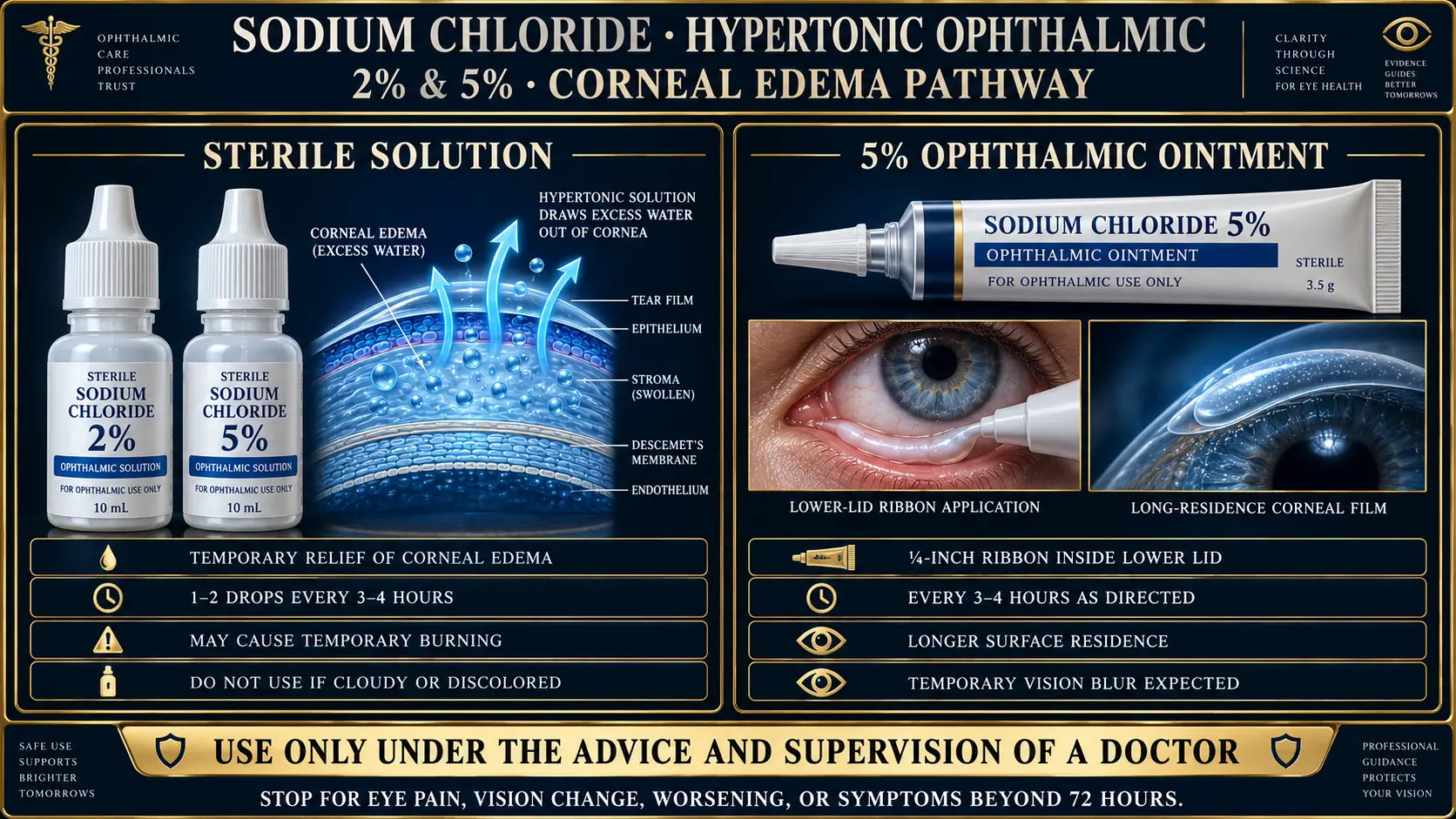
Clinical Entry PointChoose by Dosage Form and Labeled Strength
The finished product’s concentration and dosage form determine residence time, blur, administration technique, and practical use. These products provide temporary relief; they do not establish the cause of corneal edema.
Sterile hypertonicity ophthalmic solution for temporary relief of corneal edema.
More concentrated sterile solution using the same labeled temporary-relief pathway.
Hypertonic sodium chloride suspended in an ophthalmic ointment base for longer ocular-surface residence.
Formulary ComparisonStrength and Vehicle Change the Clinical Experience
| Pathway | Delivery | Primary Advantage | Principal Trade-Off |
|---|---|---|---|
| Sodium chloride 2% | Aqueous solution | Lower-concentration drop pathway with rapid distribution across the ocular surface. | Frequent administration; transient burning; product-specific preservative exposure. |
| Sodium chloride 5% | Aqueous solution | Higher extracellular tonicity in a familiar drop format. | May sting more; shorter residence than ointment; still requires professional supervision. |
| Sodium chloride 5% | Ophthalmic ointment | Longer residence and reduced rapid washout. | Pronounced temporary blur, greasy film, and separate ribbon-application technique. |
Osmotic PharmacologyHow Hypertonicity Temporarily Reduces Corneal Swelling
Excess water increases corneal thickness and disrupts optical clarity.
A higher solute concentration at the ocular surface creates an osmotic gradient.
Temporary fluid-shift support
- The formulation increases tear-film osmolarity at the corneal surface.
- Water movement out of the swollen cornea can temporarily reduce epithelial or stromal edema.
- The effect depends on continued surface contact, which is why solution and ointment behave differently.
- The product does not correct endothelial failure, dystrophy, postoperative complications, infection, trauma, or another underlying cause.
Drug Facts ControlProfessional Supervision Is Part of the Label
Current labels direct consumers not to use these products except under the advice and supervision of a doctor.
Do not touch the bottle or tube tip to the eye, fingers, or another surface. Replace the cap after each use.
Stop use and seek professional review if the condition worsens or persists longer than 72 hours.
Stop and seek care
- Eye pain or a change in vision.
- Continued redness or irritation.
- Worsening swelling, marked light sensitivity, discharge, trauma, or chemical exposure.
- Cloudy, discolored, contaminated, difficult-to-dispense, or particle-containing product.
Clinical BoundaryCorneal Edema Is a Finding, Not a Complete Diagnosis
Temporary symptom support after corneal edema has been identified and the patient has been advised to use a specific product.
Persistent morning blur, worsening halos, increasing discomfort, recurrent symptoms, or inadequate response despite directed use.
Sudden vision loss, significant pain, severe photophobia, trauma, chemical injury, suspected infection, or postoperative deterioration.
Primary Label SourcesEvidence and Regulatory Control
The physical package label governs the exact directions, inactive ingredients, storage, and warnings for the product in hand.