
Skip to content
MFCP mortar and pestle emblemMichael’s FormularyCLINICAL PERSPECTIVE™

Clinical library / Eye, ear, nose & throat

On this page
MICHAEL’S FORMULARY & CLINICAL PERSPECTIVE™ · CONTROLLED OPHTHALMIC MONOGRAPH
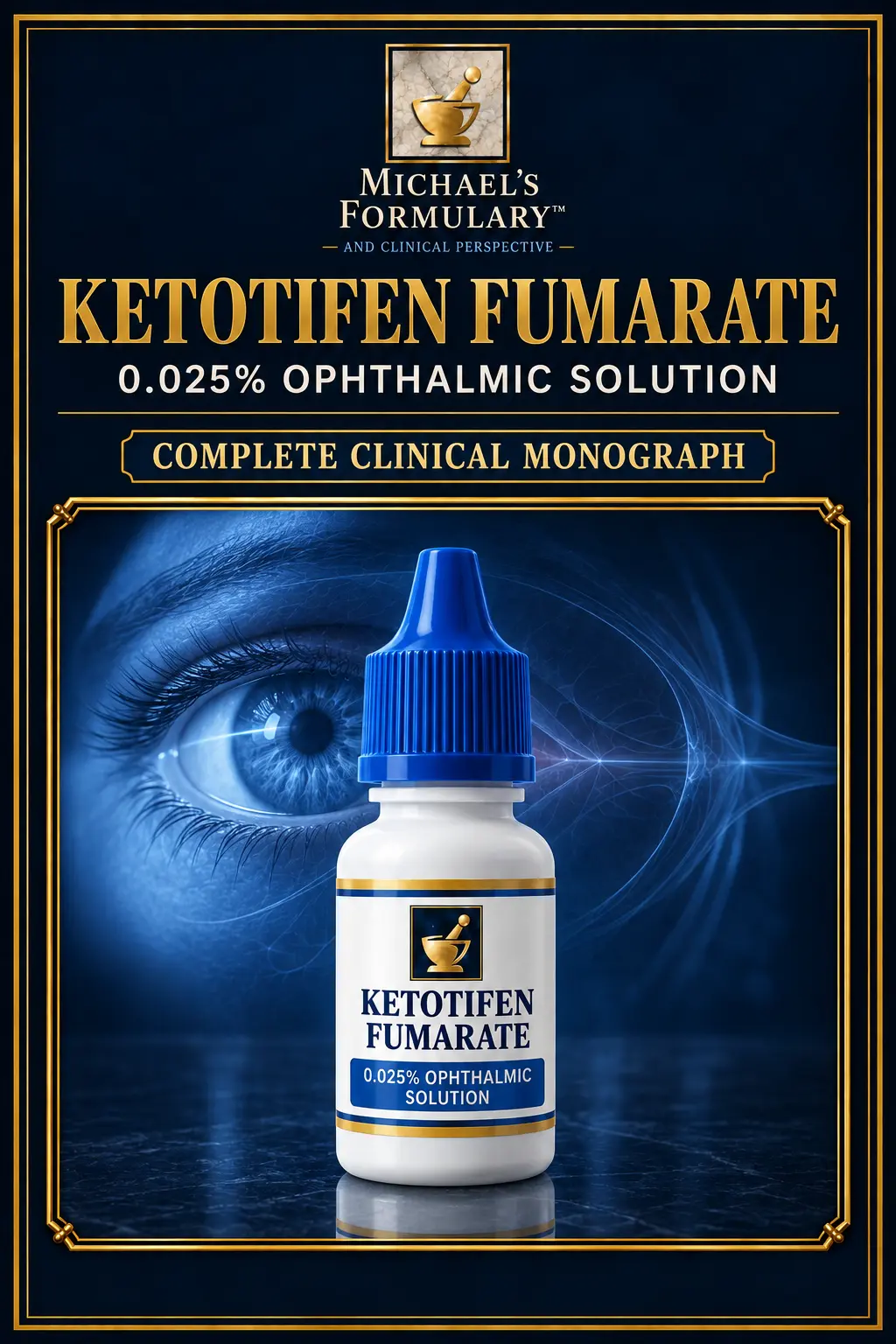
Michael’s Formulary Ketotifen Fumarate 0.025% Ophthalmic Solution branded product cover with labeled eye-drop bottle
Michael’s Formulary Trust and Reliability Nexus
OPHTHALMIC ANTIHISTAMINE · MAST-CELL STABILIZER

Ketotifen
Fumarate

0.025% OPHTHALMIC SOLUTION

Rapid relief and preventive control for allergic eye itch.

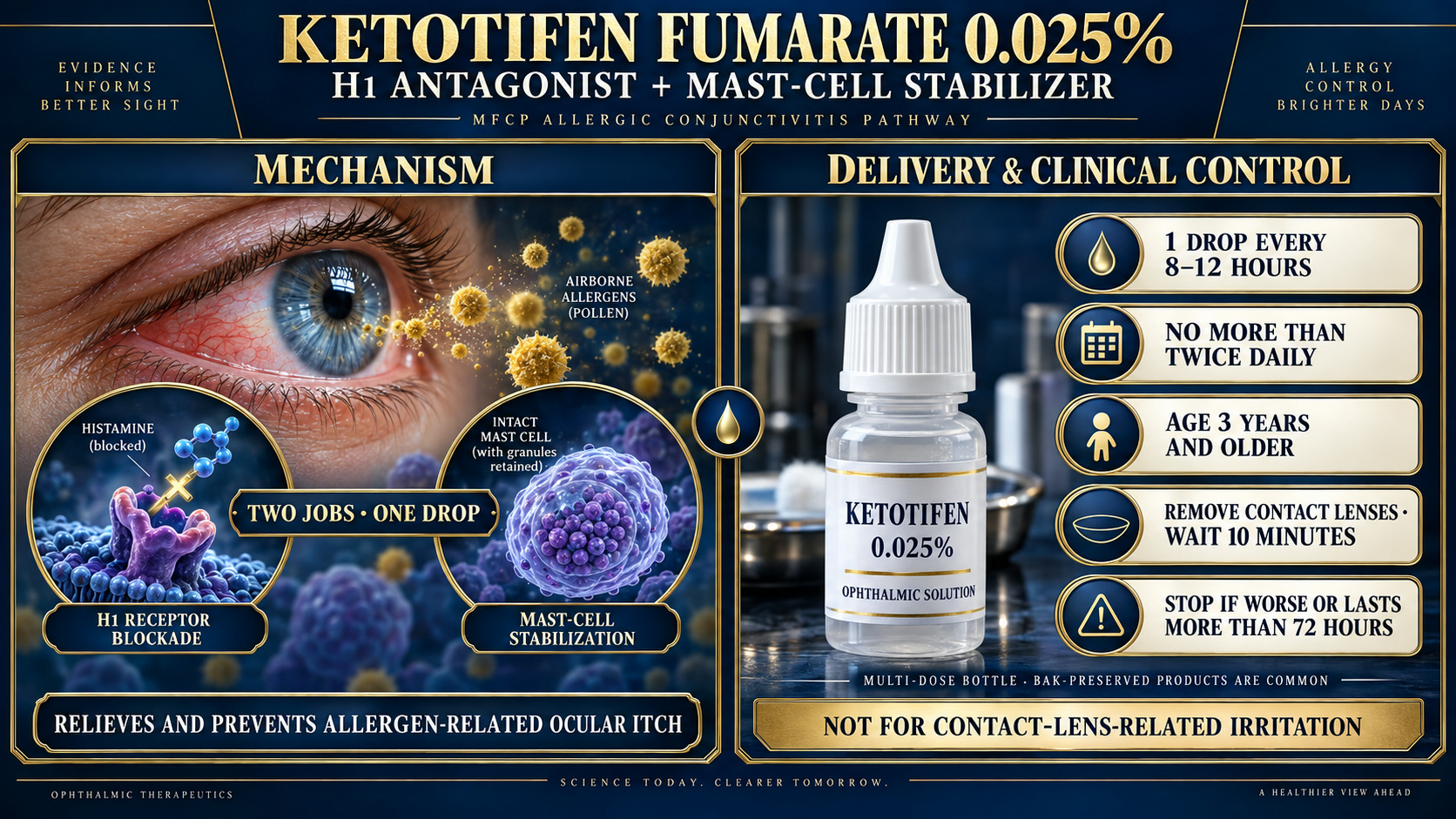
Anatomically correct eye receiving an ophthalmic drop with H1 receptor blockade and mast-cell stabilization insets
TWO JOBS · ONE DROPH1 BLOCKADE → MAST-CELL STABILIZATION
Ketotifen fumarate 0.025 percent dual-panel introduction showing H1-receptor blockade and mast-cell stabilization beside delivery, dosing, age, contact-lens, preservative, and 72-hour safety controls
KETOTIFEN FUMARATE 0.025% · MECHANISM + DELIVERY AND CLINICAL CONTROL

Contents

03

Monograph at a Glance

ROUTEOphthalmic
AGE3 years and older
DOSE1 drop every 8–12 hours
CEILINGNo more than twice daily
04
MFCP READING STOP

Where It Fits

03
MFCP CATEGORICAL CONTROL

Therapeutic Domain Indicator

Anatomically correct eye receiving ketotifen with H1-receptor and mast-cell stabilization insets
FEATURED MONOGRAPH

KETOTIFEN FUMARATE 0.025% OPHTHALMIC SOLUTION

Antihistamine · Mast-cell stabilizer
Temporary relief and prevention of ocular itching due to common allergens.

MFCP THERAPEUTIC DOMAIN CONTROL

ONE PRIMARY DOMAIN · NO SECONDARY OR TERTIARY ASSIGNMENT

EYE

OPHTHALMIC · ALLERGY RELIEF

PRIMARY INDICATION
RESP

RESPIRATORY · SINUS RELIEF

NOT ASSIGNED
DERM

SKIN · DERMATOLOGY

NOT ASSIGNED
GI

DIGESTIVE · GI DISCOMFORT

NOT ASSIGNED
PAIN

PAIN · INFLAMMATION

NOT ASSIGNED
IMM

IMMUNITY · ALLERGY

NOT ASSIGNED
WH

WOMEN’S HEALTH

NOT ASSIGNED
DRY

EYE HEALTH · DRY EYE

NOT ASSIGNED
PRIMARY: OPHTHALMIC · ALLERGY RELIEF NO SECONDARY DOMAINNO TERTIARY DOMAIN
03
CONTROLLED CLINICAL SECTION

Two Numbers, One Bottle — Identity and Chemistry

Ketotifen base and fumarate salt structures

Attaching fumaric acid makes ketotifen stable and water-soluble. Once the drop reaches the eye, the salt separates and the ketotifen base acts at the receptor.

What is counted Percent Per mL Molecular weight
Ketotifen base 0.025% 0.25 mg/mL 309.43 g/mol
Ketotifen fumarate 0.035% 0.345 mg/mL 425.51 g/mol
Salt-to-base ratio 1.375× 1.375× 1.375×
0.025% × 1.375 = 0.034% ≈ 0.035%
SAME MOLECULE, DIFFERENT LABEL CONVENTION

The two percentages identify the same dose.

RETURN TO CONTENTS ↑
04
CONTROLLED CLINICAL SECTION

Mechanism of Action — Two Jobs in One Drop
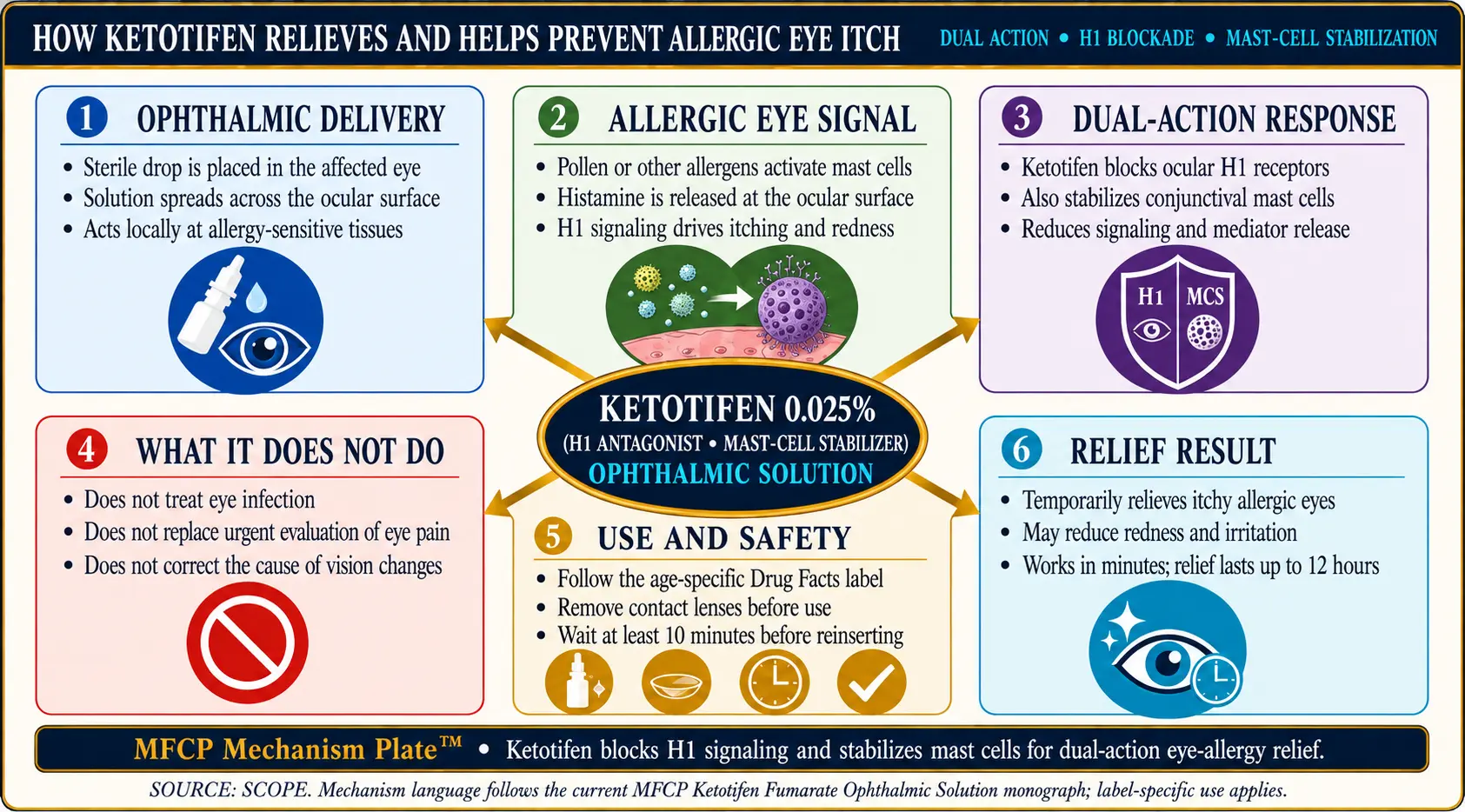
How ketotifen relieves and helps prevent allergic eye itch

Ketotifen blocks histamine already released and stabilizes conjunctival mast cells so they release less histamine during the next exposure. It also reduces later eosinophil recruitment.
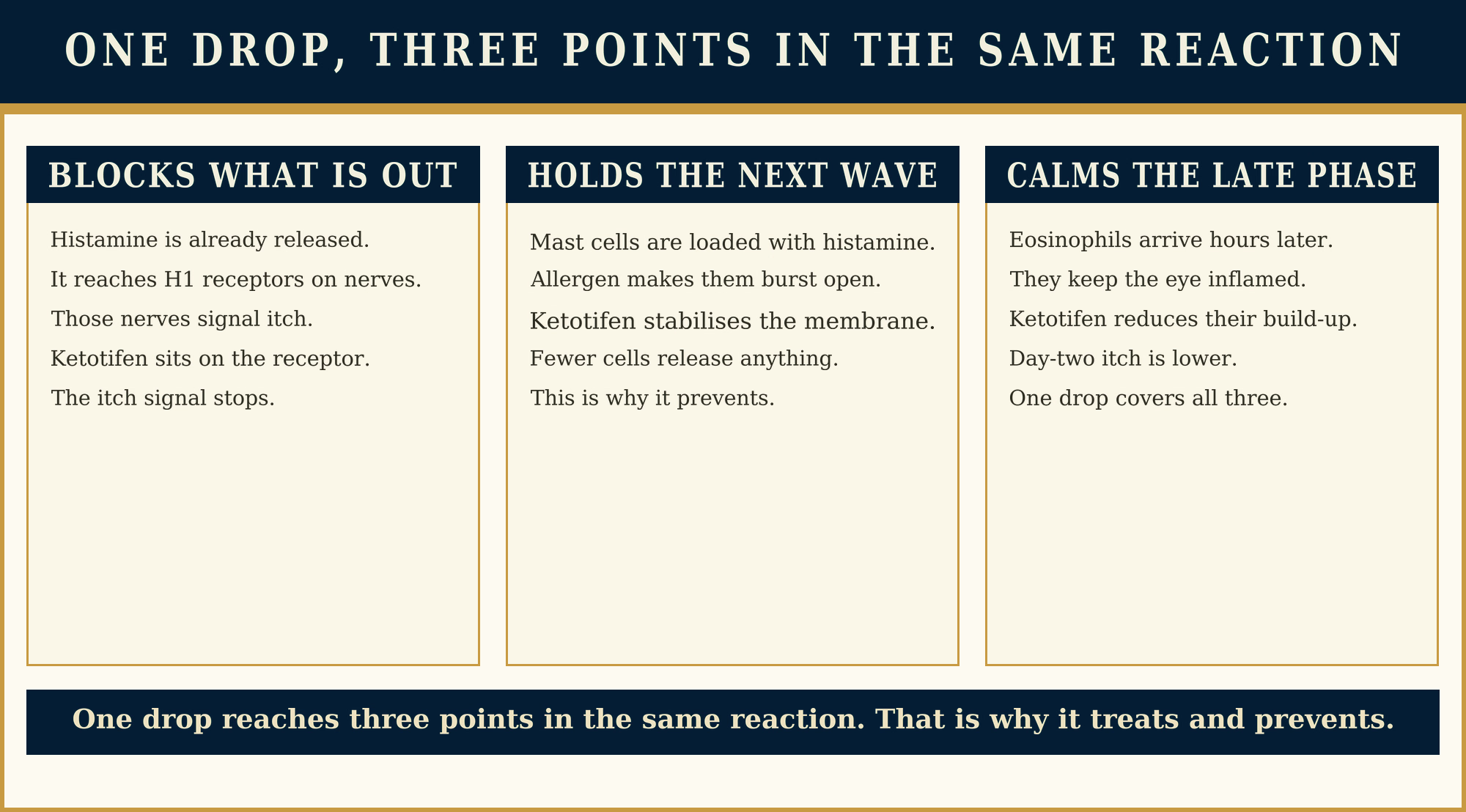
Three points in one allergic reaction
WHY TWO MECHANISMS CHANGE THE ADVICE

Ketotifen can be used after itching begins and before a predictable allergen exposure.

RETURN TO CONTENTS ↑
05
MFCP READING STOP

Use It Right

02
CONTROLLED CLINICAL SECTION

Production Mandate and Bottom Line

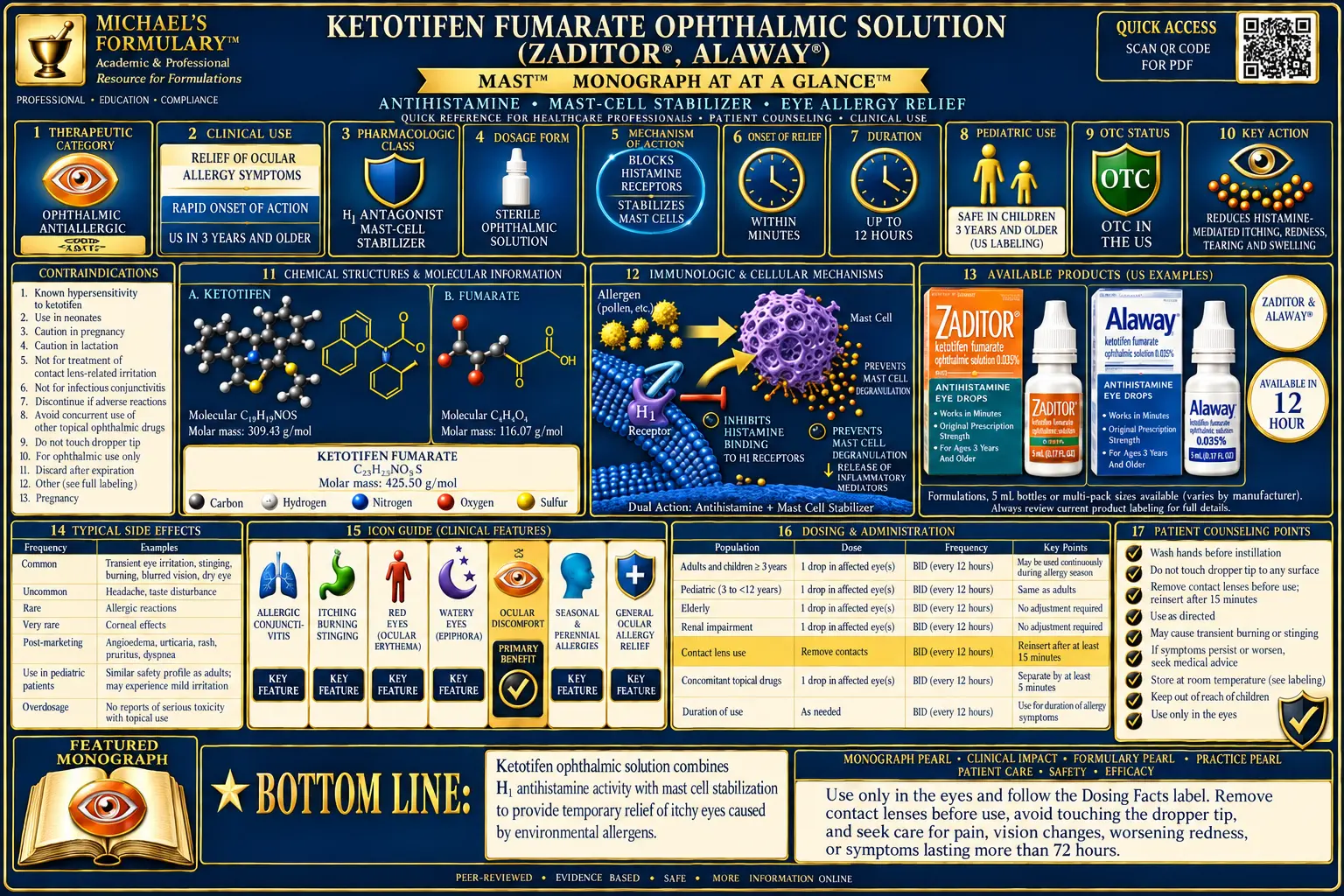
MFCP Ketotifen monograph at a glance overview

This monograph covers OTC ketotifen ophthalmic solution sold as Zaditor®, Alaway®, and store-brand equivalents.

THE BOTTOM LINE

Use one drop in each affected eye every 8–12 hours. Do not use more than twice daily. Remove contact lenses and wait at least 10 minutes before replacing them. Stop if itching worsens or lasts more than 72 hours.

Drug Facts item Controlled detail
Active ingredient Ketotifen 0.025% (equivalent to ketotifen fumarate 0.035%)
Purpose Antihistamine
Use Temporarily relieves itchy eyes due to pollen, ragweed, grass, animal hair, and dander
Dose 1 drop in affected eye or eyes every 8–12 hours
Ceiling No more than twice daily
Age 3 years and older; under 3, ask a doctor
RETURN TO CONTENTS ↑
05
CONTROLLED CLINICAL SECTION

Onset, Duration, and Why It Also Prevents

Relief starts within minutes. Eight to twelve hours between doses reflects the duration of effect on the ocular surface.

Question Answer
How fast? Within minutes
How long between doses? 8–12 hours
Daily ceiling? Two doses; never three
Does it prevent? Yes—the mast-cell action supports prevention
RETURN TO CONTENTS ↑
06
CONTROLLED CLINICAL SECTION

A Drop Is Still a Dose

Some liquid drains through the tear duct into the nose and may be swallowed. Oral ketotifen data describe the molecule in the body; they do not measure exposure from this eye drop.

Oral property Reported data Meaning here
Absorption About half an oral dose The swallowed fraction can be absorbed
Protein binding About 75% Most circulating drug is bound
Metabolism Liver, to norketotifen Oral data only
Excretion Mostly urine Most is metabolized first
LOWER SYSTEMIC EXPOSURE

Close the eye and press the inner corner beside the nose for about one minute.

RETURN TO CONTENTS ↑
07
CONTROLLED CLINICAL SECTION

Dosing and the Twice-Daily Ceiling

Who How much How often Ceiling
Adults and children 3+ 1 drop per affected eye Every 8–12 hours 2 doses in 24 hours
Children under 3 Ask a doctor Ask a doctor Safety not established
TWO SPACING RULES
  • Keep at least 8 hours between ketotifen doses.
  • Keep at least 5 minutes between different eye products.

A second immediate drop overflows; it does not double the useful dose.

RETURN TO CONTENTS ↑
08
CONTROLLED CLINICAL SECTION

Technique — The Drop That Actually Lands

  1. WASHWash and dry your hands before handling the bottle.
  2. REMOVE CONTACTSTake out contact lenses before instilling the drop.
  3. POSITIONTilt the head back and look upward.
  4. LOWER LIDGently pull down the lower lid to form a pocket.
  5. INSTILLPlace one drop into the pocket beneath the lid.
  6. KEEP TIP CLEANDo not let the dropper tip touch the eye or any surface.
  7. CLOSE & PRESSClose the eye and press the inner corner for one minute.
  8. WAIT 10 MINUTESWait at least 10 minutes before replacing contact lenses.
  9. RECAPReplace the cap securely after each use.
Do not use solution that is cloudy or discolored.
RETURN TO CONTENTS ↑
11
CONTROLLED CLINICAL SECTION

Children — the Age-Three Floor

Age 3 is the floor for self-care. The dose for children 3 and older is one drop per affected eye every 8–12 hours, no more than twice daily.

WHEN A CHILD WILL NOT COOPERATE

Lay the child on their back with both eyes closed. Place the drop at the inner corner, then ask the child to open the eye.

A ketotifen-eluting contact lens is a different product with different age limits.

RETURN TO CONTENTS ↑
12
CONTROLLED CLINICAL SECTION

What This Drop Is Not For

Do not use

  • If cloudy or discolored.
  • With ingredient sensitivity.
  • For contact-lens irritation.
  • In the ear, nose, or mouth.

Stop and ask a doctor

  • Eye pain.
  • Vision change.
  • Eye redness.
  • Worsening or persistent itch.
PAIN AND VISION CHANGE REQUIRE SAME-DAY ASSESSMENT

If swallowed, call Poison Control at 1-800-222-1222.

RETURN TO CONTENTS ↑
06
MFCP READING STOP

Stay Safe

09
CONTROLLED CLINICAL SECTION

Contact Lenses and Benzalkonium Chloride

The bottle contains benzalkonium chloride 0.01%. It can bind to soft contact lenses and concentrate against the cornea.

LENSES OUT · TEN MINUTES · LENSES BACK

Remove lenses before dosing and wait at least 10 minutes before replacing them.

DO NOT USE FOR LENS DISCOMFORT

Ketotifen cannot correct a poor fit, damaged lens, contamination, infection, or overwear.

RETURN TO CONTENTS ↑
10
CONTROLLED CLINICAL SECTION

The 72-Hour Rule, and What Itching Is Not

What else itches? Typical clue Why ketotifen will not fix it
Dry eye Gritty; worse late Needs lubrication
Blepharitis Crusted lid margins Problem is on the lid
Bacterial conjunctivitis Thick discharge Needs assessment
Viral conjunctivitis Watery and contagious Antihistamines do not treat it
Lens overwear Occurs with lenses The lens is the cause
Preservative sensitivity Began after the drop The product may be the cause
STOP · EYE PAIN · VISION CHANGE · WORSENING · OVER 72 HOURS
RETURN TO CONTENTS ↑
13
CONTROLLED CLINICAL SECTION

Pregnancy, Older Adults, and Disease Cautions

Pregnancy and breastfeeding

Ask a health professional before use.

Older adults

The dose is unchanged. Dry eye and difficulty handling a small bottle may change the practical plan.

Situation Why it matters
Soft lenses Preservative binds to lenses
Dry eye Itch may be dryness
Glaucoma drops Separate products by 5 minutes
Recent surgery Ask the surgeon
Eye infection Treat infection; do not mask symptoms
RETURN TO CONTENTS ↑
07
MFCP READING STOP

Buy the Right Bottle

14
CONTROLLED CLINICAL SECTION

Comparative Decision Architecture — the Allergy Eye Aisle

ProductWhat it treatsOnsetHow oftenThe catch
Ketotifen 0.025%Itch from allergyMinutesTwice dailyAlso prevents
Olopatadine 0.1–0.2%Itch from allergyMinutesOnce or twice dailyAlso prevents
Naphazoline / pheniramineRedness and itchMinutesUp to 4 times dailyRebound redness
Artificial tearsDryness; washingOn contactAs neededNo drug action
Cromolyn 4% (Rx)Prevention onlyDaysFour times dailyMust start early
ONLY TWO OPTIONS BOTH RELIEVE AND PREVENT · A REDNESS RELIEVER CAN CREATE A PROBLEM OF ITS OWN

Ketotifen and olopatadine both relieve and help prevent allergy itch. Redness relievers can cause rebound redness. Artificial tears address dryness.

THE QUESTION THAT PICKS THE RIGHT BOTTLE

Itching supports an antihistamine. Grittiness and burning suggest dryness. Thick discharge, pain, light sensitivity, or vision change requires referral.

RETURN TO CONTENTS ↑
08
MFCP READING STOP

Ask and Verify

16
CONTROLLED CLINICAL SECTION

Counseling Algorithm and Red-Flag Triage

1 · IS IT ALLERGY?

Itching supports allergy. Pain, blurred vision, light sensitivity, thick discharge, or unilateral worsening requires referral.

2 · IS THIS THE RIGHT PERSON?

Under 3: refer. Lens irritation: wrong product. Pregnancy or breastfeeding: ask a clinician.

3 · SET EXPECTATIONS

Relief starts within minutes. Twice daily is the ceiling. No improvement by 72 hours means examination.

MFCP PROFESSIONAL JUDGMENT

Confirm that the itch is allergic and that contact lenses will be removed.

RETURN TO CONTENTS ↑
Readability and literacy
17
CONTROLLED CLINICAL SECTION

Health Literacy and Readability

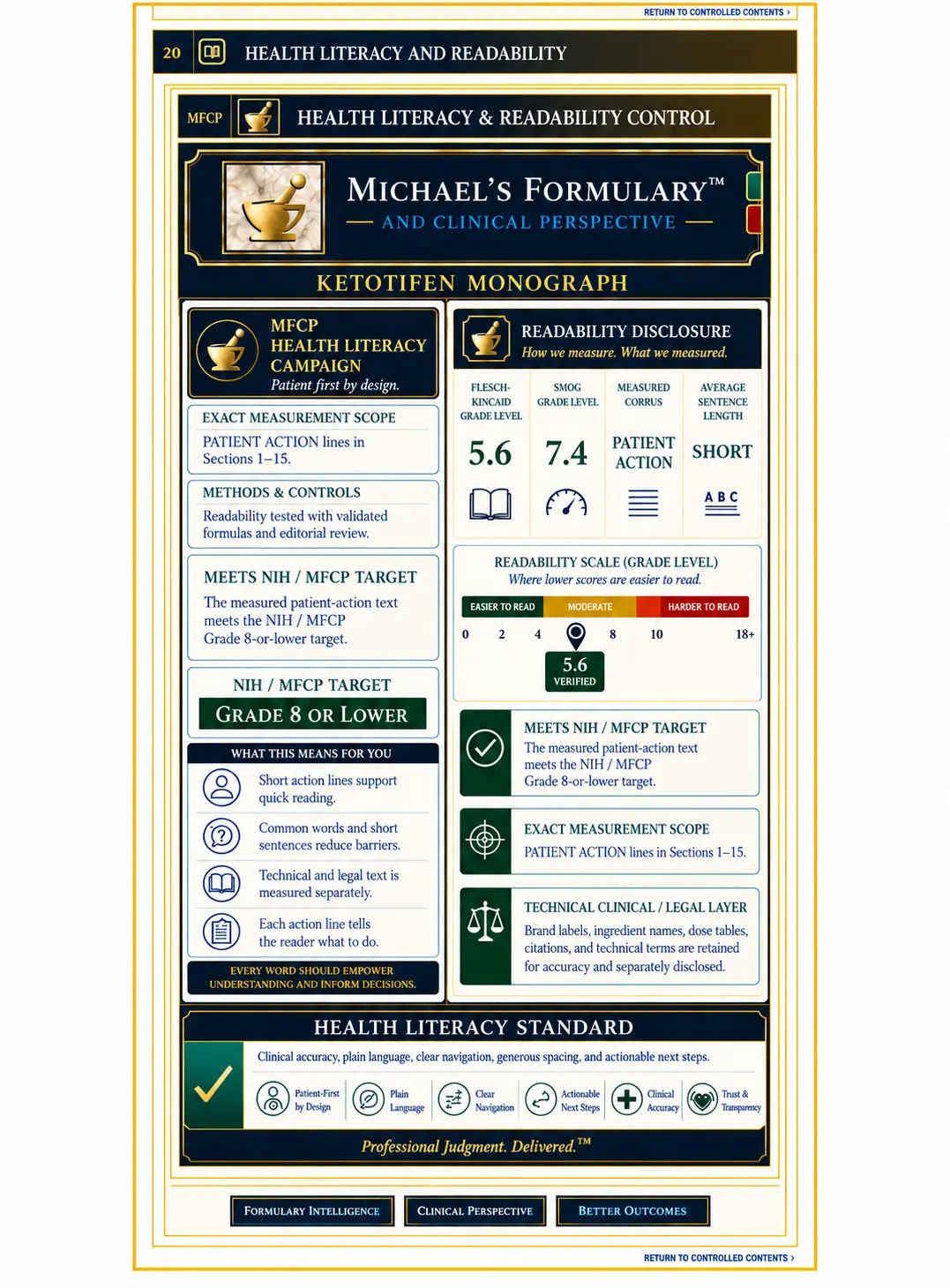
MFCP Ketotifen Health Literacy and Readability Control. Flesch-Kincaid Grade Level 5.6; SMOG Grade Level 7.4; NIH and MFCP Grade 8-or-lower target met.
RETURN TO CONTENTS ↑

Evidence Map & References

INTERPRETIVE RULES
  • Strengths, doses, and warnings follow current Drug Facts labeling.
  • The two percentages are reconciled with displayed arithmetic.
  • Systemic pharmacokinetic figures are identified as oral data.
  • Technical language is separated from patient-action text.
  1. DailyMed: Alaway ketotifen fumarate ophthalmic solution.
  2. DailyMed: Zaditor ketotifen fumarate ophthalmic solution.
  3. DailyMed: Ketotifen fumarate ophthalmic solution/drops.
  4. AHFS Drug Information: Ketotifen.
  5. U.S. FDA NDA 21-066: Zaditor approval and OTC switch.
  6. Ketotifen conjunctival allergen-challenge studies.
  7. Benzalkonium chloride contact-lens binding studies.

Glossary

Allergen
Something that triggers an allergic reaction.
Antihistamine
A medicine that blocks histamine.
Benzalkonium chloride
A preservative used in multidose bottles.
Conjunctiva
The membrane over the white of the eye and inside the lids.
H1 receptor
A site where histamine signals itch, swelling, and redness.
Mast-cell stabilizer
A medicine that reduces mediator release from mast cells.
Nasolacrimal duct
The drain from the eye into the nose.
Rebound redness
Redness that returns worse after repeated decongestant-drop use.
15
CONTROLLED CLINICAL SECTION

From Prescription to Shelf — the OTC Switch

Ketotifen ophthalmic solution was approved as a prescription medicine in 1999 and moved to OTC status in 2006.

WHAT AN OTC SWITCH MEANS

Self-care remains inside the label boundaries: age 3 and older, no more than two doses daily, and reassessment at 72 hours.

An OTC switch does not weaken the medicine or make warnings optional.

RETURN TO CONTENTS ↑