MICHAEL'S FORMULARY™AND CLINICAL PERSPECTIVEGUAIFENESIN + DEXTROMETHORPHAN HBr
MUCUS CLEARANCE · COUGH SUPPRESSION
Contents
ONE CONTROLLED ROUTE · Select a module and return to this index.
Production Mandate and Bottom Line

Guaifenesin
Helps loosen phlegm and thin bronchial secretions.
Dextromethorphan HBr
Acts centrally to reduce the cough reflex.
Two ingredients should solve two present problems. The current physical carton controls strength, interval, and maximum dose.
PATIENT ACTIONUse this combination only when both mucus clearance and cough suppression are needed.
Two Actives, Opposite Directions
Clearance direction
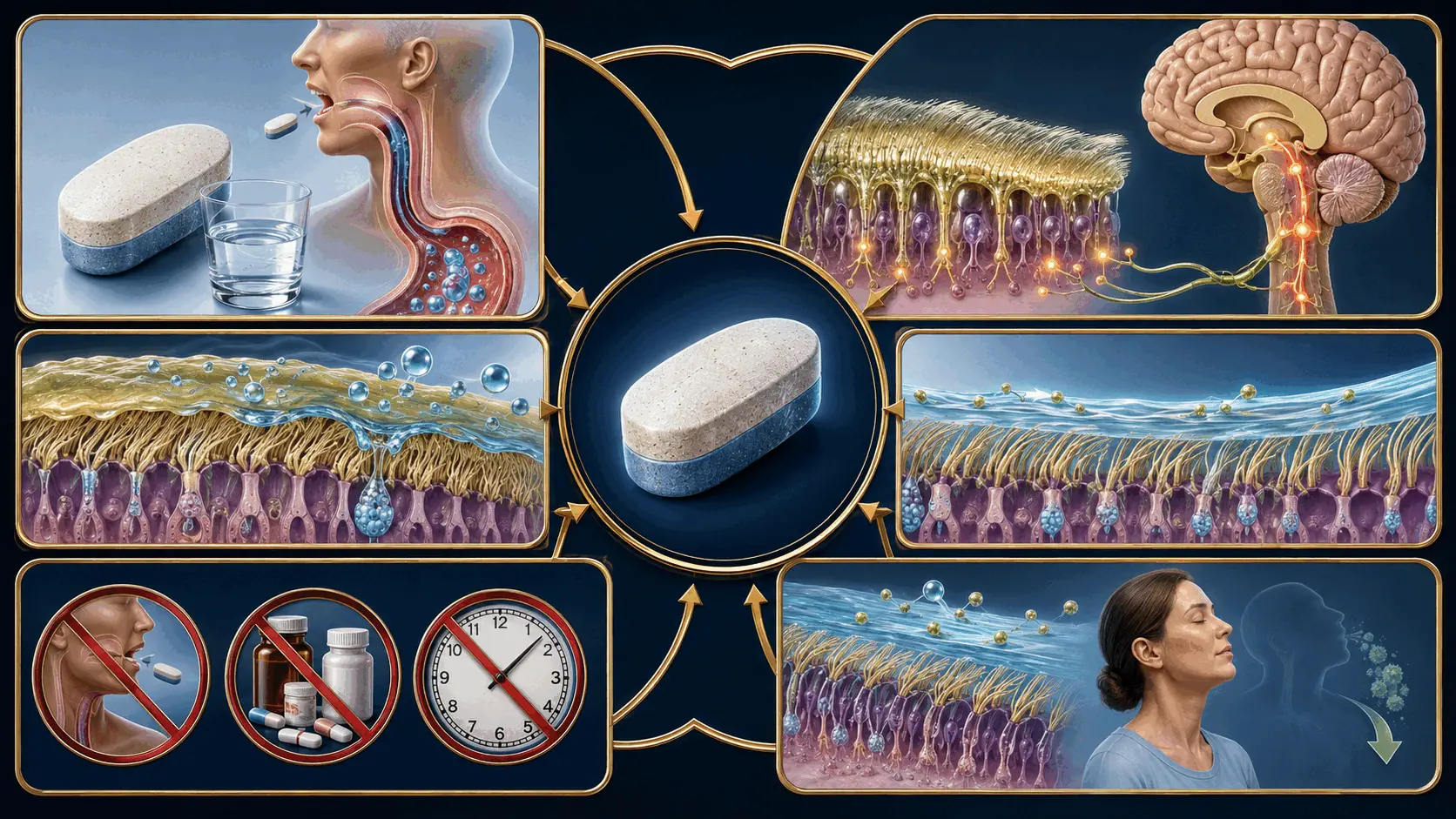
Guaifenesin supports thinner, more mobile mucus so coughing can clear it.
Suppression direction
Dextromethorphan reduces cough signaling in the brainstem.
These actions can pull in opposite directions. Do not suppress a cough automatically when mucus clearance or clinical evaluation is the priority.
PATIENT ACTIONName both treatment goals before choosing a two-drug product.
Identity and Chemistry
| Ingredient | Role | Common extended-release strength |
|---|---|---|
| Guaifenesin | Expectorant | 600 mg regular strength; 1,200 mg maximum strength |
| Dextromethorphan HBr | Cough suppressant | 30 mg regular strength; 60 mg maximum strength |
Brand-family names are not enough. Confirm the exact actives, strengths, dosage form, and Drug Facts directions.
PATIENT ACTIONVerify both active ingredients on the current Drug Facts panel.
Guaifenesin — What It Does
Label purpose
Guaifenesin helps loosen phlegm and thin bronchial secretions to make coughs more productive.
What it does not prove
It does not treat pneumonia, asthma, COPD, infection, or another underlying cause. “It does nothing without water” is too absolute.
PATIENT ACTIONUse fluids as directed; hydration supports mucus clearance.
Dextromethorphan — What It Does
Central action
Dextromethorphan raises the cough threshold through central nervous-system action. It does not numb the throat or open the airways.
Form matters
This combination uses dextromethorphan HBr in an extended-release bilayer tablet. Dextromethorphan polistirex is a different 12-hour suspension form, such as Delsym.
PATIENT ACTIONDo not add another dextromethorphan product.
The Bilayer Tablet

Layer 1
Some medicine is released sooner.
Layer 2
The remaining medicine is released over time for up to 12 hours.
PATIENT ACTIONSwallow the extended-release tablet whole.
Dosing and Strength Control
Regular strength
Common tablet: guaifenesin 600 mg plus dextromethorphan HBr 30 mg.
Maximum strength
Common tablet: guaifenesin 1,200 mg plus dextromethorphan HBr 60 mg.
DailyMed directions for some regular-strength labeling state 1 or 2 tablets every 12 hours, maximum 4 daily. Manufacturer web directions may state 1 tablet every 12 hours, maximum 2 daily. Do not reconcile this by guessing: the current physical carton in the patient’s hand controls.
PATIENT ACTIONUse the current physical carton to select the dose.
Who Must Not Use It
Do not use while taking a prescription monoamine oxidase inhibitor (MAOI), or for 14 days after stopping it.
- Do not use an adult extended-release tablet in a child under 12.
- Do not use if allergic to either ingredient.
- Do not use a damaged, split, crushed, or chewed extended-release tablet.
PATIENT ACTIONDo not use with a current MAOI or within 14 days after stopping one.
MAOI and Interaction Screen
MAOI screen
Check current use and the full 14-day washout period. If uncertain, stop and ask a pharmacist or prescriber.
Other interaction review
Serotonin toxicity is uncommon at labeled doses but has been reported, especially with overdose or interacting serotonergic medicines. Review antidepressants and other serotonergic drugs. Sedatives and alcohol can increase impairment.
PATIENT ACTIONAsk a pharmacist to screen antidepressants, serotonergic drugs, sedatives, and alcohol.
The Duplication Trap
One ingredient can hide in many packages.
□ Guaifenesin
□ Dextromethorphan
□ Acetaminophen
□ Decongestant
□ Antihistamine
□ Nighttime sedative
Compare the Active ingredients boxes across every cough, cold, flu, allergy, and nighttime medicine. Do not rely on front-panel branding.
PATIENT ACTIONRead every cough, cold, flu, and nighttime label before each dose.
Children and Special Populations
| Population | Control |
|---|---|
| Under 12 | Do not use this extended-release tablet. |
| Pregnancy or breastfeeding | Ask a clinician; use only ingredients that are actually needed. |
| Older adults | Review swallowing, kidney function, fall risk, sedation, and interacting medicines. |
| Chronic lung disease | Ask before self-care, especially with substantial phlegm. |
PATIENT ACTIONDo not use this extended-release tablet for a child under 12.
When This Is the Wrong Product

Wrong symptom match
Do not choose the combination when only one task is needed.
Wrong care setting
Breathing trouble, blue lips, chest pain, confusion, coughing blood, severe worsening, or significant chronic disease needs evaluation.
PATIENT ACTIONChoose evaluation instead of self-care when warning signs are present.
Counseling and Red-Flag Triage
- Name the goals. Confirm both mucus and a cough that should be suppressed.
- Read the whole label. Match both ingredients, strengths, age, interval, and maximum.
- Screen interactions. Apply the MAOI rule and review serotonergic or sedating medicines.
- Prevent duplication. Compare all active-ingredient panels.
- Use correctly. Swallow whole; do not repeat a 12-hour dose early.
- Apply the stop rule. Stop after seven days or earlier for fever, rash, persistent headache, or worsening.
Call emergency services for severe breathing trouble, blue lips, chest pain, collapse, or severe confusion. Call Poison Control at 1-800-222-1222 for overdose.
PATIENT ACTIONStop and get help for severe symptoms or a cough lasting more than seven days.
Evidence Map and References
- DailyMed current guaifenesin/dextromethorphan labels
- FDA OTC Monograph M012
- Poison Control
- MFCP Guaifenesin/Dextromethorphan prototype and supplied visual controls, reviewed September 4, 2026.
Glossary
| Term | Meaning |
|---|---|
| Bilayer tablet | A tablet with two layers designed for staged release. |
| Expectorant | A medicine that helps loosen mucus. |
| Cough suppressant | A medicine that reduces the urge or reflex to cough. |
| MAOI | A monoamine oxidase inhibitor; the label requires a 14-day separation. |
| Serotonin toxicity | A potentially serious reaction involving excess serotonin activity. |
| Drug Facts | The regulated label listing actives, uses, warnings, and directions. |
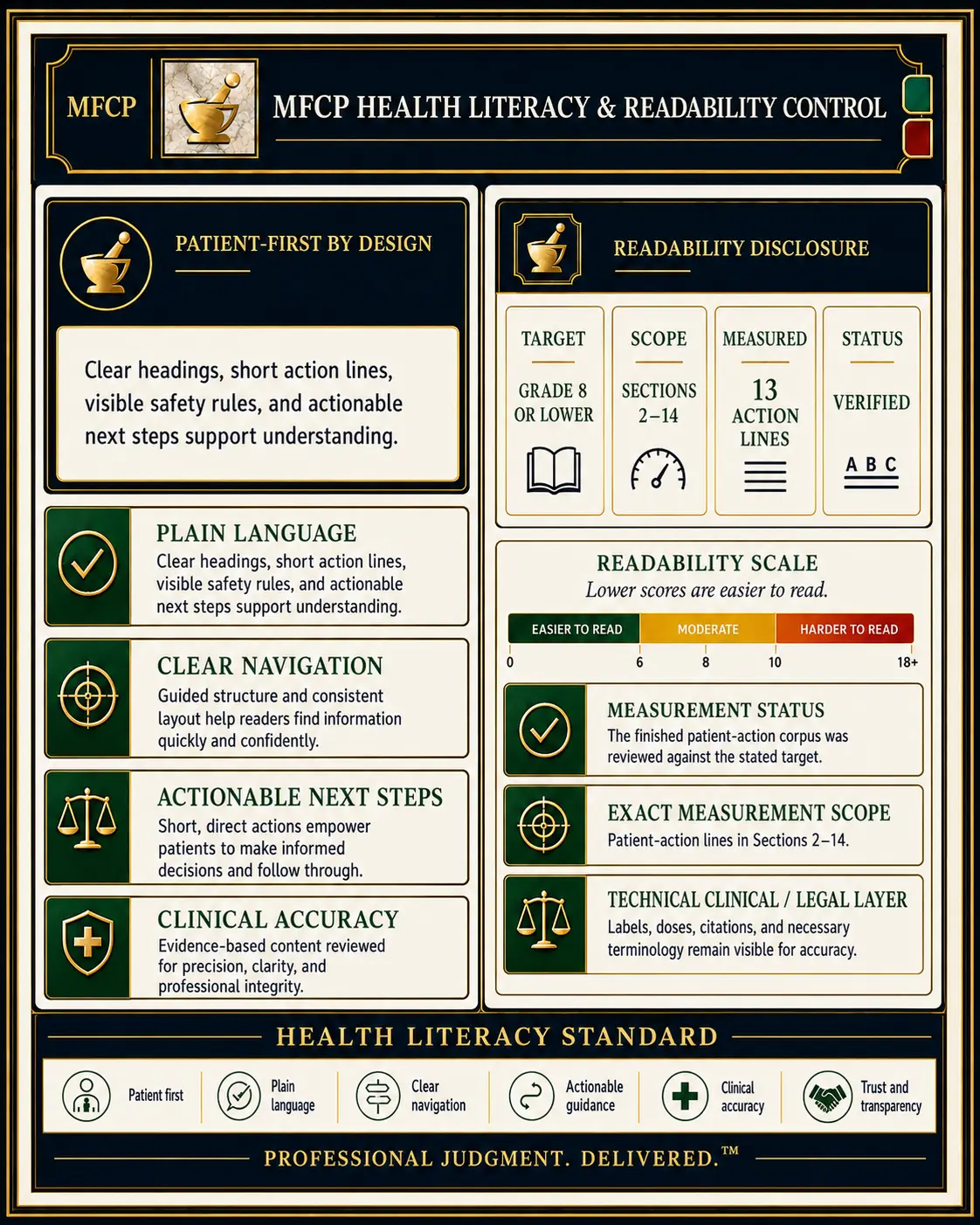
Health Literacy and Readability