
Carboxymethylcellulose Sodium 0.5%–1%
Cellulose-derived ophthalmic demulcent with product-specific viscosity, electrolyte, preservative, packaging, contact-lens, and dosing controls.
Monograph at a Glance™MAG™ · Controlled Snapshot
Regulatory IdentityWhat CMC Is—and What the OTC Label Establishes
Carboxymethylcellulose sodium (CMC) is a high-molecular-weight, anionic, water-soluble cellulose ether. FDA OTC Monograph M018 permits CMC sodium as an ophthalmic demulcent at 0.2% to 2.5%. Its labeled role is temporary relief of burning, irritation, and discomfort due to dryness of the eye or exposure to wind or sun, and protection against further irritation.
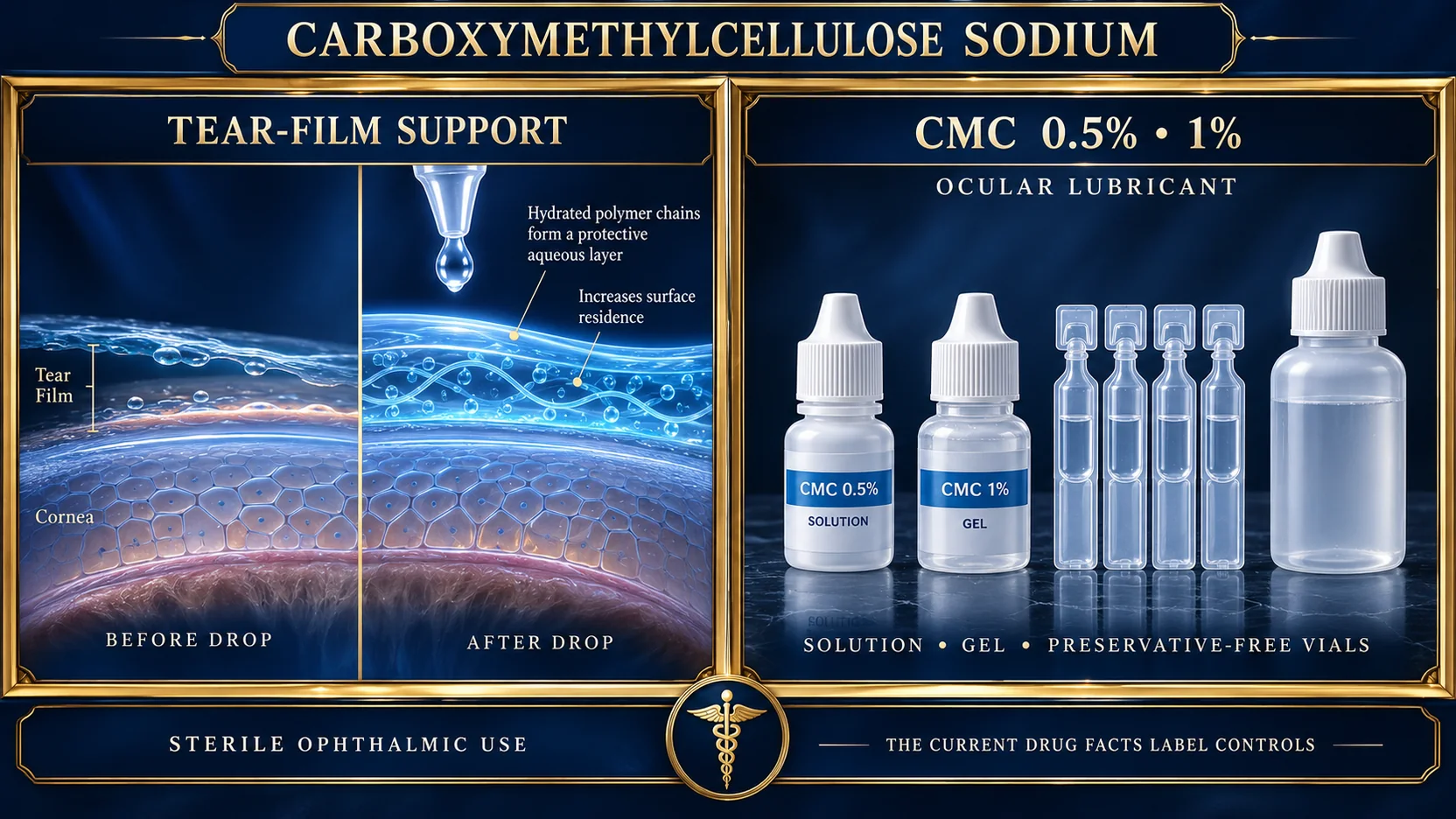
Carboxymethyl groups introduce negatively charged carboxylate sites and strong hydration capacity along the substituted cellulose backbone.
The polymer increases aqueous-phase viscosity and surface residence, supporting a lubricating film across the corneal and conjunctival epithelium.
The OTC monograph does not establish treatment of Sjögren disease, neurotrophic keratitis, exposure keratopathy, epithelial wounds, or postoperative complications.
Mechanistic FrameworkTear-Film Support, Rheology & Experimental Biology
CMC can bind to human corneal epithelial cells and may interact with the mucin-rich glycocalyx. Specific electrostatic binding to individual MUC1, MUC4, or MUC16 proteins should be treated as a mechanistic model rather than a universal clinical claim.
Many polymeric tears exhibit pseudoplastic behavior, with lower apparent viscosity under blink shear. The magnitude depends on molecular weight, substitution, concentration, salts, co-polymers, and the complete vehicle.
Experimental studies report CMC binding to corneal epithelial cells and modulation of cell migration or wound closure. These findings support biological plausibility but do not establish that every OTC CMC product accelerates clinical recovery after injury.
Instilled lubricant fluid temporarily changes tear volume and osmolarity. Electrolytes and tonicity are formulation-specific; CMC itself should not be credited with a universal bicarbonate-containing or hypo-osmolar profile.
Concentration and VehicleCMC 0.5% Versus 1% Product Pathways
| Control Point | CMC 0.5% | CMC 1% |
|---|---|---|
| Common presentation | Frequently marketed as a lubricant solution in multidose bottles or preservative-free unit-dose vials. | Frequently marketed as a higher-viscosity drop or gel; presentation remains product-specific. |
| Viscosity | Often lower than a companion 1% product, but polymer grade and vehicle can reverse simple concentration assumptions. | Often higher, with longer perceived coating; concentration does not independently specify rheology. |
| Transient blur | Generally less likely with lower-viscosity solutions, but no universal seconds-long interval is established. | May cause more noticeable temporary blur; the duration varies by formulation and individual. |
| Labeled indication | The same demulcent indications under M018: temporary relief of dryness-related burning, irritation, and discomfort; protection against further irritation. | |
| Directions | Representative Drug Facts labels direct 1 or 2 drops in the affected eye(s) as needed. Do not replace the label with a fixed schedule inferred from strength. | |
| Selection principle | Useful when a lighter drop and less blur are priorities. | Useful when a thicker coating is desired and temporary blur is acceptable. |
Dosage Form and PackageDelivery-System Architecture
A preservative supports microbial control during repeated opening. Do not touch the tip to any surface; replace the cap after use. Preservative identity and discard period vary.
Blow-fill-seal packages avoid a chemical preservative. M018 labeling directs users not to reuse the vial and to discard it once opened.
Valve, filter, tip-seal, or related technologies may reduce microbial entry without a conventional preservative. Follow the exact priming, handling, and discard instructions.
Flows readily and may be easier to spread with less blur, but ocular residence depends on the complete formulation.
Provides a thicker coating and may reduce perceived need for frequent instillation, while increasing temporary blur or residue.
Do not use a cloudy or discolored solution, a damaged unit-dose vial, or a package with a broken or missing tamper-evident seal.
Excipient ControlPurite, Preservative-Free Selection & Electrolytes
Some CMC multidose products use a stabilized oxychloro complex rather than benzalkonium chloride. It is designed to decompose after instillation into simpler tear-compatible components, but it should not be described as completely eliminating irritation or epithelial toxicity.
Preservative-free delivery is commonly favored when use is frequent, the ocular surface is compromised, multiple preserved drops are used, or sensitivity is suspected. No single use-frequency threshold applies to every patient or product.
Representative CMC labels include sodium, potassium, calcium, and magnesium salts; some include lactate or borate systems. Bicarbonate is not universal, and electrolyte presence does not itself prove osmoprotection.
Unit-dose vials can reduce preservative exposure but may be harder to open and more expensive. Multidose preservative-free systems may improve convenience but require correct technique.
Administration and IntegrationRegimen Controls
Warnings and ReferralSafety Gate
Stop and ask a doctor for eye pain, changes in vision, continued redness or irritation, worsening symptoms, or persistence for more than 72 hours.
Remove lenses and seek prompt assessment. Contact-lens-associated keratitis can progress rapidly and is not a routine dry-eye problem.
Never touch the dropper tip to the eye or another surface. Do not reuse a single-use vial. Never share ophthalmic containers.
Do not use. Check tamper evidence, package integrity, expiration, storage, and the labeled after-opening discard period.
Recurrent unilateral symptoms, discharge, corneal pain, marked redness, trauma, or meaningful vision change requires diagnosis rather than continued lubricant escalation.
CMC is also used in foods, tablets, gels, and non-sterile products. Only a sterile product labeled for ophthalmic use belongs in the eye.
Controlling SourcesEvidence & Labeling
- U.S. Food and Drug Administration. OTC Monograph M018: Ophthalmic Drug Products for OTC Human Use.
- DailyMed. Carboxymethylcellulose sodium 0.5% multidose lubricant eye drops.
- DailyMed. Carboxymethylcellulose sodium 1% ophthalmic gel.
- DailyMed. Preservative-free carboxymethylcellulose sodium 0.5% single-use containers.
- Garrett Q, Simmons PA, Xu S, et al. Carboxymethylcellulose binds to human corneal epithelial cells and is a modulator of corneal epithelial wound healing.
- Randomized controlled study of a preservative-free artificial tear containing carboxymethylcellulose and hyaluronic acid.