
Nasal Saline
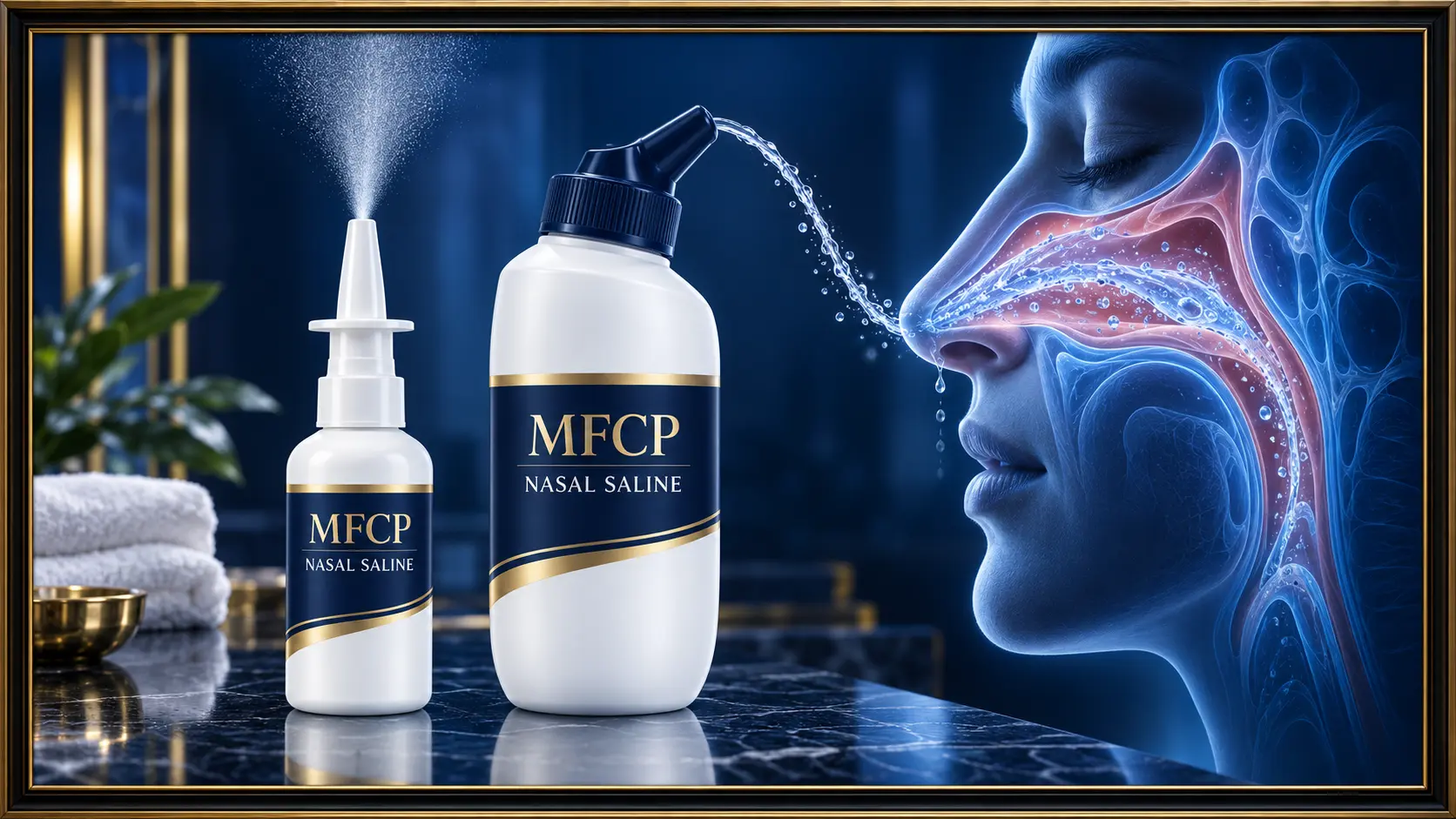
Match the concentration and device to the task.
Nasal saline can moisten dry passages or rinse mucus and allergens from the nose. The label, salt concentration, water source, and delivery system all matter.
Saline Paths
Hypertonic Saline 3%
NEILMEDSalt water with a higher concentration that can draw fluid from swollen nasal tissue.
Verify the exact concentration and device. Hypertonic saline may sting more than isotonic saline.Grade Level6.0
Selection Control
| Path | Primary task | Device control | Key caution |
|---|---|---|---|
| Isotonic saline | Moisten or gently rinse | Fine mist, drops, or rinse system | Use the directions for the exact device |
| Hypertonic saline | Higher-salt rinse or spray | Confirm concentration before use | May cause more burning or stinging |
| High-volume irrigation | Flush mucus and allergens | Squeeze or gravity-fed rinse bottle | Water preparation and device cleaning are essential |
Technique Control
Use safe water
For nasal rinsing, follow the product instructions for distilled, sterile, or previously boiled and cooled water.
Mix exactly
Use the supplied packet or the labeled solution. Do not estimate the salt concentration.
Clean the device
Wash, rinse, and air-dry the device as directed. Do not share it.
Safety Screen
Ask before use
- Recent nasal surgery or injury
- Frequent nosebleeds or severe irritation
- Completely blocked nasal passages
- A child who cannot cooperate with the device
Stop and seek advice
- Severe pain, bleeding, or worsening pressure
- Fever, facial swelling, or breathing difficulty
- Symptoms that persist or repeatedly return
- Any concern that this is more than routine dryness or allergy
HEALTH LITERACY AND READABILITY
 HEALTH LITERACY & READABILITY CONTROLMICHAEL’S FORMULARY™— AND CLINICAL PERSPECTIVE —
NASAL SALINE MONOGRAPH
MFCP
HEALTH LITERACY CAMPAIGN
Patient-first by design.EXACT MEASUREMENT SCOPE
PATIENT ACTION lines in Sections 1–4.
METHODS & CONTROLS
Readability tested with validated formulas and editorial review.
MEETS NIH / MFCP TARGET
The measured patient-action text meets the NIH / MFCP Grade 8-or-lower target.
WHAT THIS MEANS FOR YOU
Short action lines support quick reading.
Common words and short sentences reduce barriers.
Technical and legal text is measured separately.
Each action line tells the reader what to do.
UNDERSTANDING AND INFORM DECISIONS.
READABILITY DISCLOSURE
How we measure. What we measured.GRADE LEVEL6.0VERIFIED
GRADE LEVEL8.4POLYSYLLABIC-WORD CHECK
CORPUS176WORDS
SENTENCE LENGTH10.4WORDS
READABILITY SCALE (GRADE LEVEL)
Where lower scores are easier to read.VERIFIED
MEETS NIH / MFCP TARGET
The measured patient-action text meets the NIH / MFCP Grade 8-or-lower target.
EXACT MEASUREMENT SCOPE
PATIENT ACTION lines in Sections 1–4.
TECHNICAL CLINICAL / LEGAL LAYER
Ingredient names, concentrations, device terms, and cautions are retained for accuracy and separately disclosed.