
Frequent, familiar heartburn
OTC omeprazole treats frequent heartburn occurring 2 or more days a week in adults 18 years and older.


Frequent heartburn · verify form, strength, and current label
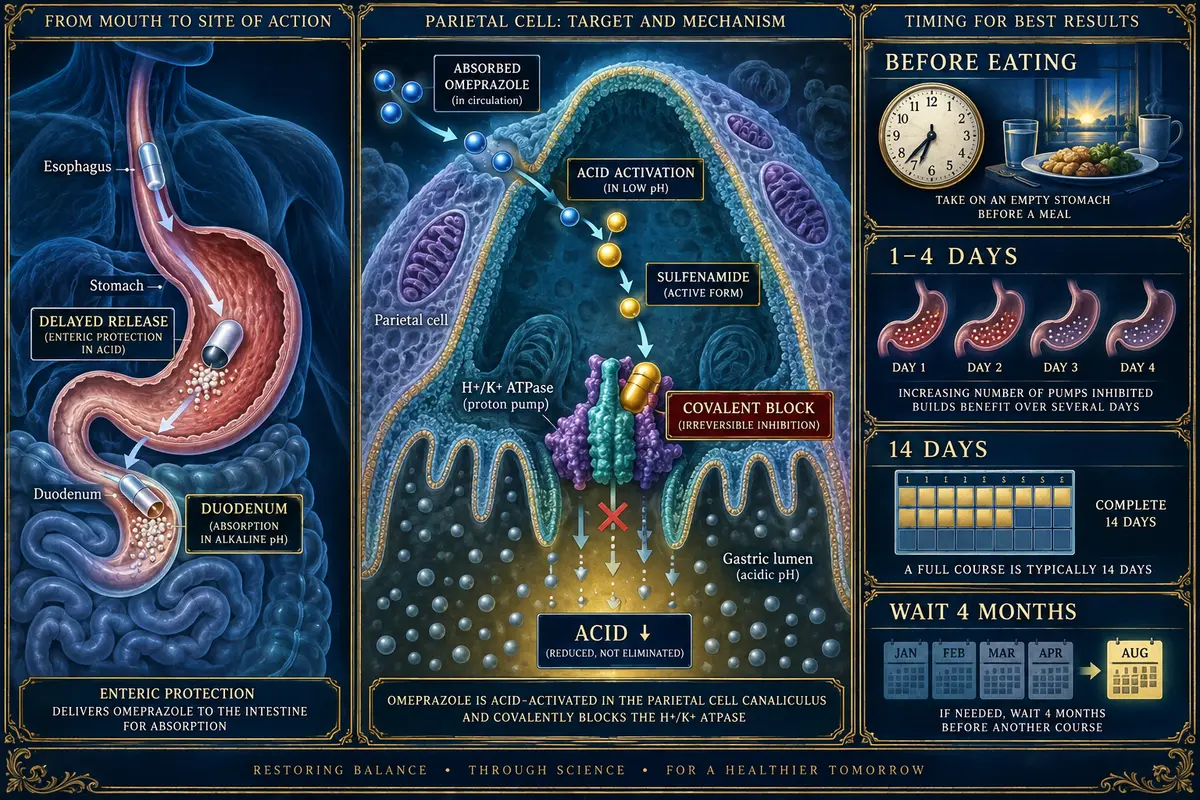
OTC omeprazole treats frequent heartburn occurring 2 or more days a week in adults 18 years and older.
This is not an instant-relief product. Some people improve within 24 hours, but the current label says full effect may take 1 to 4 days.
Take it every day for the labeled course. Do not exceed one tablet or capsule per day or extend self-treatment beyond 14 days.
A 14-day course may be repeated every 4 months if needed. Earlier recurrence or persistent symptoms requires clinical review.
Products may state omeprazole 20 mg or omeprazole magnesium 20.6 mg, equivalent to 20 mg omeprazole.
The delayed-release system protects acid-labile omeprazole through the stomach. Swallow the labeled unit whole.
Immediate-release capsules and OTC suspension packets are combination products with a substantial sodium-bicarbonate load—not plain delayed-release omeprazole.
| Product family | Active identity | Dosage form | MFCP control |
|---|---|---|---|
| OTC delayed-release tablet | Omeprazole 20 mg | Enteric delayed-release tablet | Swallow whole; follow that exact Drug Facts label |
| OTC delayed-release capsule | Omeprazole 20 mg | Delayed-release capsule | Do not transfer opening or sprinkling instructions between products |
| OTC immediate-release capsule | Omeprazole 20 mg + sodium bicarbonate 1,100 mg | Combination capsule | Verify sodium restrictions and combination label |
| OTC powder packet | Omeprazole 20 mg + sodium bicarbonate 1,680 mg | Powder for oral suspension | Mix with water exactly as labeled; not plain omeprazole granules |
Clinical GERD guidance generally places PPIs 30–60 minutes before a meal. For OTC self-care, the Drug Facts direction—before eating in the morning—controls.
Omeprazole has a short plasma half-life, but acid suppression persists because activated drug covalently inhibits active proton pumps.
| User / situation | Current OTC direction | Timing | Control |
|---|---|---|---|
| Adults 18+ | Swallow 1 delayed-release 20 mg unit with water | Before eating in the morning | Once every 24 hours |
| Course | Take every day for 14 days | Use a consistent morning routine | Do not use longer unless directed by a doctor |
| Repeated course | May repeat a 14-day course if needed | Every 4 months | More frequent need requires evaluation |
| Children under 18 | Not self-selected | — | Ask a doctor |
Breaking a delayed-release unit can defeat its acid-protective delivery system. Do not improvise capsule-opening instructions.
Do not take extra tablets because relief is not immediate. Check the complete medication and risk profile before adding a short-acting product.
Tablet, capsule, and omeprazole–sodium bicarbonate labels are not interchangeable. Read the current package every time.
Trouble or pain swallowing, vomiting blood, or bloody or black stools requires medical evaluation.
Frequent chest pain, lightheadedness, sweating, dizziness, shortness of breath, or spreading pain belongs outside the OTC aisle.
Heartburn longer than 3 months, frequent wheezing, unexplained weight loss, nausea, vomiting, or stomach pain requires a clinician's judgment.
Stop and ask a doctor if symptoms continue or worsen, diarrhea develops, or rash with joint pain appears.
The OTC label directs pregnant or breast-feeding patients to obtain professional guidance before use.
Short OTC courses and chronic therapy are different decisions. Long-term use should have a documented indication and periodic review.
Hypomagnesemia, vitamin B12 deficiency, fractures, kidney injury, enteric infection, and rebound symptoms chiefly concern longer or inappropriate exposure, comorbidity, or other risk factors.
| Medication / condition | Why it matters | Controlled action |
|---|---|---|
| Clopidogrel | Omeprazole inhibits CYP2C19 and can reduce formation of clopidogrel's active metabolite | Avoid casual co-selection; pharmacist or prescriber review |
| Prescription drugs generally | Acid reducers can alter absorption or metabolism of certain medicines | Ask a doctor or pharmacist before use |
| High-dose methotrexate | PPIs may delay methotrexate elimination | Clinician-managed therapy only |
| Drugs requiring gastric acidity | Higher gastric pH may reduce absorption of selected antivirals, antifungals, and oncology drugs | Verify the specific interaction; do not apply a blanket spacing rule |
| Low-magnesium risk / diuretics / digoxin | Prolonged PPI exposure can contribute to important hypomagnesemia | Clinical assessment and monitoring when use is prolonged |
Choose plain omeprazole 20 mg delayed release only when that is intended. A sodium-bicarbonate combination is a different formulation.
Dosage form determines technique. Never infer crushing, opening, sprinkling, or mixing instructions from another package.
The package should support one unit daily for 14 days, not open-ended continuous self-treatment.
Check age, alarm symptoms, pregnancy language, interactions, storage, and repeat-course instructions before purchase.
| Front-panel claim | What it means | What it does not mean |
|---|---|---|
| 24 HR | Once-daily labeled course dosing | Immediate 24-hour rescue from the first dose |
| Delayed release | Acid protection is built into the dosage form | Safe to crush or chew |
| Frequent heartburn | Symptoms occurring 2 or more days a week | Any unexplained chest or abdominal symptom |
| Compare to Prilosec OTC | Compare active ingredient and labeled use | Permission to ignore inactive ingredients, form, or directions |
Omeprazole 20 mg delayed-release tablet label ↗
Controls use, warnings, directions, 14-day course, and four-month repeat interval.
Delayed-release capsule label ↗
Confirms OTC delayed-release capsules; exact product directions control technique.
OTC powder-for-suspension label ↗
Confirms the 20 mg/1,680 mg combination packet and water-mixing directions.
American College of Gastroenterology guideline summary ↗
Supports meal-related PPI timing and clinician-directed GERD management.
Links already cited on this page.