
Name the target
Inflammatory pain, fever, dysmenorrhea, dental pain, or musculoskeletal pain may fit short-course self-care.

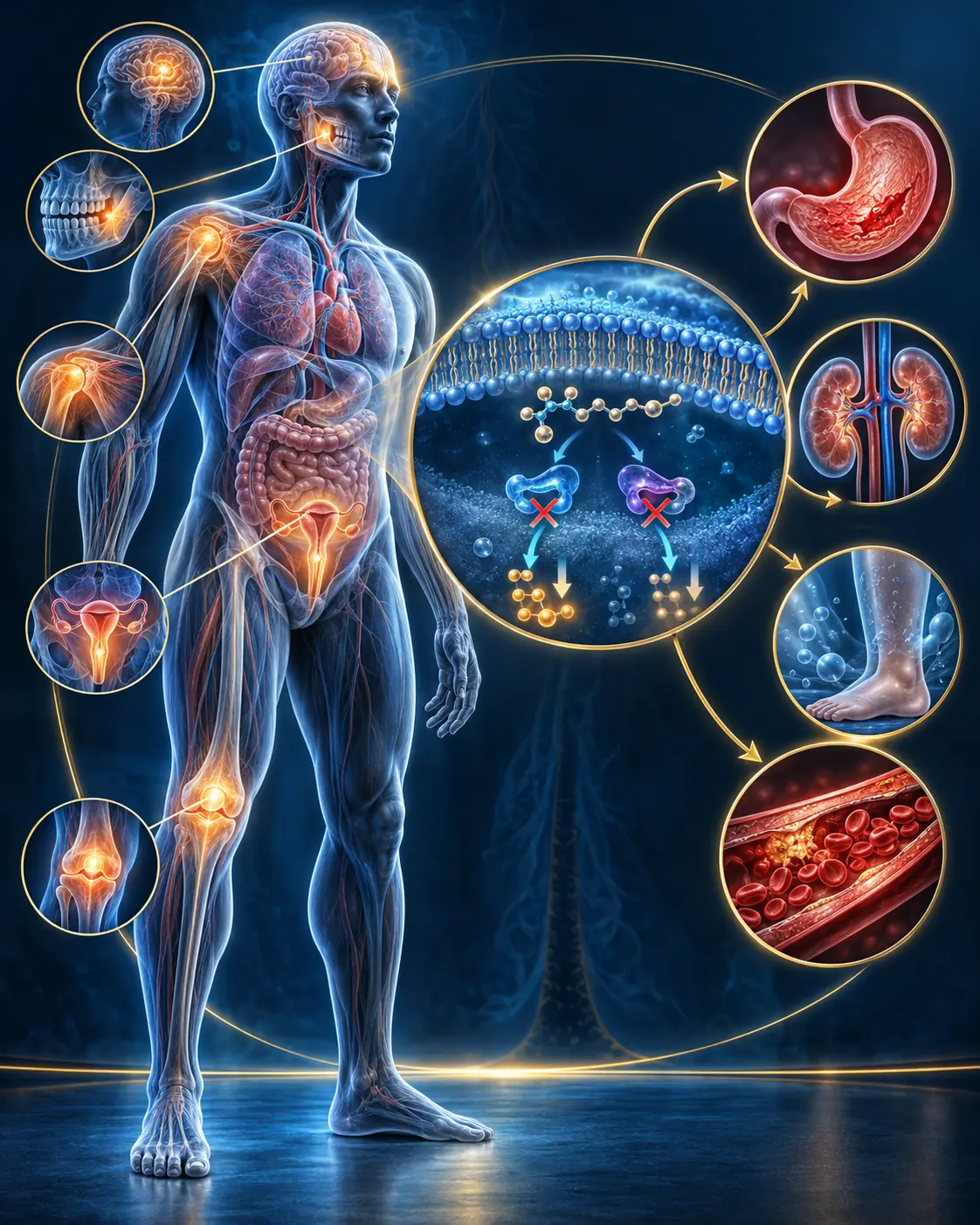

Naproxen's longer interval is both an advantage and a safety liability. Fewer daily doses do not mean lower risk: exposure persists, so patient selection, hydration, interacting medicines, dose, and duration control whether it fits.
Longer action demands tighter selection.
Inflammatory pain, fever, dysmenorrhea, dental pain, or musculoskeletal pain may fit short-course self-care.
Check GI bleeding, kidney, heart, pregnancy, asthma, dehydration, age, and interaction risk.
A 12–17-hour half-life means exposure continues after the immediate decision point.
Do not add ibuprofen, aspirin for pain, or another NSAID while naproxen remains active.
Twenty decision modules from identity through evidence control.
Chemistry, stereochemistry, equivalence, prostaglandin effects, and kinetics.
Indications, adult limits, age gate, interval, and duration.
GI, renal, cardiovascular, allergic, pregnancy, and older-adult risks.
OTC boundaries, comparison, buying standard, red flags, and evidence.
The marketed active drug is the S-enantiomer.
Arylpropionic-acid nonsteroidal anti-inflammatory drug.
Each 220 mg sodium-salt unit is equivalent to naproxen 200 mg.
Molecular weight 230.26 g/mol for naproxen; anhydrous sodium salt 252.23 g/mol.
Unlike ibuprofen, naproxen is not supplied as a racemic mixture.
Reversible nonselective COX inhibition reduces prostaglandins.
Onset may vary; the safety class does not.
Peak exposure is often reached in about 1–2 hours; food and formulation can alter timing.
Substantially longer than ibuprofen and central to interval control.
Albumin status and high exposure can alter the unbound fraction.
Hepatic transformation precedes renal excretion of metabolites and conjugates.
Temporary relief does not establish the diagnosis.
May provide sustained symptom relief; persistent daily need requires evaluation.
Early use may help; screen pregnancy and abnormal bleeding.
Can reduce symptoms when appropriate; the dental cause still requires care.
Frequent use or recurrent disability requires assessment.
Every 8–12 hours does not mean every 8 hours by default.
| Decision point | Label control | MFCP translation |
|---|---|---|
| Adults and age 12+ | 1 unit (220 mg naproxen sodium) every 8–12 hours while symptoms persist | Use the smallest effective amount. |
| First dose | 2 units may be taken within the first hour | Not a standing two-unit regimen. |
| Per interval | Do not exceed 2 units in any 8–12-hour period | Do not shorten the interval. |
| Daily ceiling | No more than 3 units (660 mg) in 24 hours | Equivalent to naproxen 600 mg. |
| Pain | Stop if worse or lasting more than 10 days | Persistent pain requires diagnosis. |
| Fever | Stop if worse or lasting more than 3 days | Seek earlier care for red flags. |
Do not calculate a child’s dose from adult tablets.
Eligible only when the adolescent is otherwise appropriate for self-care.
The adult OTC label provides no self-selected dose.
Avoid during vomiting, diarrhea, poor intake, or volume depletion.
Do not use naproxen to continue unsafe training or play.
Risk rises with prior history, age, interacting drugs, dose, and duration.
History strongly predicts recurrent ulceration or bleeding.
Warfarin, DOACs, heparin, and antiplatelets require professional review.
Medication and disease-state screening is necessary.
Avoid routine combination and alcohol while taking naproxen.
Low circulating volume magnifies prostaglandin-dependent kidney risk.
Vomiting, diarrhea, fever, low intake, or heavy exertion raises acute kidney injury risk.
Reduced renal reserve narrows the margin for self-care.
The “triple whammy” combination requires medication and renal review.
Sodium retention, edema, blood-pressure rise, and decompensation may worsen.
Risk may begin early and increases with dose and duration.
Do not default to naproxen; obtain clinician guidance.
Fluid retention and prostaglandin effects can raise blood pressure.
Edema, kidney function, and decompensation may worsen.
NSAIDs are contraindicated in the perioperative coronary-bypass setting.
Do not casually rechallenge.
Hives, facial swelling, wheezing, throat tightness, or shock requires immediate care.
Asthma plus nasal polyps or prior aspirin/NSAID reaction signals cross-reactive risk.
Blistering, peeling, widespread rash, or mucosal lesions requires urgent evaluation.
Do not assume OTC status means pregnancy safety.
Discuss frequent or persistent NSAID use.
Use only with obstetric or clinical guidance.
If necessary, use the lowest dose for the shortest duration.
Fetal renal and premature ductal-closure risks control the decision.
Reserve, comorbidity, and polypharmacy matter.
Daily or near-daily self-treatment requires clinical assessment.
Bleeding, anemia, kidney injury, hypotension, and interactions can worsen falls.
Anticoagulants, steroids, ACEI/ARBs, diuretics, SSRIs/SNRIs, lithium, and methotrexate matter.
Heart failure and kidney impairment make self-selection inappropriate.
Duplicate toxicity offers little useful additional relief.
| Exposure | Primary risk | Controlled action |
|---|---|---|
| Ibuprofen, aspirin for pain, diclofenac, ketorolac, other NSAIDs | Duplicate GI, renal, and cardiovascular toxicity | Do not combine unless specifically directed. |
| Warfarin, DOACs, heparins, clopidogrel | Additive bleeding | Avoid self-directed use; obtain professional review. |
| SSRIs/SNRIs or corticosteroids | Higher GI bleeding risk | Review the total risk profile. |
| ACE inhibitors, ARBs, and diuretics | Kidney injury and blood-pressure effects | Review renal status, hydration, and medications. |
| Lithium | Reduced lithium clearance | Avoid without monitoring. |
| Methotrexate | Potential reduced clearance and toxicity | Prescriber or pharmacist review. |
| Low-dose aspirin | Bleeding and possible antiplatelet interaction | Ask a pharmacist before combining. |
| Alcohol | GI irritation and bleeding | Avoid while using naproxen. |
Early expert direction controls the response.
Nausea, vomiting, abdominal pain, drowsiness, dizziness, or tinnitus may occur.
Seizure, coma, severe hypotension, acidosis, respiratory compromise, or kidney injury may occur.
In the United States, call Poison Control at 1-800-222-1222. Do not induce vomiting unless instructed.
Do not transfer OTC instructions to prescription products.
| Product | Typical form | Boundary |
|---|---|---|
| OTC naproxen sodium | 220 mg tablet, caplet, or liquid-filled capsule | Follow Drug Facts; maximum 660 mg/day. |
| Prescription naproxen | 250, 375, or 500 mg tablets; suspension | Patient-specific prescription directions only. |
| Prescription naproxen sodium | 275 or 550 mg tablets | Not interchangeable with OTC directions. |
| Extended/delayed release | Indication-specific prescription forms | Do not crush or substitute. |
| Sumatriptan/naproxen sodium | Prescription fixed-dose combination | Separate migraine and cardiovascular screening. |
Longer duration is not automatically better.
| Decision factor | Naproxen sodium | Ibuprofen | Acetaminophen |
|---|---|---|---|
| Dosing interval | Every 8–12 hours | Every 4–6 hours | Often every 4–6 hours; product specific |
| Anti-inflammatory effect | Yes | Yes | Minimal |
| NSAID GI/renal/CV mechanism | Present | Present | Absent |
| Pregnancy around 20+ weeks | Avoid unless directed | Avoid unless directed | Often preferred when otherwise appropriate |
| Primary advantage | Longer-duration relief | More flexible shorter dosing | Pain/fever option when NSAIDs are unsuitable |
| Primary caution | Persistent exposure and stacking | Repeated dosing and NSAID risk | Hidden duplication and liver toxicity with excess total dose |
The package is a clinical control.
Combination products add ingredients, sedation, or duplicate-risk pathways.
The package should keep the 200 mg naproxen equivalent visible.
Seal, blister, neckband, carton, lot, expiration, and storage must be acceptable.
Purchase a quantity consistent with temporary self-care.
Current labels outrank remembered directions.
Exclude severe trauma, neurologic deficits, chest pain, GI bleeding, severe dehydration, and persistent fever.
Screen pregnancy, CKD, ulcer history, cardiovascular disease, heart failure, asthma reaction, and anticoagulants.
Use the label-directed amount and shortest necessary duration.
Stop for worsening symptoms, rash, bleeding, reduced urine, edema, dyspnea, allergy, pain over 10 days, or fever over 3 days.
Links already cited on this page.