
Pain reliever and fever reducer; NSAID (Haleon, 2026)
Michael’s Formulary & Clinical Perspective™ (MFCP)America’s OTC Pharmacy™ · Professional Judgment. Delivered.™
MFCP Monograph · Domain 03 · Pain, Fever, Inflammation
Ibuprofen
Pain reliever · Fever reducer · NSAID · 200 mg
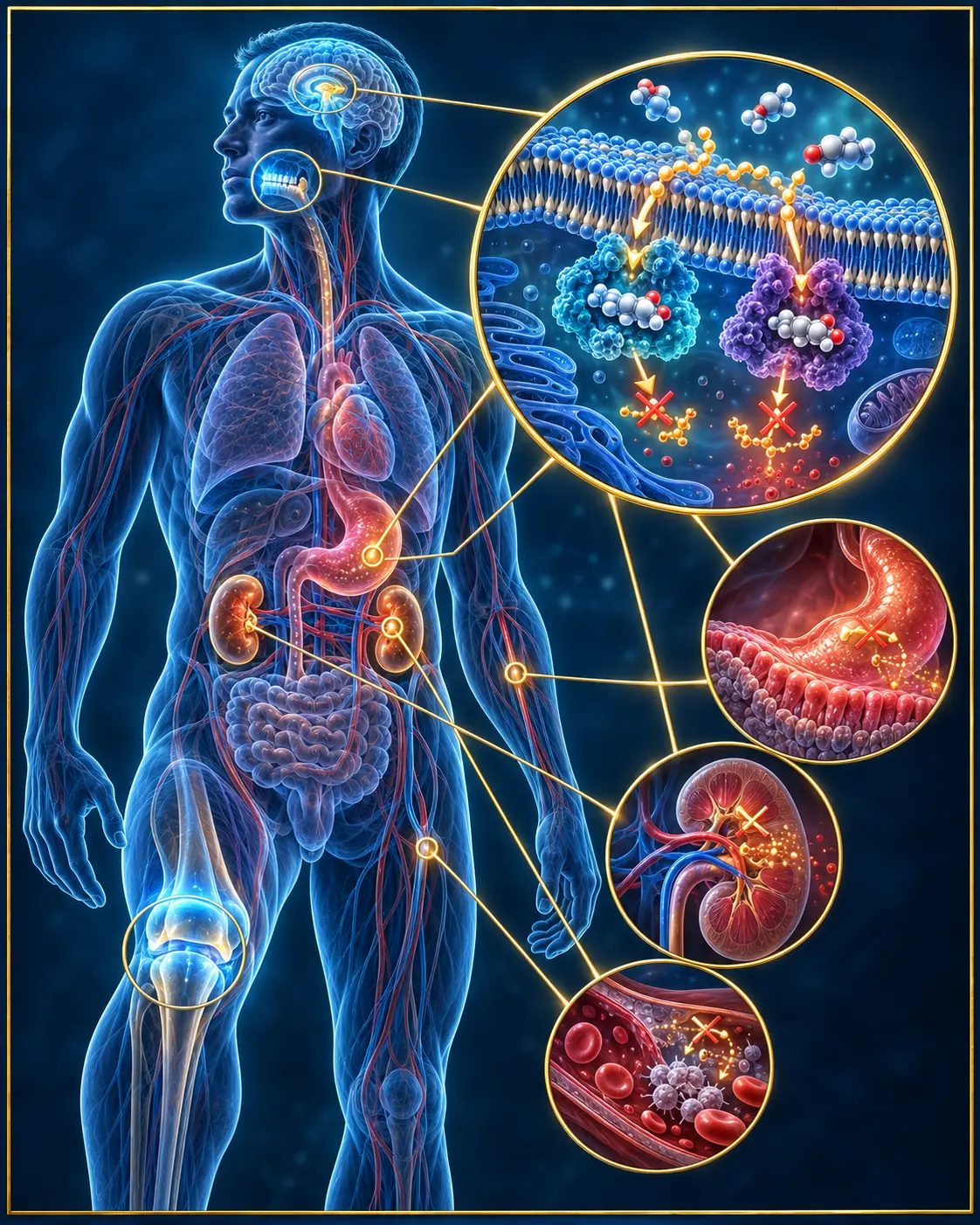
A nonsteroidal anti-inflammatory drug (NSAID) for minor aches, pains and fever (Haleon, 2026). Its label carries a stomach bleeding warning and a heart attack and stroke warning (Haleon, 2026).
Part of the guide: Top 20 OTC Medicines for Ear and Balance Self-Care →

Use
Pain and fever
Form
Tablet, caplet, liquid
Label age
12+ adult; 2+ children’s
Limit
10 days pain; 3 fever
Pharmacist bottom line
Confirm the person before confirming the dose. Bleeding, heart, kidney and pregnancy risks decide whether ibuprofen fits.
Adults take 1 tablet every 4 to 6 hours, 2 if needed, no more than 6 in 24 hours (Haleon, 2026). Do not use at 20 weeks or later in pregnancy unless a doctor directs it (Haleon, 2026).
ScopeOver-the-counter (OTC) ibuprofen 200 mg for adults and children’s ibuprofen 100 mg per 5 mL. Prescription strengths and long-term arthritis treatment are outside this monograph.
MFCP MonographIbuprofen1 / 9
01
One drug, benefit and risk together

What it is and how it works
Ibuprofen is a pain reliever and fever reducer in the NSAID class (Haleon, 2026). Heart attack or stroke risk can begin in the first weeks of use, with or without heart disease (U.S. Food and Drug Administration, 2015).
Class
Adult strength
200 mg per tablet, caplet or gel caplet (Haleon, 2026)
Children’s strength
100 mg per 5 mL suspension (Kenvue, 2024)
Uses
Minor aches and pains, menstrual cramps, minor arthritis pain, fever (Haleon, 2026)
What it does, and the limits that matter
Relieve
Pain and fever
Headache, toothache, backache, cramps, muscle aches and fever (Haleon, 2026).
Smallest
Lowest dose that works
Use the smallest effective dose (Haleon, 2026).
Limit
10 days pain; 3 days fever
Longer means stop and ask a doctor (Haleon, 2026).
LimitHeart attack and stroke risk appears greater at higher doses and may increase with longer use (U.S. Food and Drug Administration, 2015).
MFCP MonographIbuprofen2 / 9
02
Read the label in hand
Adult dose and limits
One tablet every 4 to 6 hours while symptoms last; two if one does not work (Haleon, 2026). Never more than 6 in 24 hours unless a doctor directs it (Haleon, 2026).
Age
Dose
How often
Most in 24 hours
12 and older
1 tablet (200 mg); 2 if 1 does not work
Every 4 to 6 hours
6 tablets (1,200 mg)
2 to 11
Children’s product by weight
Every 6 to 8 hours
4 doses
Under 2
Ask a doctor
Ask a doctor
Ask a doctor
Advil 200 mg and Children’s Motrin 100 mg per 5 mL labels (Haleon, 2026; Kenvue, 2024). Read the label in hand.
Rules on every label
1
Use the smallest effective dose (Haleon, 2026).
2
Do not take more than directed (Haleon, 2026).
3
Take with food or milk if stomach upset occurs (Haleon, 2026).
4
Do not use right before or after heart surgery (Haleon, 2026).
MFCP MonographIbuprofen3 / 9
03
Weight for children; weeks for pregnancy
Children and special populations
Children are dosed by weight when possible, otherwise by age; under 2, ask a doctor (Kenvue, 2024). In pregnancy, 20 weeks is the line (Haleon, 2026; U.S. Food and Drug Administration, 2020).
6 × 200 mg = 1,200 mg a day
The adult label maximum (Haleon, 2026). More needs a doctor’s direction (Haleon, 2026).
Children’s Motrin, 100 mg per 5 mL
5 mL
24 to 35 pounds (2 to 3 years)
10 mL
48 to 59 pounds (6 to 8 years)
15 mL
72 to 95 pounds (11 years)
Selected rows from the label chart; repeat every 6 to 8 hours, no more than 4 doses in 24 hours (Kenvue, 2024).
Pregnancy
Do not use at 20 weeks or later unless a doctor directs it (Haleon, 2026).
The risk is rare kidney problems in the unborn baby and low amniotic fluid (U.S. Food and Drug Administration, 2020).
Breastfeeding
A preferred pain reliever for nursing mothers (National Library of Medicine, 2026).
Levels in breast milk are extremely low (National Library of Medicine, 2026).
Children
Ask a doctor first if the child is not drinking or has lost fluid from vomiting or diarrhea (Kenvue, 2024).
No relief in 24 hours: stop and ask a doctor (Kenvue, 2024).
MFCP MonographIbuprofen4 / 9
04
Expected effects and the serious ones
Side effects and safety
The label carries a stomach bleeding warning and a heart attack and stroke warning (Haleon, 2026). Risk rises with more or longer use than directed (Haleon, 2026).
Allergy
Hives, facial swelling, wheezing, shock, rash or blisters: stop and get help right away (Haleon, 2026).
Stomach bleeding
Higher at 60 or older, or with ulcers, blood thinners, steroids, other NSAIDs or 3 or more drinks a day (Haleon, 2026).
Heart and stroke
Risk can begin in the first weeks of use (U.S. Food and Drug Administration, 2015).
Upset stomach
Take with food or milk (Haleon, 2026).
!
Two hard stops
Do not use right before or after heart surgery (Haleon, 2026). Do not use at 20 weeks or later in pregnancy unless a doctor directs it (Haleon, 2026).
Ask a doctor or pharmacist first
1
Is 60 or older, or has had stomach ulcers or bleeding problems (Haleon, 2026).
2
Has high blood pressure, heart disease, kidney disease, liver cirrhosis, asthma or a prior stroke (Haleon, 2026).
3
Takes a diuretic (water pill) (Haleon, 2026).
4
Has had problems or serious side effects from any pain reliever or fever reducer (Haleon, 2026).
MFCP MonographIbuprofen5 / 9
05
Most interactions add risk
Interactions
Ask a doctor or pharmacist before use if taking any other drug (Haleon, 2026). Most interactions add bleeding, kidney or heart risk (Haleon, 2026; MFCP analysis).
Medicine
What happens
Action
Aspirin for heart attack or stroke
Ibuprofen may reduce its benefit (Haleon, 2026).
Ask a doctor or pharmacist first (Haleon, 2026).
Blood thinners or steroids
Raise stomach bleeding risk (Haleon, 2026).
Ask a doctor first (Haleon, 2026).
Other NSAIDs, such as naproxen
Raise stomach bleeding risk (Haleon, 2026).
Do not combine (MFCP analysis).
Diuretics (water pills)
Named on the label (Haleon, 2026).
Ask a doctor first (Haleon, 2026).
Alcohol, 3 or more drinks a day
Raises stomach bleeding risk (Haleon, 2026).
Avoid while using (MFCP analysis).
Rule
Before recommending ibuprofen, ask about aspirin, blood thinners, steroids, water pills, alcohol and every other drug.
LabelAsk a doctor or pharmacist before use if taking any other drug (Haleon, 2026).
MFCP MonographIbuprofen6 / 9
06
Right product, right job
Choose, buy and verify
Same drug, different products. Match the strength and device to the person.
Adult 200 mg
Children’s 100 mg per 5 mL
Combination products
Who
12 and older
2 to 11, by weight
Read the label
Most a day
6 tablets
4 doses
Counts toward ibuprofen total
Watch for
Bleeding, heart, pregnancy
Fluids, dosing cup
A second active ingredient
Adult and children’s labels (Haleon, 2026; Kenvue, 2024); combinations such as Advil Dual Action with Acetaminophen and Advil Allergy Sinus are listed on DailyMed (National Library of Medicine, n.d.).
!
Adult and children’s products differ
Children’s suspension is 100 mg per 5 mL and comes with its own dosing cup (Kenvue, 2024). Never dose a child from adult tablets without a doctor (MFCP analysis).
MFCP Buying Standard™ · check the package in hand
1
Active ingredientIbuprofen 200 mg (NSAID) (Haleon, 2026).
2
Single ingredientCombination products add other drugs; prefer ibuprofen alone when it is the only need (National Library of Medicine, n.d.; MFCP analysis).
3
Children’s deviceUse only the enclosed dosing cup (Kenvue, 2024).
MFCP MonographIbuprofen7 / 9
07
Clinical red-line gate
When to stop and get care
Pain relief should never delay care for bleeding, a heart or stroke symptom, or a severe allergic reaction.
Get care now
1
Feeling faint, vomiting blood, bloody or black stools, or stomach pain that does not get better (Haleon, 2026)
2
Chest pain, trouble breathing, weakness on one side, slurred speech or leg swelling (Haleon, 2026)
3
Hives, facial swelling, wheezing, shock, rash or blisters (Haleon, 2026)
4
Redness or swelling in the painful area (Haleon, 2026)
5
Overdose: get medical help or contact a Poison Control Center right away (Haleon, 2026)
Stop and ask a doctor
1
Pain gets worse or lasts more than 10 days (Haleon, 2026).
2
Fever gets worse or lasts more than 3 days (Haleon, 2026).
3
Any new symptoms appear (Haleon, 2026).
MFCP bottom line
Screen bleeding, heart, kidney and pregnancy risks; use the smallest dose; adults no more than 6 a day; stop at 10 days for pain, 3 for fever.
MFCP MonographIbuprofen8 / 9