
Name the target
Pain, fever, swelling, or another condition determines whether an NSAID fits.

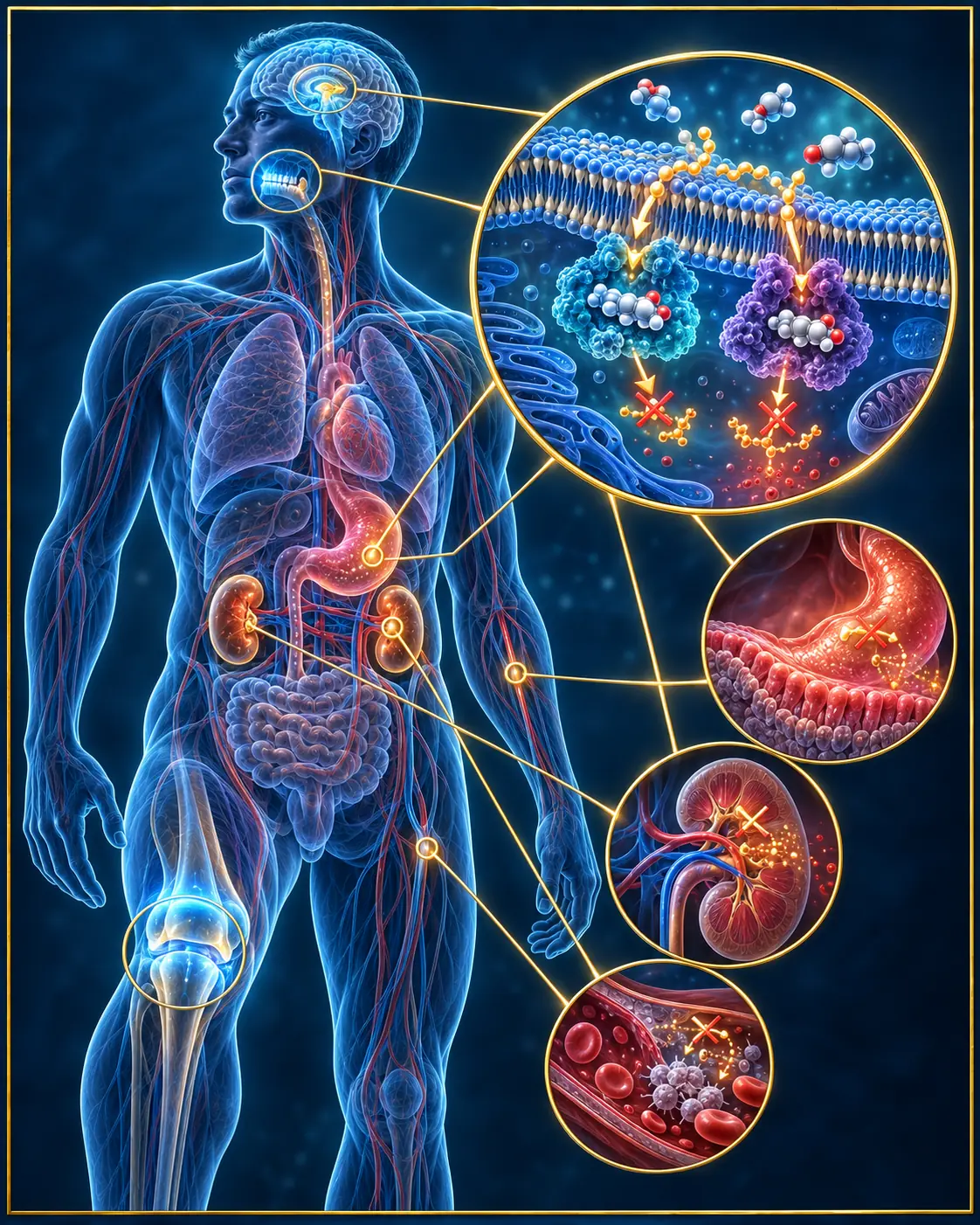

Ibuprofen is useful for pain, fever, and inflammation. It is not a benign default: patient, dose, duration, hydration, disease state, and interacting medicines control whether it fits.
Confirm the person before confirming the dose.
Pain, fever, swelling, or another condition determines whether an NSAID fits.
Check GI bleeding, kidney, heart, pregnancy, asthma, dehydration, and interaction risk.
Choose the smallest effective amount for the shortest necessary time.
Worsening, persistent, or red-flag symptoms require assessment, not more ibuprofen.
Eighteen decision modules from identity through evidence control.
Class, chemistry, formulation, and prostaglandin effects.
Indications, adult limits, pediatric concentration controls.
GI, renal, cardiovascular, allergic, pregnancy, and age risks.
Buying standard, red flags, overdose response, and evidence.
The active ingredient—not the brand family—controls identity.
Nonsteroidal anti-inflammatory drug for pain relief and fever reduction.
Chemical formula C13H18O2; molecular weight 206.28 g/mol.
The S-enantiomer provides most direct COX-inhibitory activity; some R converts to S in vivo.
Tablet, caplet, liquid-filled capsule, chewable, suspension, and drops require form-specific directions.
Reversible COX inhibition reduces prostaglandin production.
Temporary relief does not establish the diagnosis.
Often useful for acute inflammatory pain when NSAID risk does not exclude use.
Mechanistic fit is strong; screen pregnancy and abnormal bleeding.
May help selected episodic attacks; frequent use requires evaluation.
Short-term relief may help; do not use pain suppression to continue unsafe activity.
Hydration and the cause of illness matter more than the number alone.
Persistent daily need is a signal for clinical assessment.
Ibuprofen does not treat the virus; inspect combination products for duplicate NSAIDs.
Trauma, neurologic change, chest pain, GI bleeding, or severe illness requires another pathway.
One product, one interval, one maximum.
The same milliliter volume can deliver very different amounts.
Do not use unless a clinician specifically directs treatment.
Confirm the exact concentration before reading any volume from a chart.
This is a concentrated product. Keep its oral syringe paired with its bottle.
| Weight | Age guide | 50 mg/1.25 mL drops | 100 mg/5 mL liquid | 50 mg chewable |
|---|---|---|---|---|
| 12-17 lb | 6-11 months | 1.25 mL | 2.5 mL | 1 tablet |
| 18-23 lb | 12-23 months | 1.875 mL | 3.75 mL | 1½ tablets |
| 24-35 lb | 2-3 years | 2.5 mL | 5 mL | 2 tablets |
| 36-47 lb | 4-5 years | 3.75 mL | 7.5 mL | 3 tablets |
| 48-59 lb | 6-8 years | Use exact label | 10 mL | 4 tablets |
| 60-71 lb | 9-10 years | Use exact label | 12.5 mL | 5 tablets |
| 72-95 lb | 11 years | Use exact label | 15 mL | 6 tablets |
Risk rises with patient factors, dose, and duration.
Avoid routine self-selection; recurrence risk is clinically important.
Anticoagulants, antiplatelets, corticosteroids, and other NSAIDs add risk.
Baseline bleeding risk and reduced physiologic reserve increase concern.
Three or more drinks daily, higher doses, or longer use increase risk.
Short duration does not erase susceptibility.
Reduced circulating volume makes prostaglandin-dependent renal perfusion more vulnerable.
Do not use routinely unless a clinician has specifically approved it.
Adding an NSAID can produce hemodynamic acute kidney injury.
Sodium and water retention can worsen blood pressure and congestion.
Risk may begin early and rises with dose and duration.
Do not default to ibuprofen; obtain clinician guidance.
Fluid retention and prostaglandin effects may worsen control.
Ibuprofen may worsen edema, renal function, and decompensation.
Do not use in the perioperative coronary artery bypass graft setting.
Stop immediately when allergic or severe skin symptoms appear.
Facial or throat swelling, wheezing, shock, or breathing difficulty requires emergency care.
Avoid self-directed use after aspirin or NSAID respiratory reactions.
Stop and seek urgent evaluation for widespread rash or mucosal lesions.
Stop use and obtain medical advice even without systemic symptoms.
Pregnancy stage changes fetal renal and ductal risk.
Do not assume safety; obtain individual guidance.
If necessary, FDA recommends the lowest effective dose for the shortest duration.
Fetal renal dysfunction and premature ductus arteriosus closure are concerns.
Short-term use is often compatible, but patient and infant factors still matter.
Reserve, polypharmacy, and chronic use narrow the margin.
Occult loss may present as fatigue, dizziness, weakness, or falls.
Dehydration, CKD, and interacting medicines increase acute kidney injury risk.
Edema, blood pressure, and heart-failure control can worsen.
Daily or near-daily self-treatment requires diagnosis and medication review.
Duplicate toxicity provides little useful additional relief.
| Exposure | Primary risk | Controlled action |
|---|---|---|
| Aspirin, naproxen, diclofenac, ketorolac, other NSAIDs | Duplicate GI, renal, and cardiovascular toxicity | Do not combine unless explicitly directed. |
| Warfarin, DOACs, heparins, clopidogrel | Additive bleeding risk | Avoid self-directed use; obtain professional review. |
| Corticosteroids or SSRIs/SNRIs | Higher GI bleeding risk | Review the full risk profile before use. |
| ACE inhibitors, ARBs, and diuretics | Kidney injury and blood-pressure effects | Review renal status, hydration, and medications. |
| Lithium | Reduced lithium clearance | Avoid without monitoring and prescriber involvement. |
| Methotrexate | Potential reduced clearance and toxicity | Prescriber or pharmacist review. |
| Low-dose aspirin | Ibuprofen may interfere with antiplatelet benefit | Ask a pharmacist about regimen and timing. |
| Alcohol | GI irritation and bleeding | Avoid while using ibuprofen. |
Severity depends on dose, age, comorbidity, and co-ingestants.
Vomiting, lethargy, dizziness, or tinnitus may occur.
Seizures, coma, hypotension, or respiratory depression can occur.
Significant exposure can disrupt acid-base status and kidney function.
In the United States, contact Poison Control at 1-800-222-1222 or seek emergency care.
Package clarity is a clinical safety control.
Choose ibuprofen-only when ibuprofen is the intended therapy.
Verify 200 mg per adult unit or the exact pediatric concentration.
Pediatric liquid must include an appropriate marked syringe or cup.
Seal, neckband, carton, blister, lot, and expiration must be intact and readable.
Tablet, caplet, liquid-filled capsule, chewable, liquid, and drops are not interchangeable.
Dye-free or sugar-free claims matter only when the individual requires them.
Choose a package size that does not normalize indefinite daily use.
Use established pharmacy or verified retail channels and inspect the delivered package.
Every yes must remain yes before the dose is taken.
Use the shortest necessary duration and record the stop rule before starting.
Do not compensate by shortening the interval, stacking NSAIDs, or increasing duration.
Current labels outrank remembered dosing and package familiarity.
Decisions are stated as direct actions, with technical detail separated from the required next step.
Strength, age, dose, interval, duration, and warnings can differ by product.
This monograph supports product selection and counseling; it does not replace individualized care.
Links already cited on this page.