MFCP IDENTITY RULE: fatigue is not a diagnosis, a high-dose bottle is not a treatment plan, and the route must match the cause, severity, neurologic risk, and ability to absorb.
Panel 1 · Biology and deficiency control
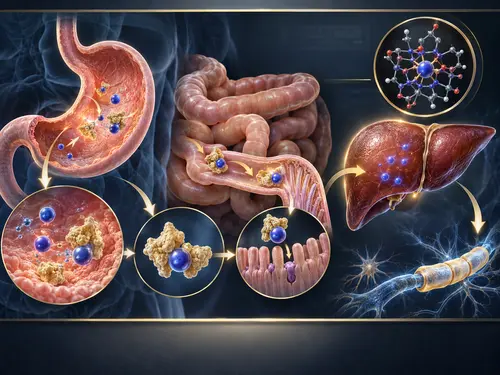
The Absorption Chain
Deficiency can occur despite adequate intake. Every link from stomach to terminal ileum matters.
Atrophic gastritis, pernicious anemia, gastric surgery, and prolonged acid suppression can disrupt early steps. Crystalline supplement B12 is already free from food protein, but intrinsic-factor loss remains clinically important.
Intestinal failure
Pancreas, ileum, or competing disease
Pancreatic disease, ileal inflammation or resection, bariatric anatomy, and other malabsorptive disorders can change route, dose, monitoring, and duration.
Medicine control
Metformin is a recognized risk
Risk rises with longer exposure, higher dose, and other deficiency factors. Test when anemia, neuropathy, or compatible symptoms appear; consider periodic monitoring in patients at risk.
Functional inactivation
Nitrous oxide is not a nutrition problem
Nitrous oxide can inactivate cobalamin and precipitate neurologic injury even when a serum result appears reassuring. Exposure history changes the urgency and diagnostic pathway.
Blood pathway
DNA synthesis and erythropoiesis
Deficiency can cause macrocytosis, megaloblastic anemia, leukopenia, thrombocytopenia, glossitis, fatigue, and pallor—but the CBC may be normal early or after folate exposure.
Neurologic danger
Nerve injury can occur without anemia
Numbness, gait change, loss of vibration or position sense, weakness, cognitive change, or visual symptoms require prompt assessment. Do not wait for macrocytosis before acting.
Panel 2 · Product identity and myth control
Which B12—and Why?
Cobalamin form, route, dose, diagnosis, and monitoring are separate decisions.
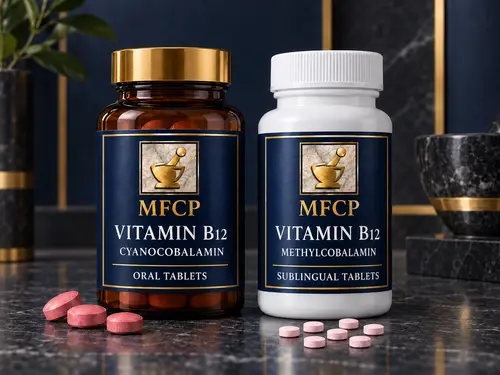
The axial ligand distinguishes cobalamin forms. Cyanocobalamin and hydroxocobalamin are converted to metabolically active methyl- and adenosylcobalamin.
Cyanocobalamin
Common · stable · well characterized
Widely used in oral supplements and prescription injection. “Synthetic” does not mean clinically inactive.
Methylcobalamin
Active form—not proven superior
NIH reports no evidence that supplement absorption rates differ by B12 form.
Oral / sublingual
Same efficacy signal
Evidence does not show a routine efficacy advantage for sublingual over oral products. High oral doses have low fractional absorption but can still deliver meaningful amounts.
Clinician-directed prescription routes
Injectable B12 is Rx-only—not OTC
Injectable B12 products and prescription nasal products are distinct from OTC oral supplements. Severe deficiency, neurologic involvement, pernicious anemia, malabsorption, adherence, and response determine professional route selection.
“B12 gives everyone energy”Correcting deficiency may improve related fatigue. B12 does not function as a stimulant and does not validate unexplained-fatigue self-treatment.
“Methyl is always better”No established absorption advantage. Product quality, adequate dose, cause, route, adherence, and clinical response matter more than front-panel prestige.
“Injections are always necessary”False as a universal rule. Injection is clinician-directed—not an OTC self-care form. Oral therapy can be appropriate for selected patients; serious neurologic disease or unreliable absorption may favor parenteral treatment.
“A normal CBC rules it out”False. Neurologic manifestations can occur without anemia or macrocytosis, and folate can obscure the hematologic signal.
“Serum B12 settles the diagnosis”Not always. Laboratory cutoffs vary. Methylmalonic acid can clarify borderline results, but kidney dysfunction can elevate MMA.
“Folate fixes B12 deficiency”Dangerous. Folate can improve the anemia while B12-related neurologic damage continues. It must not replace B12 evaluation and treatment.
Professional Responsibility · Make the Diagnosis Before Selling the Story
1 · Recognize
Symptoms outrank the sales claim
Neuropathy, gait change, cognitive change, glossitis, cytopenias, malabsorption history, or nitrous-oxide exposure moves the case out of casual retail selection.
2 · Confirm
Use context-aware testing
Interpret serum B12 with symptoms, CBC, folate, MMA when appropriate, kidney function, medicines, diet, surgery, and autoimmune risk.
3 · Treat
Cause and severity select the route
Do not delay treatment when neurologic injury is suspected. Oral, sublingual, nasal, IM, and SC products are not automatically interchangeable.
4 · Reassess
Response does not close the case
Confirm clinical and biochemical response, identify the cause, decide whether replacement is lifelong, and avoid masking a persistent absorption disorder.
SAFETY GATE: new weakness, gait instability, progressive numbness, bowel or bladder change, confusion, visual loss, severe anemia symptoms, or suspected nitrous-oxide neurotoxicity requires prompt medical evaluation—not a supplement comparison.