

Hypertonic Sodium Chloride
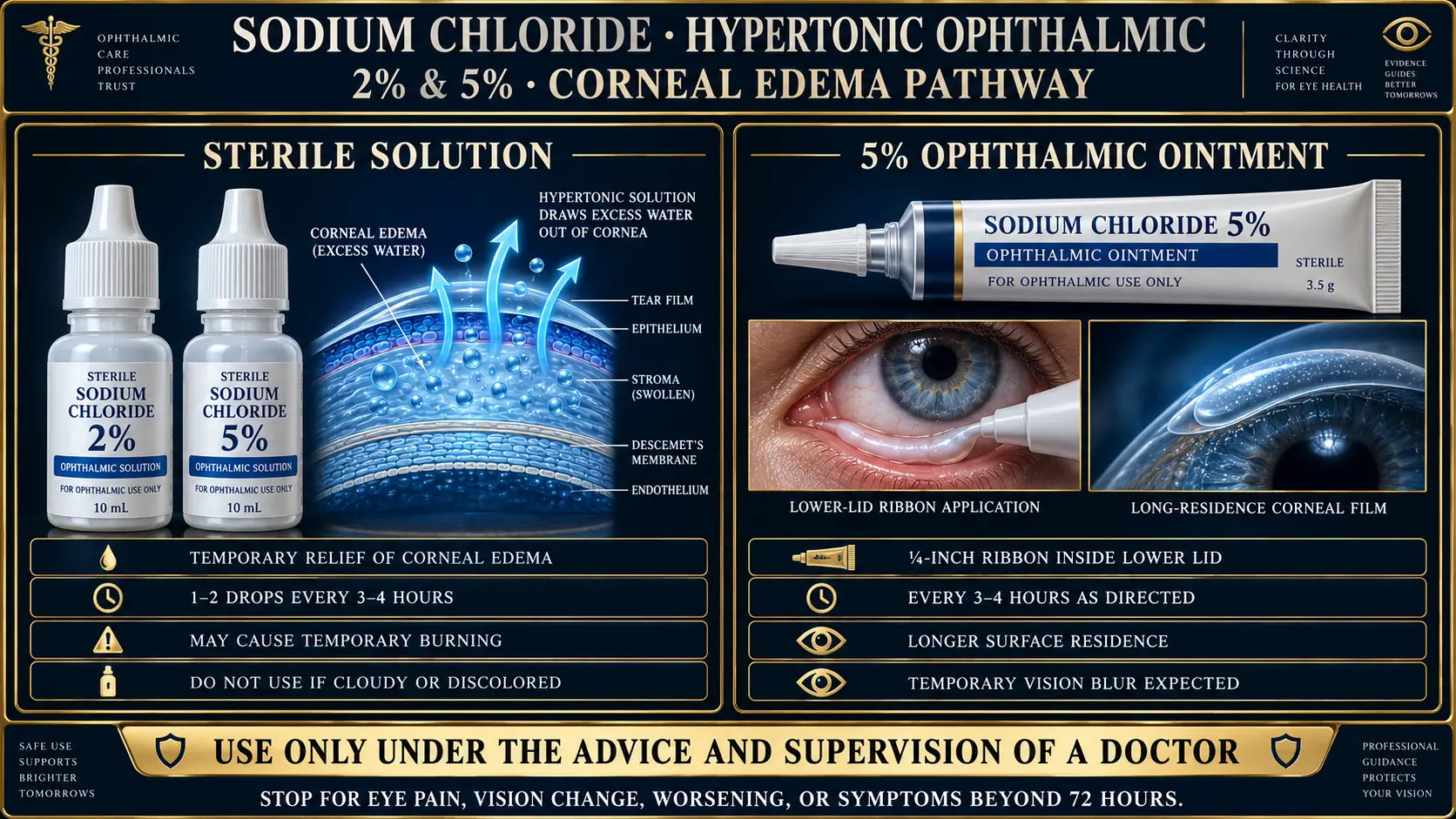
Sodium chloride 2% and 5% ophthalmic formulations create an osmotic gradient that temporarily draws water from an edematous cornea.
Monograph NavigationContents
Regulatory IdentitySodium Chloride 2%–5% · Ophthalmic Hypertonicity Agent
The United States Food and Drug Administration (FDA) OTC Monograph M018 identifies sodium chloride at 2% to 5% as an ophthalmic hypertonicity agent. Its labeled use is the temporary relief of corneal edema. The monograph definition is functional: the agent creates an osmotic gradient greater than that in body tissues and fluids, drawing water from the cornea across a semipermeable membrane.
Sodium chloride 2%–5%.
Ophthalmic hypertonicity agent.
Temporary relief of corneal edema.
Clinical Entry PointChoose by Dosage Form and Labeled Strength
The finished product’s concentration and dosage form determine residence time, blur, administration technique, and practical use. These products provide temporary relief; they do not establish the cause of corneal edema.
Sterile hypertonicity ophthalmic solution for temporary relief of corneal edema.
More concentrated sterile solution using the same labeled temporary-relief pathway.
Hypertonic sodium chloride suspended in an ophthalmic ointment base for longer ocular-surface residence.
Formulary ComparisonStrength and Vehicle Change the Clinical Experience
| Pathway | Delivery | Primary Advantage | Principal Trade-Off |
|---|---|---|---|
| Sodium chloride 2% | Aqueous solution | Lower-concentration drop pathway with rapid distribution across the ocular surface. | Frequent administration; transient burning; product-specific preservative exposure. |
| Sodium chloride 5% | Aqueous solution | Higher extracellular tonicity in a familiar drop format. | May sting more; shorter residence than ointment; still requires professional supervision. |
| Sodium chloride 5% | Ophthalmic ointment | Longer residence and reduced rapid washout. | Pronounced temporary blur, greasy film, and separate ribbon-application technique. |
Osmotic PharmacologyHow Hypertonicity Temporarily Reduces Corneal Swelling
Excess water increases corneal thickness and disrupts optical clarity.
A higher solute concentration at the ocular surface creates an osmotic gradient.
Temporary fluid-shift support
- The formulation increases tear-film osmolarity at the corneal surface.
- Water movement out of the swollen cornea can temporarily reduce epithelial or stromal edema.
- The effect depends on continued surface contact, which is why solution and ointment behave differently.
- The product does not correct endothelial failure, dystrophy, postoperative complications, infection, trauma, or another underlying cause.
Corneal PhysiologyDeturgescence, Barrier Function, and Optical Clarity
The cornea remains transparent only when hydration and collagen spacing are tightly controlled. The endothelial pump and intact epithelial barrier support relative dehydration, or deturgescence. When endothelial reserve falls or the surface barrier is disrupted, water accumulates within the stroma and epithelium, increasing thickness and light scatter.
Endothelial ion transport and barrier integrity limit stromal hydration.
Stromal swelling disrupts regular fibril spacing; epithelial microcysts or bullae may develop.
Blur, halos, foreign-body sensation, photophobia, and pain require cause-directed evaluation.
Clinical PlacementCorneal-Edema Contexts That Require Diagnosis and Follow-Up
The following disorders may be associated with corneal edema, but they are not separate OTC indications. Hypertonic sodium chloride is supportive care used only within a clinician-directed plan.
| Clinical Context | Why Edema Occurs | MFCP Control |
|---|---|---|
| Fuchs endothelial corneal dystrophy | Progressive endothelial dysfunction reduces fluid-pump reserve; morning blur may be prominent. | Temporary optical or comfort support does not halt disease progression. |
| Pseudophakic or aphakic bullous keratopathy | Endothelial cell loss after intraocular surgery permits chronic stromal and epithelial swelling. | Painful bullae, persistent edema, or deteriorating vision require ophthalmology management. |
| Postoperative or post-traumatic edema | Transient endothelial stress, inflammation, pressure changes, or tissue injury may impair deturgescence. | Postoperative changes must be managed by the operating clinician; do not self-treat new deterioration. |
| Recurrent corneal erosion context | Some specialist regimens use hypertonic ointment to reduce epithelial edema and nocturnal surface adhesion. | This is a clinician-directed use; acute epithelial defects and infection require separate management. |
Vehicle ArchitectureDelivery Systems and Preservative Burden
Common 15 mL dropper bottles may contain parabens or another product-specific preservative system. The complete inactive-ingredient panel must be checked.
PRESERVATIVE IDENTITY VARIESOintment vehicles commonly use petrolatum, mineral oil, water, and sometimes lanolin. Some marketed products contain no separately listed antimicrobial preservative.
DO NOT ASSUME LANOLIN-FREETip contamination, damaged seals, particles, discoloration, cloudiness, expiration, and improper storage can make a product unsuitable for use.
THE PHYSICAL LABEL CONTROLSAdministration EngineeringSolution and Ointment Are Separate Techniques
| Step | Solution | Ointment |
|---|---|---|
| Preparation | Wash hands; inspect clarity and package integrity. | Wash hands; inspect tube, seal, and product consistency. |
| Delivery | Instill the labeled number of drops without touching the tip. | Pull down the lower lid and place a small ¼-inch ribbon inside the lower-lid pocket. |
| After dosing | Close the eye gently; replace the cap. | Close the eye gently; expect temporary blur; replace the cap. |
| Frequency | Every 3–4 hours or as directed by a doctor. | Follow the finished product label and clinician’s regimen; marketed labels may specify every 3–4 hours or directed use. |
Device and Surface ControlContact Lenses, Epithelial Defects, and Complex Eyes
Do not invent a universal contact-lens interval
Hypertonic therapy is used for a diseased corneal state, and contact-lens wear may be inappropriate. Remove lenses unless the treating eye-care professional and the specific product label explicitly permit otherwise. Therapeutic bandage lenses are medical devices managed by an eye-care professional, not an OTC self-care exception.
Marked pain, a ruptured bulla, abrasion, or suspected infection requires examination before continued self-administration.
New edema, pain, redness, or vision decline after surgery belongs to the operating clinician’s pathway.
Preservative burden, epithelial staining, tolerability, and ongoing need should be reviewed clinically.
Drug Facts ControlProfessional Supervision Is Part of the Label
Current labels direct consumers not to use these products except under the advice and supervision of a doctor.
Do not touch the bottle or tube tip to the eye, fingers, or another surface. Replace the cap after each use.
Stop use and seek professional review if the condition worsens or persists longer than 72 hours.
Stop and seek care
- Eye pain or a change in vision.
- Continued redness or irritation.
- Worsening swelling, marked light sensitivity, discharge, trauma, or chemical exposure.
- Cloudy, discolored, contaminated, difficult-to-dispense, or particle-containing product.
Clinical BoundaryCorneal Edema Is a Finding, Not a Complete Diagnosis
Temporary symptom support after corneal edema has been identified and the patient has been advised to use a specific product.
Persistent morning blur, worsening halos, increasing discomfort, recurrent symptoms, or inadequate response despite directed use.
Sudden vision loss, significant pain, severe photophobia, trauma, chemical injury, suspected infection, or postoperative deterioration.
MFCP Buying Standard™Verify the Product Before It Reaches the Eye
Sodium chloride 2% or 5%. Do not substitute ordinary isotonic saline.
Ophthalmic solution or ophthalmic ointment. Ointment and solution are not dose-for-dose interchangeable.
Never substitute a nasal, inhalation, wound-irrigation, or injectable sodium chloride product.
Check preservatives, lanolin, petrolatum, mineral oil, and known sensitivities.
Seal intact; not expired; solution clear; tube dispenses normally; no particles or contamination.
Confirm the intended eye, product, frequency, duration, and reassessment threshold.
Primary SourcesEvidence and Regulatory Control
The physical package label governs the exact directions, inactive ingredients, storage, warnings, and discard requirements for the product in hand.