
Familiar heartburn or regurgitation
Alginate raft products can provide local, post-meal reflux relief by forming a barrier above stomach contents. Antacid-containing products also neutralize acid.
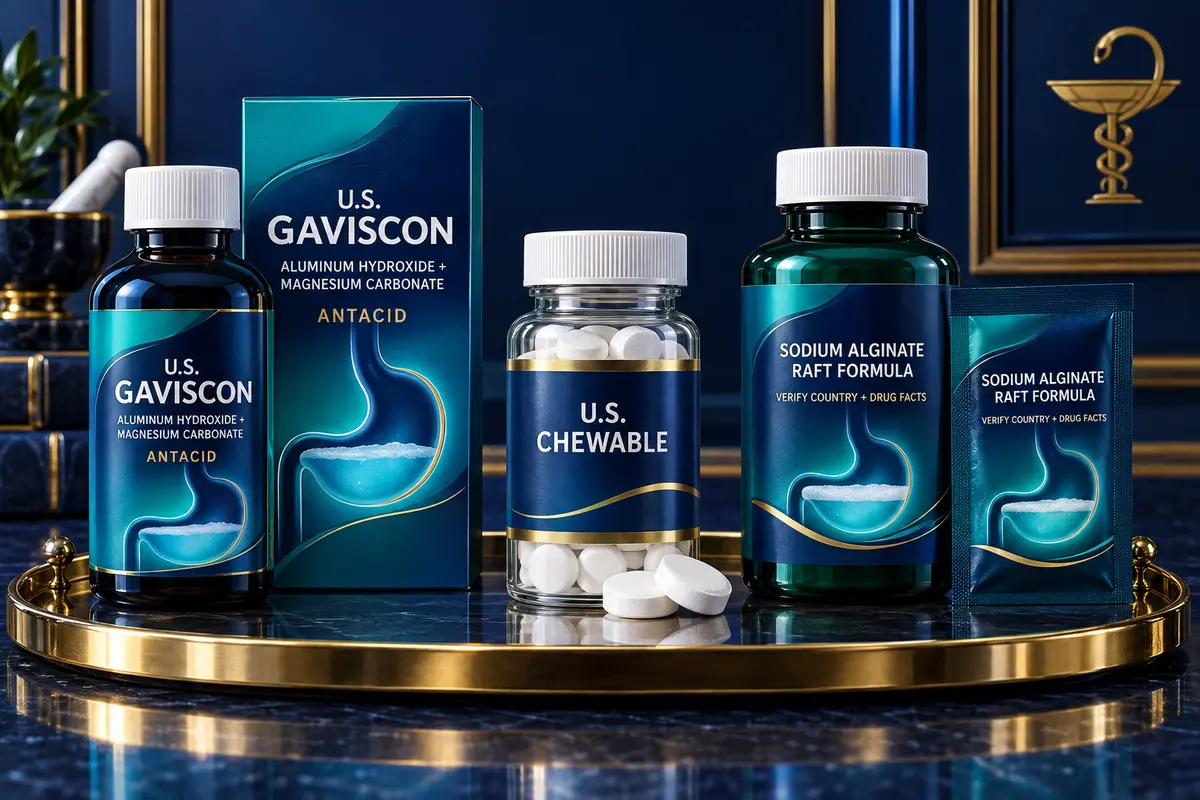

Verify country · active ingredients · dosage form · current label
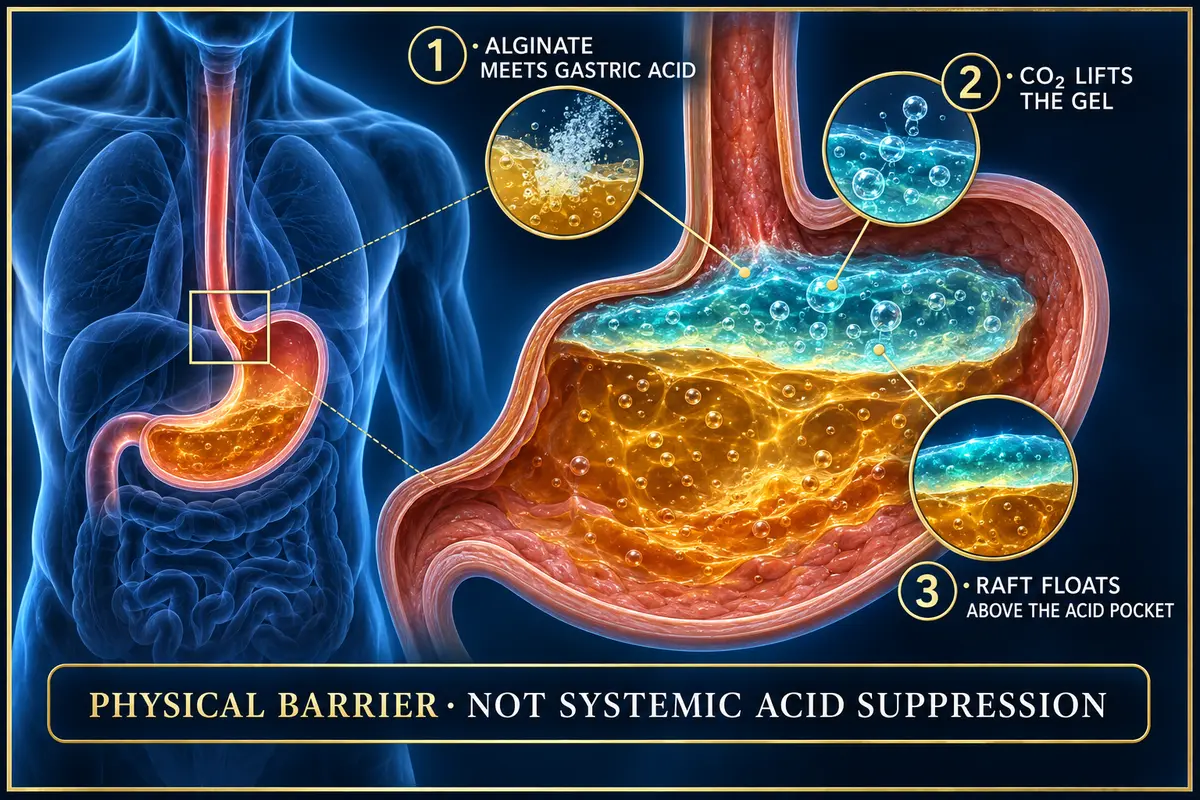
Alginate raft products can provide local, post-meal reflux relief by forming a barrier above stomach contents. Antacid-containing products also neutralize acid.
“Gaviscon” does not identify one worldwide formula. Country, dosage form, strength, and current label determine what the product actually does.
A raft formulation works in the stomach. It does not inhibit acid production throughout the body like a proton-pump inhibitor or H₂ blocker.
Improvement after an antacid or alginate does not prove that chest, swallowing, bleeding, or upper-abdominal symptoms are benign.
Current Extra Strength chewables list aluminum hydroxide 160 mg and magnesium carbonate 105 mg per tablet. Alginic acid is listed as inactive.
Current liquid labels list aluminum hydroxide plus magnesium carbonate. Sodium alginate appears among inactive ingredients.
Each 10 mL contains sodium alginate 500 mg, sodium bicarbonate 213 mg, and calcium carbonate 325 mg.
| Product / market | Active identity | What the label supports | MFCP control |
|---|---|---|---|
| U.S. Extra Strength chewable | Aluminum hydroxide 160 mg + magnesium carbonate 105 mg per tablet | Antacid relief | Do not present it as a sodium-alginate active product |
| U.S. Regular Strength liquid | Aluminum hydroxide 95 mg + magnesium carbonate 358 mg per 15 mL | Antacid relief | Measure liquid; follow this exact Drug Facts label |
| U.S. Extra Strength liquid | Aluminum hydroxide 254 mg + magnesium carbonate 237.5 mg per 5 mL | Antacid relief | Strength is per teaspoon; do not transfer tablespoon directions |
| UK Double Action liquid | Sodium alginate 500 mg + sodium bicarbonate 213 mg + calcium carbonate 325 mg per 10 mL | Raft barrier plus acid neutralization | UK directions and sodium burden remain formulation-specific |
The barrier occupies the region from which post-meal reflux often originates and can reduce or delay refluxate reaching the esophagus.
Calcium carbonate or other antacids neutralize acid while alginate supplies the physical barrier. The exact actives decide whether both mechanisms are present.
| Product / user | Current direction | Timing / technique | Boundary |
|---|---|---|---|
| U.S. Extra Strength chewable | Adults: chew 2–4 tablets, up to four times daily | After meals and at bedtime or as needed; follow with half a glass of water | Do not swallow whole; maximum 16 tablets in 24 hours; maximum dose no longer than 2 weeks |
| U.S. Regular Strength liquid | 1–2 tablespoonfuls four times daily | Shake well; after meals and at bedtime; use a measuring device | Maximum 8 tablespoonfuls in 24 hours; maximum dose no longer than 2 weeks |
| U.S. Extra Strength liquid | 2–4 teaspoonfuls four times daily | Shake well; after meals and at bedtime; use a measuring device | Maximum 16 teaspoonfuls in 24 hours; maximum dose no longer than 2 weeks |
| UK Double Action liquid, age 12+ | 10–20 mL after meals and at bedtime | Up to four times daily; shake well and measure | Under 12 only on medical advice; consult if needed beyond 7 days |
“Chewable” is a technique instruction. Do not swallow the U.S. tablets whole, and do not assume a liquid dose is equivalent.
Suspensions separate. Use the supplied measure or a calibrated device—not a household spoon.
Different strengths can look almost identical. Confirm teaspoons versus tablespoons and the maximum daily amount every time.
Chest pressure, breathing difficulty, sweating, faintness, or pain spreading beyond the chest requires emergency evaluation—not an antacid trial.
Vomiting blood, coffee-ground material, black or bloody stool, progressive trouble swallowing, or painful swallowing requires prompt care.
Unexplained weight loss, marked fatigue or suspected anemia, recurrent vomiting, severe pain, or a new persistent pattern is outside routine self-care.
Symptoms that worsen, recur frequently, wake the patient repeatedly, or persist beyond the product's labeled self-care window require reassessment.
UK Double Action supplies 127.88 mg sodium per 10 mL—up to 1,023.04 mg at the maximum daily dose. Sodium-restricted patients need product-specific review.
Sodium, calcium, aluminum, and magnesium exposure varies. Renal impairment, heart failure, edema, or electrolyte restrictions move selection toward clinician or pharmacist review.
The UK Double Action leaflet permits use during pregnancy and breast-feeding with the shortest necessary duration. Follow the label for the exact product and market.
| Medication / condition | Why it matters | Controlled action |
|---|---|---|
| Prescription drugs generally | Antacids and gastric pH changes can alter absorption | Ask a doctor or pharmacist before U.S. use |
| Other oral medicines | The UK leaflet directs separation from several medicines | Use a 2-hour separation around the UK Double Action product unless a clinician directs otherwise |
| Iron, levothyroxine, tetracyclines, fluoroquinolones, bisphosphonates | Binding or pH effects may reduce absorption | Verify the interaction and the required interval for the exact medicine |
| Digoxin, selected beta blockers, azole antifungals | Absorption or exposure may change | Pharmacist review; do not rely on one blanket spacing rule |
| Severe renal impairment | Aluminum or magnesium accumulation and electrolyte disturbance are more consequential | Avoid casual self-selection; obtain professional guidance |
A U.S. product page cannot validate a UK bottle, and a UK leaflet cannot supply U.S. Drug Facts directions.
If alginate is not listed among the active ingredients, do not assume a proven raft-former from the brand name or package graphics.
Form controls shaking, chewing, measuring, water, dose unit, and timing. Directions are not transferable.
Verify per-dose and maximum daily exposure, age cutoff, interaction spacing, and the point at which symptoms require evaluation.
| Front-panel cue | What to verify | What not to assume |
|---|---|---|
| “Gaviscon” | Country, active ingredients, strength, form | That all Gaviscon products contain active sodium alginate |
| “Double Action” | Which two mechanisms the exact actives support | That the phrase identifies one global formula |
| “Extra Strength” | Strength per tablet, teaspoon, or tablespoon | That more volume or more tablets are appropriate |
| “Raft” or barrier imagery | Active alginate and current authorized label | That marketing artwork replaces ingredient verification |
Gaviscon Extra Strength chewable ↗
Controls U.S. active ingredients, antacid purpose, directions, maximum, and duration.
Separates Regular and Extra Strength liquids and their measurement units.
Gaviscon Double Action liquid leaflet ↗
Controls active alginate identity, dose, sodium burden, spacing, and product-specific warnings.
Supports raft localization at the postprandial acid pocket and reduced reflux compared with antacid.
Alginate therapy for GERD symptoms ↗
Fourteen studies involving 2,095 participants favored alginate therapy over placebo or antacid for symptom resolution.
Alginate added to once-daily PPI ↗
Provides clinician-directed context for residual symptoms; it does not create a universal OTC recommendation.
Links already cited on this page.