
HIGH-CONSEQUENCE OTC CLASS
PHENYLEPHRINE HCl
10 mg · ORAL TABLETS
SINGLE-INGREDIENT CONTROL

MICHAEL’S FORMULARY™
PHENYLEPHRINE HCl
10 mg · ORAL TABLETS
CONTROLLED MONOGRAPH
MICHAEL’S FORMULARY & CLINICAL PERSPECTIVE™ · DOMAIN 3 · ENTRY 2

ORAL NASAL DECONGESTANT · CONTROLLED MONOGRAPH

Clinical meaning · decisive action
Measured layer for patients and consumers. The clinical and legal modules remain the technical reference layer.
Oral phenylephrine is sold in many cold products. It may be listed alone or with other drugs. Read the Drug Facts label before each dose.
FDA reviewed the oral form. FDA found that the labeled oral dose does not ease a stuffy nose. In 2024, FDA proposed taking oral phenylephrine out of the OTC rule. The proposal is not a final order. Products may still be sold while FDA completes this work.
This action applies only to phenylephrine taken by mouth. It does not apply to phenylephrine nasal spray. Do not mix up the two forms.
Do not take more than the label states. A higher dose may raise the risk of harm. Check the label for age limits. Do not use two products with the same drug.
Ask a pharmacist or doctor before use if you have high blood pressure, heart disease, thyroid disease, diabetes, or trouble passing urine. Ask before use if you take other drugs. Do not use it with an MAOI or within 14 days after stopping an MAOI.
Stop use and get help for chest pain, fainting, a very fast heartbeat, or a severe headache. Seek care if symptoms get worse or do not improve.
For a stuffy nose, ask about other choices with better proof. Saline spray may help. A nasal drug may help some people, but it must be used as its label directs.
Oral phenylephrine 10 mg is still sold in U.S. OTC products. FDA found that the labeled oral dose does not relieve a stuffy nose. In November 2024, FDA proposed removing oral phenylephrine from the OTC monograph. The rule will change only if FDA issues a final order.
Do not confuse oral phenylephrine with phenylephrine nasal spray. The FDA action covers only products taken by mouth.
One controlled route · select a destination
Choose the clinical destination
Complete single-view clinical overview
10 mg oral tablet · direct-acting sympathomimetic.
The label claim remains; FDA found the recommended oral dose unsupported as effective.
Found alone and in multi-ingredient cold, flu, allergy, and sinus products.
10 mg every 4 hours; no more than 6 doses in 24 hours.
No MAOI use within 14 days. Screen cardiovascular and duplicate-ingredient risk.
Consider saline, an intranasal corticosteroid, or screened pseudoephedrine when appropriate.
MFCP BOTTOM LINE: Shelf access and receptor plausibility do not establish clinical effectiveness.
RETURN TO CONTENTS ↑Label claim · evidence qualification
PRIMARY: EYE · EAR · NOSE · THROAT · SECONDARY: RESPIRATORY · ALLERGY · SINUS RELIEF · NO TERTIARY DOMAIN ASSIGNMENT
RETURN TO CONTENTS ↑Ingredient · salt · class · route

Absorption · first-pass loss · clinical consequence
Use the label · do not escalate dose
Where the claim fits—and where it does not
Oral route · combination products · route control
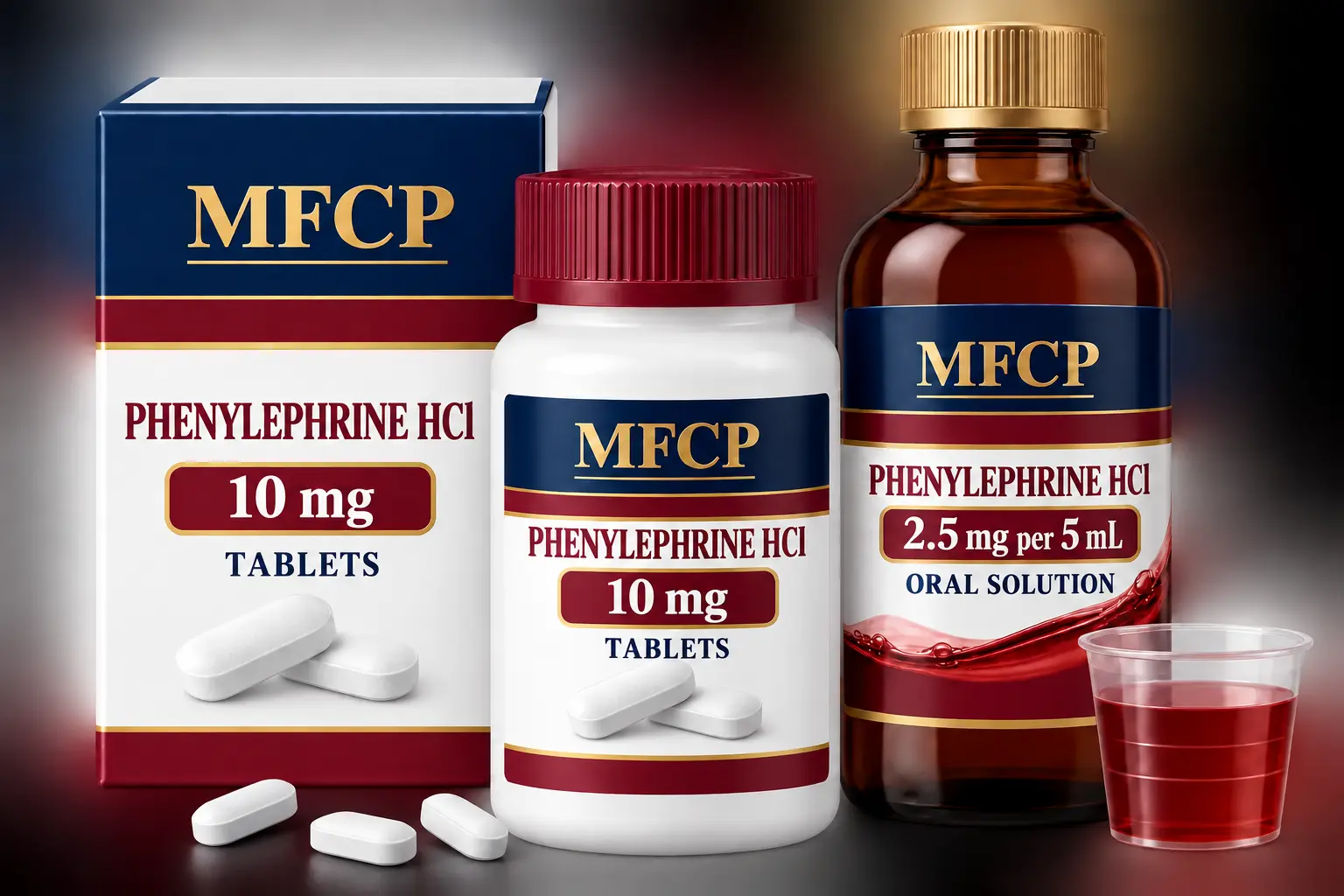
Oral tablet or caplet. Verify the active ingredient and current Drug Facts label.
Use the supplied dosing device. Do not substitute a household spoon.
Current label directions · age limits
Evidence-supported alternatives · route separation
Recognize · stop · reassess
MAOI · cardiovascular · duplicate ingredients
Individualized screening and referral
Verify before use
Separate every active ingredient, clinical task, dose, route, and evidence conclusion before selection.
Confirm phenylephrine HCl, its strength, and every additional active ingredient on the Drug Facts label.
Guaifenesin targets mucus clearance. Phenylephrine carries a nasal-decongestant claim. One package does not make the tasks equivalent.
Expectorant support and α₁-receptor activity are separate pharmacologic concepts with separate evidence.
FDA concluded that available evidence does not support effectiveness at the recommended oral dose.
Check age, interval, maximum daily dose, duplicate ingredients, cardiovascular risk, and MAOI exclusions.
Guaifenesin may loosen mucus. Do not promise that oral phenylephrine will relieve nasal congestion.
Plain-language clinical definitions
Current authorities · traceable record
Public action layer · measurement disclosure · label verification
Plain-language structure, defined clinical terms, and explicit decision points support public use.
Oral phenylephrine is still sold, but FDA found that the labeled oral dose does not ease a stuffy nose. Do not take extra doses because symptoms continue. Check every active ingredient and ask about options with better evidence.
VERIFY BEFORE USE: Brand · active ingredient · strength · dosage form · route · package count · current U.S. Drug Facts label.
RETURN TO CONTENTS ↑Stop sale · stop use · urgent referral





















 RETURN TO CONTENTS
 BEGIN MONOGRAPH

 EXPOSURE CONTROL