
A tea-associated amino acid
L-theanine is a non-protein amino acid found principally in tea. A purified supplement is not dose-equivalent to a cup of tea.
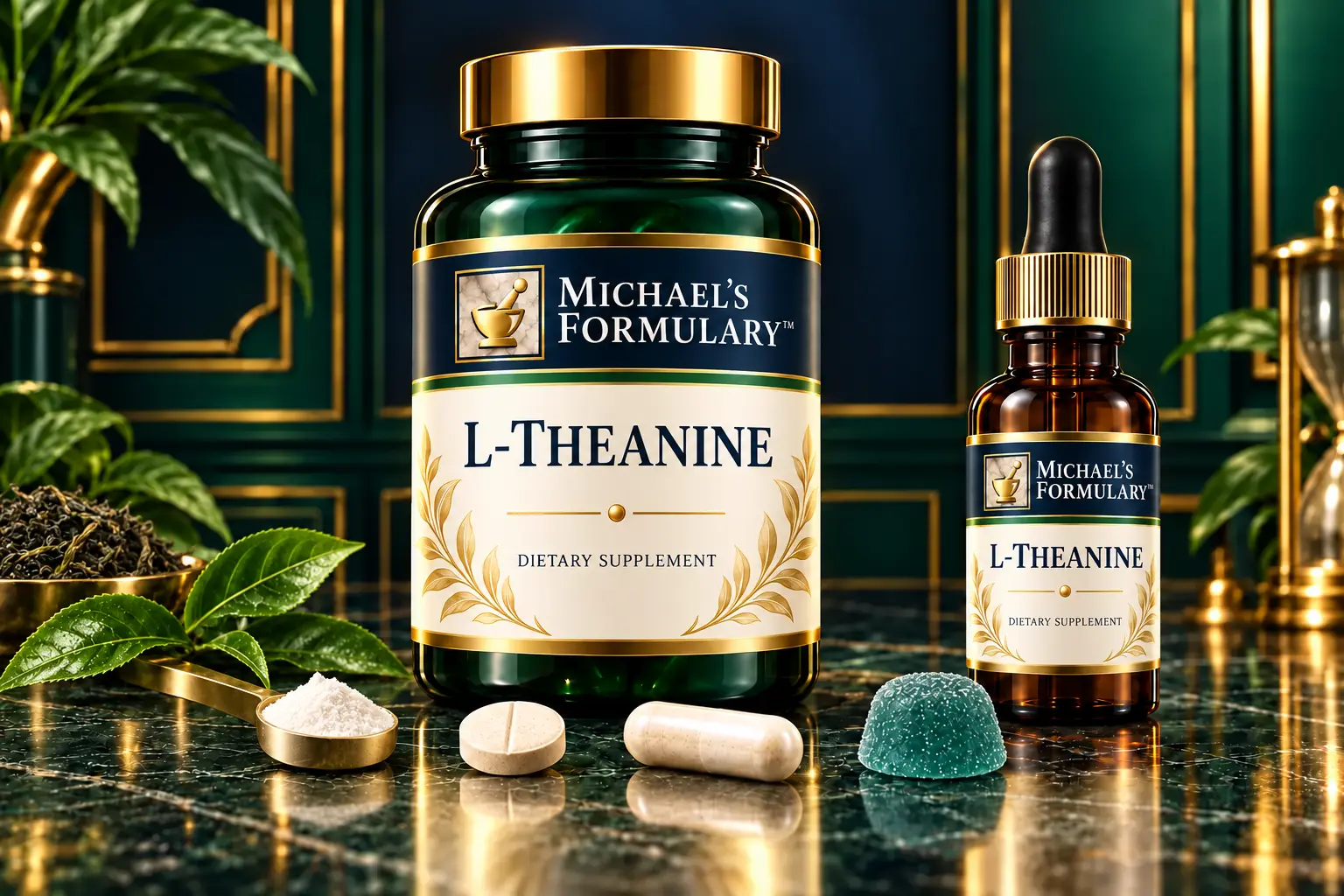 PowderTabletCapsuleGummyLiquid

Powder · tablet · capsule · gummy · liquid
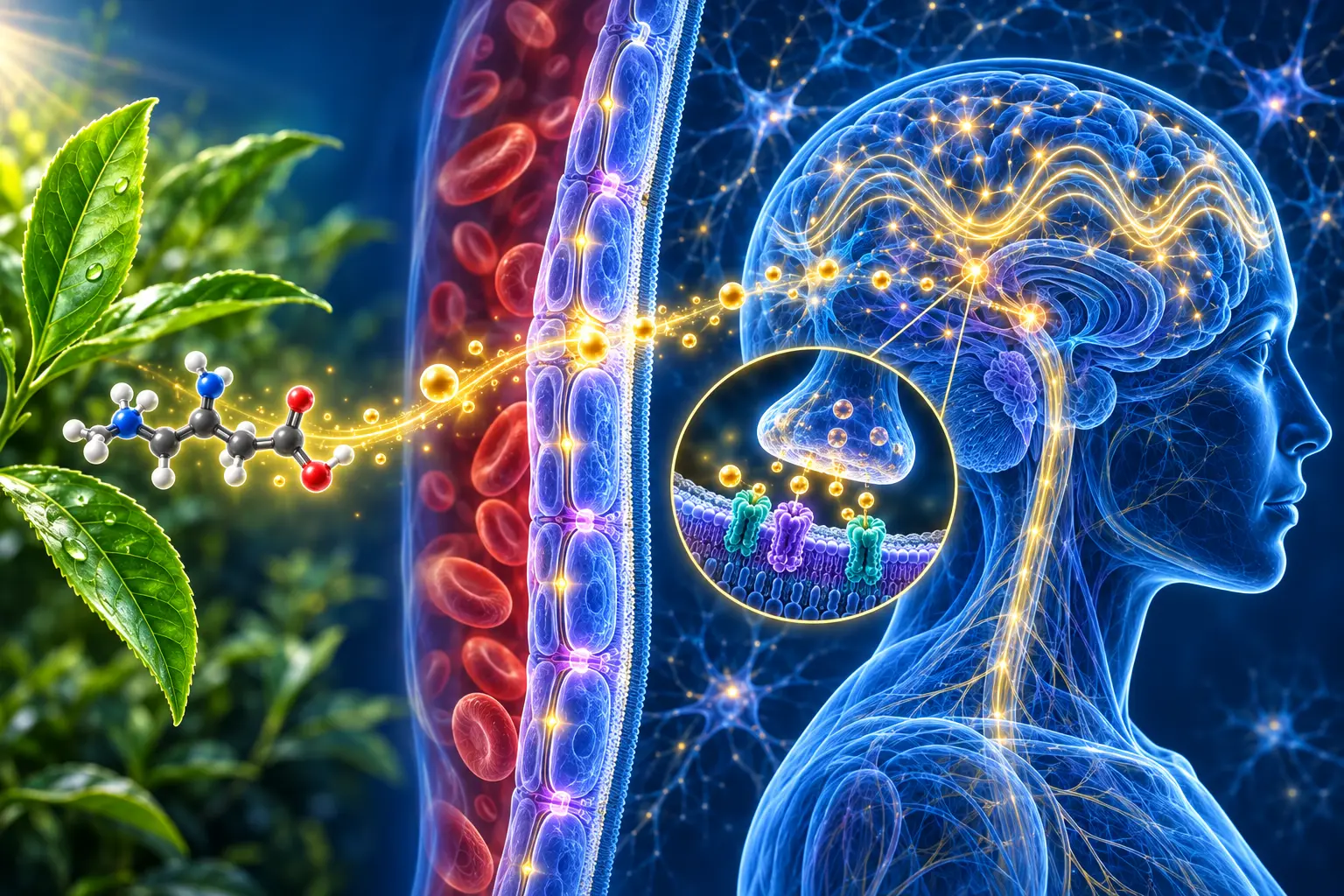 Camellia sinensisL-theanineBlood–brain barrierProposed neural modulationAlpha activity · 8–12 Hz
L-theanine is a non-protein amino acid found principally in tea. A purified supplement is not dose-equivalent to a cup of tea.
Research explores relaxation, attention, stress response, and sleep, but L-theanine is not an antihistamine, hypnotic, stimulant, or approved psychiatric drug.
Sleep findings do not establish ADHD treatment; cognitive findings in healthy adults do not establish efficacy in autism or anxiety disorders.
Tea extracts, purified L-theanine, gummies, liquids, powders, and caffeine combinations differ in serving size, co-ingredients, and quality controls.
Experimental work has examined glutamatergic signaling, GABA-related balance, monoamines, and stress physiology. These pathways remain mechanistic hypotheses, not indications.
Changes in 8–12 Hz alpha activity have been associated with relaxed attention in some studies. A biomarker shift does not prove better function, sleep, or disease control.
| Product family | Possible contents | What must be verified | MFCP control |
|---|---|---|---|
| L-theanine-only supplement | Capsule, tablet, powder, chew, gummy, or liquid | Milligrams per serving, units per serving, concentration, and excipients | Use the exact Supplement Facts panel; do not transfer directions between forms |
| Tea or tea extract | Variable L-theanine plus caffeine, catechins, and other constituents | Tea species, serving preparation, extract standardization, and caffeine content | Do not convert cups of tea into a purified research dose |
| L-theanine + caffeine | Two pharmacologically active ingredients in varying ratios | Total caffeine from every beverage, medicine, energy product, and supplement | Combination evidence cannot be assigned to L-theanine alone |
| Sleep or relaxation blend | May include melatonin, magnesium, GABA, chamomile, valerian, or other botanicals | Every ingredient amount, sedation burden, duplication, and timing | Each added ingredient creates a separate evidence and safety question |
| Proprietary blend | Named blend with incomplete per-ingredient quantities | Total blend weight does not reveal the L-theanine dose | A hidden dose fails the MFCP identity standard |
Count capsules, gummies, scoops, drops, and all repeat doses. Record milligrams of L-theanine and every active co-ingredient.
Purified L-theanine may contain no meaningful caffeine; tea and combination products may. The label and laboratory quality—not the source story—determine exposure.
| Clinical question | Evidence position | Controlled interpretation |
|---|---|---|
| General sleep outcomes | A 2025 systematic review found modest improvements in some subjective outcomes, but noted limited studies of pure L-theanine and unresolved dose and duration | Potential signal—not a universal insomnia recommendation |
| Pediatric ADHD with sleep problems | One six-week randomized trial in 98 boys ages 8–12 used 400 mg/day and improved some actigraphy measures | The study addressed sleep quality; it did not establish treatment of core daytime ADHD symptoms |
| Pediatric ADHD cognition | A four-way crossover proof-of-concept study had only five completers and tested L-theanine, caffeine, their combination, and placebo | Hypothesis-generating only; caffeine and combination effects require separate interpretation |
| Adult ADHD | No large confirmatory monotherapy trial establishes L-theanine as an adult ADHD treatment | Do not extrapolate healthy-volunteer attention studies into a treatment claim |
| Autism spectrum disorder | Evidence remains preliminary, small, heterogeneous, and focused on secondary outcomes | No established role for core social-communication or restrictive/repetitive symptoms |
| Stress or anxiety symptoms | Small trials report mixed changes in stress-related or cognitive outcomes | Do not substitute a supplement for evaluation of persistent or disabling anxiety |
Research regimens vary by population, formulation, purpose, and duration. The pediatric ADHD sleep trial’s 400 mg/day regimen should not be copied without pediatric clinical supervision.
Morning, daytime, and bedtime use create different functional questions. Select timing only after defining the outcome and reviewing caffeine or sedating co-ingredients.
Record sleep continuity, daytime function, anxiety severity, attention task, blood pressure symptoms, and adverse effects. Reassess rather than escalating automatically.
Many studies are brief. Ongoing use should trigger review of continued need, effectiveness, formulation quality, medication changes, and emerging symptoms.
| Product feature | What it changes | Question to answer |
|---|---|---|
| Purified single ingredient | Clearer attribution of benefit or harm | Is the milligram amount fully disclosed? |
| Tea beverage or extract | Variable L-theanine and caffeine exposure | How was it prepared, standardized, and counted? |
| Caffeine combination | Alerting, cardiovascular, and sleep effects | What is the total caffeine from all sources today? |
| Gummy or chew | Palatable multi-unit serving | How many units equal one serving, and how is it secured from children? |
| Sleep blend | Multiple mechanisms and adverse-effect pathways | Which ingredient caused the benefit, impairment, or reaction? |
Short trials generally report limited adverse effects, but product variability and incomplete long-term data prevent a blanket safety guarantee.
People using antihypertensive therapy or prone to dizziness or fainting should review the product and monitor symptoms rather than assuming neutrality.
Review caffeine, alcohol, cannabis, antihistamines, sleep drugs, calming botanicals, stimulants, and every combination supplement.
| Situation | Why it matters | Controlled action |
|---|---|---|
| Prescription stimulants or complex psychiatric therapy | Symptoms, pulse, blood pressure, sleep, and treatment response need coordinated interpretation | Do not alter prescribed therapy; review adjunct use with the prescriber |
| Antihypertensive medicines or recurrent faintness | Potential additive blood-pressure effects and attribution problems | Use only after pharmacist or clinician review; stop for symptomatic dizziness or fainting |
| Sedatives, alcohol, cannabis, or multiple sleep products | Impairment may be additive even when mechanisms differ | Avoid stacking; do not drive or perform safety-sensitive work while impaired |
| Pregnancy, breast-feeding, liver or kidney disease, or planned surgery | Clinical data and product-specific risk assessment may be limited | Obtain professional review before routine use and disclose every supplement |
| Persistent insomnia, panic, functional decline, worsening behavior, or new neurologic symptoms | An underlying disorder or medication effect may require evaluation | Stop self-escalation and assess the cause |
The six-week ADHD sleep trial enrolled boys ages 8–12 and used a standardized product under research supervision. Do not generalize it across ages, diagnoses, or retail formulations.
L-theanine has not established control of core ADHD symptoms. Do not replace stimulants, nonstimulants, behavioral plans, school supports, or sleep evaluation.
Early exploration of anxiety, sensory reactivity, or sleep does not establish benefit for core social-communication or restrictive/repetitive symptoms.
Human safety data are not sufficient for automatic self-selection. Review the exact product, dose, indication, and all co-ingredients with the care team.
Assess dizziness, postural symptoms, sleep medicines, sedating agents, and complex regimens before adding a supplement.
Use child-resistant storage and retain the original labeled container. Palatable dosage forms should never be left where children can self-dose.
Read the Supplement Facts panel and ingredient list. Do not infer dose, purity, or caffeine content from “tea-derived,” “calm,” or “focus.”
Record milligrams per serving, units per serving, liquid concentration, caffeine amount, and every botanical, nutrient, or sleep ingredient.
Prefer transparent manufacturers, lot and expiration information, intact tamper evidence, and credible independent quality certification when available.
Document the purpose, baseline severity, current treatment, planned duration, and stop rule. Avoid products that promise disease treatment beyond supplement labeling boundaries.
| Source | Controls used in this monograph | Open source |
|---|---|---|
| NIH PubChem · L-Theanine | Chemical identity, names, molecular formula, and compound record | PubChem identity ↗ |
| Lyon et al. · Pediatric ADHD sleep RCT | 98 boys ages 8–12, six weeks, 400 mg/day, objective sleep outcomes, and study limits | PubMed trial record ↗ |
| Kahathuduwa et al. · ADHD proof-of-concept | Five completers, four-way crossover, L-theanine, caffeine, combination, and placebo separation | Open study ↗ |
| Bulman et al. · 2025 sleep review | Nineteen articles, modest subjective sleep signals, limited pure-L-theanine studies, unresolved dose and duration | PubMed review ↗ |
| FDA · Dietary Supplement Labeling Guide | Supplement Facts, ingredient identity, serving, and claims framework | FDA labeling guide ↗ |
| MFCP development dossier | 09.13.2026 L-theanine structural source; safety and efficacy claims narrowed to current evidence | Controlled internal source |
Links already cited on this page.