
MICHAEL’S FORMULARY & CLINICAL PERSPECTIVE™ · DOMAIN 3 · ENTRY 11

TOPICAL ANTIVIRAL · CONTROLLED MONOGRAPH
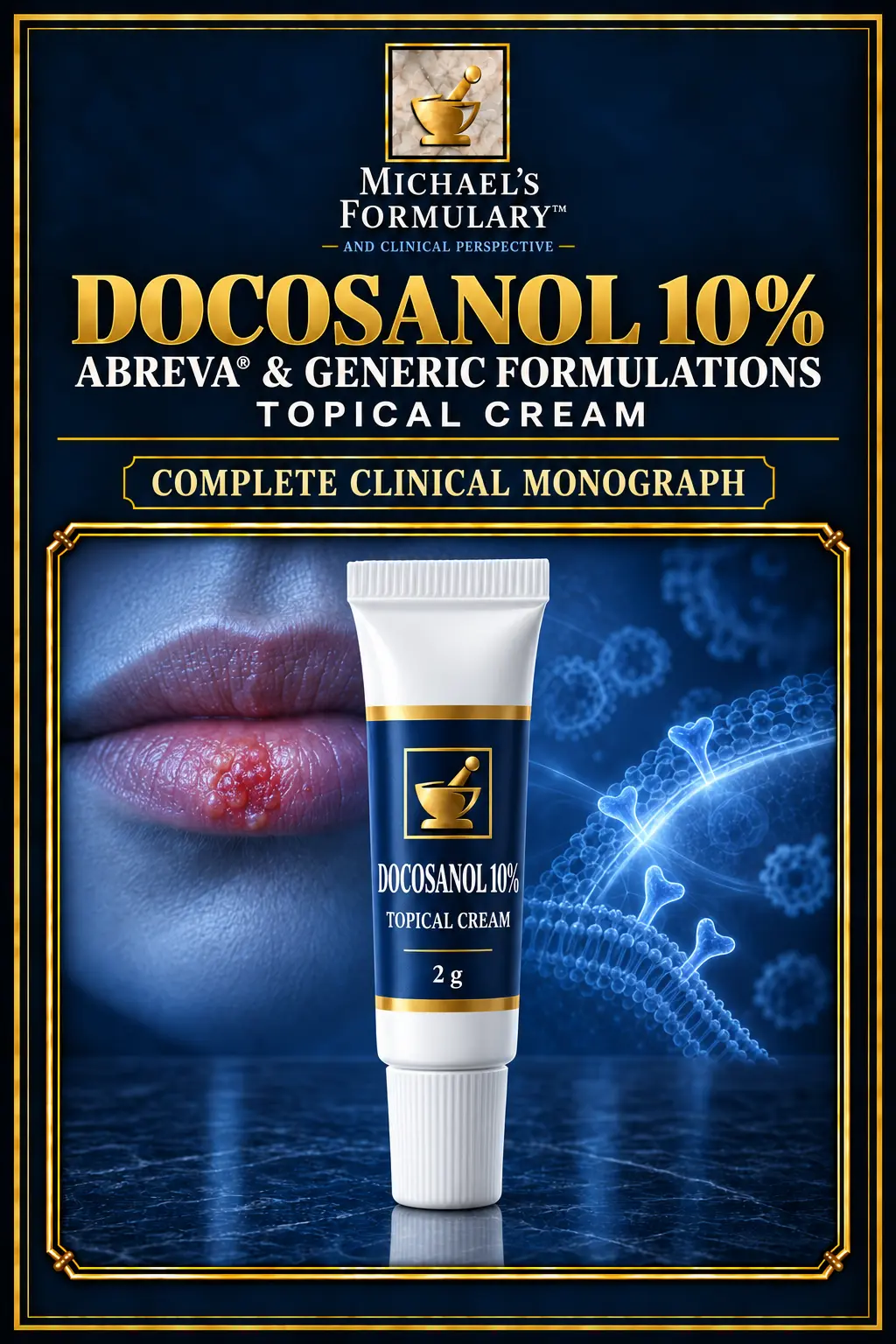
Docosanol 10% Topical Cream
Start at the first sign. Keep treatment local.

Pharmacist Bottom Line™
MFCP CONTROLLED MONOGRAPH · TOPICAL ANTIVIRAL
PLAIN-LANGUAGE PATIENT ACTION LAYER
This locked 17-sentence layer is the measured public-action corpus. Clinical, technical, and legal material is measured separately.
Docosanol 10% is a cream for cold sores on the face or lips. Start at the first tingle, itch, burn, or red spot. Wash your hands before you touch the sore. Put the cream on the sore and the red skin around it. Rub the cream in with care until it is absorbed. Use it five times each day until the sore heals. Wash your hands after each use. Do not put the cream in or near your eyes. Do not put it inside your mouth. Do not share the tube or pump with anyone. Do not pick at or squeeze the sore. People age 12 and older may use the product as labeled. Ask a doctor before use in a child under age 12. Stop use if the sore gets worse. Ask a doctor if the sore is not healed in 10 days. Get medical help now for hives, face swelling, wheezing, or trouble breathing. If swallowed, get medical help or call Poison Control now.
Start Docosanol 10% at the first sign of a recurrent cold sore. Apply it to the affected area on the face or lips five times daily until healed. Stop and ask a doctor if the sore worsens or has not healed within 10 days.

Contents
MFCP CONTROLLED MONOGRAPH · TOPICAL ANTIVIRAL

Rapid Clinical Navigation™
MFCP CONTROLLED MONOGRAPH · TOPICAL ANTIVIRAL
Face or lips only. Never in the mouth, eye, or near the eye.
Begin at tingling, itching, burning, or redness.
Age 12+ with a recurrent cold sore.
Seek care if worse or not healed by day 10.

MAG™ · Monograph at a Glance™
MFCP CONTROLLED MONOGRAPH · TOPICAL ANTIVIRAL

DOCOSANOL 10%
ABREVA® & GENERIC FORMULATIONSTOPICAL ANTIVIRAL · COLD SORE CREAM
Where It Fits

Therapeutic Domain Indicator™
MFCP CONTROLLED MONOGRAPH · TOPICAL ANTIVIRAL
Recurrent herpes simplex labialis on the lips or face.
Not oral, ophthalmic, intranasal, or genital-herpes therapy.

Drug Identity and Chemistry
MFCP CONTROLLED MONOGRAPH · TOPICAL ANTIVIRAL
Identity
- Generic
- Docosanol
- Synonym
- 1-docosanol; behenyl alcohol
- Formula
- C₂₂H₄₆O
- Molecular mass
- 326.61 g/mol
Formulation
- Strength
- 10% topical cream
- Route
- External use on face or lips
- Appearance
- Smooth white cream that dries clear
- Brand
- Abreva®; generic equivalents

Mechanism of Action
MFCP CONTROLLED MONOGRAPH · TOPICAL ANTIVIRAL
Cream reaches the cold sore and surrounding skin.
Docosanol associates with nearby skin-cell membranes.
It interferes with HSV-envelope fusion.
Fewer new cells become infected.
It does not eradicate HSV, prevent recurrence, or prevent transmission.
Use It Right
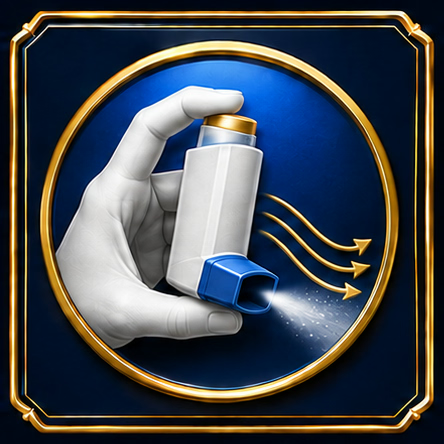
Administration—Critical Instructions
MFCP CONTROLLED MONOGRAPH · TOPICAL ANTIVIRAL
- Start at the first sign of tingling, itching, burning, or redness.
- Wash hands before touching the area.
- Cover the sore and surrounding red border.
- Rub the cream in gently and completely.
- Apply five times daily until healed.
- Wash hands after each application.
- Let it dry before cosmetics, lip balm, or sunscreen.

Indication Fit
MFCP CONTROLLED MONOGRAPH · TOPICAL ANTIVIRAL
| Finding | Fit | Action |
|---|---|---|
| Recurrent cold sore on lip/face | YES | Start early. |
| Canker sore inside mouth | NO | Use another pathway. |
| Lesion in or near eye | NO | Urgent assessment. |
| First severe outbreak, fever, or spreading lesions | NO | Medical assessment. |
| Immunocompromised patient | NO | Clinician-directed care. |
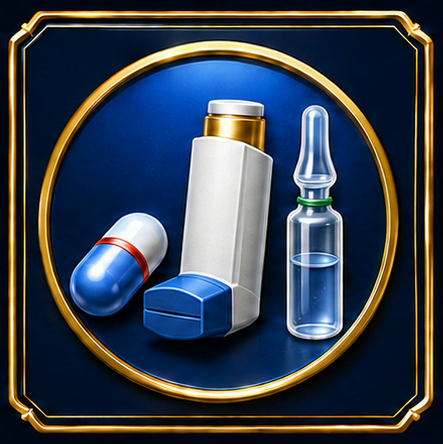
Dosage Forms and Delivery Systems
MFCP CONTROLLED MONOGRAPH · TOPICAL ANTIVIRAL
SQUEEZE TUBE
Topical-cream tube. Replace the cap after use.
PUMP
Pump package containing docosanol 10% cream.
Abreva Cold Sore Cream is sold in tube and pump packages. Verify the current Drug Facts label before use.

Dose by Product and Age
MFCP CONTROLLED MONOGRAPH · TOPICAL ANTIVIRAL
| Patient | Amount | Frequency | Maximum |
|---|---|---|---|
| Adults and children 12+ | Cover affected area | Five times daily | Until healed; no more than 10 days |
| Children under 12 | Ask a doctor before use. | ||
Apply when remembered, then resume the daytime schedule. Do not apply a large extra amount.

Who It Helps and Who It Does Not
MFCP CONTROLLED MONOGRAPH · TOPICAL ANTIVIRAL
| Presentation | Fit | Controlled action |
|---|---|---|
| Familiar recurrent cold sore on the face or lips | YES | Begin docosanol at the first tingle, itch, burn, redness, or bump. |
| Child younger than 12 years | NOT SELF-SELECTED | Ask a doctor before use. |
| Sore inside the mouth, near an eye, or on the genitals | NO | Use another clinical pathway; lesions near an eye require prompt assessment. |
| First severe outbreak, fever, spreading lesions, or immune suppression | REFER | Clinician-directed diagnosis and treatment. |
Docosanol belongs in a narrow self-care lane: a recognized recurrent cold sore on the external face or lips.

Timing and Expectations
MFCP CONTROLLED MONOGRAPH · TOPICAL ANTIVIRAL
START
Begin at the first prodrome or visible sign: tingling, itching, burning, redness, or a bump.
SCHEDULE
Apply to the cold sore and surrounding border five times daily until healed.
EXPECTATION
Early use offers the greatest chance of benefit. Docosanol may shorten healing time and symptom duration; it is not an instant cure.
Stop use and ask a doctor if the cold sore worsens or is not healed within 10 days.
Stay Safe

Local or Product Safety
MFCP CONTROLLED MONOGRAPH · TOPICAL ANTIVIRAL
Do not use
- If allergic to docosanol or another ingredient.
- In or near the eyes.
- Inside the mouth.
- On genital herpes.
Stop and get medical help
- Hives or a spreading rash.
- Facial swelling.
- Wheezing or trouble breathing.
- Symptoms of a severe allergic reaction.
| Local effect | Response |
|---|---|
| Marked or persistent irritation, burning, redness, or rash | Stop use and seek professional advice. |
| Accidental swallowing | Get medical help or contact Poison Control promptly. |
Drug and Substance Interactions
MFCP CONTROLLED MONOGRAPH · TOPICAL ANTIVIRAL
| Question | Controlled answer |
|---|---|
| Prescription or OTC drug interactions | No specific drug interaction is listed in the current OTC Drug Facts. Confirm the full ingredient list and ask a pharmacist when the patient uses other medicated lip or skin products. |
| Cosmetics, lip balm, or sunscreen | Apply docosanol first and rub it in gently. Let the treated area dry before applying another nonmedicated product. |
| Another cold-sore medicine on the same site | Do not layer medicated products unless a pharmacist or prescriber confirms the combination and order of application. |
| Alcohol or food | No route-specific food or alcohol restriction is stated on the topical Drug Facts label; external-use controls still apply. |
The physical package and current Drug Facts label control. Omit interactions that are not established—do not invent them.

Children, Pregnancy, and Older Adults
MFCP CONTROLLED MONOGRAPH · TOPICAL ANTIVIRAL
CHILDREN
The OTC label is for adults and children 12 years and older. Under 12: ask a doctor.
PREGNANCY / BREASTFEEDING
Ask a health professional before use. Keep treated skin and unwashed hands away from an infant.
OLDER ADULTS
No separate label dose. Confirm diagnosis, vision, hand function, and ability to complete five daily applications.
Age does not change the labeled route or schedule. Diagnosis, safe application, and the ability to follow directions remain the practical controls.
Buy the Right Bottle
MFCP Buying Standard™ · Product Identifier™
MFCP CONTROLLED MONOGRAPH · TOPICAL ANTIVIRAL
Package size, inactive ingredients, directions, and retailer presentation may vary. The physical Drug Facts label controls.
Ask and Verify

Counseling Pearls and Triage
MFCP CONTROLLED MONOGRAPH · TOPICAL ANTIVIRAL
Keep the product available before the next recurrence. Begin at prodrome—not after the lesion is fully developed.
Wash hands before and after use. Cover the sore and surrounding red border; rub in gently.
Do not share the tube, pump, lip products, towels, or utensils. Avoid picking or squeezing the lesion.
Stop self-care if the lesion worsens or is not healed within 10 days.
| Triage level | Finding | Action |
|---|---|---|
| URGENT | Lesion near an eye, eye pain, light sensitivity, or vision change | Prompt professional assessment. |
| REFER | First severe episode, widespread lesions, fever, swollen glands, or suspected infection | Clinician-directed care. |
| HIGH RISK | Immune suppression, uncertain pregnancy use, or frequent severe recurrence | Ask a pharmacist or prescriber before self-treatment. |
Correct site, early start, clean application, no sharing, and a firm referral threshold define safe self-care.

Evidence and References
MFCP CONTROLLED MONOGRAPH · TOPICAL ANTIVIRAL
- DailyMed. Abreva® Cold Sore Treatment Cream—docosanol 10% Drug Facts.
- U.S. Food and Drug Administration. Docosanol topical approval materials.
- Abreva. Cold Sore Cream Drug Facts and package directions.
- Sacks SL, et al. Clinical efficacy of topical docosanol 10% cream for recurrent herpes simplex labialis.
- MFCP Docosanol 10% Deep-Dive Monograph Development Dossier.
Current Drug Facts labeling controls ingredient, strength, age, directions, warnings, and package instructions.
Readability and literacy
Health Literacy & Readability Control
MFCP CONTROLLED MONOGRAPH · TOPICAL ANTIVIRAL
20–21 HEALTH LITERACY & READABILITY CONTROL
DEMOCRATIZE · ENLARGE · MEASURE · DISCLOSE
DEMOCRATIZING
HEALTHCARE™
Access. Understand. Decide. Act.
HEALTH LITERACY IS TRULY AN EQUALIZER.
When people can find, understand, and use health information, they can participate in decisions, follow instructions, and achieve better outcomes. We design every document to be clear, actionable, and inclusive.
WHAT HEALTH LITERACY MEANS HERE
This monograph translates clinical evidence into plain language so patients and professionals can make informed decisions together.
We use plain language, clear structure, generous spacing, and meaningful visuals so key information is easy to find, understand, and use.
THE MFCP HEALTH LITERACY COMMITMENT
- Use plain English and short, meaningful sentences.
- Organize information with clear headings and summaries.
- Measure readability and disclose the method.
- Design for patients, families, and professionals.
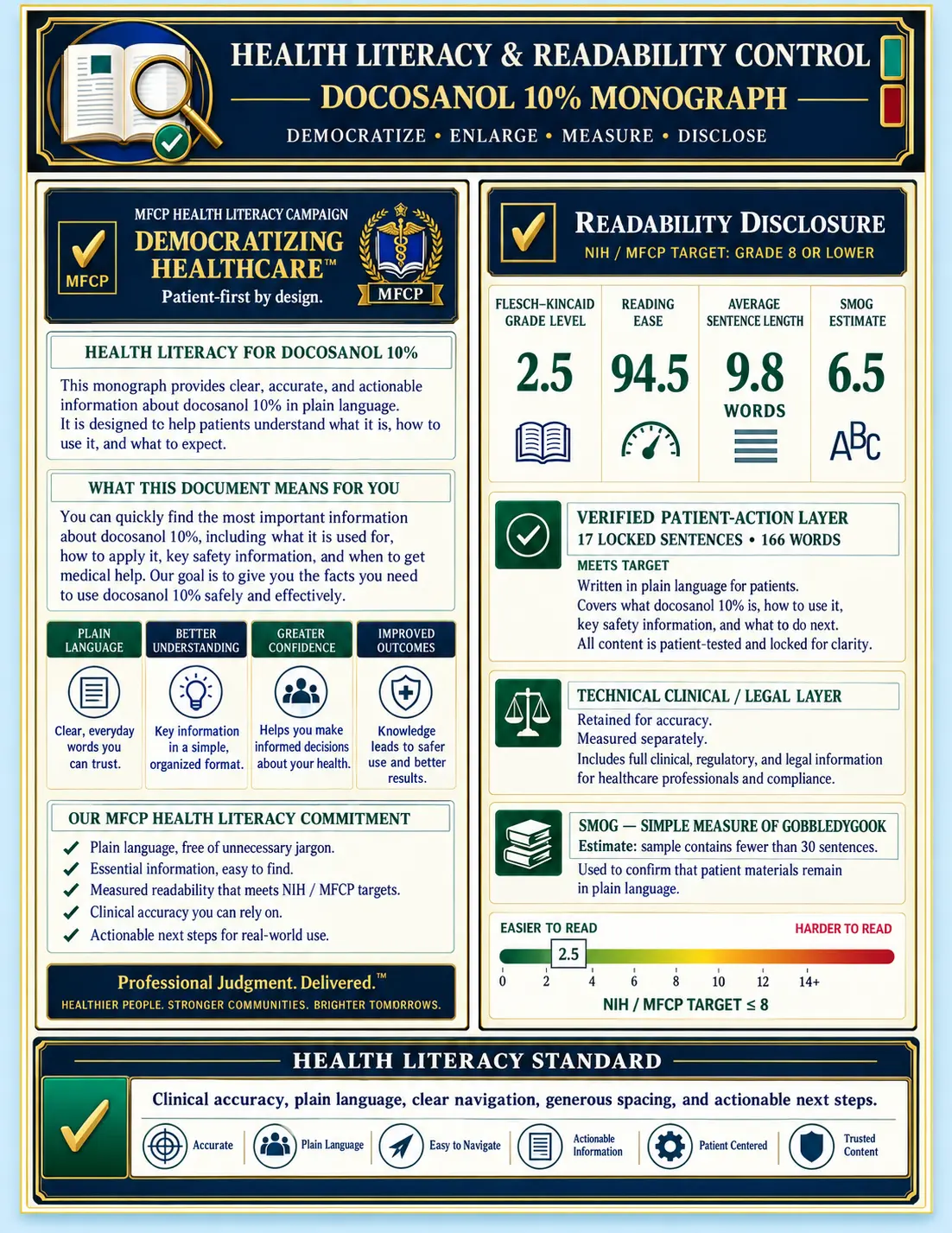
READABILITY DISCLOSURE
NIH / MFCP TARGET: GRADE 8 OR LOWER
GRADE 2.5 READING
EASE 94.5 AVG.
SENTENCE 9.8 SMOG
ESTIMATE 6.5 ABC
Measurement sample: 17 locked sentences · 166 words.
MEETS TARGETRetained for accuracy. Not used as the patient-action score. Separately disclosed.
This sample contains fewer than 30 sentences, so the SMOG result is identified as an estimate.
EXACT MEASUREMENT SCOPE
17 sentences · 166 words · 201 estimated syllables · 6 polysyllabic words. Drug names, strengths, headings, citations, and technical discussion are excluded.
NIH / MFCP TARGET ≤ 8